The Model Prayer (Matthew 6:7-15)

The Lord’s Prayer, by He Qi

And when you pray, do not use vain repetitions as the heathen do. For they think that they will be heard for their many words.

“Therefore do not be like them. For your Father knows the things you have need of before you ask Him. In this manner, therefore, pray:

Our Father in heaven,
Hallowed be Your name.
Your kingdom come.
Your will be done
On earth as it is in heaven.
Give us this day our daily bread.
And forgive us our debts,
As we forgive our debtors.
And do not lead us into temptation,
But deliver us from the evil one.
For Yours is the kingdom and the power and the glory forever. Amen.

“For if you forgive men their trespasses, your heavenly Father will also forgive you. But if you do not forgive men their trespasses, neither will your Father forgive your trespasses. (New King James Version)

God knows what we need before we even ask, which means the Creator of the universe has the divine ear inclined to listen to us. The Lord desires, even longs for us to pray to him.

Since this is God’s daily disposition, Jesus communicated for us a model way of prayer which exemplifies the values of Christ’s Beatitudes and reflects the priorities of God’s kingdom.

The Lord’s Prayer is meant to be prayed often, mindfully, and with flavor.

Jesus gave us six petitions to guide us in our prayers: The first three petitions are priorities of God that set the tone for the next three petitions, which are centered in our problems of living in this fallen world.

Addressing God

Jesus gave us instruction of how to address God: “Our Father in heaven.” All the pronouns in the Lord’s Prayer are plural, not singular. We are to be concerned for both our own individual issues, and for the needs of the community, and of the problems of the world.

“Father” is an endearing and relational word. “In heaven” balances the closeness and nearness of our heavenly Father with his sovereign and transcendent nature. Our God is both near and far – a close friend as well as a holy king. So, we address our prayers with a proper understanding of who God is.

First Petition: “Hallowed be your name.”

“Hallow” comes from the root word for holiness; it is to sanctify and set apart. God is concerned that we know the distinction between the Creator is holy, and so, the creatures are also to be holy. 

As He who called you is holy, you also be holy in all your conduct, because it is written, “Be holy, for I am holy.” (1 Peter 1:15-16, NKJV)

Notice the use of the verb: not hallowed “is” your name, but hallowed, or holy “be” your name. Jesus guides us to pray that God’s name would be shown as holy through us by the way we live. The world sees a holy God when God’s people walk in holiness, reflecting the Lord’s benevolent nature. 

Second Petition: “Your kingdom come.”

We live in a fallen world that has come under the domain of dark forces. The unfolding drama of Holy Scripture is that God is on a mission to restore creation to a benevolent rule.

Jesus is the King, we are the subjects, and God’s realm exists wherever his subjects go.  And where his subjects go, they are to pierce the darkness by embodying the good news that King Jesus has overcome the demonic realm and brought us into God’s kingdom. The prayer and proclamation of this good news is of utmost priority to God.

Third Petition: “Your will be done on earth as it is in heaven.”

God’s ethical will has been revealed to us by Jesus in the Sermon on the Mount; the Beatitudes are the cornerstone of his teaching (Matthew 5-7). God’s will is that Christ’s followers be humble; grieve over sin in the world; act with gentleness instead of prideful condescension; hunger for true righteousness instead of legalistic self-righteousness; show mercy; be pure in heart; pursue peace; and, rejoice when persecuted. All of this results in being salt and light in this dark world. (Matthew 5:3-16)

Jesus spells out God’s will in his sermon. Christ’s followers are to:

  1. reconcile with others instead of hold grudges
  2. deal with lust through accountability instead of making excuses for mental adultery
  3. cherish our spouse instead of taking the easy way out when problems arise in marriage
  4. tell the truth at all times instead of shading it
  5. love, not retaliate when personally hurt or insulted.

If God’s will seems an impossible task, that’s because we need divine resources to live a Christian ethic; we need to pray!

The first three petitions are priorities for God. They are asking the same thing – that the full manifestation of God’s reign on earth be realized. 

Therefore, our prayers are not primarily to receive goods and services from God, but for us to render service to God. These prioritized petitions are a desire to see God honored on earth as God is already honored in heaven.

Fourth Petition: “Give us today our daily bread.”

Our bodies enable us to do God’s will, and so we must be concerned for them. Daily, we must have the basic necessities of life to carry out God’s priorities for the church and the world.

In the ancient world, people were paid at the end of each day. Folks also shopped every day at the marketplace for their food because there was no refrigeration. Whenever there was a flood or a drought, it meant much more than high grocery prices; people faced starvation and death.

They needed to trust God for today, and not worry about tomorrow. Even though contemporary people may not always readily perceive their great dependence on God, we still are in divine hands and need faith.

Fifth Petition: “Forgive our debts, as we also have forgiven our debtors.”

Sin is pictured as a debt. If someone has sinned (trespassed) against us, we must forgive them, thus releasing them from their debt. To forgive does not mean to forget. Rather, we do not hold the debt (the sin) over someone’s head for the rest of their life. 

The person who is forgiven by God is a forgiving person. Our own forgiveness implies that we have done the hard work of repentance through identifying our sin and renouncing it. So, if we fail to forgive, it demonstrates a lack of change on our part. We cannot be forgiven if we spurn God’s freely offered grace. 

Forgiveness is important to Jesus. Thus, we are to squarely face our bitterness. Simply sweeping our hurt under the rug and not extending forgiveness only gives the darkness a foothold into our lives – which is why we are to pray the final petition:

Sixth Petition: “And lead us not into temptation but deliver us from evil.”

Just as we must trust God for our physical necessities, we also must trust God for our spiritual needs – which hinge on the issue of forgiveness – our forgiveness from God through Christ, and the forgiveness we extend to others who have hurt or offended us. 

An unforgiving heart is a major temptation to hate, seek revenge, and retaliate. If we have spent days, weeks, months, years, or even decades harboring an unforgiving spirit through anger, bitterness, and avoidance of facing our past trauma, we have embraced the dark side and need deliverance from evil. 

Freedom comes through acknowledging the offense, receiving grace and forgiveness from God, and passing that same forgiveness and grace to those who hurt us. This is not about whether they deserve it or not; it’s a matter of what I need to do.

Conclusion

The truth sets us free; telling our secrets brings freedom. Apart from naming our shame, we will remain bound and in need of liberation. Tell your secrets to God in the prayer closet, and then tell them to a trusted friend(s). We pray, and we act on what God tells us in prayer.  

The Lord’s Prayer is a model prayer. That means we use the six petitions of Jesus to frame our prayers in our own words, as well as say the words in our favorite translation of the Bible.

Praying this prayer daily shapes our everyday lives, serves as a guide for how to live, and provides discernment in making life’s many decisions. So, let us daily and in every way make use of our Lord’s Prayer.

Our Father in heaven, the One who is both near and far,

May your Name be shown as holy through us, your people.

May others submit to your lordship and become holy, too.

Help us to know your will and to do it.

We need you God, so provide our necessities for today.

Forgive us of our great and many sins, just as we forgive those who have sinned egregiously against us.

Lead us in paths of righteousness, which shoo the devil away.

For you are the Ruler, the Mighty One, forever full of glory and grace. Amen!

Naming and Forsaking Evil (Psalm 83:1-4, 13-18)

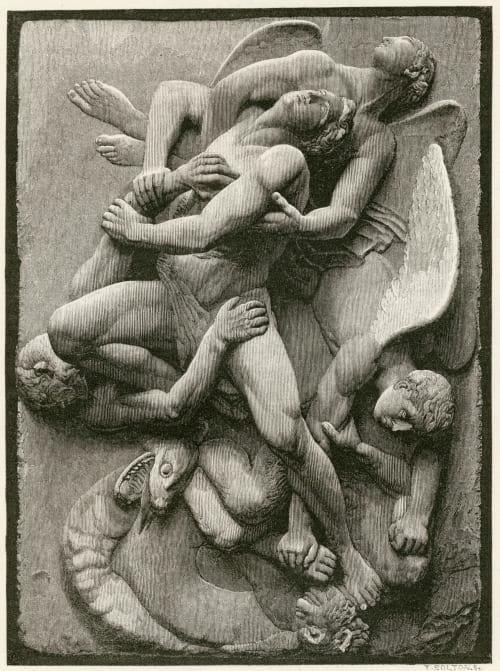
Deliver Us From Evil, by John Flaxman (1755-1826)

God, don’t shut me out;
    don’t give me the silent treatment, O God.
Your enemies are out there whooping it up,
    the God-haters are living it up;
They’re plotting to do your people in,
    conspiring to rob you of your precious ones.
“Let’s wipe this nation from the face of the earth,”
    they say; “scratch Israel’s name off the books.”
And now they’re putting their heads together,
    making plans to get rid of you….

My God! I’ve had it with them!
    Blow them away!
Tumbleweeds in the desert waste,
    charred sticks in the burned-over ground.
Knock the breath right out of them, so they’re gasping
    for breath, gasping, “God.”
Bring them to the end of their rope,
    and leave them there dangling, helpless.
Then they’ll learn your name: “God,”
    the one and only High God on earth. (The Message)

The psalms are the church’s prayer book. Many of the psalms are laments; and many of them are worshipful songs of praise. And there are also the “imprecatory” (pronounced im-PRECK-a-tory) psalms. To “imprecate” means to invoke evil upon someone; it is to pronounce a curse. 

The reason for the imprecatory psalm is that it is not any person’s place to engage in revenge or retaliation. Instead, for people who are genuinely caught in the crosshairs of evil and have sinful persons dogging them, prayer is their most effective recourse; an appeal to God is their best chance at survival and hope.

Sometimes you have to tell it like it is. There’s a time to do your best in putting up a good face and dealing with people who never stop gossiping, slandering, and trying to get their way. But there is also a time to call such behavior “evil” and cry out to God for help.

There are a lot of folks who consider imprecatory psalms a problem because of their detailed expressions of imprecation, of cursing. Yet, such psalms refuse to put a positive spin on malevolent motives, wicked words, and destructive actions.

Desperate people utter desperate prayers. Their unflinching sense of injustice will not allow them to sugarcoat the villainous plans of corrupt people.

Evil is never toppled with tepid prayers from wimpy worshipers. Rather, nefarious agendas are thwarted in the teeth of specific, focused, and intense prayers directed with spiritual precision and passion to the very core of diabolical forces.

We need not be shy about being real with God, even with praying imprecatory prayers. There really are people in this world, maybe even in your own life, that have malicious intent against you or others. Our job is not personal revenge, but to entrust ourselves to the God who fights for the poor, the oppressed, and the needy against the arrogant and the powerful. Let your prayers, then, reflect your life.

Along with psalms of praise lifted during times of celebration, so imprecatory psalms are not to be ignored but need to be uttered equally loud as prayers to almighty God in seasons of desperate evil.

If you have a gut feeling deep down that wicked people are running amok, then use this psalm as a prayer against the darkness which seeks to envelop the earth.

Jesus Christ will build his church and the gates of hell shall not overcome it (Matthew 16:18). The picture Jesus portrayed is one of faithful believers equipped with righteousness and justice storming the gates of hell, not shying away from it. Baked within the Lord’s words were the promise that evil atrocities will not have the day – that God’s people will not be destroyed or overwhelmed because of demonic and satanic power.

There is a time to flee and then there is a time to engage. I am suggesting that the chief way of mitigating evil is to punch it in the mouth with imprecatory psalms prayed with righteous flavor and focused directly against the powers of this present darkness. Why pray, out of all the things we could do, in order to deal with the evil of this world?…

For we do not wrestle against flesh and blood, but against principalities, against powers, against the rulers of the darkness of this age, against spiritual hosts of wickedness in the heavenly places. (Ephesians 6:12, NKJV)

Spiritual problems require spiritual implements to solve. And the tool of imprecatory psalms is a major way of pushing back the dark forces of this world, as well as the means of spiritual assertiveness against all forms of heinous acts and acerbic words from depraved people and evil systems.

God’s wrath is an expression of God’s love – because God is not okay with evil taking root in the lives and institutions of humanity. Prayer is our privilege of coming to the God who upholds justice and righteousness. For if God is for us, who can be against us?

Almighty God, hear me in the day of my trouble and send help from your holy sanctuary and strengthen my faith. Do not let me amble down the path of temptation, but deliver me from the evil one.

Holy Spirit, breathe your enablement into me and inspire me with a passion for goodness, truth, justice, and righteousness.

Lord Jesus be present with me in your risen power and protect me from harm and from everything that hinders your healing presence in this world. You overcame the forces of Satan, redeemed the world, then ascended to the Father.

Blessed Holy Trinity – Father, Son, and Sprit – the God whom I serve: May you be with me and within me; before me and behind me; on my right and on my left; above me and beneath me; and around me always, for the sake of your glory. Amen.

To Forgive Is Divine (Genesis 50:15-26)

Joseph pardons his brothers, by Bacchiacca (1495-1557) http://www.nationalgallery.org.uk/paintings/NG1219

When Joseph’s brothers realized that their father was now dead, they said, “What if Joseph bears a grudge against us, and wants to pay us back seriously for all of the terrible things we did to him?” So they approached Joseph and said, “Your father gave orders before he died, telling us, ‘This is what you should say to Joseph. “Please, forgive your brothers’ sins and misdeeds, for they did terrible things to you. Now, please forgive the sins of the servants of your father’s God.”’” Joseph wept when they spoke to him.

His brothers wept too, fell down in front of him, and said, “We’re here as your slaves.”

But Joseph said to them, “Don’t be afraid. Am I God? You planned something bad for me, but God produced something good from it, in order to save the lives of many people, just as he’s doing today. Now, don’t be afraid. I will take care of you and your children.” So he put them at ease and spoke reassuringly to them.

Thus Joseph lived in Egypt, he and his father’s household. Joseph lived 110 years and saw Ephraim’s grandchildren. The children of Machir, Manasseh’s son, were also born on Joseph’s knees. Joseph said to his brothers, “I’m about to die. God will certainly take care of you and bring you out of this land to the land he promised to Abraham, to Isaac, and to Jacob.” Joseph made Israel’s sons promise, “When God takes care of you, you must bring up my bones out of here.” Joseph died when he was 110 years old. They embalmed him and placed him in a coffin in Egypt. (Common English Bible)

“All people commit sins and make mistakes. God forgives them, and people are acting in a divine way when they forgive.”

Alexander Pope, “An Essay on Criticism”

If there was anyone who had a supposed right to be bitter and unforgiving, it would be Joseph. His brothers had hated him, left him for dead, sold him into slavery, and lied to their father Jacob about him. For years, Joseph languished in servitude and prison – for no fault of his own.

And yet, Joseph was able to discern that it wasn’t his place to be the judge. At the end of his life, he had the perspective and the insight to understand that all the hardship earlier in his life was noticed by God, and then bent for good and divine purposes in the saving of many lives.

If we can keep in mind that it is God’s business to run the world, and our business to forgive others, then life will go a lot better for everyone.

Many people live discontented lives because they say to themselves, “I will not forget what you did, and I will not forgive.” Persistent thoughts of revenge only serve as a cancer that destroys the mind’s thoughts, erodes the soul, and hinders the heart’s ability to love. 

But people who practice forgiveness are much less likely to be hateful, hostile, and belligerent toward others. They are healthier and happier, and more at peace.

I’ve had many people tell me over the years, “But you don’t know what I’ve been through.” My typical response is, “You don’t know what I’ve been through, either. You may not even believe some of the things I have experienced, and some of the things that have happened to me and were said to me. So, can I tell you what I have done to forgive those who have sinned against me?”

1. When I am trying to forgive someone, I pray for them.

It’s hard to keep resenting someone and wish them ill, whenever you are praying for them on a regular basis. Joseph was the victim of his brothers’ abuse. If there was ever a dysfunctional family to grow up in, it was Joseph’s. Being sold into slavery by your own brothers and being the target of their derision would cause anyone to be upset. But, many years later, Joseph chose to forgive his brothers. He acted with their best interests at mind. He prayed for them and did not actively work against them. What’s more, he saw the hand of God in it all.

2. I write a letter of forgiveness (which I may or may not send).

In the letter I write in full detail how the person hurt me. I leave nothing out. I express exactly how it made me feel, and how it affected my life. Then, I express forgiveness and say that I will not hold the offense over their head. The following is a five-step process for forgiving others using the acrostic REACH:

Recall 

Name the hurt, and name it squarely. Don’t fudge by saying it’s not that bad, or as bad as others have experienced. Call it what it is: deceit, stealing, harassment, assault, abuse, adultery, verbal shaming, murder, etc. 

The Truth and Reconciliation Commission in South Africa after apartheid was based on providing full disclosure of all crimes. Those that stepped forward, giving a complete account of their actions, were offered a full pardon. 

Archbishop Desmond Tutu, who led the commission, was most struck by how many people wanted to hear what had happened to their loved ones from the perpetrators themselves so that they could know whom to forgive. Methinks we have much to learn from our African brothers and sisters.

Empathize

Try and see the offense from the other person’s perspective. Attempt to put yourself in the other’s shoes. This does not mean we paper over the offense; it just means we don’t demonize another as a monster. That only feeds and fuels our own lack of forgiveness. When we view others as non-human, then we feel no responsibility to forgive.

Altruistic

Choose to do the right thing and treat the other person well, not necessarily because they deserve it, but because it is within your control to extend grace. Again, this is what Joseph chose to do with his brothers. He gave them words of assurance, and promises of taking care of them and their children.

Commit

Commit to practicing forgiveness. Make the decision to do it. Don’t wait too long for your feelings to catch up to you.  

Bear with each other and forgive one another if any of you has a grievance against someone. Forgive as the Lord forgave you.

The Apostle Paul (Colossians 3:13, NIV)

Hold

Hold on to your forgiveness. Just because you make the decision to forgive does not mean you’ll never have to do it again. Once you have forgiven, let it be a stake in the ground in which you look back to it again and again, saying, “I forgave him/her, and I will not let the enemy of my soul keep trying to make me bitter about it all over again.” 

One of the reasons we repeat the Lord’s Prayer Sunday after Sunday in my church is to keep forgiving those who have sinned against us.

3. I talk to a trusted friend, mentor, or counselor about my effort to forgive.

Many people get stuck and have an inability to forgive because they don’t seek a wise person to help them walk through the process of forgiving. 

The easy path is to complain about the offense to someone we know who will react with the same level of disgust and spirit of revenge that we ourselves have in our hearts. But that only reinforces the bitterness. We must have someone who can offer us what we need to hear, and not only what we want to hear.

Forgiveness is at the heart of the gospel, and, so, ought to be at the core of a healthy spiritual life. It is always open season on offering grace, forgiveness, and reconciliation. To see all of life from a divine perspective is to forgive.

Pray like this:

Our Father who is in heaven,

uphold the holiness of your name.

Bring in your kingdom

so that your will is done on earth as it’s done in heaven.

Give us the bread we need for today.

Forgive us for the ways we have wronged you,

just as we also forgive those who have wronged us.

And don’t lead us into temptation,

but rescue us from the evil one.

If you forgive others their sins, your heavenly Father will also forgive you. But if you don’t forgive others, neither will your Father forgive your sins. (Matthew 6:9-15, CEB)

Dealing with Hate (Genesis 37:5-11)

One night Joseph had a dream, and when he told his brothers about it, they hated him more than ever. “Listen to this dream,” he said. “We were out in the field, tying up bundles of grain. Suddenly my bundle stood up, and your bundles all gathered around and bowed low before mine!”

His brothers responded, “So you think you will be our king, do you? Do you actually think you will reign over us?” And they hated him all the more because of his dreams and the way he talked about them.

Soon Joseph had another dream, and again he told his brothers about it. “Listen, I have had another dream,” he said. “The sun, moon, and eleven stars bowed low before me!”

This time he told the dream to his father as well as to his brothers, but his father scolded him. “What kind of dream is that?” he asked. “Will your mother and I and your brothers actually come and bow to the ground before you?” But while his brothers were jealous of Joseph, his father wondered what the dreams meant. (New Living Translation)

We need to talk about hate, and it’s wicked stepsisters jealousy and disrespect.

In the ancient world, the oldest son was usually the one favored by parents. The eldest child would typically grow up to lead the family and inherit the largest share of the family resources. Joseph and Benjamin were two sons born to Jacob and Jacob’s favored wife, Rachel (Genesis 30:22-24). They were the youngest of Jacob’s twelve sons.

Jacob loved Joseph more than any other of his children (Genesis 37:3). To make things even more complicated, Jacob made his affection for the seventeen-year-old Joseph very public by giving Joseph a special long multi-colored robe. Not surprisingly, the other brothers hated him. 

“Joseph’s Dreams” by Susan Govatos

From the brothers’ perspective, Joseph added insult to injury by sharing a dream of his, implying that all of them would one day bow down to him. Dreams were significant in the ancient world; they were understood to be one way the divine realm could communicate with humans. But all this only made Joseph’s brothers hate him more than they already did.

Unfortunately, as the story unfolds further into Genesis, Joseph’s brothers take their sibling rivalry to a diabolical level. And it’s all fueled by their hatred and jealousy.

We all can relate to feelings of hatred and jealousy toward another. They can overwhelm us. So, what do we do when these big emotions come upon us?

  1. Consider your thoughts. If you find that you’ve been engaging in an all-or-nothing thought or a generalization, consider what a more balanced thought might be. Instead of saying, “He’s a total jerk,” consider instead, “I don’t like what he did to me” as an alternative. This approach typically makes the difference between health and sickness. A peaceful heart leads to a healthy body; jealousy is like cancer in the bones. (Proverbs 14:30, NLT)
  2. Pause for a moment and be curious about whether what you’re telling yourself about the other person or group is accurate. Crowds came from the villages around Jerusalem, bringing their sick and those possessed by evil spirits, and they were all healed. The high priest and his officials, who were Sadducees, were filled with jealousy. They arrested the apostles and put them in the public jail. (Acts 5:15-18, NLT)
  3. Lead with empathy and compassion if you feel hatred toward a person or group. Empathy is the ability to understand and share the feelings of another. Compassion is engaging in an act of kindness. If you come upon your enemy’s ox or donkey that has strayed away, take it back to its owner. If you see that the donkey of someone who hates you has collapsed under its load, do not walk by. Instead, stop and help. (Exodus 23:4-5, NLT) “But to you who are willing to listen, I say, love your enemies! Do good to those who hate you. Bless those who curse you. Pray for those who hurt you.” (Luke 6:27-28, NLT)
  4. Talk to God instead of bottling up your feelings. Many people believe that ignoring their emotions will make them disappear, but in reality, it’s quite the opposite. Rather than going away, unaddressed emotions build up and intensify over time. Praying to the Lord and crying out to God are therapeutic. Rescue me from the mud; don’t let me sink any deeper! Save me from those who hate me, and pull me from these deep waters. (Psalm 69:14, NLT)
  5. Receive God’s love and kindness. We cannot give that which we have not first received. Once we, too, were foolish and disobedient. We were misled and became slaves to many lusts and pleasures. Our lives were full of evil and envy, and we hated each other. But when God our Savior revealed his kindness and love, he saved us, not because of the righteous things we had done, but because of his mercy. He washed away our sins, giving us a new birth and new life through the Holy Spirit. (Titus 3:3-5, NLT)

If we spend a disproportionate amount of time hating someone in our heart, have difficulty focusing on other things because of jealousy, or consider disrespecting another to the point of violence, then we need help; we cannot handle this alone.

Seeking help to resolve hatred doesn’t mean that there’s mental illness going on. Everyone experiences hatred at some point in their lives. Allowing God and others to help is a rational, responsible, and courageous act.

Almighty God, from whom all thoughts of truth and peace proceed: kindle, we pray, in the hearts of all, the true love of peace and guide us with your pure and peaceable wisdom, so that your kingdom may go forward on this earth, filled with the knowledge of your love; through Jesus Christ your Son our Lord, who is alive and reigns with you, in the unity of the Holy Spirit, one God, now and forever. Amen.