Job 1:1-22 – A Better Way Through Impossible Suffering

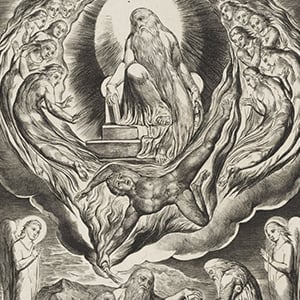
Satan Going Forth from the Presence of the Lord by William Blake, 1825

In the land of Uz there lived a man whose name was Job. This man was blameless and upright; he feared God and shunned evil. He had seven sons and three daughters, and he owned seven thousand sheep, three thousand camels, five hundred yoke of oxen and five hundred donkeys, and had a large number of servants. He was the greatest man among all the people of the East.

His sons used to hold feasts in their homes on their birthdays, and they would invite their three sisters to eat and drink with them. When a period of feasting had run its course, Job would arrange for them to be purified. Early in the morning he would sacrifice a burnt offering for each of them, thinking, “Perhaps my children have sinned and cursed God in their hearts.” This was Job’s regular custom.

One day the angels came to present themselves before the Lord, and Satan also came with them. The Lord said to Satan, “Where have you come from?”

Satan answered the Lord, “From roaming throughout the earth, going back and forth on it.”

Then the Lord said to Satan, “Have you considered my servant Job? There is no one on earth like him; he is blameless and upright, a man who fears God and shuns evil.”

“Does Job fear God for nothing?” Satan replied.“Have you not put a hedge around him and his household and everything he has? You have blessed the work of his hands, so that his flocks and herds are spread throughout the land. But now stretch out your hand and strike everything he has, and he will surely curse you to your face.”

The Lord said to Satan, “Very well, then, everything he has is in your power, but on the man himself do not lay a finger.”

Then Satan went out from the presence of the Lord.

One day when Job’s sons and daughters were feasting and drinking wine at the oldest brother’s house, a messenger came to Job and said, “The oxen were plowing and the donkeys were grazing nearby, and the Sabeans attacked and made off with them. They put the servants to the sword, and I am the only one who has escaped to tell you!”

While he was still speaking, another messenger came and said, “The fire of God fell from the heavens and burned up the sheep and the servants, and I am the only one who has escaped to tell you!”

While he was still speaking, another messenger came and said, “The Chaldeans formed three raiding parties and swept down on your camels and made off with them. They put the servants to the sword, and I am the only one who has escaped to tell you!”

While he was still speaking, yet another messenger came and said, “Your sons and daughters were feasting and drinking wine at the oldest brother’s house, when suddenly a mighty wind swept in from the desert and struck the four corners of the house. It collapsed on them, and they are dead, and I am the only one who has escaped to tell you!”

At this, Job got up and tore his robe and shaved his head. Then he fell to the ground in worship and said:

“Naked I came from my mother’s womb,
    and naked I will depart.
The Lord gave and the Lord has taken away;
    may the name of the Lord be praised.”

In all this, Job did not sin by charging God with wrongdoing. (New International Version)

Much of life is a mystery. We simply do not know why some things happen. And it’s likely we won’t have answers to many of our vexing questions, this side of heaven. From our limited human perspective, **** happens, and that’s about all we can say about it. 

There are times in Holy Scripture, however, when the veil between heaven and earth is peeled back long enough for us to catch a glimpse of mystery. Today’s Old Testament lesson is such a story. 

Job was a wealthy man and had everything this earthly life could offer. What’s more, he was a pious godly person of faith. It was commonly understood that those two things always went together. So, when we see behind the curtain and are privy to a conversation between God and Satan, the devil himself points this out – that Job only praises God because of how good he has it.  Even with this understanding of what was behind Job’s misery, we still see the mysterious God allowing Satan to operate with only God-knows reasons why.

Whenever calamity strikes, or bad news causes us to slump in our chairs, or adversity hits unexpectedly, or trouble smacks us upside our life like a sledgehammer, it’s only human to begin wondering what we did wrong or what we did to bring on such a terrible set of circumstances. 

But the truth is this: We just don’t always know. 

Yes, I fully understand that statement is hard to swallow; it even sucks. For example, no amount of understanding why my grandson has a rare form of epilepsy will make the pain go away. All my wonderings about his future isn’t going to help my daughter. It’s an impossible emotional place to be. It’s sad and it’s frustrating.

Yet, there is a better way.

Although there is so much we don’t know, we do know Job’s inconceivable response to the mystery of God. He made an incredible confession of faith, despite the most awful of circumstances. Job made the affirmation:

“When I was born into this world,
    I was naked and had nothing.
When I die and leave this world,
    I will be naked and have nothing.
The Lord gives,
    and the Lord takes away.
Praise the name of the Lord!”

Job 1:21, ERV

Rather than spending all of our emotional energy trying to figure out an answer to our “why” questions, perhaps the more sage response is to confess our faith in a radical trust of God. 

Using these actual words from Job can be a necessary start to navigating the troubled waters of evil which swirl around us, even if we have to say them over and over again to believe them.

I know I do.

Almighty God, every good thing I have in my life comes from you. It is your prerogative whether I continue to have those things, or not. Whatever happens, whether it causes heartbreak or happiness, is completely known to you. I trust that you know what you are doing, and I completely throw myself upon your mercy through Jesus Christ, my Savior. Amen.

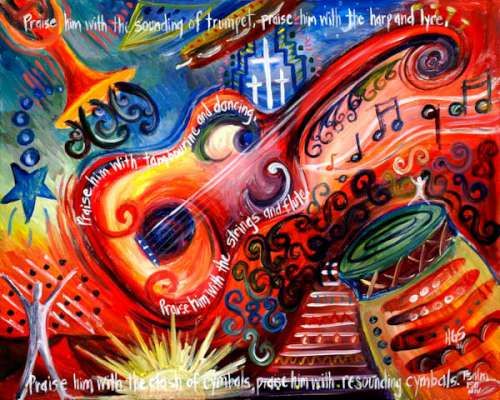
Psalm 150 – Praising God

Psalm 150 by Hope G. Smith

Shout praises to the Lord!
    Praise God in his temple.
    Praise him in heaven,
    his mighty fortress.
Praise our God!
    His deeds are wonderful,
    too marvelous to describe.

Praise God with trumpets
    and all kinds of harps.
Praise him with tambourines
    and dancing,
    with stringed instruments
    and woodwinds.
Praise God with cymbals,
    with clashing cymbals.
Let every living creature
praise the Lord.
    Shout praises to the Lord! (CEV)

There is a time for quiet reflection and contemplation, and there is a time for jubilant shouts of praise. The biblical psalms mirror the full range of human emotion. Having moved through the ups and downs of doubt, curiosity, anger, lament, and trust, it is appropriate that the psalter ends with lots of joyful noise.

I grew up in a generation where children were expected to be quiet in church. Not surprisingly, as a child, I found the church worship service on Sunday to be the most boring hour of my week. After a Saturday of morning cartoons, sugary cereal, All-Star Wrestling, and playing outside in the dirt with my brother, Sunday morning was typically a big letdown.

All I have to say about that, and about cranky old women shushing kids in church, is that the adults somehow forgot to read Psalm 150. Maybe if us big people were better about encouraging our little people to dance in the aisles, blow a kazoo as loud as they can, and freely give a shout to the Lord, then perhaps there would be a lot fewer defections from church worship services.

“Praise is the rehearsal of our eternal song. By grace we learn to sing, and in glory we continue to sing. What will some of you do when you get to heaven, if you go on grumbling all the way? Do not hope to get to heaven in that style. But now begin to bless the name of the Lord.”

Charles Haddon Spurgeon

But don’t think I’m advocating going all out noise, all the time. Just as it is neither necessary nor appropriate to always shout everything you say, and skip everywhere you go, so the worship of God needs to encompass the broad scope of the human condition. Silence, meditation, and stillness have their important place. In a desire to make church fun, some Christians have created imbalanced experiences of only victory in Jesus.

One of the reasons I follow the Christian Year with its liturgical movements is that it holds and maintains the balance of worship and the theological tension of both crucifixion and resurrection. We need healthy rhythms of sorrow and joy, stillness and movement, quietness and shouting.

The Church is currently in the Christian season of Eastertide. It is a focused time of celebration – which is why we have biblical sections in this time of year like Psalm 150. This is the appropriate time to lift loud praise to God for the risen Christ and celebrate salvation and new life in Jesus.

I’m not really a numbers kind of guy, yet its easy to notice the word “praise” occurs 10 times in a psalm of just 6 verses. And 7 musical instruments are mentioned. Methinks we’re supposed to not miss something here.

“Through Jesus, therefore, let us continually offer to God a sacrifice of praise—the fruit of lips that openly profess his name.”

hebrews 13:15, NIv

Praise is to happen in heaven and earth, in all creation, out in the world as well as inside the walls of the church building. It is to be done with voice, dance, drums, horns, woodwinds, and stringed instruments. Because God has done wonderful and marvelous acts throughout the earth, people are to respond with profuse gratitude expressed with lots of emotion.

Just so you know, that means sourpuss Christians who wrongheadedly believe human feelings ought to be stuffed and suppressed, need some remedial theological education about who God is and exactly what he expects from people. Somebody, please dispense the laxative of Psalm 150 to loosen their spiritual constipation!

God gave us our breath, and we are to use it for praise. If we see the entire book of Psalms as a life, then it is fitting the final psalm ends with sanguine praise. Indeed, when a person is at end of life, do they have reason to praise? A life of walking with God through thick and thin will inevitably end with recounting the ways in which the Lord has shown up and delivered. They want musical praise filling their last days and minutes.

That is exactly what Duke Ellington did in the twilight of his life. On January 19, 1968, Ellington performed a concert of sacred music at St. John the Divine cathedral in New York City. Among the original songs he performed and later recorded was his musical interpretation of Psalm 150. He called it “Praise God and Dance.”

Duke Ellington said that this praise music, and the two other albums of sacred music he recorded, were “the most important thing I have ever done.” When Ellington performed “Praise God and Dance” at the ancient Church of Santa Maria del Mar in Barcelona, Spain, the congregation spontaneously burst into the aisles with dancing and singing.

The whole person is to be involved in praise – mind, body, emotions, and spirit – because God is Lord of all of us, not just the spiritual dimension.

Make a joyful noise to the Lord, all the earth; break forth into joyous song and sing praises. Sing praises to the Lord with the lyre, with the lyre and the sound of melody. With trumpets and the sound of the horn make a joyful noise before the King, the Lord. (Psalm 98:4-6, NRSV)

I will bless you every day. I will praise your name forever and always. The Lord is great and so worthy of praise! God’s greatness can’t be grasped. (Psalm 145:2-3, CEB)

Praise the Lord! My whole being, praise the Lord. I will praise the Lord all my life; I will sing praises to my God as long as I live. (Psalm 146:1-2, NCV)

Shout praises to the Lord! Our God is kind, and it is right and good to sing praises to him. (Psalm 147:1, CEV)

Amen.