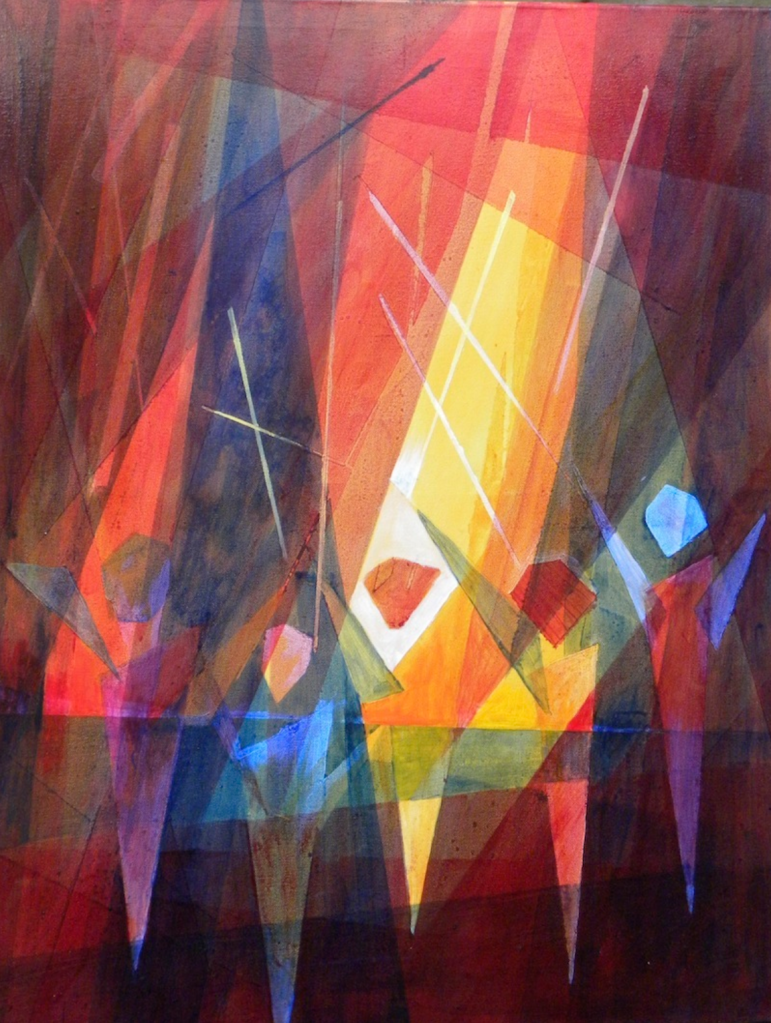
Psalm 29 – The Power of Language

Praise the Lord, you heavenly beings;
    praise his glory and power.
Praise the Lord’s glorious name;
    bow down before the Holy One when he appears.

The voice of the Lord is heard on the seas;
    the glorious God thunders,
    and his voice echoes over the ocean.
The voice of the Lord is heard
    in all its might and majesty.

The voice of the Lord breaks the cedars,
    even the cedars of Lebanon.
He makes the mountains of Lebanon jump like calves
    and makes Mount Hermon leap like a young bull.

The voice of the Lord makes the lightning flash.
His voice makes the desert shake;
    he shakes the desert of Kadesh.
The Lord’s voice shakes the oaks
    and strips the leaves from the trees
    while everyone in his Temple shouts, “Glory to God!”

The Lord rules over the deep waters;
    he rules as king forever.
The Lord gives strength to his people
    and blesses them with peace. (Good News Translation)

“Language is the blood of the soul into which thoughts run and out of which they grow.”

Oliver Wendell Holmes

I have always felt comforted during thunderstorms. Having grown up in the Midwest of America, strong thunderstorms are a given every summer. When my daughters were small children and frightened by the loud clap of thunder, I routinely said to them, “That’s just God letting us know he is powerful and watching over us.”

God spoke and stirred up a storm… So, they cried out to the Lord in their distress, and God brought them out safe from their desperate circumstances. God quieted the storm to a whisper; the sea’s waves were hushed. (Psalm 107:25, 29-30, CEB)

Yet, there is even more going on in today’s psalm than a reminder of God’s glory and power throughout creation. God’s very voice is the source of all the power.

In the beginning, God created the heavens and the earth – with words. The Lord Almighty spoke the entire world into existence. God’s words are generative, that is, the speech of God creates and gives life. When God’s voice goes forth, things happen.

God said, “Let the waters under the sky come together into one place so that the dry land can appear.” And that’s what happened. (Genesis 1:9, CEB)

God generously gives through speech.

Yes, the mechanism of God’s provision for us is language. The Lord creates, gives, sustains, and blesses us creatures through language. Out of all creation, humans are the only creatures formed in the image and likeness of God with the power of connection through speech.

God said, “Now we will make humans, and they will be like us. (Genesis 1:26, CEV)

Not only are we as people capable of speech, but we also have the ability and the capacity to form our own generative words. We have the God-given means to give life with how we use our power of language.

“Life and death lie in the power of language”

Helen Keller

I believe we all intuitively know this is true. As we reminisce the history of our lives, we can observe events where another’s words impacted us so significantly that it was as if they gave us the gift of life. We never forgot those words.

Unfortunately, we also have had times when another’s words cut us emotionally and it felt as if a part of us died. We remember those as well, and they hold us back in our own life-giving speech to ourselves and others.

“The godless destroy their neighbors by their words, but the righteous are saved by their knowledge.” (Proverbs 11:9, CEB)

We must listen to the voice of the Lord. God’s speech neither disappoints nor destroys. God’s Word is eternal life. The better we listen to God, the better we can have the generative power of words to provide life for others.

It only takes a cursory look at Holy Scripture to realize that words are powerful and are to be used with great care. We are all to continually develop the craft of wordsmithing so that we might ascribe to the Lord the glory due his name, as well as bless the world.

“As a tree gives fruit, healing words give life, but dishonest words crush the spirit.” (Proverbs 15:4, NCV)

The language we use—spoken and written words, sign language, facial expressions, bodily gestures, singing—helps us understand ourselves and lets us create relationships with others. Our words give us the power to describe our past, define our present, and dream of our future. 

“Words from wise people are like water bubbling up from a deep well—the well of wisdom.” (Proverbs 18:4, ERV)

We adults may balk at the notion that words are anything more than a creative expression. Yet, as I believe is typical with most things, children are closer to the kingdom of God than us bigger folk. Kids effortlessly make connections between words and reality – whereas older people barely have an idea this even occurs.

My grandson once remarked, when I was talking to him about being cautious at the playground, “How am I supposed to meet new people if I can’t talk to strangers?”

“When I asked my son (5 years old) how his day was, he said it was awesome. I asked him what made it so awesome – his response was ‘because I wanted it to be.’” – Tanya Niedzwiecki (Huffington Post, November 2015)

The voice of the Lord exhibits a mighty God who has the power to create and recreate with but a word.

As people in God’s likeness, our words are powerful tools to be used with wisdom and care. Our speech allows us to praise God and encourage one another. Even more, the use of language enables us to speak into existence new realities for ourselves and others.

May our words bring forth hope and blessing to a world in need of healing.

Mighty God, the Lord who is King and all powerful, I am overwhelmed before such awesome majesty, and my response to your voice is reverent worship through Jesus Christ, your Son, my Lord, who lives and reigns with you and the Holy Spirit, one God, now and forever. Amen.

Psalm 97 – Celebrate the Lord

The Lord rules! Let the earth rejoice!
    Let all the islands celebrate!
Clouds and thick darkness surround God.
    His throne is built on righteousness and justice.
Fire proceeds before him,
    burning up his enemies on every side.
His lightning lights up the world;
    the earth sees it and trembles!
The mountains melt like wax before the Lord,
    before the Lord of the whole world!

Heaven has proclaimed God’s righteousness,
    and all nations have seen his glory.
All those who worship images,
    those who are proud of idols,
    are put to shame.
    All gods bow down to the Lord!
Zion has heard and celebrates,
    the towns of Judah rejoice,
    because of your acts of justice, Lord,
    because you, Lord, are the Most High
        over all the earth,
    because you are so superior to all other gods.

Those of you who love the Lord, hate evil!
    God guards the lives of his faithful ones,
    delivering them from the power of the wicked.
Light is planted like seed for the righteous person;
    joy too for those whose heart is right.
Rejoice in the Lord, righteous ones!
    Give thanks to his holy name! (Common English Bible)

Being overwhelmed with a tremendous sense of majesty for King Jesus is an appropriate response, especially in the wake of Ascension Day – the Christian holiday celebrating Christ’s return to heaven.

Today’s psalm portrays the Lord as a huge God whose presence impacts the world in cataclysmic glory. God is truly large and in charge. 

Nothing moves God; but God moves mountains. 

This is no wimpy deity who needs creatures to sustain him and his memory. Conversely, all of creation is dependent upon God for life, sustenance, and flourishing.

Our view of God deeply impacts how we think, feel, and live. Whenever people catch a mere glimpse of God’s glory, it causes them to renounce useless idol worship, and brings forth humble celebration from the penitent. 

The sheer dearth of penitence and praise to God in today’s world ought to clue us to the reality that we are not seeing God for how God truly is. And what is the God of Holy Scripture? The Lord is the great and glorious king who is so immense and so concerned for justice that just a snort of his nostrils could thoroughly lay waste to the earth.

Confronted with such a majestic and awesome Being, the ultimate conclusion in how to order our lives is this: Love the Lord. Hate evil. Why? Because we are God’s people. 

Therefore, celebration and praise to God are in order. So, let us collectively make a simple choice to celebrate and praise God in some simple ways:  

  • Acknowledge God in both the big and the small things of life
  • Talk about God’s grace in your everyday conversations– we don’t have to be preachy, just real, genuine, and authentic
  • Praise God in public as well as in private
  • Pray to God with simple heartfelt prayers – they don’t need to be eloquent, because God simply wants to hear the voice we have been given
  • Be generous toward others through forgiveness and tangible help because the Lord is a generous God
  • Read God’s Word because it honors the Lord
  • Give thanks to God and have a predetermined mindset to find gratitude in all things God has put in your life
  • Count your blessings today, and then again, tomorrow, so that it eventually becomes a spiritual habit
  • Sing to God with the joyful noise you are able to make

The power of God is more than enough to bring effective and lasting transformation of body, mind, emotions, and spirit. The might of God is unlimited, able to establish social change, economic uplift, physical healing, relational peace, spiritual hope, mental rest, and so much more.

Celebrating the sovereignty of God is downright good for us. It releases our stress, energizes us, provides a positive way of reflection, challenges evil, and acknowledges realities which we might have forgotten – especially that God is with us, loves us, and has only good plans for us.

Praise and celebration are both organic acts on our part and need to be intentionally planned. That is, celebrating the Lord ought to be both spontaneous and prepared. Liturgical rhythms of worship to God need to be both formulaic and free.

The shape of our worship can remind us that we are in continuity with believers throughout history and in all places on earth. We are not alone. We are joined by the entire community of worshipers, offering our celebration – both old and new.

Having both fixed forms of worship and free expressions of worship enable us to tap into the full dimension of faith. Practicing both personal prayers in our secluded closet and corporate prayers together with others strengthens our faith, makes more sure our hope, and connects us with the God who is Love.

A big God ought to be worshiped with all the means available to us.

Mighty God, you are worthy of all the praise, honor, and glory I can give you. May my life be a simple offering to you, so that your kingdom comes not only in my own life but impacts the lives of others; through Jesus, my King. Amen.

Psalm 100 – Know That the Lord is God

Shout for Joy by Lucy Adams

Shout for joy to the Lord, all the earth.
    Worship the Lord with gladness;
    come before him with joyful songs.
Know that the Lord is God.
    It is he who made us, and we are his;
    we are his people, the sheep of his pasture.

Enter his gates with thanksgiving
    and his courts with praise;
    give thanks to him and praise his name.
For the Lord is good and his love endures forever;
    his faithfulness continues through all generations. (New International Version)

The worship of God cannot be contained with one dimension of a person – their spirit. Worshiping God requires the body, mind, and emotions, as well. Anything less, is withholding praise. We are to worship with our entire being.

The original use of today’s psalm was for the ancient Israelites approaching the temple to worship God.  Before worshipers ever came into the presence of the Lord, they were preparing themselves to encounter God through giving thanks, using this very psalm.

When King David and other Hebrew writers penned their poetic songs, they centered what they most wanted to draw attention to in the middle, so that what came before it and after it pointed to that central message. The center of the psalm is:

Know that the Lord is God. Knowing God is to experience the divine through a close relationship. It means we have a place and a purpose. It is a knowing and belonging which exists deep down in our gut.

We get to know God by how he has worked in people’s lives, as well as our own. So, gatherings of believers (whether physical or virtual) are an opportunity to reinforce collective values, strengthen faith, and encourage the discouraged.

Faithful worshipers deeply desire to focus on who God is and what God has done, remembering and rehearsing divine qualities and deeds. Through this activity, we help one another know the Lord. And knowing God is what real life is all about. The Lord is worthy of all the praise, adoration, and worship we can give.

There are three imperatives (commands) that come before the middle phrase to know that the Lord is God; and three imperatives coming after it.  All six imperatives are meant to help us know God better, to give our proper praise to the Lord.

Shout for joy to the Lord, all the earth. Declaring loudly of God’s gracious and loving character, expressed through right, just, and fair actions.

Worship the Lord with gladness. Kneeling and prostrating before God in humble reverence, awe, and adoration.

Come before the Lord with joyful songs. Approaching God’s throne with confidence and boldness.

Those are the three imperatives which lead us to know the Lord. 

The following three imperatives point back to know that the Lord is God:

Enter the Lord’s gates with thanksgiving. Immersing oneself in the presence of God.

Give thanks to the Lord. Giving voice in gratitude to God

Praise the name of the Lord. Declaring God’s holy name with heartfelt expression.

We belong to God. God’s people celebrate this tremendous experience of belonging with deliberate actions that put us in a position to know God better.

I keep asking that the God of our Lord Jesus Christ, the glorious Father, may give you the Spirit of wisdom and revelation, so that you may know him better. (Ephesians 1:17, NIV)

One of my all-time favorite verses in the Bible has to do with knowing God:

I want to know Christ—yes, to know the power of his resurrection and participation in his sufferings, becoming like him in his death.

Philippians 3:10, NIV

Everything in our lives, whether good or bad, is designed to help us know God better. Shared experiences with each other encourage Christians to keep living for Jesus. All of life, from a Christian perspective, points us to the mid-point of history, Jesus Christ, and him crucified, risen, and coming again.

And this is eternal life, that they may know you, the only true God, and Jesus Christ whom you have sent. (John 17:3, NRSV)

So, let us express gratitude today for all the gracious ways of God’s self-revealing and reaching out to save such ones as us.

I pray that out of his glorious riches he may strengthen you with power through his Spirit in your inner being, so that Christ may dwell in your hearts through faith. And I pray that you, being rooted and established in love, may have power, together with all the Lord’s holy people, to grasp how wide and long and high and deep is the love of Christ, and to know this love that surpasses knowledge—that you may be filled to the measure of all the fullness of God.

Now to him who is able to do immeasurably more than all we ask or imagine, according to his power that is at work within us, to him be glory in the church and in Christ Jesus throughout all generations, for ever and ever! Amen. (Ephesians 3:16-21, NIV)

Gracious and almighty God, the One who works on my behalf, give me grace to put away the rootless existence of someone who has no place; and help me to experientially know your radical acceptance and inclusion into the dance of the Trinity – Father, Son, and Spirit – one God, now and forever. Amen.

Grace and peace be yours in abundance through the knowledge of God and of Jesus our Lord. (2 Peter 1:2, NIV)

Amen. Soli Deo Gloria.

Revelation 19:1-8 – The Time Is Coming

Photo by Andrea Piacquadio on Pexels.com

After this I heard what sounded like the roar of a large crowd of people in heaven, saying, “Praise God! Salvation, glory, and power belong to our God! True and just are his judgments! He has condemned the prostitute who was corrupting the earth with her immorality. God has punished her because she killed his servants.” Again, they shouted, “Praise God! The smoke from the flames that consume the great city goes up forever and ever!” The twenty-four elders and the four living creatures fell down and worshiped God, who was seated on the throne. They said, “Amen! Praise God!”

Then there came from the throne the sound of a voice, saying, “Praise our God, all his servants and all people, both great and small, who have reverence for him!” Then I heard what sounded like a crowd, like the sound of a roaring waterfall, like loud peals of thunder. I heard them say, “Praise God! For the Lord, our Almighty God, is King! Let us rejoice and be glad; let us praise his greatness! For the time has come for the wedding of the Lamb, and his bride has prepared herself for it. She has been given clean shining linen to wear.” (The linen is the good deeds of God’s people.) (Good News Translation)

The past few years, it seems as if the world is upside-down. For many people, living on this earth has become something of a surreal experience of folks dying apart from loved ones, racism rearing its ugly head through microaggressions, as well as overt words and actions, and neighbors killed due to gun violence. The suffering is palpable.

However, things will not always be this way. There is coming a time when disease, death, and poverty will end. In the age to come there will be no more numbing grief, seemingly endless tears, constant oppression, grinding hardship, and silent suffering.

The day will arrive when, together with all saints past and present, and along with the angelic host, we will collectively shout, “Hallelujah!” The end of this present age will eventually come.

Time is nothing more than the relationship between events. When all events are ended, there will be no more time – only unending eternity in the presence of God. For the Christian, this is our hope and ultimate salvation. Our deliverance from sin, death, and hell will be complete.

So, we wait and watch, preparing ourselves for the consummation of God’s kingdom. Meanwhile, we are truly in an awkward time between the two advents of Christ. It is the already/not yet time. We are already saved, yet not fully; we are holy, yet not completely; we have our adoption papers as children of God, yet still wait for our celebration feast with Christ.

There are few times more impatient, agonizing, joyful, and hopeful than a marriage engagement. It’s as if two people are inextricably connected but not yet completely together.

I still remember the weird feeling of the six months between my engagement to my heart’s love and standing at the altar marrying my bride. Those months included every emotion imaginable, from exuberant happiness to agonizing waiting, along with hopeful anticipation and sheer nervousness.

It was a time, for me, of unique joy and unwanted suffering. Since I was separated by two-thousand miles from my beloved for most of our engagement, it was an unparalleled longing for the marriage to occur.

That is likely how believers have felt throughout the ages as they look forward to the second coming of Christ. In a period of hardship and even persecution, Christians long for their Savior – to be with Jesus forever and be shed of the world’s crud, the sinful nature, and the machinations of the devil.

In this present age, we have received the Holy Spirit as a sort of engagement ring, a constant sign and presence to help us until the marriage happens with Christ as groom and the Church as bride. Since we have not yet experienced this, it is difficult for us to anticipate just how incredible and inconceivable the coming age will be.

Yet, the Christian intuitively knows, by means of the Spirit, that the upcoming marriage supper will be a heavenly paradise – and so we long for it, especially in these days of uncertainty and difficulty.

Presently, the great harlot attempts to seduce the believers, if that were possible, away from Christ. However, along with all God’s holy angels, we will join in the heavenly chorus which continually sings, “Praise God!” to Father, Son, and Spirit.

The book of Revelation describes the end of history for the purpose of encouraging the saints of God in the present moment of hardship. God will, once and for all, destroy evil, and faithful believers will be united with Christ forever in glory.

So, as we plod through the Christian season of Lent, we do so with the anticipation and hope of Easter and new life. Because Jesus is risen from death, we gaze into the future longing for our own resurrection. Presently, we hold both suffering and glory together, the past and the future.

For it is the past redemptive deeds of Christ which guide us in the present and gives shape to our future. Christ shall return – and it will be soon.

Even so, come, Lord Jesus. Amen.