God Is Both Near and Far (Psalm 145:1-5, 17-21)

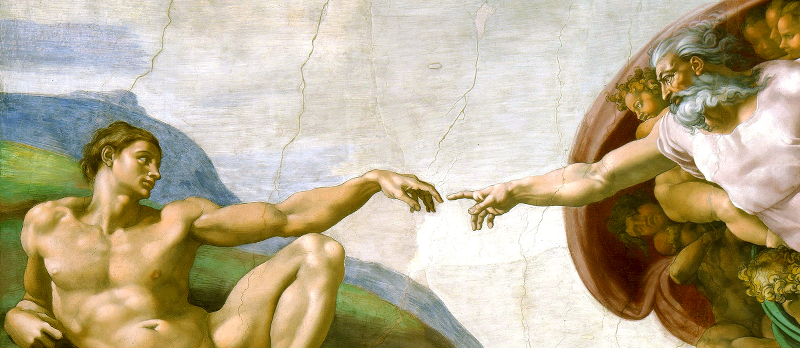
God giving life to Adam, by Michelangelo (1475-1564) on the ceiling of the Sistine Chapel, Rome

I will exalt you, my God the King;
    I will praise your name for ever and ever.
Every day I will praise you
    and extol your name for ever and ever.

Great is the Lord and most worthy of praise;
    his greatness no one can fathom.
One generation commends your works to another;
    they tell of your mighty acts.
They speak of the glorious splendor of your majesty—
    and I will meditate on your wonderful works….

The Lord is righteous in all his ways
    and faithful in all he does.
The Lord is near to all who call on him,
    to all who call on him in truth.
He fulfills the desires of those who fear him;
    he hears their cry and saves them.
The Lord watches over all who love him,
    but all the wicked he will destroy.

My mouth will speak in praise of the Lord.
    Let every creature praise his holy name
    for ever and ever. (New International Version)

The Lord is both near and far. The God of Holy Scripture is, at the same time, both:

  • approachable and aloof
  • close and distant
  • beside us and beyond us
  • available and elusive
  • revealing and remote
  • warm and cool
  • knowable and mysterious
  • readily at hand and at arm’s length
  • a good neighbor next door and a politician over in a city you’ve never been

The technical theological terms for describing God in such a way is that the Lord is both immanent and transcendent. And that is a good thing. We need the Lord to be both.

This psalm is a hymn of praise to God. The psalmist, David, celebrates the attributes and the actions of the Lord. David understood, better than most, that God is so far above humanity in divine majesty that miracles are always possible. Because God is God, the Lord’s arm is never too short to extend help and deliverance.

David knew that God’s powerful ability and God’s loving affection go hand-in-hand together; God’s mighty strength and God’s compassionate spirit work together harmoniously for our benefit.

They did not conquer the land with their swords;
    it was not their own strong arm that gave them victory.
It was your right hand and strong arm
    and the blinding light from your face that helped them,
    for you loved them. (Psalm 44:3, NLT)

God’s interventions, wonders, and miracles are never done dispassionately; the Lord’s arm is extended with deep concern and loving care for people.

The Lord acts as a close relative, like a parent, exhibiting qualities of both father and mother. God is close enough to not only hear our verbal prayers but to also hear our faint whispers. Indeed, the Lord is so close that we don’t even have to speak for the prayers of our heart to be heard.

The righteous call to the Lord, and he listens;
    he rescues them from all their troubles.
The Lord is near to those who are discouraged;
    he saves those who have lost all hope.

Good people suffer many troubles,
    but the Lord saves them from them all. (Psalm 34:17-19, GNT)

In the New Testament Gospels, Jesus gave us instruction on how to address God: “Our Father in heaven.” Not just “my” Father, but “our” Father. We are to pray with the mindful sense of our union with the Lord, as well as our connection with one another as believers.

The Lord sits in heaven as the Most High God, the transcendent Lord of me, you, and all people – watching over and protecting all whose hearts are in the right place, and effectively guarding us from a lofty divine vantage point.

My shield is God Most High, who saves the upright in heart. (Psalm 7:10, NIV)

Clap your hands, all you nations;
    shout to God with cries of joy.

For the Lord Most High is awesome,
    the great King over all the earth.
He subdued nations under us,
    peoples under our feet. (Psalm 47:1-3, NIV)

With our transcendent God always having a watchful eye over us, we need not fear anything or anyone. The Lord knows the score of how things are going in the world and in your life. And, what’s more, God knows the ropes in providing for us, protecting us, and powerfully handling any and all enemies to our souls.

Yet, at the same time, all the time, God is both our high holy King, and our close intimate Friend. Indeed, the Lord is graciously immanent as my Abba – the Father who is near and dear to our hearts.

Because you are [adopted] sons and daughters, God sent the Spirit of his Son into our hearts, crying, “Abba, Father!” Therefore, you are no longer a slave but a son or daughter, and if you are his child, then you are also an heir through God. (Galatians 4:6-7, CEB)

Christians everywhere in the world, and throughout the ages, gather together and repeat the Lord’s Prayer, every Sunday, as well as in weekly small groups, and daily individual prayers. We cry out, “Our Father in heaven” as the most used phrase over the course of our Christian lives.

And that sort of repetition is a good thing. It is important to verbalize that God is transcendent – far above all earthly powers as the sovereign Lord of the universe; and to vocalize that God is immanent – near to us as a father to a child.

Just because a phrase can become vain repetition doesn’t mean that repeating it is a bad thing. Using our words to reiterate both the far distance and the close relation of God is a worthy activity which fortifies our faith, and which passes truth to successive generations of the faithful.

The best way I know of cultivating a healthy sense of God’s transcendence and immanence (outside of reading scripture and praying) is through clouds and kids – both of which require mature adults to practice some much needed humility.

There is nothing quite like putting clocks and schedules aside, stretching out a blanket on a hill, laying back, and watching the clouds roll by. The perspective of massive highness reminds us that our problems are neither as daunting nor as important as we thought.

In contrast to the high clouds, there’s also nothing quite like forgetting your age and getting on the ground to be eye level with a kid. Fortunately, I have rambunctious and curious grandsons who continually remind me that, the lower I get, the better I understand what’s truly most important.

Neither my kids nor my grandkids care all that much about the what’s in my life – what I do – my work, my hobbies, my angst, my daily activities. But they do care a great deal about who I am and why I’m with them.

Intentionally developing a sense of God as both far and near, helps us remember who we are and why are here.

Ironically, the closer I get in touch with the reality that I’m mere dust, and will return back to the ground, the better I’m able to see the Most High God. And, conversely, the more I gaze into the sky, the greater awareness I have of the people around me. I learn to love God and neighbor, as I ought.

There’s no better time than now to get out there and take advantage of the clouds and the kids. It will likely help you to know God better; and it will probably bring a greater awareness, clarity, and connection to the truly significant which is always around us.

Father God, you formed us from the dust of the earth. Remind us of our place as your creatures at home in your creation. Forgive us when we forget our connection to the earth, and our dependence upon the goodness of your world. Lord have mercy.

Brother Jesus, you were born into this world, and made your earthly home in Nazareth. Help us to know and love the people and places where you have set us. Forgive us when we fail to care for our homes, our communities, and your creation. Christ, have mercy.

Blessed Holy Spirit, you desire to grow in us your fruit of love, joy, peace, patience, kindness, goodness, faithfulness, gentleness, and self-control. Forgive us when our roots are so shallow, and our hearts so restless, that our lives fail to bear fruit. Enable us to find our home in you, and in the places to which you call us. Lord have mercy.

Blessed Holy Trinity – Father, Son, and Spirit – the God who is both far and near: Forgive us our sins, settle us in a place of belonging, and enable us to bear fruit for your kingdom. Amen.

All Saints Day (Psalm 149)

All Saints Day I, Wassily Kandinsky, 1911

Praise the Lord!

Sing a new song to the Lord;
    sing his praise in the meeting of his people.

Let the Israelites be happy because of God, their Maker.
    Let the people of Jerusalem rejoice because of their King.
They should praise him with dancing.
    They should sing praises to him with tambourines and harps.
The Lord is pleased with his people;
    he saves the humble.
Let those who worship him rejoice in his glory.
    Let them sing for joy even in bed!

Let them shout his praise
    with their two-edged swords in their hands.
They will punish the nations
    and defeat the people.
They will put those kings in chains
    and those important men in iron bands.
They will punish them as God has written.
    God is honored by all who worship him.

Praise the Lord! (New Century Version)

Most of us are aware and in touch with how imperfect we are. Sometimes we view our imperfections as failure, weakness, or sin. But how does God see us? In what way does the eternally perfect, infinitely strong, and sovereign Lord feel about us?

The Lord is happy with his people, he is pleased with us. And because God is delighted with people, the Lord saves the humble in heart, beautifies the unlovely, and turns the sinner into a saint.

Throughout the ages, the faithful have experienced the love of God. Even now, they are rejoicing, singing for joy, and celebrating the ways God changed them to make the world a better place.

On the Christian Calendar, November 1 is the day each year to remember the saints who have gone before us, to acknowledge that God has always taken pleasure in using imperfect broken people to impact the world.  

Today is meant to be a day of remembrance – a way of not forgetting the people, friends, and family, as well as the long-dead historical saints, who have made a significant difference in our spiritual lives.

All Saints Day is more than simply acknowledging extraordinary persons; today also highlights the work of ordinary Christians who faithfully lived their lives and persevered to the end. We give thanks for the gift of how they daily lived their faith.

We remember today that:

  • Christians everywhere and throughout time are united and connected to one another.
  • God’s good pleasure saves and redeems all sorts of people.
  • Underprivileged and underserved people are noticed by God and God’s saints.
  • Influential people in our lives, now in the presence of the Lord, can be honored through emulating their faith and perseverance.

“Remember your leaders, who spoke the word of God to you.  Consider the outcome of their way of life and imitate their faith.” (Hebrews 13:7, NIV)

The saints of the past are an inspiration to us in the present. They serve us as a model of faithfulness in persevering in our Christian lives. Through biblical stories of very human persons being used of God, as well as reading biographies of godly people who were dedicated to God in service, we gain motivation and patience until Jesus returns.

All Saints Day II, by Kandinsky, 1911

Who went out of their way to communicate God’s love to you with both words and actions? 

Who wrestled in prayer for you so that you and others might know God? 

If any of those persons are still around, and you know where they are, remember them. Drop them a note. Express to them a simple thank you for their influence in your life. You will not only encourage that person – it will help you remember and re-engage with something in your life you may have forgotten or have just taken for granted for too long.

We truly stand on the shoulders of faithful and wise people those who have gone before us. We will continue to persevere and thrive in faith by remembering them; and also by allowing people now, presently with us, to join us in our journey along the road of faith.

It is sage to recall events of rescue and pull them forward into the present so that all God’s worshipers can taste and see that the Lord is good.

Like newborn babies, crave pure spiritual milk, so that by it you may grow up in your salvation, now that you have tasted that the Lord is good. As you come to him, the living Stone—rejected by humans but chosen by God and precious to him—you also, like living stones, are being built into a spiritual house to be a holy priesthood, offering spiritual sacrifices acceptable to God through Jesus Christ. (1 Peter 2:2-5, NIV)

God uses symbols as a means of revelation and remembrance. We need both special days and ordinary events;  shared meals and silent fasting, tangible signs and necessary endings, active rituals and passive observances, iconic images and iconoclastic nonconformity.

We need both words and sacraments – to have days set apart for gathering together and expressing our verbal gratitude and love for each other, as well as giving our nonverbal gifts of food, fun, and friendship.

Our shared spiritual history connects us to God, to one another, and to all of God’s people who have gone before us. We remember that history by energizing our time together with words and symbols of care and redemption.

Christ told the disciples about his upcoming death and provided symbols which reinforced the words: 

“Take and eat – this is my body…. Take this cup – drink from it, all of you.” (Luke 22:7-20)

The taste of real bread reminds us of the physical incarnation of Christ, and Christ’s humiliation and death. Drinking from the tangible cup reminds us of the bodily sacrifice of Christ, the drops of blood which Jesus sweat in Gethsemane, and the beatings, floggings, nails, and crown of thorns that caused the bleeding. Tasting the bread and cup when celebrating communion reminds us that our sins are forgiven, we are united to Christ, and we are united together. 

There are past historical events which are now presently forgotten. Yet, there are also past actions that ripple and linger with continuing results into the present. The incarnation, life, death, resurrection, ascension, and glorification of the Lord Jesus are past redemptive events which continually exert powerful force into the here and now.

The saints throughout church history moved the message of Christ along and demonstrated for us that the past is alive in the person of Jesus Christ. Along with them, we proclaim:

Christ has died, Christ has risen, Christ is coming again.

And God has something planned for those who have gone before us, along with us, so that together we will experience the perfect righteousness of Christ forever. (Hebrews 11:39-40)

Remember and celebrate, eat and drink, taste and see, that the Lord is good.

May we remember the Lord’s people and never forget their example of godly living.

Our spiritual ancestors in faith continue to praise the Lord, to proclaim that God is our refuge and strength, our ever-present help. Let us follow in their footsteps.

Almighty God, you have knit together your elect in one communion and fellowship in the mystical Body of your Son: Give us grace to emulate your saints by living virtuous and godly lives so that we may share the joy you have prepared for those who truly love you, through Jesus Christ our Lord, who with you and the Holy Spirit lives and reigns as one God, in glory everlasting. Amen.

Give Thanks and Praise (Luke 17:11-19)

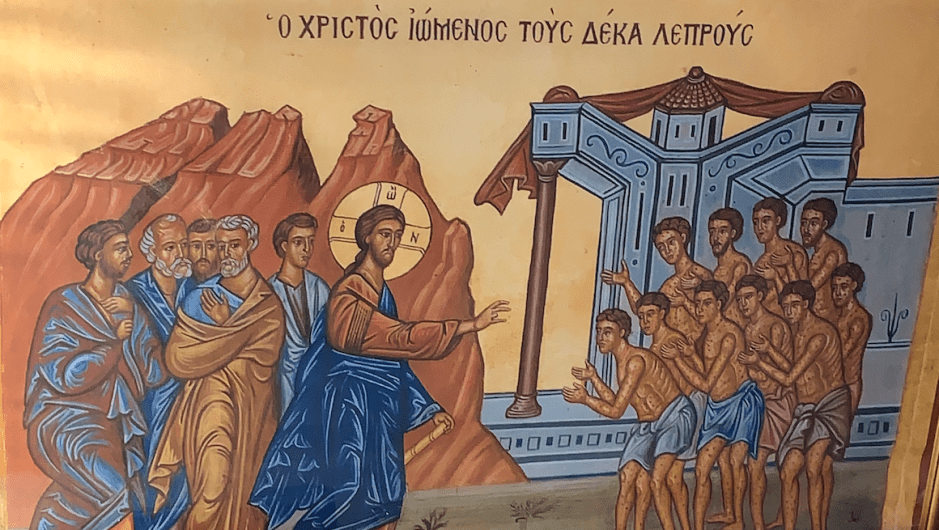
Eastern Orthodox depiction of Jesus Christ healing the ten lepers

Now on his way to Jerusalem, Jesus traveled along the border between Samaria and Galilee. As he was going into a village, ten men who had leprosy met him. They stood at a distance and called out in a loud voice, “Jesus, Master, have pity on us!”

When he saw them, he said, “Go, show yourselves to the priests.” And as they went, they were cleansed.

One of them, when he saw he was healed, came back, praising God in a loud voice. He threw himself at Jesus’ feet and thanked him—and he was a Samaritan.

 Jesus asked, “Were not all ten cleansed? Where are the other nine? Has no one returned to give praise to God except this foreigner?” Then he said to him, “Rise and go; your faith has made you well.” (New International Version)

Today’s Gospel story is both joyous and sad. The healing of ten lepers is astonishing and elicits praise and thanks… from only one. Maybe it’s because they stood at a distance. After all, it’s a close connection to God which causes praise and gratitude to arise within us – and not some appreciation from afar. Therefore, methinks we ought to consider what the nature of our own connection is. 

“Thanksgiving” to most Americans is Thanksgiving Day – a holiday filled with food, football, and family, the trifecta of American celebration. I myself admit to liberally indulging in all three. Although Thanksgiving has become a form of secular liturgical worship, I believe that underneath all the gravy, naps at halftime, and the occasional obnoxious relative, we know why we celebrate: To praise God and give thanks for our abundant blessings. 

It seems that even those who do not readily acknowledge the Divine intuitively know there is a power and source of blessing well beyond themselves which makes all good things occur.

Celebrations are a spiritual activity. God invented parties. When Israel was preparing for a new national life in the Promised Land, God told them to celebrate the Feast of Harvest with the first fruits of the crops (Exodus 23:16). The Levitical law prescribed how to go about giving thanksgiving offerings and offering praise (Leviticus 7:11-34).

Gratitude and praise was commanded, expected, and an important dimension of Old Testament worship. King David established a group of 288 full-time musicians to do nothing but praise and give thanks before God day and night (1 Chronicles 25).

Let us come into his presence with thanksgiving; let us make a joyful noise to him with songs of praise!

Psalm 95:2, NRSV

Enter his gates with thanksgiving
    and his courts with praise.
    Give thanks to him; bless his name.

For the Lord is good;
    his steadfast love endures forever
    and his faithfulness to all generations. (Psalm 100:4-5, NRSV)

It ought to have been reflexive for all ten lepers healed by Jesus to offer their worship to Jesus. A Samaritan, considered by many of the time as the lowliest of the low, a “half-breed,” was the lone person who came and fell at Christ’s feet with effusive praise and heartfelt gratitude. While the other nine went about their lives, free from disease and glad for it, only one guy took the time to thank Jesus and give glory to God. 

The Samaritan leper alone gives thanks to Christ, by Unknown artist

Sometimes we need to be reminded that celebration is a spiritual practice. It’s important to celebrate Jesus and for the ways God has provided and blessed us. In Holy Scripture, it is often the homeless, the sick, the lowly, and the outsiders who lead the way and demonstrate what genuine praise and honest thanksgiving looks like.

We, the Church, who belong to God and possess the Spirit, are to always remember and be mindful of what we truly have in Jesus Christ:

So then, just as you received Christ Jesus as Lord, continue to live your lives in him, rooted and built up in him, strengthened in the faith as you were taught, and overflowing with thankfulness. (Colossians 2:6-7, NIV)

We, like King David of old, are to establish continual worship of God:

Rejoice always, pray continually, give thanks in all circumstances; for this is God’s will for you in Christ Jesus.

1 Thessalonians 5:16-18, NIV

Our sacrifice as Christians is not with the blood of animals but with our lips and our lives:

Through Jesus, therefore, let us continually offer to God a sacrifice of praise—the fruit of lips that openly profess his name. (Hebrews 13:15, NIV)

And the worship service is eternal; it will never end:

And the twenty-four elders, who were seated on their thrones before God, fell on their faces and worshiped God, saying:

“We give thanks to you, Lord God Almighty,
    the One who is and who was,
because you have taken your great power
    and have begun to reign.” (Revelation 11:16-17, NIV)

Praising God and giving thanks to the Lord go together like mashed potatoes and gravy. Since God created everything, and since Jesus has brought healing to us through the cross, every juicy morsel of goodness we have is to be received with the full cognizance that God is behind it all.

Our lives need to be punctuated with times of celebration, praise, gratitude, and even blowout parties. Otherwise, we become dull, boring, lifeless, and bereft of Christ’s lifeblood coursing through our spiritual veins. A joyous and raucous group of healed believers jabbering incessantly with thanksgiving of God’s goodness are winsome and peculiar (in a good way and not in the strange way of your weird uncle who wants the turkey neck to gnaw on at the Thanksgiving meal).

Seems to me that Christians really ought to be at the forefront of having maximum fun because we are forgiven people; we know and experience the presence of God; our lives are hidden with God in Christ; we are confident and can approach the throne of God with boldness; and we possess the power of the Spirit and the shepherding ministry of Jesus.

Remember to give thanks. Plan to praise – out loud and with others – for the God who stands behind every good gift of creation. Let thanksgiving (not complaint) shape your life. Be the person who comes back to Jesus and offers praise and gratitude – and see how such gratefulness and glory can change the world.

Gracious God, Father of all mercies, we your unworthy servants give you humble thanks for all your goodness and steadfast love to us and to all whom you have made. We bless you for our creation, preservation, and all the blessings of this life; but above all praise you for your immeasurable love in the redemption of the world by our Lord Jesus Christ; for the means of grace, and for the hope of glory.

Give us such an awareness of your mercies, that with truly thankful hearts we may show forth your praise, not only with our lips, but in our lives, by giving up ourselves to your service, and by walking before you in holiness and righteousness all the days of our lives, through Jesus Christ our Lord, who with you and the Holy Spirit, be honor and glory throughout all ages and forevermore. Hallelujah! Amen!

Psalm 139:1-6, 13-18 – Known and Loved by God

The Inescapable God by Mike Moyers

You have looked deep
into my heart, Lord,
    and you know all about me.
You know when I am resting
    or when I am working,
and from heaven
    you discover my thoughts.

You notice everything I do
    and everywhere I go.
Before I even speak a word,
    you know what I will say,
and with your powerful arm
you protect me
    from every side.
I can’t understand all of this!
Such wonderful knowledge
    is far above me….

You are the one
who put me together
    inside my mother’s body,
and I praise you because of
the wonderful way
    you created me.
Everything you do is marvelous!
    Of this I have no doubt.

Nothing about me
    is hidden from you!
I was secretly woven together
    out of human sight,
but with your own eyes you saw
    my body being formed.
Even before I was born,
you had written in your book
    everything about me.

Your thoughts are far beyond
    my understanding,
much more than I
    could ever imagine.
I try to count your thoughts,
but they outnumber the grains
    of sand on the beach.
And when I awake,
    I will find you nearby. (Contemporary English Version)

Many people struggle with their basic self-image. And it’s no wonder why.

Beautiful people reign over the television and the movies; the rich and powerful are highlighted in the media; and those with perfect teeth and immaculate attire are splashed in front of us in the daily barrage of advertisements. 

Meanwhile, the rest of us 99% of the population, quickly notice we do not measure up to such a high standard. You don’t have to be a people watcher to know that less than perfect bodies are the norm and that most folks do not have a budget to live like the other 1% humanity.

If we make comparisons with others too much and for too long, it gets downright depressing. Yet, into this dark abyss of one’s self-image enters the biblical truth that each one of us, no matter our station in life, was personally hand-crafted by a heavenly Being who loves us dearly.

We are indeed fearfully and wonderfully made. The Creator took great care to make us and form us just so. 

The real standard from which we ought to judge ourselves is this: God knows us intimately, inside-and-out, and neither condemns us nor shames us but loves us wholly.

So then, rather than wasting our emotional energy and mental faculties on wishing we looked different or were more like so-and-so who seems to always have it all together, try practicing what the psalmist David did: Praise God. 

Whenever we have the notion that we do not measure up to our imposed arbitrary standard, keep in mind that the only real measurement is grace. No matter who we are, the entire race of humanity has been created in the image of God, and, on that basis alone, we have inherent value, worth, and majesty. Let us, then, treat ourselves and others with the yardstick of grace.

The inner critic, that is, the inner judgmental dialogue we have with ourselves, needs to be replaced with the truth of Psalm 139. Although we might be rather hard on ourselves and say things in the reclusive parts of our minds and hearts that we would never say to others, nor tolerate others saying about someone else – God speaks to us with tender words of grace.

Perhaps you think that only you know the depth of your own sorrows, hurts, fears, insecurities, and worries. Except… God. The Lord knows it all intimately – and is not one bit repulsed. 

You see, God knows that the answer to all the self-doubts is Divine care and protection. You and I have the freedom to plumb the recesses of our hearts and souls – to bring out all that is inside the cluttered closet of our minds and lay it on the table without fear of God calling you what you call yourself.

Therefore, please do not quickly pass over the inspired words from Holy Scripture contained in today’s psalm. Take the time to carefully digest each phrase slowly so that the message becomes internalized and believed in real-time experience.

One of the theories of human psychology is that people are driven by two primary needs: 

  1. To intimately know another person.
  2. To be intimately known by another person. 

God knows us even better than we know ourselves – and still loves us! There is nothing we learn about ourselves that God does not already know. No human relationship can even come close to the level of knowing that God has for us and about us.

To know God is perhaps the greatest and highest pursuit we could ever enjoy. God is so immense and infinite that we will spend an eternity getting to know the Lord and will never get to the end of it. That is the kind of God we serve. 

Be encouraged today and always with the reality that you are known, and can know, God – and even more, loved deeply as a specially fashioned creature.

O God, thank you that I am wonderfully made in your likeness. I praise you that I am fully accepted, even when I do not accept myself. In Jesus Christ you have demonstrated the height of your love and mercy. May this grace be with me every day so that I will conduct myself in a manner worthy of being part of the human family. Amen.