Clap your hands, all you people! Shout joyfully to God with a joyous shout! Because the Lord Most High is awesome, he is the great king of the whole world. He subdues the nations under us, subdues all people beneath our feet. He chooses our inheritance for us: the heights of Jacob, which he loves.
God has gone up with a joyous shout— the Lord with the blast of the ram’s horn. Sing praises to God! Sing praises! Sing praises to our king! Sing praises because God is king of the whole world! Sing praises with a song of instruction!
God is king over the nations. God sits on his holy throne. The leaders of all people are gathered with the people of Abraham’s God because the earth’s guardians belong to God; God is exalted beyond all. (Common English Bible)
God is King, the Supreme Sovereign over all creation and the entire universe.
In the Christian tradition specifically, Jesus is King. Christ is the One who gives shape, form, and substance to the reign of God over the earth. This is what the Lord’s ascension to heaven communicates – that Jesus sits at the right hand of God the Father, exercising a benevolent rule as the rightful monarch over all creation.
This redemptive reality of the Lord’s good reign is a cause for praise. And this is what today’s psalm is all about. We, as the subjects of God’s kingdom, are called to praise the Lord.
The psalm tells us exactly how to praise the Lord because of God’s powerful and compassionate authority: Clap your hands and shout!
For worshipers who believe acknowledgment of God is most appropriate with silence and contemplation, even a cursory reading of the psalms will inform them differently. Although it seems to me most worship experiences need more familiarity with silence, I also passionately believe they could use a whole lot more enthusiasm with clapping and shouting.
Depending upon where you fit in the spectrum of Christianity’s tradition of worship, high church or low church, very liturgical, or not, it behooves all churches to incorporate the full range of human expression to God – including both silence and shout, hands clasped reverently in prayer as well as exuberantly clapping in praise.
It’s biblical to applaud God! And it’s healthy, too – both spiritually and physically.
Whenever we fail to pause in our feelings of happiness and enjoy the moment, it’s more than a missed opportunity. Unacknowledged and unexpressed joy trains us to depress our feelings, eventually leading to depression itself. Yet, whenever we pause to outwardly demonstrate gratitude through the exuberance of shouting and clapping, it benefits everyone – God, others, and self.
Physically clapping and shouting helps keep the heart and lungs healthy, even playing a curative role with pulmonary problems. It gives relief to joint pain, gout, headaches, insomnia, and digestion. Shouting and clapping even sharpens the intellect and increases the brain’s ability. And, of course, applause is a social phenomenon which binds folks together in community.
For the psalmist, applause to the Lord is the appropriate response to God’s power and victory in the world. Since the Divine presence is everywhere – and that presence is merciful, just, and kind – we ought to take the time to acknowledge and celebrate a loving God watching over us with tender care and concern.
No matter the circumstance, God is with us. That reality alone is enough cause for exuberance and celebration. Even though evil still resides in this old fallen world, God is King, and still sits on the throne. The pastor and hymnwriter, Maltbie Davenport Babcock (1858-1901), had it right:
This is my Father’s world: O let me ne’er forget That though the wrong seems oft so strong, God is the Ruler yet. This is my Father’s world: Why should my heart be sad? The Lord is King: let the heavens ring! God reigns; let earth be glad!
It isn’t the attempt to rouse human and personal confidence which enables us to face the foulness and degradation of this world. Rather, it’s the spiritual awareness of God’s presence and power which resides around us and within us. This is the basis of our confidence, and the ground of our peace. It’s the reason for the believer’s joy, even amidst awful circumstances.
Our connection with one another as worshipers is the common acknowledgment of God’s rule and reign over all creation. And our link as followers of Jesus is the collective conviction that Christ is King, we are his subjects, and all things belong to God, including us.
Whenever we connect with this basic theology, spontaneous and joyous praise is the result. So, if we lack the joy of the Lord in our lives, the place to go is to use today’s psalm. Read it several times over, out loud. Shout the psalm! Clap while shouting the psalm! Sing the psalm aloud! Praise the risen and ascended Lord!
Praise our God, all peoples, let the sound of his praise be heard; he has preserved our lives and kept our feet from slipping. For you, God, tested us; you refined us like silver. You brought us into prison and laid burdens on our backs. You let people ride over our heads; we went through fire and water, but you brought us to a place of abundance.
I will come to your temple with burnt offerings and fulfill my vows to you— vows my lips promised and my mouth spoke when I was in trouble. I will sacrifice fat animals to you and an offering of rams; I will offer bulls and goats.
Come and hear, all you who fear God; let me tell you what he has done for me. I cried out to him with my mouth; his praise was on my tongue. If I had cherished sin in my heart, the Lord would not have listened; but God has surely listened and has heard my prayer. Praise be to God, who has not rejected my prayer or withheld his love from me! (New International Version)
“God made humans because God loves stories.”
Elie Wiesel
The Church’s Prayer Book
Those of us who utilize the Revised Common Lectionary Daily Readings are familiar with having a psalm each day. In addition, the same psalm is repeated three consecutive days, following the pattern of Thursday, Friday, and Saturday readings preparing for Sunday – and Monday, Tuesday, and Wednesday readings reflecting on Sunday. The Psalter has such a prominent place in the readings because it is viewed as the Church’s Prayer Book.
Within the book of Psalms, we have the full range of human experience and emotion. Much like athletes in weight training, putting in their reps (repetitions), so the Christian is to use the weighty Psalms with repeated use for spiritual growth and development. Prayer and praise, lament and celebration, are necessary equipment for the strengthening of faith and a healthy Christian life.
Psalms of Praise and Thanksgiving
Today’s psalm is a song of thanksgiving for the community of worshipers approaching the temple and offering their sacrifices to God. Together, as the people of God, they proclaim what God has done for them. Through hardship and difficulty, they have realized abundance and joy. Personal witness and testimony are given to the congregation for answered prayer so that all may rejoice together in God’s steadfast and unfailing love.
Expressing celebration is important. Without it, our spirits are famished and find it difficult to be patient and persevere. With celebration, our spiritual muscles flex with joy and are in shape for the trials and tribulations which lie ahead. Corporate affirmation and personal appreciation are meant to work together in a grand profession of faith in God’s good guidance and help.
“Come and listen and I will tell you what God did for me,” benefits both the individual and the group. If all we ever hear and experience is hardship, our faith muscle will be overused and give out. We need stories to celebrate. We need to hear testimonies of God’s enduring love.
So, what has God done for you? What celebrations do we have today? Are you willing to share your story?
Ritual Celebration
Celebrations are necessary because they highlight the things most important to us. And it is okay to make them regular rituals – which is why I care about attending to the Christian Year with it’s centrality of Jesus and the movements of Advent, Christmas, Epiphany, Lent, Easter(tide), Ascension, Pentecost, and “Ordinary” Time.
Ritual celebration is, of course, not unique to Christianity. Rituals are part of being human. At it’s heart, ritual is a form of celebration, of remembering to observe significant events, special seasons, and daily routines. Each ritual observance is a re-telling of meaningful stories for an individual, family, or group of people.
Observing ritual celebrations:
Re-enforces our values.
Gives us a sense of belonging.
Marks time for us in meaningful ways.
Forms daily habits in us.
Reminds of us of who we are and what our purpose in this world is.
Helps us express our emotions in a healthy way.
Adds new stories to our lives.
Connects us to our spiritual ancestors and bonds us to one another.
Builds close relationships and trust.
Heals us from traumatic events.
Not observing ritual celebrations:
Causes a lack of identity and purpose.
Creates loneliness and confusion.
Hollows out our lives and sucks our souls of joy.
Sharing stories, and paying attention to rituals, are a primary connection between the individual and the community, a place where our identities and our values are reinforced and transformed into a force for good in the world.
Both the smallest and biggest of celebrations are appropriate, along with everything in between. While writing at my desk, a majestic male red wing blackbird perched himself on the bush in front of the window. Being only a few feet from him, I could see his feathers in detail and his glorious preening for the benefit of the females.
You are wonderful, Lord, and you deserve all praise, because you are much greater than anyone can understand.
Each generation will announce to the next your wonderful and powerful deeds. I will keep thinking about your marvelous glory and your mighty miracles. Everyone will talk about your fearsome deeds, and I will tell all nations how great you are. They will celebrate and sing about your matchless mercy and your power to save. (Psalm 145:3-7, CEV)
On a much grander scale, today I gathered with a family at the bedside of their loved one to grieve his death, and to also remember and celebrate his life for the gift he had been to so many. Together we were able to say, “Let the whole world bless our God and loudly sing his praises.”
We pray. God answers. We rejoice. If we don’t rejoice in the company of others, then we eventually forget – which then makes the next hardship even harder.
The practice of telling our story is the means by which we come to understand our faith. Testimony not only declares what we believe, but is also the vehicle that shapes our belief. The psalmist issues an invitation for people to come and hear, and he will tell what God has done. The story, the psalmist’s testimony of faith, is a simple one, essentially saying: I prayed to God. God listened. God answered. Praise be to God! And I will now tell you about God.
Tell a Story
When the Bible speaks about God, it most often does so by telling a story of what God has done. The Bible, as a whole, follows the pattern of a story: creation, fall, redemption, and new creation.
Beginning in the Old Testament, we get stories of God’s creative activity, humanity’s fall into sin, and God’s response of covenant and promise. The Lord calls Abraham and Sarah and their ancestors to a special relationship with a special purpose to reclaim all the world to it’s intended design.
The story continues with the Exodus from Egypt, the giving of God’s divine commandments, the wandering in the wilderness, the conquest of the land, the monarchy and finally the exile.
The New Testament picks up the story, telling about Jesus as the fulfillment of the Old Testament promises and spelling out the meaning of his death and resurrection.
The book of Acts continues the grand story of redemption and of what God has done, climaxing in the life, death and resurrection of Jesus. The apostles further the story by spreading good news of great joy: in Jesus Christ, there is grace, forgiveness, purpose, faith, hope, and love for all people everywhere.
In all the storytelling, remember to celebrate the mighty acts of God and declare what the Lord has done for you.
Creator God, because of your abundant love, you chose to bring light and order into the formless void, to create a world of unsurpassed beauty; and you saw that it was good. We ask that you continue to recreate the world with that same attentive love, to bring light into today’s ever increasing chaos and darkness. Replenish our hearts so that we too can renew the face of the earth, through Christ our Lord. Amen.
Praise the Lord! Those who honor the Lord, who adore God’s commandments, are truly happy! Their descendants will be strong throughout the land. The offspring of those who do right will be blessed; wealth and riches will be in their houses. Their righteousness stands forever. They shine in the dark for others who do right. They are merciful, compassionate, and righteous. Those who lend generously are good people— as are those who conduct their affairs with justice. Yes, these sorts of people will never be shaken; the righteous will be remembered forever! They won’t be frightened at bad news. Their hearts are steady, trusting in the Lord. Their hearts are firm; they aren’t afraid. In the end, they will witness their enemies’ defeat. They give freely to those in need. Their righteousness stands forever. Their strength increases gloriously. (Common English Bible)
To live well is to obey well. Well, that’s a thought! And a deep subject it is.
It’s a matter of whether we’ll take our cues for living from S. Hiney Wells or his brother, Russ T. Wells.
S. Hiney tells us this:
“Listen, my friends, the Lord’s commands are not made for drudgery. They’re how to be happy in this here life. Obeying what God says leads to blessings of family, security, contentment, and peace. God’s never failed to keep bacon in my frying pan, folks to help me out in a pinch, and a heap of hope for when I’m lower than a snake’s belly in a wagon rut.”
Russ T. tells us:
“Well, the world ain’t shiny at all. It’s all dark and covered in rust so thick you’d think nuthin’ good’s been used fer a coon’s age.”
S. Hiney responds: “Well, Russ T., there’s certainly a powerful lot of darkness everywhere; but that don’t mean there’s no light! Even a few little lightnin’ bugs helps us to see where we are in the night.”
Russ T. retorts: “Well, S. Hiney, them little bugs don’t help none when I’m brinin’ away in pickle barrel so full of vinegar that I don’t know whether I’m in the field or the henhouse.”
S. Hiney: “Well, now, fortunately we’ve got more than a few matches in our pockets. God’s own light shines so bright that it lights up the whole earth, a world-illuminating light that keeps every old fox away from the barn.”
Russ T.: “Well, that’d be mighty nice. But if that light’s so all-powerful, I ought to be able to see my hand in front of my face! All’s I see is a bunch o’ nasty weasels lurkin’ about, givin’ me a headache bigger than the Ozark Mountain Daredevils singin’ and playin’ on my tin roof while I’m tryin’ to sleep.”
S. Hiney: “Well, Russ T., I see it every time I lend money without any expectation of interest or return. I see it in my neighbor’s generous hand and sharing her prize winnin’ tomatoes and blue ribbon apple pies. And I mostly saw it with our dear mama’s teaching to “give until it’s gone, boys, not until it hurts,” rest her soul.
Russ T.: “I obeyed mama, bless her heart; she was one of the good ones. And I certainly didn’t wanna be on her bad side!”
S. Hiney: “Me, too. Her words of affirmation felt a lot better than those times when I was disobedient and found a willow switch on my behind! So, Russ T., were you happy listening to mama and doing what she said?”
Russ T.: “Well, now, I reckon I was. Things was a lot simpler and a lot less complicated when I listened to her. Whenever I didn’t, I felt like I was a polecat in the chicken house, like I didn’t much belong.”
S. Hiney: “My heart’s calculatin’ that your true love, the Lord God, is presently waitin’ on you to shake all that rust off so that he can give you a good shine on that soul of yours. But yer goin’ to have to listen, to obey what you hear, brother.”
Maybe because we tend to be all or nothing people, we often get hung up on either being perfect or being a failure. In reality, we are neither. We’re just simple folk trying to do our best in loving and serving the Lord with an obedient heart.
Christianity takes its cues in reading the psalms from Christ’s illumination. Jesus embodied the ideals of humanity, having neither material wealth nor actual physical descendants; yet he distributed gifts more generously than anyone ever did; and he has more spiritual progeny than anybody else.
Following in the way of Christ, we live in such a way that it is possible to be:
Poor and rich
Compassionate and competent
Gentle and shrewd
Gracious and tough
Giving and receiving
Faithful and doubting
Light and dark
Happy and sad
Vulnerable and powerful
Confident and scared
Brave and hesitant
Generous and just
Consistent and unpredictable
Mindful and forgetful
Weak and strong
Loving and questioning
Open to change and immovable
Living well means obeying well enough to see the best in others, seek the common good of everyone, and be resilient to deal with our personal foibles and the unforeseen pitfalls we sometimes experience.
What will you do when you’re in a pickle?
O God, whose blessed Son came into the world that he might destroy the works of the devil and make us children of God and heirs of eternal life: Grant that, having this hope, we may purify ourselves as he is pure; that, when he comes again with power and great glory, we may be made like him in his eternal and glorious kingdom; where he lives and reigns with you and the Holy Spirit, one God, for ever and ever. Amen.
Praise the Lord! Praise the Lord from the heavens; praise him in the heights! Praise him, all his angels; praise him, all his host!
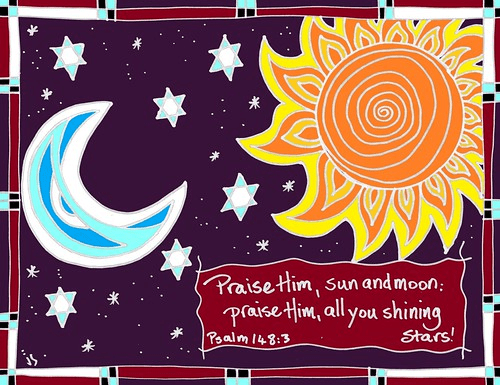
Praise him, sun and moon; praise him, all you shining stars! Praise him, you highest heavens and you waters above the heavens!
Let them praise the name of the Lord, for he commanded, and they were created. He established them forever and ever; he fixed their bounds, which cannot be passed.
Praise the Lord from the earth, you sea monsters and all deeps, fire and hail, snow and frost, stormy wind fulfilling his command!
Mountains and all hills, fruit trees and all cedars! Wild animals and all cattle, creeping things and flying birds!
Kings of the earth and all peoples, princes and all rulers of the earth! Young men and women alike, old and young together!
Let them praise the name of the Lord, for his name alone is exalted; his glory is above earth and heaven. He has raised up a horn for his people, praise for all his faithful, for the people of Israel who are close to him. Praise the Lord! (New Revised Standard Version)
Everything in all creation points to a Creator who cares for us. The 12 days of Christmas (December 25–January 5) are a great celebration. King Jesus has come; he is the rightful Sovereign over all creation. Believers recognize Christ’s incarnation – affirming the identity of Jesus as both full human and fully divine.
Worshipers praise the Lord. It’s in our spiritual DNA to give adoration, praise, and honor to God. Today’s Psalm is not only meant for good times; it’s also for the despondent, difficult, and downright hard times. There’s always an open season on praising the Lord, no matter what’s going on in and around us.
Psalm 148 helps to re-orient us around praise to God, instead of remaining stuck in being disoriented. Whether in good times or bad, we praise the Lord.
Who should praise the Lord?
Everyone. Everything.
God has created and continues to impact every nook and cranny of creation. Therefore, the entire universe – every creature and all humanity – acknowledge the Lord with praise.
The outer reaches of the universe, on everything out there which we cannot even see, praise the Lord.
The earth and everything in it praise the Lord.
The forces of nature praise the Lord.
The landscape, the flora and fauna, animals and humans, together with all creation, praise the Lord.
Young people, old people, men and women – no matter who they are or where they come from – praise the Lord.
The proper purpose of everything and everyone that exists is giving adoration and praise to God.
In the Ancient Near East, the sun, moon, and stars were considered gods by the various people groups. This Psalm was, therefore, more than a summons to praise – this was a call to recognize the One true God as the sovereign and the rightful ruler of all. Thus, the ancient peoples understood this psalm as a claim that their gods must bow to Israel’s God.
What is praise to the Lord?
Praise to the Lord is a recognition that God deserves praise from everyone and everything. Praise is physical posture and a heart stance of bowing, yielding, and submitting to God. “Praise the Lord” in the Hebrew language is “hallelujah.” And “hallelujah literally means “to raise the hands.”
We are told 10 times in the 14 verses of Psalm 148 to praise the Lord, that is, to raise our hands. It’s a symbol of submission and joy. To have open hands lifted toward heaven conveys our obedience and commitment to God.
When do we praise the Lord?
Praising the Lord and lifting the hands, is not only to occur in church or worship setting; praise happens everywhere.
We lift our arms in reverent submission at our workplaces when we land a client or have a good day; and when cranky and critical people demean us. Praising the Lord isn’t limited to good circumstances.
We raise our hands and praise the Lord when our neighbors care about us and look out for us, as well as when they make noise and irritate us with their less than kept up yards and houses. Yielding to God’s purposes for our lives is not dependent upon whether we have good neighbors or not.
We praise the Lord and raise our hands when our marriages are life-giving and thriving, as well as when our relationship with our spouse is dry, dull, and going nowhere. It’s always open season on praising the Lord and reflecting his image through love.
We praise the Lord for our kids, not only when they do what’s right; but also when they’re complete stinkers and drive us nuts. We are to use our hands for praise and enact obedience, and not for violence through finger pointing or physical punishment.
In adversity, we praise the Lord because it gives us a chance to put our faith into action. In times when someone is being insensitive and callous, it provides the opportunity to praise the Lord and love them because God loves us.
At all times, in all places, in every circumstance, and with each situation we raise our hands in hallelujah to Jesus for saving us from our misguided ways and bringing us back into fellowship with God.
Lift your hands, always! And when, like Moses, we can no longer lift them, let others help hold them up we so that we can keep praising God. (Exodus 17:11-12)
Why praise the Lord?
Because God created everything and everyone.
The Lord designed every living thing and fashioned a man and a woman in the divine image as the pinnacle of creative work.
Adam and Eve walked with God and had perfect praise of the Lord and fellowship with each other. Yet, tragedy happened. The people God formed were deceived into thinking that the Lord was holding out on them by not letting them eat from a certain tree in the garden. So, they disobeyed, ate the fruit, and so plunged the world into darkness.
However, God did not turn away from humanity. Holy Scripture is the revelation of a God who goes out of the way to do whatever it takes to reclaim people back to fellowship so that they can fulfill their original design to praise the Lord.
The height of God’s love is sending the Son, the Lord Jesus. God became one of us so that he could save us from ourselves.
Whenever we have exhausted all the avenues this world has to offer in bringing fulfillment, satisfaction, and peace to our lives – there stands Jesus, crucified, risen, ascended, and waiting with open arms for you and me to lift our hands and see that he has the only way for us to live.
The reason you have felt for so long that you are a square peg in a round hole is that your life is meant to praise the Lord. You are not meant to fit into the world; you are meant for God.
Where do we praise the Lord?
From the heavens and the earth. From everywhere in all creation, and from everyone as creatures, there is to be praise to the Lord.
Humanity is one part of a big grand chorus of praise that arises from all creation. Some of the psalmist’s pairings of praise are quite informative.
The sun that praises God during the daytime and the moon that offers its praise at night, reminds us that God’s praise is never silenced.
The highest heavens and waters above the sky, along with the earth and what’s under its waters, helps us recall that God’s creation, from top to bottom, praises the Lord.
The mountains and hills, with creatures and flying birds on them and circling them, communicates to us that both the noticeable and scarcely noticeable offer their praises to our God and King.
All creation burps out their praise – which means that some folk really are dumber than rocks because even the rocks know enough to praise the Lord.
We praise the Lord – outdoors, indoors, at home, at work, in the neighborhood, with family, church, from every place there is to be a lifting of the hands to God.
How do we praise the Lord?
Of course, we raise our hands in adoration for the God who gives us life and watches over us in such a way that not a hair on our heads can fall apart from the divine will.
We praise the Lord by being the people God created us to be – walking in fellowship with the Lord and enjoying the divine/human relationship forever.
No matter our current situation, every day and every situation is a summons to praise the Lord. God’s claim upon our lives leads us toward raising our hands to heaven.
The person who praises God is marked by a deep humility of understanding that they are not God; expressive gratitude for God’s actions; patient confidence in God’s promises; and a sense of unity, participating in harmony with God, others, and all creation in praising the Lord!
Most High, all-powerful, all-good Lord, All praise is Yours, all glory, honor and blessings. To you alone, Most High, do they belong; no mortal lips are worthy to pronounce Your Name.
We praise You for all Your creatures, especially for Brother Sun, who is the day through whom You give us light. He is beautiful and radiant with great splendor, of You Most High, he bears Your likeness.
We praise You for Sister Moon and the stars, in the heavens You have made them bright, precious and fair.
We praise You for Brothers Wind and Air, fair and stormy, all weather’s moods, by which You cherish all that You have made.
We praise You, for Sister Water, so useful, humble, precious and pure.
We praise You for Brother Fire, through whom You light the night. He is beautiful, playful, robust, and strong.
We praise You for Sister Earth, who sustains us with her fruits, colored flowers and herbs.
We praise You for those who pardon, or who for love of You bear sickness and trial.
Blessed are those who endure in peace, by You they will be crowned.
We praise You for Sister Death, from whom no-one living can escape. Woe to those who die in their sins! Blessed are those that She finds doing Your Will. No second death can do them harm.
We praise and bless You Lord, give You thanks, and humbly serve You. Amen.









 Rev. Tim Ehrhardt