Against Exorbitant Wealth (Amos 3:9-4:5)

Proclaim to the strongholds in Ashdod
    and to the strongholds in the land of Egypt,
and say, “Assemble yourselves on Mount Samaria,
    and see what great tumults are within it
    and what oppressions are in its midst.”
They do not know how to do right, says the Lord,
    those who store up violence and robbery in their strongholds.
Therefore thus says the Lord God:
An adversary shall surround the land
    and strip you of your defense,
    and your strongholds shall be plundered.

Thus says the Lord: As the shepherd rescues from the mouth of the lion two legs or a piece of an ear, so shall the people of Israel who live in Samaria be rescued, with the corner of a couch and part of a bed.

Hear and testify against the house of Jacob,
    says the Lord God, the God of hosts:
On the day I punish Israel for its transgressions,
    I will punish the altars of Bethel,
and the horns of the altar shall be cut off
    and fall to the ground.
I will tear down the winter house as well as the summer house,
    and the houses of ivory shall perish,
and the great houses shall come to an end,
            says the Lord.

Hear this word, you cows of Bashan
    who are on Mount Samaria,
who oppress the poor, who crush the needy,
    who say to their husbands, “Bring something to drink!”
The Lord God has sworn by his holiness:
    The time is surely coming upon you
when they shall take you away with hooks,
    even the last of you with fishhooks.
Through breaches in the wall you shall leave,
    each one straight ahead,
    and you shall be flung out into Harmon,
            says the Lord.
Come to Bethel—and transgress;
    to Gilgal—and multiply transgression;
bring your sacrifices every morning,
    your tithes every three days;
bring a thank offering of leavened bread
    and proclaim freewill offerings, publish them;
    for so you love to do, O people of Israel!
            says the Lord God. (New Revised Standard Version)

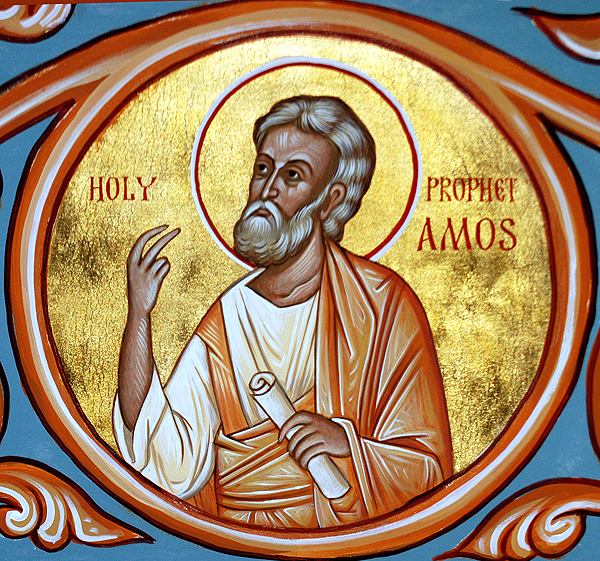
Orthodox icon of the prophet Amos

The prophet Amos sought to leave no stone unturned in exposing the transgressions of God’s wayward people. He went after social injustice; personal sins; religious idolatry; and all aspects of life in which the nation practiced self-indulgent hoarding of wealth and power.

Whenever people become focused on earthly power and control, they fall out of the realm of living in God’s power. If there is ever a personal or corporate sense of losing spiritual power, the problem is never with the Lord. The more one amasses worldly power and authority, the less effective they are with spiritual power.

It is possible for a nation or a church to have great political strength, yet in reality be powerless. Impressive constructed human strongholds are totally defenseless before the all-powerful God of the universe.

It’s always been curious to me why folks who claim the name of Christ, or who make grand confessions of faith, can then turn around and be enamored with obtaining wealth, real estate, resources of all sorts, and high-level positions. Such persons don’t deserve worldly power. It’s like putting a gold ring in a pig’s snout.

Persons with lots of worldly wealth and power will eventually find that their acquisitions fail them. And if their religion is powerless, everything in their life will lack power – no matter how it looks, or what spin they put on their situation.

Ignoring grace and mercy, compassion and kindness, to the poor and needy is a surefire way of experiencing divine condemnation. Treating one’s society and social relationships as mere pawns to get what I want is a prescription for alienation from God.

Whether someone believes in an almighty God, or not, oppressing and gaslighting others breaks down a society, and compromises basic law and order. Being concerned only with one’s constituents, and turning away from the common good of all, brings about injustice for the many.

But the ones in charge simply don’t care – which is why it raises the ire of a holy God. Any person who demeans meekness and gentleness, and clearly evidences a profound lack of humility, you can be sure that person is up to no good – despite any “good” words they might say.

Violence and robbery are the tools of those who care nothing for what their actions do to others. Justifying the rounding up of people into detention centers and robbing them of their lives and livelihood doesn’t fool God.

Those who go after unjust gain through any means possible will find that there is a boomerang effect to their actions. Their violent and unjust ways will turn back on them. They themselves shall be destroyed, and not the powerless and vulnerable.

In ancient Israel at the time of Amos, it was the Gentile nations who would rise up and be their judge. Pagan nations who thought nothing of despising and abusing others were the very ones to stand up and judge Israel. That’s how bad it was, even though there was wild prosperity, exorbitant wealth, and loads of power, that is, only among the upper class.

Living below the level of grace means showing no dignity or respect to one’s fellow humanity. It is unthinkable that such persons could or would ever exercise power in a democratic form of government. Just because they were elected and appointed to office, doesn’t mean they’ll act as civil servants.

Those in power who act only in self-interest will find themselves on the bad side of a holy God:

“Why would God withdraw from such a people? Because there was nothing in their lives corresponding to a heart concern for spiritual things; their character-reference could be written without mentioning God, or prayer, or holiness; their legacy to the future was wholly a testimony to a life lived for the body. And these claimed to be the people of God!” J.A. Motyer

Unchecked covetousness is actually a form of war against the poor. And any worship disconnected from righteousness and justice is an affront to both the needy among us, and God.

Wealth and power, in and of themselves, are neither good nor bad; they just are. But what we do with them is of vital concern. However, exorbitant riches and a lust for power, in and of themselves, are egregious sins.

In Holy Scripture, the poor are never chastised for their poverty and neediness. But the rich are continually exhorted and warned against for any sort of failing to care for the lower classes of people. (Matthew 25:14-30; Luke 12:13-21; 16:19-31)

The psalmist has a reality check for us:

Don’t be overly impressed when someone becomes rich,
    their house swelling to fantastic proportions,
    because when they die, they won’t take any of it with them.
    Their fantastic things won’t accompany them down under.
Though they consider themselves blessed during their lives,
    and even thank you when you deal well with them,
    they too will join the ancestors who’ve gone ahead;
    they too will never see the light again.
Wealthy people? They just don’t understand;
    they’re just like the animals
    that pass away. (Psalm 49:16-20, CEB)

The Teacher gives us some practical wisdom:

If you love money and wealth, you will never be satisfied with what you have. This doesn’t make a bit of sense. (Ecclesiastes 5:10, CEV)

Whoever becomes wealthy through unfair loans and interest collects them for the one who is kind to the poor. (Proverbs 28:8, GW)

And the Lord Jesus said:

“No one can serve two masters. Either you will hate the one and love the other, or you will be devoted to the one and despise the other. You cannot serve both God and money.” (Matthew 6:24, NIV)

“God blesses you who are poor,
    for the Kingdom of God is yours.” (Luke 6:20, NLT)

As for me, I’ll choose to take my cues from Jesus and the prophets, and not from those with earthly influence, riches, and power. How about you?

Almighty God, everything we possess – our time, abilities, resources, money, and material possessions – are gifts from You, and belong to You. Enable me to be a good steward of all that you have provided for me, so that I may be a blessing to the poor and needy; through Jesus Christ my Lord, in the strength of the Holy Spirit. Amen.

A Calling Is a Sacred Responsibility (2 Kings 9:1-13)

King Jehu

The prophet Elisha called to a member of the group of prophets, “Get ready, take this jug of oil with you, and go to Ramoth-Gilead. When you arrive there, look for Jehu, Jehoshaphat’s son and Nimshi’s grandson. Go to him, then pull him away from his associates, taking him to a private room. Take the jug of oil and pour it on his head. Then say, ‘This is what the Lord has said: I anoint you king of Israel.’ Then open the door, and run out of there without stopping.”

So the young prophet went to Ramoth-Gilead. He came in, and the military commanders were sitting right there. He said, “Commander, I have a word for you.”

“For which one of us?” Jehu asked.

The young prophet said, “For you, Commander.”

So Jehu got up and went inside. The prophet then poured oil on his head and said to him, “This is what the Lord, Israel’s God, says: I anoint you king over the Lord’s people, over Israel. You will strike down your master Ahab’s family. In this way I will take revenge for the violence done by Jezebel to my servants the prophets and to all the Lord’s servants. Ahab’s whole family will die. I will eliminate from Ahab everyone who urinates on a wall, whether slave or free, in Israel. I will make Ahab’s dynasty like the dynasty of Jeroboam, Nebat’s son, and like the dynasty of Baasha, Ahijah’s son. And as for Jezebel: The dogs will devour her in the area of Jezreel. No one will bury her.” Then the young prophet opened the door and ran.

Jehu went out to his master’s officers. They said to him, “Is everything okay?

Why did this fanatic come to you?”

Jehu said to them, “You know the man and the nonsense he talks.”

“That’s a lie!” they said. “Come on, tell us!”

Jehu replied, “This is what he said to me: ‘This is what the Lord says: I anoint you king of Israel.’”

Then each man quickly took his cloak and put it beneath Jehu on the paved steps. They blew a trumpet and said, “Jehu has become king!” (Common English Bible)

The biblical books of 1 & 2 Kings (originally one book of Kings) tells of the kingdoms of Israel and Judah over a five-hundred year period from c.960-586 B.C.E. The dynasties of the house of Omri and the house of Jehu were the longest lasting in Israel.

The books of First and Second Kings are primarily concerned with an evaluation of the 20 kings of Judah and the 19 kings of Israel. Of greatest concern was whether the particular king was loyal to God, or not. If the king tolerated worship of other gods besides Yahweh, and established sacrifices outside of Jerusalem, then that king was evaluated as doing evil in the eyes of the Lord.

This judgment of the kings is consistent with Deuteronomic laws of sole loyalty to God, and the importance of a central location for all Jewish people to worship (in Jerusalem).

To understand why it was so important for Jehu to be anointed with a mission is to know something of the house of Omri, and in particular, the king Ahab and his queen Jezebel. They are both conveyed to us in the biblical text as a power couple who want what they want, without a lot of concern about the subjects of their kingdom.

Jezebel was a follower of Baal and Asherah, not Yahweh. She provided for hundreds of their prophets. Her husband the king was fine with this situation. Jezebel was a clear enemy of God’s prophets, and killed hundreds of them, so that there were only a few left, including Elijah and Elisha (1 Kings 18:13).

Ahab and Jezebel’s powerful misuse of authority is relayed in the story of Naboth (1 Kings 21). Ahab wanted to buy Naboth’s vineyard, which was adjacent to his own land. But Naboth refused to sell, mainly because the land was his family’s ancient generational inheritance.

Jezebel went to work and arranged false witnesses to claim that Naboth had cursed both God and King (which was the ultimate sign of treason in Israel). As a result, Naboth was wrongly stoned to death; and Ahab unjustly confiscated his property.

Elijah prophesied that Ahab’s descendants would die, his dynasty will perish, and that Jezebel would be eaten by dogs (1 Kings 21:17-24). In our story for today, this is alluded to in the reference of God eliminating all that belong to Ahab who “urinate on a wall,” that is, unjustly marking the territory of another as their own property.

Indeed, it all shook-out according to prophecy. Ahab died in battle. Then, Ahab and Jezebel’s son Ahaziah succeeded him as king. Young Ahaziah died two years into his reign, and his brother Jehoram became king. Jehoram was then killed by Jehu. After this, some of Jezebel’s own palace officials tossed her out a window to her death, and dogs descended on her carcass – all to Elijah’s earlier prophecy.

Injustice, unrighteousness, abuse of power, and selfish concerns are ugly nasty business. These sorts of attitudes and behaviors ruin people, and keep others locked into patterns of poverty and powerlessness. God is not okay with any of it.

Whenever we are in the middle of oppression and/or authoritative people abusing their power for their own benefit, its hard to maintain our sense of rightness and goodness. Yet, we must. In such times, patience and perseverance is needed without resorting to attempts of paying back evil with evil.

What’s more, we can find ways of tapping into the spiritual power of God within us, in order to resist and subvert unjust authority with righteousness. To some degree, everyone can do something by employing nonviolent resistance tactics like networking, protest, persuasion, non-cooperation, and speaking out through either speech or writing.

Only those who possess nothing can be entrusted with everything. Systemic evil isn’t changed from the top, because those at the top benefit from the system. Rather, structural evil is transformed through grass roots efforts from the bottom up. What’s more, individuals rarely change from the outside-in, but rather from the inside-out.

A ruling establishment is not always necessarily wrong. Yet, it takes a lot of willing accountability and plenty of intentional soul searching for administrations to remain on the straight and narrow.

Such realities characterized Jehu. He was a non-descript military man. There was nothing, in particular, which distinguished him as having a special calling from God.

Yet, although Jehu fulfilled his calling, he added to the call; the Lord was not pleased with Jehu’s form of violent bloodshed, and so, put an end to Jehu’s house, just as Omri’s house had been purged from Israel.

Power and authority will do that to a person – which is why leaders must be continuously vigilant to guard against developing a thick ego and following their pride.

And so do we. Anyone who receives a call from God has a sacred responsibility and trust to fulfill that calling with competence, care, and conscientiousness.

Almighty God, direct me in all my activity with Your grace, wisdom, and help, so that in all I do and say may glorify Your holy Name; through Jesus Christ our Lord, in the power of the Holy Spirit. Amen.

When Things Are Screwy (Esther 3:1-15)

After these events, King Xerxes honored Haman son of Hammedatha, the Agagite, elevating him and giving him a seat of honor higher than that of all the other nobles. All the royal officials at the king’s gate knelt down and paid honor to Haman, for the king had commanded this concerning him. But Mordecai would not kneel down or pay him honor.

Then the royal officials at the king’s gate asked Mordecai, “Why do you disobey the king’s command?” Day after day they spoke to him but he refused to comply. Therefore they told Haman about it to see whether Mordecai’s behavior would be tolerated, for he had told them he was a Jew.

When Haman saw that Mordecai would not kneel down or pay him honor, he was enraged. Yet having learned who Mordecai’s people were, he scorned the idea of killing only Mordecai. Instead Haman looked for a way to destroy all Mordecai’s people, the Jews, throughout the whole kingdom of Xerxes.

In the twelfth year of King Xerxes, in the first month, the month of Nisan, the pur (that is, the lot) was cast in the presence of Haman to select a day and month. And the lot fell on[a] the twelfth month, the month of Adar.

Then Haman said to King Xerxes, “There is a certain people dispersed among the peoples in all the provinces of your kingdom who keep themselves separate. Their customs are different from those of all other people, and they do not obey the king’s laws; it is not in the king’s best interest to tolerate them. If it pleases the king, let a decree be issued to destroy them, and I will give ten thousand talents of silver to the king’s administrators for the royal treasury.”

So the king took his signet ring from his finger and gave it to Haman son of Hammedatha, the Agagite, the enemy of the Jews. “Keep the money,” the king said to Haman, “and do with the people as you please.”

Then on the thirteenth day of the first month the royal secretaries were summoned. They wrote out in the script of each province and in the language of each people all Haman’s orders to the king’s satraps, the governors of the various provinces and the nobles of the various peoples. These were written in the name of King Xerxes himself and sealed with his own ring. 

Dispatches were sent by couriers to all the king’s provinces with the order to destroy, kill and annihilate all the Jews—young and old, women and children—on a single day, the thirteenth day of the twelfth month, the month of Adar, and to plunder their goods. A copy of the text of the edict was to be issued as law in every province and made known to the people of every nationality so they would be ready for that day.

The couriers went out, spurred on by the king’s command, and the edict was issued in the citadel of Susa. The king and Haman sat down to drink, but the city of Susa was bewildered. (New International Version)

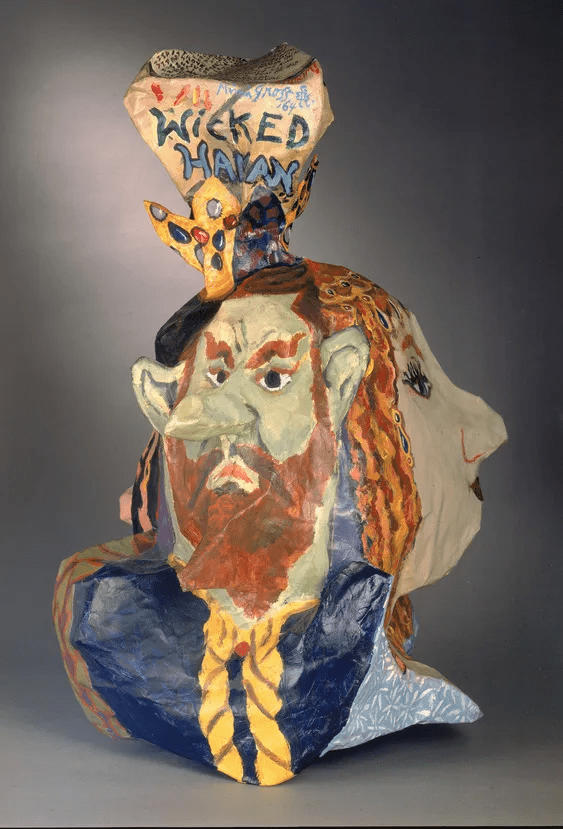
A Purim mask of Haman, by Mimi Gross, 1964

I don’t like arrogant people. I don’t like those who only think of themselves, and expect others to fall in line with them, too! It’s unlikely that an arrogant person would be reading or listening to this, namely because such individuals believe they are above the menial task of reading – unless it gets them more attention and/or power.

I don’t like Haman. The story clearly sets up Haman as the antagonist. He is a number one jerk in the first degree. Having a front row seat to his manipulative ways with the king arouses our sense of justice and injustice. Mordecai was the one person who saw Haman for who he is; so, if Haman couldn’t cajole and control Mordecai, he was determined to do him in, permanently.

It’s interesting that the royal command that people bow to Haman, follows the command that men are the lord of their homes. That doesn’t sound very “complimentary” to me. Haman wanted a strict hierarchical structure, with himself at the top.

It is consistent of the arrogant authoritarian person to not stop with wanting Mordecai out of the way, but also to lay plans for all of Mordecai’s people, the Jews, to be destroyed.

Because of Haman’s arrogant anger, he sought to enlist the king in his sinister plan. Every authoritarian dictator throughout history has scapegoated an entire race of people through rewriting history. Haman spun the Jewish people as a constant historical problem.

Using generalities and twisted truth, Haman depicted Jewish life as one long continuous rebellion against governmental authority. Note that Haman did not produce any hard evidence to his claims.

If this weren’t bad enough, Haman appealed to the king through the promise of financial gain with a plan of ridding the empire of Jews. The king let Haman go ahead with the plan, while keeping his own hands clean from the affair.

Thus, it was decreed that on the thirteenth day of the twelfth month, the people of the empire were to rise up against the Jews and wipe them off the face of the earth. No one was to be spared. And the Jews could be plundered.

So, King Xerxes and Haman went back to drinking and having a good time, neither being aware nor caring that the entire plan is insane and nonsensical – which is why we get the picture of the city’s citizens looking at one another quizzically… “Huh!?”

The story’s stage is set for the protagonist, Esther, to enter. Yet, we need to sit with this terrible situation for a while, and not rush to the conclusion of the narrative. That’s because the ancient Jews had to sit with this for an agonizing stretch of time, knowing that the actual day of their demise was on the calendar.

There would not be the centuries old Jewish celebration of Purim without this tension. Yes, the awful suffering would eventually end in glorious joy. However, there would not be such joy apart from the grinding circumstance of facing extinction.

Another way of putting this: There cannot be a resurrection without a crucifixion. There must be suffering before glory. When things are screwy, we have only our faith to cling to.

The wise person will ponder these things and take them to heart.

Do not forget us, your people, O Lord.
Be present to us in the time of our distress and grant us courage.
Save us by Your power, and come to our aid,
for I am alone and have no one but You on whom to depend. Amen.

Divine Providence (Esther 1:1-20)

The Refusal of Vashti, by Gustave Doré (1832-1883)

These events happened in the days of King Xerxes, who reigned over 127 provinces stretching from India to Ethiopia. At that time Xerxes ruled his empire from his royal throne at the fortress of Susa. In the third year of his reign, he gave a banquet for all his nobles and officials. He invited all the military officers of Persia and Media as well as the princes and nobles of the provinces. The celebration lasted 180 days—a tremendous display of the opulent wealth of his empire and the pomp and splendor of his majesty.

When it was all over, the king gave a banquet for all the people, from the greatest to the least, who were in the fortress of Susa. It lasted for seven days and was held in the courtyard of the palace garden. The courtyard was beautifully decorated with white cotton curtains and blue hangings, which were fastened with white linen cords and purple ribbons to silver rings embedded in marble pillars. Gold and silver couches stood on a mosaic pavement of porphyry, marble, mother-of-pearl, and other costly stones.

Drinks were served in gold goblets of many designs, and there was an abundance of royal wine, reflecting the king’s generosity. By edict of the king, no limits were placed on the drinking, for the king had instructed all his palace officials to serve each man as much as he wanted.

At the same time, Queen Vashti gave a banquet for the women in the royal palace of King Xerxes.

On the seventh day of the feast, when King Xerxes was in high spirits because of the wine, he told the seven eunuchs who attended him—Mehuman, Biztha, Harbona, Bigtha, Abagtha, Zethar, and Carcas—to bring Queen Vashti to him with the royal crown on her head. He wanted the nobles and all the other men to gaze on her beauty, for she was a very beautiful woman. But when they conveyed the king’s order to Queen Vashti, she refused to come. This made the king furious, and he burned with anger.

He immediately consulted with his wise advisers, who knew all the Persian laws and customs, for he always asked their advice. The names of these men were Carshena, Shethar, Admatha, Tarshish, Meres, Marsena, and Memucan—seven nobles of Persia and Media. They met with the king regularly and held the highest positions in the empire.

“What must be done to Queen Vashti?” the king demanded. “What penalty does the law provide for a queen who refuses to obey the king’s orders, properly sent through his eunuchs?”

Memucan answered the king and his nobles, “Queen Vashti has wronged not only the king but also every noble and citizen throughout your empire. Women everywhere will begin to despise their husbands when they learn that Queen Vashti has refused to appear before the king. Before this day is out, the wives of all the king’s nobles throughout Persia and Media will hear what the queen did and will start treating their husbands the same way. There will be no end to their contempt and anger.

“So if it please the king, we suggest that you issue a written decree, a law of the Persians and Medes that cannot be revoked. It should order that Queen Vashti be forever banished from the presence of King Xerxes, and that the king should choose another queen more worthy than she. When this decree is published throughout the king’s vast empire, husbands everywhere, whatever their rank, will receive proper respect from their wives!”

The king and his nobles thought this made good sense, so he followed Memucan’s counsel. (New Living Translation)

Vashti Refuses, by Richard McBee

The Jews were living in exile. The Babylonian Empire had taken Jerusalem, destroyed the temple, and exiled many of the people to Babylon. Later, the Medes and Persians conquered Babylon and ruled over a vast area of many different peoples.

The story of Esther begins with the story of King Xerxes and Queen Vashti. They were the most powerful people in the world, at that time. This meant that Vashti had more power and authority than any woman on earth, at that time.

Although most women had few rights, Vashti was not one of them. However, when it came to the king, the queen was most definitely second fiddle.

Today, we can understand Vashti’s response to Xerxes. But back then, it was unthinkable. It wasn’t only Xerxes who ruled the land; misogyny did, as well.

Queen Vashti appears in the story as a strong-willed independent woman of power. While the king and queen were each having their respective parties, things started to go sideways.

No limits on the bar meant unlimited drinking. A drunk King Xerxes had one of those moments that seemed logical to the inebriated mind, but was actually nonsensical. He insisted that his queen stop her celebration, leave her guests, get all gussied up in her royal accoutrements, and parade around for a bunch of drunk guys to gawk at.

As readers of the story, we can tell this is not going to have a good ending for Vashti. She was in an impossible situation. She could submit and face humiliation, or worse. So, the queen chose not to abide by the king’s order.

Little did Vashti know that she was paving the way for a new queen to ascend to the side of King Xerxes. The extreme action of Xerxes attempting to use his queen then turned into another action of consulting his advisors and deposing the queen. Vashti was banned from the court, and the kingdom.

Hence, events were set in motion to find a new queen. As the story unfolds, Esther is a young Jewish woman living in this forced diaspora of the Persian Empire. Little did she know that Vashti’s fall was the beginning of her own rise.

“So the last will be first, and the first will be last.”

Jesus (Matthew 20:16)

Although the story of Esther never mentions the word “God,” we see an incredible Providence guiding events through the biblical book of Esther. Young Esther found favor with the king, became queen, and risked her life to save the Jewish people from destruction.

Esther’s story is the Jewish story – a tale of others pronouncing pogroms upon them and attempting to rid themselves of these others who live strangely and differently. But a champion arises; one who bring deliverance.

The Jewish story is one of resilience as a people throughout the millennia. Rather than ignoring, or worse, persecuting Jews, we can observe how they have had to deal with the enduring issues of perseverance through suffering; preserving their identity; and ensuring their survival in the middle of social and cultural pressures.

We also see that just because one is in the courts of power and is not one of the peoples who is persecuted, does not necessarily mean that there is an exemption from harm. Vashti was a powerful woman, but her power didn’t last.

In the end, Vashti was treated more like an oppressed Jew than a privileged Gentile; and Esther would move from powerless to powerful.

And from a Christian perspective, we can see Jesus as the Savior who puts himself at risk to save the world from sin, death, and hell.

And let us run with perseverance the race marked out for us, fixing our eyes on Jesus, the pioneer and perfecter of faith. (Hebrews 12:1b-2a, NIV)

We can, as well, observe that God is not fazed by any big earthly political power. The Lord sees all, knows all, and has the authority to do something about injustice and accomplishing just purposes on this earth.

O God, your never-failing providence sets in order all things both in heaven and earth: Put away from us, we entreat you, all hurtful things, and give us those things which are profitable for us; through Jesus Christ our Lord, who lives and reigns with you and the Holy Spirit, one God, for ever and ever. Amen.