The Need to Defend a Ministry (2 Corinthians 10:1-11)

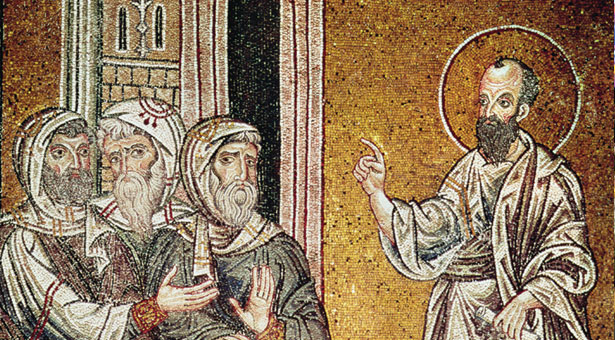
Mosaic of St. Paul Preaching, 12th century, Duomo, Monreale, Sicily, Italy

By the humility and gentleness of Christ, I appeal to you—I, Paul, who am “timid” when face to face with you, but “bold” toward you when away! I beg you that when I come I may not have to be as bold as I expect to be toward some people who think that we live by the standards of this world. 

For though we live in the world, we do not wage war as the world does. The weapons we fight with are not the weapons of the world. On the contrary, they have divine power to demolish strongholds. We demolish arguments and every pretension that sets itself up against the knowledge of God, and we take captive every thought to make it obedient to Christ. And we will be ready to punish every act of disobedience, once your obedience is complete.

You are judging by appearances. If anyone is confident that they belong to Christ, they should consider again that we belong to Christ just as much as they do. So even if I boast somewhat freely about the authority the Lord gave us for building you up rather than tearing you down, I will not be ashamed of it. I do not want to seem to be trying to frighten you with my letters. 

For some say, “His letters are weighty and forceful, but in person he is unimpressive and his speaking amounts to nothing.” Such people should realize that what we are in our letters when we are absent, we will be in our actions when we are present. (New International Version)

I don’t know about you, but I’m not a fan of feeling like I have to defend my ministry – my philosophy of how to go about things, my hermeneutics, my words, my actions, my clothes, my food – and pretty much everything about me. Believe it or not, I’ve been criticized for things like not having shiny enough shoes (and having too nice of shoes), the make and model of the car I drive (and don’t drive), being too serious (and not being serious enough).

So, for me, I detect in the Apostle Paul’s retort to the Corinthian Church, an exasperation. Reading between the lines, I can hear him saying something like, “I can’t believe I’m even talking about this stuff because you guys are about as spiritually aware as a bowling ball – and bowling balls haven’t even been invented yet. Heck, I don’t even know what a bowling ball is! That’s about how much you know what you’re talking about. Sheesh!”

Yet, despite Paul’s annoyance and displeasure with the Corinthians’ line of thinking, the Apostle still made up his mind to craft a response that was as humble and gentle as he could possible come up with.
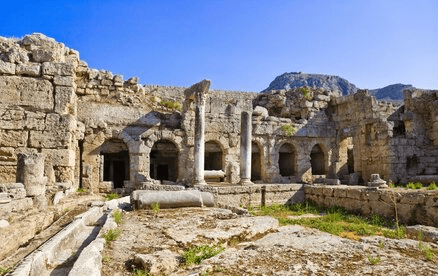
A modern archaeological site at Corinth, Greece

The Church’s first criticism toward Paul is that he is bold from a distance, but up close and personal, rather weak and unimpressive as an Apostle. I’m willing to be that every church pastor in the U.S. is more than able to know what this feels like in putting themselves in the Apostle’s shoes.

It’s an age old criticism that every preacher faces at various points, or at least with some sermons or writings. The people just don’t appreciate or like what they’re hearing or reading. It often comes out in the ubiquitous phrase, “I’m just not getting spiritually fed.” Wrapped up in that phrase is not only the criticism of oratorical skills, but also that they don’t like something about the preacher’s physical appearance, particular idiosyncrasies, or interaction with other people.

The second criticism of Paul by the Corinthians is that he acts too much according to human standards. In other words, the Apostle is just too worldly for them. If you happen to know anything about the ancient Corinthian Church, you’re either doing a major eye roll right now, or you’re just plain busting a gut in laughter.

There’s no more worldly church in the New Testament than the Corinthian Church. To have them bringing this point up to Paul is both laughable and downright sad. But again, every preacher nowadays knows the criticism all too well. For example, many pastors aren’t paid well with the convoluted reasoning that they shouldn’t be tempted toward worldliness – even though the parishioners themselves have no problem owning large homes, multiple cars, and high paying jobs.

The Corinthians were likely also concerned about Paul’s egoism – that he’s too much into worldly power and philosophies. Again, laughable stuff, considering the source. Yet again, these sorts of criticisms are rife within many churches. And the critics themselves tend to be ones who are enamored with wanting power and control for themselves, wanting to ensure that no one, including an upstart pastor, never treads upon their mastering of a very small world.
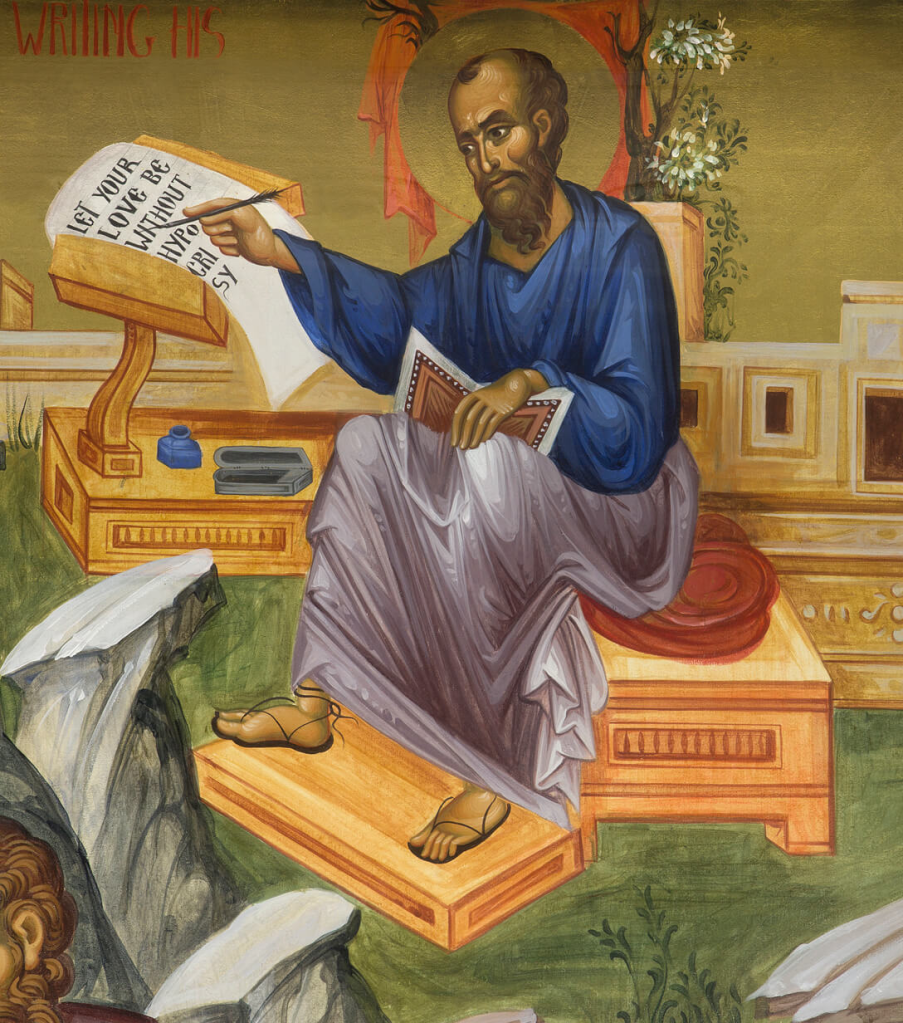
Orthodox icon of St. Paul writing to the churches

Paul responds to this by stating that he is, of course, a human being. However, he wields a different kind of power. Employing military metaphors, the Apostle describes the weapons that he uses as capable of destroying spiritual strongholds of arguments, and obstacles of pride against the knowledge of God – the very sorts of strongholds that were present among the Corinthians.

What’s more, Paul takes captive every thought and makes it obedient to Christ, and not to a self-serving agenda of worldly control and power. And he will use those weapons, if necessary, if the Corinthians keep up their petty criticisms and worldly behavior.

The bottom line of it all is that Christ made Paul an Apostle; and nobody in the Corinthian Church was made one. Paul’s authority was given, not taken, and he will use it to build up and not tear down. In other words, the Apostle Paul was committed to fulfilling his apostolic commission by establishing churches, building up those churches in the strength of faith, and protecting them from misguided and wrongheaded ways of operating.

All I have to say to this is that I am very glad that the Church belongs to Christ. Because that’s the only way we can still be talking about the Church still existing all these centuries later. God works, despite all the human foibles and nonsense.

Even though I talk like this (as does Paul!) there are still good Christian believers and good Christian churches in this world. Not every parishioner lacks self-awareness, is short-sighted, and has a plank in their eye. Nor are all pastors just in it for attention and some sort of worldly gain.

I’m still living and breathing, ministering and mentoring, after decades of Christian labor because of many good people who treated me well, spent good time with me, as well as those who received my teaching and my love, put it into practice, and have produced a harvest of righteousness beyond what I could imagine.

It would be good for all of us to experience supportive community, spiritual maturity, and wise ministry to others. If we can go through any process – no matter what it is – with the humility and meekness of Christ, then no matter what the end is, we have brought some peace and goodness into this old fallen world of ours.

And there is no shame in that!

Almighty and eternal God: Every good and perfect gift comes from you. Send down upon our pastors and parishioners alike a healthy spirit of grace and goodness, so that we all together may truly please you in all we say and do; and continually pour out your divine blessing upon us all. We ask this for the honor of your Son, our Advocate and Friend, Jesus Christ our Lord. Amen.

Jesus the King (Mark 11:1-11)

Entry Into the City, by John August Swanson (1938-2021)

As they approached Jerusalem and came to Bethphage and Bethany at the Mount of Olives, Jesus sent two of his disciples, saying to them, “Go to the village ahead of you, and just as you enter it, you will find a colt tied there, which no one has ever ridden. Untie it and bring it here. If anyone asks you, ‘Why are you doing this?’ say, ‘The Lord needs it and will send it back here shortly.’”

They went and found a colt outside in the street, tied at a doorway. As they untied it, some people standing there asked, “What are you doing, untying that colt?” They answered as Jesus had told them to, and the people let them go. When they brought the colt to Jesus and threw their cloaks over it, he sat on it. Many people spread their cloaks on the road, while others spread branches they had cut in the fields. Those who went ahead and those who followed shouted,

“Hosanna!”

“Blessed is he who comes in the name of the Lord!”

“Blessed is the coming kingdom of our father David!”

“Hosanna in the highest heaven!”

Jesus entered Jerusalem and went into the temple courts. He looked around at everything, but since it was already late, he went out to Bethany with the Twelve. (New International Version)

We are presently in the 12 Days of Christmas (December 25–January 5), the annual celebration of Christ’s birth on the Christian Calendar. It may seem odd that the Revised Common Lectionary daily readings have included a text associated with Palm Sunday. However, this is reminder to us that Jesus was born a king – which is why old King Herod saw a little baby as such a threat. (Matthew 2:1-18)

“Christ” is not the surname of Jesus, but instead is a title, meaning “anointed one.” In other words, in the New Testament Gospels, Jesus is referred to as an anointed king. It was broadly understood, within the religious milieu of the ancient Jews, that the Messiah (the Hebrew term for Christ) would come and beat up God’s enemies, restore God’s people to their former glory, and usher in an everlasting state of peace.

Jerusalem had a history as the royal city – the place where ancient Jewish kings lived and ruled. So, most ancient Jews made a clear connection between the Messiah, the king, returning to reign in Jerusalem. They anticipated that the City of David would once again be the seat of power, without any meddling Gentiles to complicate things.

Nativity, by John August Swanson

So, when Jesus entered Jerusalem – in what turned out to be the final week of his earthly life – many people looked upon this as a triumphal entry. He was close to ascending the ancient throne. The disciples of Jesus were waiting for this, and ready for a future of greatness and glory alongside their Rabbi.

Not only did people lay their palm fronds on the road in front of him declaring the ancient refrain, “Blessed is he who comes in the name of the Lord!” (Psalm 118:26) but they also added an explicit reference to the days of King David stating, “Blessed is the coming kingdom of our ancestor David!” The city was awash in the messianic hope of no longer being subject to foreign rule.

Yet we know the tragic and ironic end of the week. Jesus knew it, too, even at the time. He knew what fate awaited him by entering Jerusalem (Mark 8:31; 10:33-34). And Jesus knew without a shadow of a doubt that he was not going to be a king who gains and keeps power through military might and the bloodshed of war. Instead, only his own blood would be offered, as a sacrifice for many. The power of Love will overcome any and every earthly power.

Those with the eyes to see and the spirit to discern could understand this Jesus riding on a humble donkey instead of the proud warhorse. It made complete sense. Jesus did not enter this world with the fanfare of the rich and powerful, but quietly slipped onto the earth in a non-descript and poor Jewish family. His birth, life, and ministry, were all counter cultural. So, why not also his eventual death, resurrection, ascension, and glorification?

Yes, Jesus is a king. But no, he is not a king in any conventional sense. It is Jesus, beginning with his incredible and unexpected incarnation, who helps us reimagine what power and authority can and ought to look like.

All the trappings of control we can get so enamored about, such as wielding influence through economic wealth, social status, political power, and religious weight, all get tossed aside as mere stuffed animals compared to the real deal of moral dignity, ethical love, and compassionate justice shown to people who had absolutely no ability to either pay back Jesus or prop up a throne for him to sit upon.

Jesus is a king who gives his life for the healing of humanity – all people everywhere – including the ones we don’t much like or care about. I have no problem calling Jesus a king, just as long as we understand what sort of kingship we are actually talking about.

I serve King Jesus because he throws a monkey wrench into oppressive systems that seek to keep other people under a heavy hand of injustice. My allegiance is with Christ the Lord because he uses his prodigious authority to bring peace, light, wholeness, and integrity to all the places of the world (and the human heart) that are dark and clueless.

Today I celebrate in this Christmas season the birth of a baby who was born to die to the world and for the world. I rejoice with the angels that Christ is born in Bethlehem, the king of kings and lord of lords, the prince of peace who himself became peace so that we might live in peace.

May you discover deliverance from guilt, shame, and regret, through the One who came and was wounded for us so that we might be healed. Amen.

The Question of Authority (Mark 11:27-33)

The Pharisees Question Jesus, by James Tissot (1836-1902)

Again they entered Jerusalem. As Jesus was walking through the Temple area, the leading priests, the teachers of religious law, and the elders came up to him. They demanded, “By what authority are you doing all these things? Who gave you the right to do them?”

“I’ll tell you by what authority I do these things if you answer one question,” Jesus replied. “Did John’s authority to baptize come from heaven, or was it merely human? Answer me!”

They talked it over among themselves. “If we say it was from heaven, he will ask why we didn’t believe John. But do we dare say it was merely human?” For they were afraid of what the people would do because everyone believed that John was a prophet. So they finally replied, “We don’t know.”

And Jesus responded, “Then I won’t tell you by what authority I do these things.” (New Living Translation)

Jesus was an outsider. During his earthly ministry, he was viewed, at best, as an avant-garde leader; and, at worst, a flat out heretic. It may be easy to overlook that reality, because we typically think of Christ as Lord and always on the inside of things.

Although Jesus was a teacher and a rabbi – and was neither a priest nor a member of any Jewish religious sect – he nevertheless walked around as if he owned the place (which he did). That gave the established religious leadership of the day no end of consternation and frustration.

Jesus made significant inroads into people’s lives, especially with outsiders like himself. And this situation created anger and jealousy with many of the religious ruling class. Since Jesus was not a card-carrying member, the leaders wanted to hear from him why he kept acting confidently and deliberately on their religious turf.

“What gives you the right? Who authorized you to act this way?” was their cry.

The established authorities are depicted in today’s Gospel lesson as a craven bunch who did not want to alienate the crowds, and yet were eager to get the upstart Jesus out the way. This appears to be an age-old situation of leaders putting their fingers to the wind to go with whatever will keep them popular and in power.

Since Jesus consistently refused to play such games, the authorities believed he needed to go. They, however, had no intention of risking an outright confrontation and showing their shadow motives.

Jesus clearly connected himself with John the Baptist, as both coming from the same authority. John was yet another figure for whom the established leaders could not control.

We ought never to underestimate both perceived and actual threats to status quo leadership. Such leaders have no inkling of being public servants when true moral authority comes along. The lack of conformity from John and Jesus would cost them both their very lives.

Speaking truth to power while not becoming defensive doing so is a tricky art. Yet, Jesus did it. Continual challenges to his authority left him unfazed as to his mission and purpose on this earth. Christ was assertive without becoming despotic; forward without taking the bait of useless arguments; confident with no hint of arrogance.

For me, the contrast between Jesus and the religious authorities is trenchant. The confident, wise, and calm authority of Christ is in direct opposition to the fear, anxiety, and worry of the ruling leaders. Whereas they kept anxiously ruminating about what to do about this threat to their established authority, Jesus exhibited a non-anxious presence which maintained a steadfast focus on God’s righteous, holy, and benevolent rule and reign.

Sometimes, continual fear is a big red flag that the leader is so worried about losing their place or position, that the will of God gets pushed aside as merely a secondary concern.

Questioning Christ’s credentials was the giveaway that the existing religious authorities were concerned about their power and privilege, and not the people. The wise person will see such queries for what they are.

Wherever we observe those who refuse to share power, have a xenophobic bent toward outsiders, and seem to do just about anything to maintain the status quo, there we will find the abuse of authority.

Conversely, where we observe a deep concern for equity, justice, and the common good of all persons, there we see compassionate leadership who will champion ethical leadership and espouse moral authority.

In any democratic society, we must choose our leaders wisely.

Great God of hope, in these times of change and uncertainty, unite your people and guide our leaders with your wisdom. Give us courage to overcome our fears and help us to build a future in which all may prosper and share together through Jesus Christ our Lord in the strength of your Holy Spirit. Amen.

Power in Weakness (2 Corinthians 13:1-4)

Way of the Cross, by Jyoti Sahi, 2009

This will be my third visit to you. “Every matter must be established by the testimony of two or three witnesses.” I already gave you a warning when I was with you the second time. I now repeat it while absent: On my return I will not spare those who sinned earlier or any of the others, since you are demanding proof that Christ is speaking through me. He is not weak in dealing with you, but is powerful among you. For to be sure, he was crucified in weakness, yet he lives by God’s power. Likewise, we are weak in him, yet by God’s power we will live with him in our dealing with you. (New International Version)

One witness is not enough to convict anyone accused of any crime or offense they may have committed. A matter must be established by the testimony of two or three witnesses. (Deuteronomy 19:15, NIV)

The missionary Apostle Paul had already visited Corinth twice. Citing his upcoming third visit in the context of establishing a crime, this was a warning to the Corinthian Christians: When I get there, it won’t be a pleasure cruise. Paul would flex his apostolic muscles toward the church.

The Apostle was accustomed to people opposing his ministry and generally making a stink of things against him. The Corinthians were being rather stubborn and unrepentant. They were unwilling to change their ways nor their attitudes.

In order to discredit Paul, his opponents labeled him as weak and ineffective. They challenged him as to whether Christ was actually animating his words, or not. But Paul was no weakling, nor was he a simpleton. He used their own language against them by pointing out that Jesus was accused of the very same things – Christ was crucified in weakness, but lives by the power of God.

Christianity is an inherently paradoxical religion. It’s not going to make sense to the ungodly and the unbeliever. The cross – the place of submission, torture, death, and apparent weakness – was actually the supreme demonstration of God’s power. This was proven by the resurrection of Christ from death.

In the same way, although Paul seemed weak, unimposing, always engaged in suffering service, these very things were the ultimate sign that God’s power was at work in his ministry. The Apostle shared in the sufferings of Christ and gloried in the reality that he was weak.

And since Paul also shares in Christ’s resurrection, he therefore shares in the power of Christ. He will use this power, given to him by Christ in the form of apostolic authority, and deal with the recalcitrant Corinthians forthwith.

The Corinthian Church, not knowing who they were really dealing with, had a tiger by the tail. There is a time for gentle and compassionate pastoral care, and then there is the time for using the shepherd’s crook for some tough loving discipline.

If the sin-busting strength of the cross, and the spiritual power of the resurrection, are truly fueling Christian ministry, then it is a fool’s errand to oppose it. Chastisement and a lesson in humility are in store for the haughty opponent working against authentic Christian service.

We really have to get this wrongheaded notion out of our noggins, that power and strength are all about an aggressive exercise of authority. If I see one more church put out an advertisement for a pastor who has “strong leadership” I think I’m going to puke. Because what they typically mean by strength is a command-and-control sort of stereotypical military Sargent type of person.

That’s diametrically opposed to the leadership and authority Jesus exercised, and the kind of values which characterize the kingdom of God. In God’s economy, humility and meekness are the true demonstrations of power. Real power in this world is the power of self-control – and not the control of manipulating others to get and keep power that won’t last.

Little wonder that pastors of churches these days can be some of the worst immoral and unsavory characters around. Congregations hungry for “strong leadership” inevitably hire narcissistic persons. And then when things go sideways, the church wonders what the heck happened.

But the signs were continually there, all along. When the church leaders pray, they’re not addressing God, but publicly telling those listening what they should be doing. In speaking, they tend to preface their comments with “The Bible says…” which is really a clue that they’re about to spout a bunch of opinionated nonsense cloaked in religious garb.

Until we embrace the mystery of the faith, expressed in paradoxical ways, with the weak displaying the real strength and power of the gospel, then we can expect Jesus to show up with a whip and give people what they’ve really wanted all along – and they won’t like it one bit.

Paul, a mentor to many first generation Christian pastors, encouraged them this way:

I solemnly call on you in the presence of God and Christ Jesus, who is going to judge those who are living and those who are dead. I do this because Christ Jesus will come to rule the world. Be ready to spread the word whether or not the time is right. Point out errors, warn people, and encourage them. Be very patient when you teach.

A time will come when people will not listen to accurate teachings. Instead, they will follow their own desires and surround themselves with teachers who tell them what they want to hear. People will refuse to listen to the truth and turn to myths.

But you must keep a clear head in everything. Endure suffering. Do the work of a missionary. Devote yourself completely to your work. (2 Timothy 4:1-5, GW)

Weakness, hardship, suffering, and opposition are part of the work of Christian ministry. In this, there is eternal power, which shall never be overcome.

Almighty God, may your grace be sufficient for me, and my power made perfect in weakness. Help me to rely upon and use my weaknesses, so that Christ’s power may rest on me. For Christ’s sake, I delight in weaknesses, insults, hardships, persecutions, and difficulties. For when I am weak, then I am strong, through Jesus Christ my Lord, in the enablement of the Holy Spirit. Amen.