Blessings or Woes?

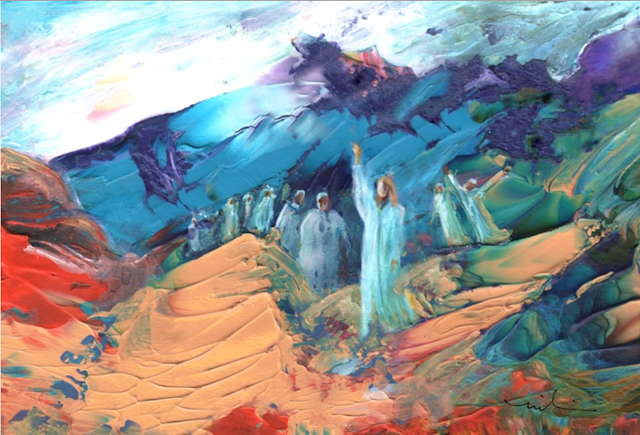
The Sermon on the Mount, by Miki de Goodaboom

There are many persons who currently feel angry and powerless in the face of recent and contemporary political events. All of this has large implications, especially for workers.

I admit to being one who is frustrated and saddened by the U.S. government’s unwillingness and inability to simply care about all of its citizens (as well as the citizens of the world). Along with their spirit of the age, they are failing to ensure the common good of everyone.

What’s more, there are large swaths of American Christianity who are either complicit or actively involved in establishing and perpetuating a system of governance which is fundamentally out of sync with biblical norms.

The Church and the Christian have a responsibility and a call, based in the words and ways of Jesus, of whom we purport to follow. In some of the first words uttered to his disciples, establishing what is of upmost importance for us to know, Jesus said:

“Blessed are you who are poor,
    for yours is the kingdom of God.
“Blessed are you who are hungry now,
    for you will be filled.
“Blessed are you who weep now,
    for you will laugh…

“But woe to you who are rich,
    for you have received your consolation.
“Woe to you who are full now,
    for you will be hungry.
“Woe to you who are laughing now,
    for you will mourn and weep.” (Luke 6:20-21, 24-25, NRSV)

Jesus was building and upholding an alternative kingdom to the political systems of the time. Christ came to this earth to set things right amidst a corrupt world whose authority was held in the hands of evil.

But change would not come through the typical means of worldly power such as coups, revolutions, or economic exploitation of some persons over others.

For those who feel helpless and without power, Christ brings a liberation which transcends all other powers and authorities. He brings blessing.

What this means for those who are enamored with worldly aspects of power (money, wealth, resources, political authority, etc.) the words and actions of Jesus brings woe.

An evil grip of the world cannot be loosened with practices and responses of hate, class warfare, verbal and physical violence, and economic takeovers. For those with spiritual eyes to see, and ears to hear, the sandy and shifting foundations of this present government administration are being, and will be, washed away. (Luke 6:49)

It’s important that people of faith participate with what is good, right, and just – that they are concerned with the public good of everyone; and are attuned to a social and economic vision for humanity that is concerned for all citizens, and not just some or a few of them.

For the past few hundred years, much of the church has made spiritual deliverance and socio-economic freedom a matter of only the individual. As long as one embraces a personal salvation in Christ, well then, all is well, right!?

Wrong. Holy Scripture is filled with concerns for the whole of humanity because of the exploitive powers of this world. We have stories in the Bible replete with such powers as the Pharaoh who enslaved and exploited workers for his and Egypt’s own wealth, power, and benefit.

Jesus came not to the religious leaders and the kings of the earth, but instead made it his purpose to spend time amongst the least in society, those for whom the rich and powerful had no inclination to pay attention to and help.

“We have for much too long settled for a gospel of private other-worldly possibility.”

Walter Brueggemann

Even amongst God’s own ancient people, King Solomon built an empire on the driving force of both slavery and cheap labor, exploiting a large class of persons in order to feed the behemoth of structural wealth.

Economic systems which exploit workers do it so that they can maintain cheap labor. They seek to keep those persons invisible and outside of any safety net of security which might cost the system money.

Unfortunately, there are extremely rich persons who rely upon workers remaining on the underbelly of their companies and of society. Embracing unrestrained individualism and unbridled capitalistic practices make for a permanent class of exploited workers who remain poor on purpose by those wishing them to remain there.

Such extremely rich individuals become political players only because of their wealth. They know little about statecraft and how a politics concerned for the common good really works. And, frankly, they don’t seem to care.

I bring up these things because many Christians have been complicit in the injustice and exploitation; and because many churches and church leaders try to operate like the super-rich, instead of trying to follow the words and ways of the Lord Jesus, whom they purport to follow.

The Apostle James minced no words in addressing the rich within the church:

Come now, you rich people, weep and wail for the miseries that are coming to you. Your riches have rotted, and your clothes are moth-eaten. Your gold and silver have rusted, and their rust will be evidence against you, and it will eat your flesh like fire. You have laid up treasure during the last days. Listen! The wages of the laborers who mowed your fields, which you kept back by fraud, cry out, and the cries of the harvesters have reached the ears of the Lord of hosts. You have lived on the earth in luxury and in pleasure; you have nourished your hearts in a day of slaughter. You have condemned and murdered the righteous one, who does not resist you. (James 5:1-6, NRSV)

Meanwhile, the poor and exploited are suffering. Christians are not to kiss-up to those in power, nor try to be like them. And, for God’s sake, we are never to get into the game of systemic evil, like those who mistreat us.

Instead, we learn to practice patience and endurance in the face of suffering, while we work toward a better society. We strengthen one another’s hearts through faith. We do not grumble and turn against each other, like a pack of wild dogs, but pray continually and practice forgiveness, so that we can be compassionate and merciful.

Since we are all connected on this planet, any time an individual shows unmitigated kindness toward another, chooses to love the enemy, expresses gratitude, or offers sincere forgiveness to someone who doesn’t deserve it, we shift the balance of the world back toward the axis of grace.

Unless we all work together to embrace our collective poverty of spirit and acknowledge our grinding emotions (and sit with them), we will eventually go the way of the already condemned who spend, eat, and laugh with sinister abandon.

Life is not a 100 meter sprint; life is a marathon. We are in the long haul of life, and do not live for the pleasures of the moment. So then, let us live up to who we are in Christ, created in the image and likeness of God, and possessing divine light and living water which will nourish us through our time of need.

For humanity does not live on bread alone, but by every word that comes from the mouth of God. I, for one, want to be blessed by Jesus, and not experience a woe from him. That means paying attention to the people and the matters of importance to Christ.

A Psalm of Lament For the Government of the United States of America

Many, if not most, people fail to acknowledge their grief, and therefore fail to lament their significant changes and losses in life.

What’s more, many, if not most, Christians do the same thing because they focus too much upon triumphalism to the exclusion of dealing with suffering. “Just get over it!” is the mantra to themselves and others.

But that is not a biblical approach to change and loss. 62 out of the 150 Psalms in the Old Testament are laments; some are communal, and others are individual expressions of grief.

Even God laments. We must never forget that a major role of God in our own loss is that the Lord grieves and laments along with us.

Keep in mind that grief can attach itself to any significant change or loss; it is the normal emotional, spiritual, physical, and relational reaction to that loss.

Lament is an intentional process of letting go of relationships and dreams, and living into a new identity after the loss or change.

Please know that everyone’s grief is personal; there is no one-size-fits-all. Thus, the following psalm of lament is my own. It is not meant to be a dig on someone else who rejoices in what I happen to lament. It’s just simply my own sadness over the state of affairs in my beloved nation…

O Lord, I’ll get right down to it: Help!

          I have always taken my refuge in You.

Rescue us, the American people;

          free us from the injustice and unrighteousness rampant in our government.

Be a strong rock to which the oppressed may rely upon;

be a place where I may always go.

You, O God, have saved us many times in the past,

          and Your divine providence has guided us, despite our past and many sins.

My God, free the innocent and the poor from the hands of wicked persons,
         from the grasp of the cruel and unjust President of the United States.

For decades, members of both political parties agreed to safely regulate business;

they’ve decided to provide a social safety net, promote infrastructure, and protect civil rights.

Ideally, the U.S. government has sought to protect every American,

by access to education, healthcare, transportation, communication, employment, and resources.

And elected officials thought primarily of the common good,

so that every American could work hard and prosper.

But what is happening today in the United States,

is the same thing which occurred so long ago in ancient times.

We are in similar situations when the Old Testament prophets called out greed,

          injustice, and abuse in Israel and Judah.

Hear this word that I take up over you in lamentation, O house of Israel…  

They [the rich and powerful] hate the one who reproves in the gate,
    and they abhor the one who speaks the truth.
Therefore because you trample on the poor
    and take from them levies of grain,
you have built houses of hewn stone,
    but you shall not live in them;
you have planted pleasant vineyards,
    but you shall not drink their wine.
For I know how many are your transgressions
    and how great are your sins—
you who afflict the righteous, who take a bribe
    and push aside the needy in the gate.

Hate evil and love good,
    and establish justice in the gate. (Amos 5:1, 10-12, 15a, NRSV)

Perhaps because so few persons even read the prophetic books anymore,

our ignorance has allowed evil means and ways to take over the government.

We are in a nation and in a world full of oligarchs,

who care only for their exorbitant wealth, abuse of power, and self-interest.

As for me, I will not amble down the path of injustice,

          but walk the path of light and life.

I will embrace truth and harmony,

          unlike so many Republican politicians and their lackeys.

They say one thing and then do another;

          lies and corruption are on their lips.

If we say we are in harmony with him [God] yet walk a path of darkness,
we are living a lie and not following the truth…
If we say that we have no broken ways,
we are lying to ourselves,
and the truth is not alive in us.

(1 John 1:6, 8, First Nations Version)

I must, I will, view our problems differently,

because You are my hope, O Almighty Lord.

You have been my confidence ever since I was young;
          I depended on You through many hard times.

My songs of praise constantly speak about You,

for You are my strong refuge,

the Rock I have built my life upon.

Therefore, my mouth is filled with your praise,

and with your glory all day long.

I make my appeal to You, merciful God;

          I ask for divine intervention and deliverance,

          from the ignorant and sinister machinations of the U.S. President.

Do not reject us forever, O Lord,

or abandon us whenever we are too weak to carry on.

My political (and spiritual) enemies talk about me behind my back,

and plot their evil schemes to silence the truth.

They say, “God is not with him and his nonsense;

          put him in his place because no one will help him.”

O God, be close to me, and to all who love the truth;

          O Lord, come quickly to my aid.

Let those who traffic in lies come to a shameful end;

          let them be covered with disgrace and humiliation.

As for me, I will always have hope,

          because You are the God of all hope.

I vow to testify when Your righteousness wins the Day;

          I will never cease to praise Your sacred way of life.

Even when I am old and my mind is no longer clear,

          do not abandon me, O God.

Let me continue to tell the people of this age

what Your divine strength has accomplished,

to someday tell about how Your power delivered us from evil leadership.

Your righteousness and justice reaches to the heavens, O God;

You have done great things.

O Lord, who is like You?

          saving the poor from injustice,

          and delivering the oppressed from evil.

We, indeed, are enduring many terrible troubles;

          yet You, God, are expert at restoration, right relations, and harmonious ways.

You are the One who comforts the afflicted,

and the One who afflicts the comfortable.

Because of your faithful and steadfast love, O God,

          I will give thanks to You as long as I live.

As long as I have a mouth to speak,

          I will tell about your righteousness all day long.

Evil will not prevail;

          ungodly leadership shall not endure.

May Your divine and loving ways come to this country, O God,

          and may your moral will be done,

          on this earth, as it is always done in Your heaven. Amen.

Rebellion In the Community (Numbers 16:1-19)

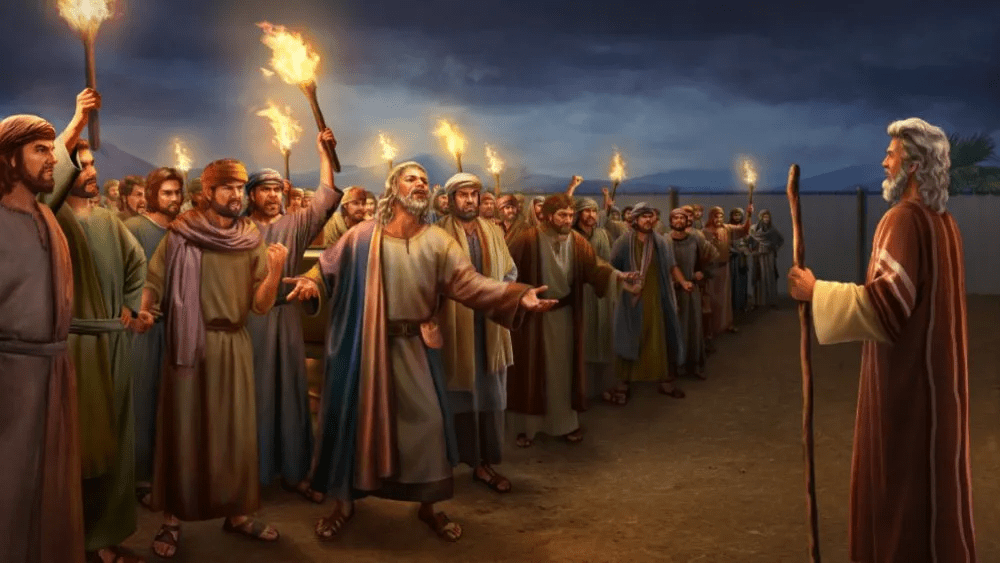
Korah and His Company Refuse to Obey Moses, by Wheatfield Media

Korah son of Izhar, the son of Kohath, the son of Levi, and certain Reubenites—Dathan and Abiram, sons of Eliab, and On son of Peleth—became insolent,and rose up against Moses. With them were 250 Israelite men, well-known community leaders who had been appointed members of the council. 

They came as a group to oppose Moses and Aaron and said to them, “You have gone too far! The whole community is holy, every one of them, and the Lord is with them. Why then do you set yourselves above the Lord’s assembly?”

When Moses heard this, he fell facedown. Then he said to Korah and all his followers: “In the morning the Lord will show who belongs to him and who is holy, and he will have that person come near him. The man he chooses he will cause to come near him. You, Korah, and all your followers are to do this: Take censers and tomorrow put burning coals and incense in them before the Lord. The man the Lord chooses will be the one who is holy. You Levites have gone too far!”

Moses also said to Korah, “Now listen, you Levites! Isn’t it enough for you that the God of Israel has separated you from the rest of the Israelite community and brought you near himself to do the work at the Lord’s tabernacle and to stand before the community and minister to them? He has brought you and all your fellow Levites near himself, but now you are trying to get the priesthood too. It is against the Lord that you and all your followers have banded together. Who is Aaron that you should grumble against him?”

Then Moses summoned Dathan and Abiram, the sons of Eliab. But they said, “We will not come! Isn’t it enough that you have brought us up out of a land flowing with milk and honey to kill us in the wilderness? And now you also want to lord it over us! Moreover, you haven’t brought us into a land flowing with milk and honey or given us an inheritance of fields and vineyards. Do you want to treat these men like slaves? No, we will not come!”

Then Moses became very angry and said to the Lord, “Do not accept their offering. I have not taken so much as a donkey from them, nor have I wronged any of them.”

Moses said to Korah, “You and all your followers are to appear before the Lord tomorrow—you and they and Aaron. Each man is to take his censer and put incense in it—250 censers in all—and present it before the Lord. You and Aaron are to present your censers also.” 

So each of them took his censer, put burning coals and incense in it, and stood with Moses and Aaron at the entrance to the tent of meeting. When Korah had gathered all his followers in opposition to them at the entrance to the tent of meeting, the glory of the Lord appeared to the entire assembly. (New International Version)

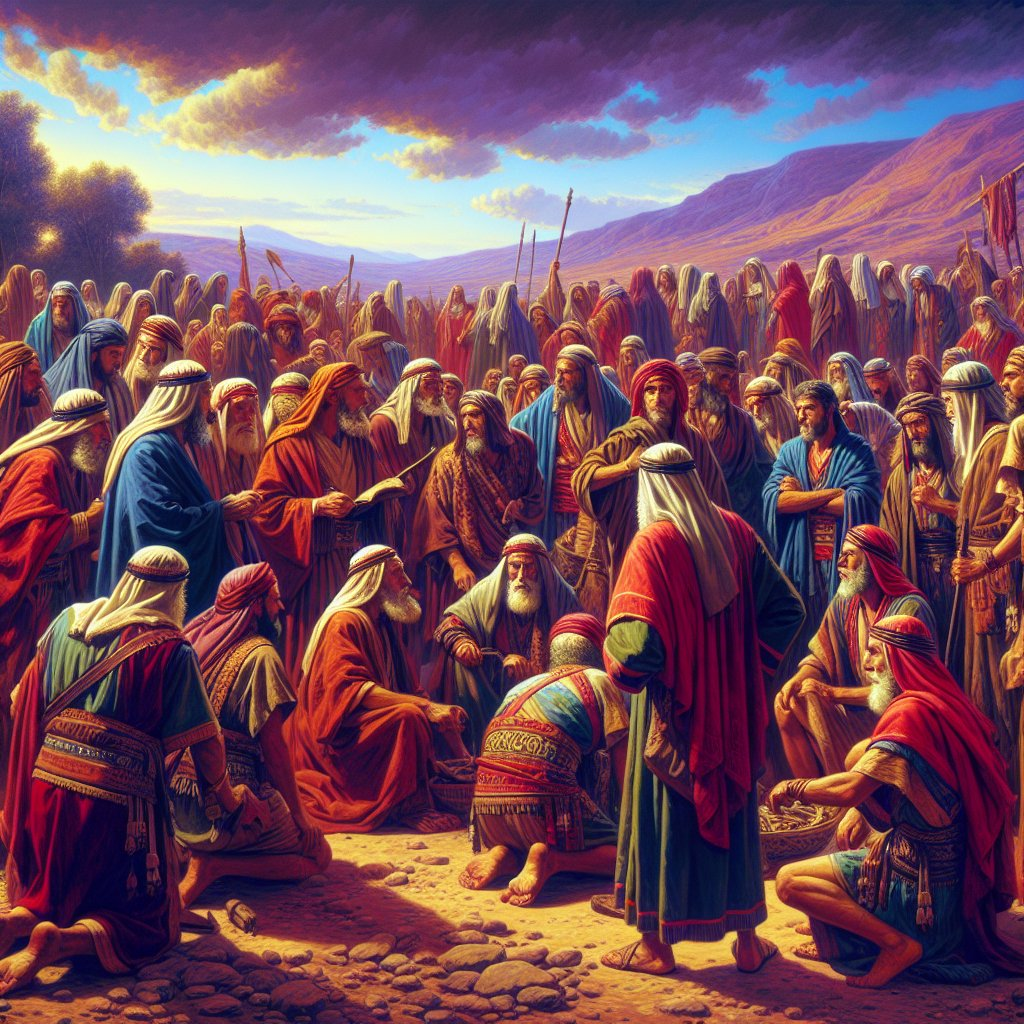
By Bible Art

I must admit that, having been a church pastor for decades, today’s story sounds eerily like several parishioners I’ve known over the years. They, along with the story’s antagonist Korah, strike me as ungrateful and continually concerned about angling for more power and authority within the community.

Rebellions are nothing new. They happen everywhere, from faith communities to neighborhood associations, from local politics to national governments.

The Book of Numbers is a rather depressing part of the Bible, largely because of the nature of the Israelite grumblings, without much gratitude happening.

The murmurings turned to complaints, and then to outright rebellion. It seems to have been a pattern with the Israelites in the desert. The animosities were directed against God or Moses, and sometimes both.

In each one of the various stories of rebellion in the desert, the rebellious people died in various ways by means of a plague, a fire, or in a battle. We get the sense with today’s story that a whopper of a divine judgment is going to happen.

The punishments mentioned in the Old Testament are meant to highlight, with rather strong illustrations, that the political and religious systems set up through the covenant code were divinely originated and sanctioned. In other words, don’t mess with God’s authority.

So then, a rebellion against Moses and Aaron was, in reality, a rebellion against God. And it would bring divine wrath on the rebels.

Having been in various leadership capacities in my life, to me the most insidious kind of rebellion is the subtle sort. Authority is challenged indirectly, in passive-aggressive forms through gossip, back-biting, and building a coalition from false information.

I also think that those subtle forms of rebellion really upset God. Which is why the Lord extended divine wrath on such rebels.

Korah was a Levite, like Moses. But that is about all he had in common with Israel’s leader. Korah’s rebellion was precisely directed against the leadership of Moses (and Aaron).

Similar to many arguments I’ve encountered throughout my ministerial life, Korah framed his argument with pious sounding language – as if Moses was the problem the one opposed to holiness.

Lord, have mercy. I really do despise religious gaslighting.

Korah implied that Moses was raising himself above the others, that the entire Israelite community was holy, therefore, there’s no need for a leader like Moses. The people’s holiness is enough. That’s all anybody needs, right?

Apparently, no.

Neither Moses nor Aaron dealt with the argument. Rather, Moses was satisfied to leave the matter with God as to what to do with the rebels.

It’s always good to let God reaffirm God’s own way of doing things. It was God who raised up Moses, and it would be God to whom Korah would have to answer.

The reason these sorts of situations keep popping up in every generation of history is that they deal with a problem which all humans encounter. Every person, group, faith community, and nation must contend with the tension between authority and freedom.

Like so many arrogant demagogues, Korah believed he was the guardian of freedom – and that the people ought to follow him. Yet, even though many did, the most important person in the room, God, did not.

Give peace in our time, O good and gracious God, a peace which the world cannot give. To those who have taken up arms in anger or revenge, or even in the cause of justice, grant the grace of conversion to the path of peaceful dialogue and constructive collaboration. And to those who are victims of human cruelty, open wide your arms and enfold them in the embrace of your compassion, healing, and life. Amen.

Second Sunday of Advent – Prepare the Way (Luke 3:1-6)

The Call from John the Baptist to Repent, by Renier de Huy, 12th century

In the fifteenth year of the reign of Tiberius Caesar, when Pontius Pilate was governor of Judea, and Herod was ruler of Galilee, and his brother Philip ruler of the region of Ituraea and Trachonitis, and Lysanias ruler of Abilene, during the high priesthood of Annas and Caiaphas, the word of God came to John son of Zechariah in the wilderness. He went into all the region around the Jordan, proclaiming a baptism of repentance for the forgiveness of sins, as it is written in the book of the words of the prophet Isaiah,

“The voice of one crying out in the wilderness:
‘Prepare the way of the Lord;
    make his paths straight.
Every valley shall be filled,
    and every mountain and hill shall be made low,
and the crooked shall be made straight,
    and the rough ways made smooth,
and all flesh shall see the salvation of God.’ ” (New Revised Standard Bible)

In this Christian season of Advent, we are reminded that God is not only high above us, transcendent, far away; God is also close to us, immanent, and with us.

We remember at this time of year that God does not remain distant, but entered our time and space at a particular moment in history, for a distinct purpose.

The Roman Empire was powerful, large, and very much in control of every place where it existed. The litany of imperial rulers and authorities which the Gospel writer Luke listed is meant to give us a feel of the Roman weight, and how much Roman might was ensconced in Judea.

The world at the turn of the common era was under the dominion of powerful people with lots of influence. But God did not come to any of them. Instead, God came to a loner – a man who spent his time out in the wilderness. His name was John, the son of Zechariah. We know him as John the Baptist.

With God coming to John at a precise point of time in a particular place, that made John a prophet with a singular message. John was born for this. (Luke 1:76)

It is fitting that a man hanging out on the fringes of society all by himself would be the one to prepare the way for Messiah.

After all, Messiah’s message would be one of bringing good news to the poor, proclaiming release to prisoners, and freeing those who are oppressed. (Luke 4:18-19; Isaiah 61:1-2)

God’s prophetic calling for John was one of preparation. John was to prepare the way of the Lord. He was to get the people ready to receive Messiah.

John went about his ministry of preparation by calling folks to repent, to change their minds and amend their ways, so that there might be forgiveness.

In a reference from the prophet Isaiah, Luke alluded to Jewish exiles returning from their Babylonian captivity. The actual physical road from Babylon to Jerusalem was a hard journey due to the distance and topography.

The “road” or the “way” in Holy Scripture is also a metaphor for the spiritual journey we take in this life. And that road has a lot of challenges to it. The very act of walking as a pilgrim over a long arduous journey changes a person.

It is rarely the destination that makes a person; it’s the journey itself which leads one to a changed life of thinking differently, and seeing things from a perspective we’ve never seen before.

The smoothing out of the road is a way of saying God is making it easier for people to return to the Lord, to get them ready for a new life with promises fulfilled and unexpected joy.

In other words, valleys raised and mountains flattened represent God’s efforts at helping us experience a complete transformation of life. The Lord will do everything possible to make renewal and restoration happen for us.

The Lord will set things right. In our contemporary world that is now largely controlled by powerful oligarchs and the super-rich, God will turn it upside-down. All of the world’s current powerful people will find themselves looking up, not down.

It would be nice and reassuring if I could give you certainty about the journey ahead. But I cannot do that. Yet, what I can do is assure us of what is at the end of the road. Look beyond the current days of self-centered leadership and popular ignorance, and understand that all flesh shall see the salvation of God.

Prepare the way of the Lord. We do that by how we go about walking the road. Each step we take every day is important and makes a difference. And when we stumble, there is plenty of grace to help get us back on our feet and moving forward.

We are all collectively journeying together to Bethlehem. And as we daily move and walk, at the end of our journey, Jesus is there.

But when the fullness of time had come, God sent his Son, born of a woman, born under the law, in order to redeem those who were under the law, so that we might receive adoption as children. (Galatians 4:4, NRSV)

And nothing can stop us or separate us from the love of God that is in Jesus Christ our Lord.

For I am convinced that neither death, nor life, nor angels, nor rulers, nor things present, nor things to come, nor powers, nor height, nor depth, nor anything else in all creation will be able to separate us from the love of God in Christ Jesus our Lord. (Romans 8:38-39, NRSV)

The journey may be arduous. You might feel like giving up. But Jesus is our Immanuel, God with us. In him, is our hope and our joy.

O Holy One of Israel, out of the embrace of mercy and righteousness, you have brought forth joy and dignity for your people. Remember now your ancient promise; make straight the paths that lead to you, and smooth the rough ways, so that in our day we might bring forth your compassion for all humanity. Amen.