Christ the King Sunday (Luke 23:33-43)

The 118 feet high Christ the King statue in Świebodzin, Poland

When they came to the place that is called The Skull, they crucified Jesus there with the criminals, one on his right and one on his left. Then Jesus said, “Father, forgive them, for they do not know what they are doing.” And they cast lots to divide his clothing. And the people stood by watching, but the leaders scoffed at him, saying, “He saved others; let him save himself if he is the Messiah of God, his chosen one!” The soldiers also mocked him, coming up and offering him sour wine and saying, “If you are the King of the Jews, save yourself!” There was also an inscription over him, “This is the King of the Jews.”

One of the criminals who were hanged there kept deriding him and saying, “Are you not the Messiah? Save yourself and us!” But the other rebuked him, saying, “Do you not fear God, since you are under the same sentence of condemnation? And we indeed have been condemned justly, for we are getting what we deserve for our deeds, but this man has done nothing wrong.” Then he said, “Jesus, remember me when you come in your kingdom.” He replied, “Truly I tell you, today you will be with me in paradise.” (New Revised Standard Version)

I’m glad that the Gospel text on this Christ the King Sunday is the story of Christ on the cross with the two criminals on each side also crucified. Why?

Because our cultural contexts tend to associate power and authority with high level earthly positions. But, in reality, Christianity is a paradoxical religion full of truths which seem antithetical to each other; yet they are not.

Many people (including many Christians) believe that, in order to influence the culture, Christians must have prominent positions in society. This leaves the majority of Christians feeling as if they have nothing to offer the world. After all, they have no important title at their job, in the government, or within the church.

But nothing could be further from the truth. Christ, in the lowest earthly position possible by being nailed to a cross, was a king who had the highest heavenly position in the universe. One will never come to grips with Jesus apart from understanding that Christianity is an inherently paradoxical religion.

The Sanctuary of Christ the King in Almada, Portugal

One of the criminals crucified with Christ discerned this reality well; the other criminal did not understand at all. One demonstrated the reality that humility is the powerful key to all things, whereas the other criminal remained full of himself.

The scene portrayed for us on Golgotha’s hill shows us what the kingly reign of Jesus Christ truly looks like: It is characterized by the power of humility and sacrifice. It highlights Christ’s authority by giving mercy to those hanging on a cross alongside himself.

True power is not found in the halls of earthly political power, but rather in the elevating power of God’s grace and Christ’s self-sacrifice. Therefore, Christians can best demonstrate their own power and authority by extending grace and mercy toward others, even when it’s hard to do.

It can be difficult to wrap both our heads and our hearts around this reality of possessing power without actually having positions and titles of authority in the world and the church.

Many a church pastor bemoans the fact that a number of their parishioners fail to be active servants in the wrongheaded notion that the clergy are supposed to do all the work. The laity may believe that the clergy are the ones with the educational, experiential, and positional power to influence culture and society.

What’s more, it can be even harder for those who once had positions of power to believe they themselves can no longer effectively work for the good, because they are now nobodies. They may ask, “Who would listen to me?”

The answer is: A lot of people. God uses all sorts of persons in all sorts of places and situations. What we all need, whether clergy or laity, is the willingness to be humble and to sacrifice one’s time or talent in showing mercy to another.

Christians must take their cues from the Lord Jesus. In the setting of the interaction between Christ and the other two crucified men in today’s story, Jesus is the innocent one sandwiched between two guilty persons. Christ’s humiliation is on full public display. The crowd of onlookers mock him, along with one of the criminals. Because of the apparent incongruence between being ‘King of the Jews’ yet not freeing himself from his awful situation.

Whereas most of us might avoid being humiliated in public at any cost, Jesus embraced the rejection and the suffering, knowing that he was offering a sacrifice for the benefit of the whole world.

Even though Jesus was extremely vulnerable, and in emotional, spiritual, and physical pain which we can only imagine, he nonetheless chose to use his kingly power and authority on behalf of others – including those who blatantly rejected and mocked him.

Grace and mercy were demonstrated by submitting to an ignominious death, and by willingly acting to be the bridge connecting others to God. Relationship is at the very heart of the divine will; God would do anything to restore broken relations with his fallen people. No one is beyond the reach of grace.

In a contemporary culture of polarized relations and angry vitriol toward one another, the ordinary Christian without earthly title or authority is in the best position to provide basic human kindness by extending mercy to “enemies” and demonstrating humility in all things.

Christ embodied love and forgiveness. He used his power for mercy, not judgment;  and for grace, not revenge.

Jesus demonstrated for us how grace is the greatest operative force in the universe.

To love and forgive another is the best demonstration of power and authority that anyone could ever show.

God’s action in Christ through the cross is what can move us to true acts of love and selflessness. We participate in Christ by giving grace through acts of mercy in comforting, encouraging, and helping others.

The only way we can give grace is to receive grace. It is God’s action in Christ through the Spirit that moves us to true acts of love and selflessness.

Personally, I am encouraged with the image of Christ as King – the One who is both sovereign over all creation, and yet is with me and knows my every need, giving grace and mercy and unconditional love.

For me, the idea of both God’s transcendence and God’s immanence is the perfect lead-in for the Advent season.

Earthly leaders can be capricious, petty, enamored with earthly power, and wield authority only in ways that serve themselves and not the common good of all. No wonder there is so much corruption and injustice in this old fallen world of ours.

Such hateful leadership has no problem leaving us beaten, bruised, and hanging on a cross. In our pain and our suffering, what will we do?

Hopefully, we will let Jesus transform our understanding of power and authority.

Ideally, in our worst situations of suffering and confusion, we will remember Jesus lifted-up on the cross, lifted-up as sovereign over all things. We will find our own true power in self-giving-love to a world which appears it has given itself to hate and selfish judgment of people they don’t like.

A participation in Christ’s rule and reign over all things means that his crucified power has given us grace and forgiveness, so that we might pass it on, pay it forward, and work for that which is just, right, and good.

May it be so, to the glory of God.

Almighty God, you rescue us from our enemies, so that we may serve you without fear. Strengthen us, that we might share in the inheritance of the saints in your kingdom of light. Amen.

Real vs. Delusional (2 Kings 22:29-40, 51-53)

So the king of Israel and Jehoshaphat king of Judah went up to Ramoth Gilead. The king of Israel said to Jehoshaphat, “I will enter the battle in disguise, but you wear your royal robes.” So the king of Israel disguised himself and went into battle.

Now the king of Aram had ordered his thirty-two chariot commanders, “Do not fight with anyone, small or great, except the king of Israel.” When the chariot commanders saw Jehoshaphat, they thought, “Surely this is the king of Israel.” So they turned to attack him, but when Jehoshaphat cried out, the chariot commanders saw that he was not the king of Israel and stopped pursuing him.

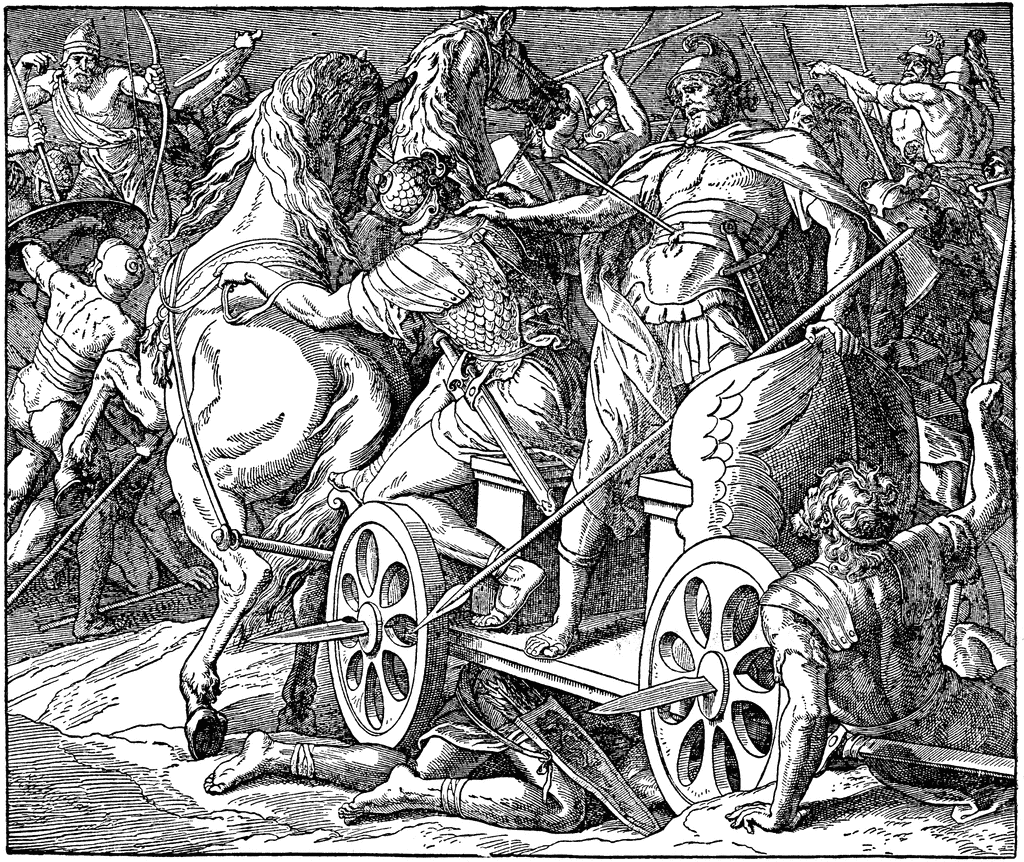
But someone drew his bow at random and hit the king of Israel between the sections of his armor. The king told his chariot driver, “Wheel around and get me out of the fighting. I’ve been wounded.” All day long the battle raged, and the king was propped up in his chariot facing the Arameans. The blood from his wound ran onto the floor of the chariot, and that evening he died. As the sun was setting, a cry spread through the army: “Every man to his town. Every man to his land!”

So the king died and was brought to Samaria, and they buried him there. They washed the chariot at a pool in Samaria (where the prostitutes bathed), and the dogs licked up his blood, as the word of the Lord had declared.

As for the other events of Ahab’s reign, including all he did, the palace he built and adorned with ivory, and the cities he fortified, are they not written in the book of the annals of the kings of Israel? Ahab rested with his ancestors. And Ahaziah his son succeeded him as king….

Ahaziah son of Ahab became king of Israel in Samaria in the seventeenth year of Jehoshaphat king of Judah, and he reigned over Israel two years. He did evil in the eyes of the Lord, because he followed the ways of his father and mother and of Jeroboam son of Nebat, who caused Israel to sin. He served and worshiped Baal and aroused the anger of the Lord, the God of Israel, just as his father had done. (New International Version)

The Death of Ahab, by Julius Schnoor von Carolsfeld (1794-1872)

Whenever someone ignores or tries to get around reality, we call such a person “delusional.” It seems that the more power and authority a person possesses, the easier it is to delude themselves into thinking they can manipulate events in their favor. They then tend to listen only to what they want to hear.

King Ahab of Israel was delusional. He, like so many kings before and after him, was focused on the externals of personal power, accumulating more wealth, and exploring alternative religions. It all led to a twisted view of reality, as well as a prophetic demise.

Identifying so much with externalities, to the detriment of the internalities, is the ultimate bogus approach to life. It never ends well. Instead of exploring the image of God within himself and others, ensuring justice for all his subjects, and using his power to provide for the common good of all Israel, King Ahab went the spiritually and emotionally insecure route of listening to the wrong people.

Insecure and delusional people only listen to what is positive; and they eschew any negatives in their life. This is why the biblical prophets throughout Old Testament history typically found themselves at loggerheads, in prison, or at the end of a spear from those in power.

Ahab feigned wanting to hear what is true, but when hearing any negative aspects, he wrongly believed he could get around reality through his earthly authority and personal ingenuity. But he couldn’t. No one can outdo the stronger unseen forces in this world. (1 Kings 22:1-28)

So, Ahab laid a delusional plan to disguise himself as an ordinary soldier in battle. But although he chose to go against prophetic truth, there was no way to ignore the reality of it.

The providence and purposes of God prevail in any and all circumstances – no matter what they are. Today’s story highlights a seemingly random arrow from an enemy solider, hitting Ahab in the precise spot which could penetrate his armor.

The king was wounded and had to leave the battle. Yet, Ahab stuck to his delusional world, having his men prop him up in his chariot so that he could watch events unfolding in front of him.

Even in his powerlessness, King Ahab could not bring himself to believe that things could be different than he planned. He died at the end of the day, still stuck in his delusional and insecure world.

The editor of the Book of Kings summarized Ahab’s reign by mentioning impressive external improvements to his palace and fortified cities. Yet, these are mere incidentals. The real – and not delusional – assessment of the king’s life is that he was a religious apostate and a moral reprobate.

In the end, Ahab was nothing more than a weak and insecure individual who compromised God’s ethical law and sought to control events for his own misguided purposes. He followed Yahweh only if it aligned with his own plans.

Furthermore, it’s sad that Ahab’s approach to life, and his behavior toward others, was reflective of the Israelite nation as a whole (2 Kings 17:7-17). His own death eerily foreshadowed the death of Israel.

In our own era of incompetent leadership, morally inferior leaders, and delusional administrations, it behooves every concerned and pious believer to pray for all those in authority.

This side of heaven, there will always be cultural and societal pressures to conform to external pride, wealth, and success. But this is not the believer’s call, to take it’s cues from worldly power. Our focus is on consistently and patiently doing what is good, right, and just – accepting the unseen real over the seen delusion.

Rather than trying to continually manipulate events for our own shortsighted purposes, we must persevere in spurring-on one another to love and good deeds (Hebrews 10:24). For only together, as the one people of God, can we resist and subvert the machinations of delusional leaders.

O Lord God, Ruler of all, and whose glory exists in all the world: We commend nations and their leaders to Your divine providence, so that we may dwell secure in Your peace.

Grant to everyone in authority everywhere the wisdom and strength to know and do Your will. Fill them with the love of truth and justice; and make them mindful of their calling to serve all people with respect and reverence; through Jesus Christ our Lord, who lives and reigns with You and the Holy Spirit, one God, world without end. Amen.

Morality Matters (2 Kings 9:14-26)

Then Jehu, Jehoshaphat’s son and Nimshi’s grandson, plotted against Joram. Now Joram along with all of Israel had been guarding Ramoth-Gilead against Aram’s King Hazael, but King Joram had gone back to Jezreel to recover from wounds that the Arameans had given him when he fought Hazael.

So Jehu said, “If this is the way you feel, then don’t let anyone escape from the city to talk about it in Jezreel.” Then Jehu got on a chariot and drove to Jezreel because Joram was resting there. Judah’s King Ahaziah had also come to visit Joram.

The guard standing on the tower at Jezreel saw a crowd of people coming with Jehu. He said, “I see a crowd of people.”

Joram said, “Take a chariot driver. Send him out to meet them to ask, ‘Do you come in peace?’”

So the driver went to meet him and said, “The king asks, ‘Do you come in peace?’”

Jehu replied, “What do you care about peace? Come around and follow me.”

Meanwhile, the tower guard reported, “The messenger met them, but he isn’t returning.”

The king sent a second driver. He came to them and said, “The king asks, ‘Do you come in peace?’”

Jehu said, “What do you care about peace? Come around and follow me.”

The tower guard reported, “The messenger met them, but he isn’t returning. And the style of chariot driving is like Jehu, Nimshi’s son. Jehu drives like a madman.”

Joram said, “Hitch up the chariot!” So they hitched up his chariot. Then Israel’s King Joram and Judah’s King Ahaziah—each in his own chariot—went out to meet Jehu. They happened to meet him at the plot of ground that belonged to Naboth the Jezreelite.

When Joram saw Jehu, he said, “Do you come in peace, Jehu?”

He said, “How can there be peace as long as the immoralities of your mother Jezebel and her many acts of sorcery continue?”

Then Joram turned his chariot around and fled. He shouted to Ahaziah, “It’s a trap, Ahaziah!”

Jehu took his bow and shot Joram in the back. The arrow went through his heart, and he fell down in his chariot. Jehu said to Bidkar his chariot officer, “Pick him up, and throw him on the plot of ground belonging to Naboth the Jezreelite. Remember how you and I were driving chariot teams behind his father Ahab when the Lord spoke this prophecy about him: Yesterday I saw Naboth’s blood and his sons’ blood, declares the Lord. I swear that I will pay you back on this very plot of ground, declares the Lord. Now pick him up, and throw him on that plot of ground, in agreement with the Lord’s word.” (Common English Bible)

Jehu shoots an arrow that strikes Joram in the back, by Jan Luyken, 1712

Ancient storytelling often had a moral to it. Historical writing was typically less concerned for objective details and much more interested to point out, in narrative form, how people morally lived and what happened to them. Rather than commenting on what the moral(s) are, the storyteller lets the story speak for itself.

Today’s Old Testament lesson brings several kings into the story (Jehu, Joram, Ahaziah, and Ahab). We are meant to contrast Jehu’s zeal for justice and living into God’s call with the others kings’ injustice and living for power and wealth. The final end of the kings is designed for us to see the ultimate consequence of injustice.

Elisha the prophet had given a non-descript Israelite military man, Jehu, instructions from the Lord about carrying out divine judgment against the unjust royal house of Omri – and more specifically, against King Ahab and Queen Jezebel.

After Jehu’s prophetic call and anointing, the soldiers under his command immediately acclaimed him as king. Jehu wasted no time in going after the people responsible for years of abusive power.

Rather than simply giving orders to his soldiers and remaining in back of his army, Jehu led his men into the thick of battle. We get the picture of a person with single-minded determination, aggressively going after unjust leaders; and seeking to upend a royal system of power which strayed far from their original mandate of upholding God’s system of law and covenant.

Jehu’s zeal is exemplified in his chariot driving: He was going to speedily get to where he needed to go, and do what he needed to do.

The story emphasizes the increasing drama of messengers sent to enquire of Jehu’s intentions: Are they peaceful? Clearly, no. There was betrayal afoot, as Jehu boldly drove against his own king of Israel, as well as the king of Judah.

The unjust kings had created a situation in their nations of peace for themselves, but not necessarily others. So, Jehu would take that peace from them.

The two kings of Israel and Judah personally went out to Jehu, not realizing what was about to happen. Ironically, it took place on land which Naboth had previously owned, and of which Ahab and Jezebel diabolically stole. It is a powerful depiction of what goes around comes around.

Jehu quickly got to the nub of the issue: There cannot be peace as long as Jezebel’s idolatry and witchcraft abound in the land. Her wicked ways had become thoroughly imbued throughout both Israel and Judah, and was supported by both of the kings.

From the perspective of Jehu, there was no peace that could exist between a follower of Yahweh and a practitioner of the Baal and Asherah cults. Jehu’s intent was to fulfill the prophecy that was announced by Elijah twelve years earlier. And he went about it with violent zeal.

Whenever the Lord begins to exact judgment and ensconce justice, there’s no way anyone is going to stop it. Joram went out to face an enemy that he could not stop. There was no escaping the inexorable force of God.

Divine providence brought the kings together on the very piece of land that was once Naboth’s vineyard – the place where Ahab took sinister control of it. (1 Kings 21). Murderous theft was the inevitable result of spiritual fornication; Ahab and Jezebel had prostituted themselves with the gods Baal and Asherah.

Spiritual adultery never ends well. Because God is a jealous Lover. Peace is not achieved by letting everyone do whatever they want. Instead, it is established through integrity, justice, truth, and ethical morality.

Eternal God, in whose perfect kingdom the sword of righteousness is drawn: Spread abroad your mighty Spirit, so that all peoples may be gathered under the banner of the Prince of Peace, as children of one Father; to whom be dominion and glory, now and forever. Amen.

A Calling Is a Sacred Responsibility (2 Kings 9:1-13)

King Jehu

The prophet Elisha called to a member of the group of prophets, “Get ready, take this jug of oil with you, and go to Ramoth-Gilead. When you arrive there, look for Jehu, Jehoshaphat’s son and Nimshi’s grandson. Go to him, then pull him away from his associates, taking him to a private room. Take the jug of oil and pour it on his head. Then say, ‘This is what the Lord has said: I anoint you king of Israel.’ Then open the door, and run out of there without stopping.”

So the young prophet went to Ramoth-Gilead. He came in, and the military commanders were sitting right there. He said, “Commander, I have a word for you.”

“For which one of us?” Jehu asked.

The young prophet said, “For you, Commander.”

So Jehu got up and went inside. The prophet then poured oil on his head and said to him, “This is what the Lord, Israel’s God, says: I anoint you king over the Lord’s people, over Israel. You will strike down your master Ahab’s family. In this way I will take revenge for the violence done by Jezebel to my servants the prophets and to all the Lord’s servants. Ahab’s whole family will die. I will eliminate from Ahab everyone who urinates on a wall, whether slave or free, in Israel. I will make Ahab’s dynasty like the dynasty of Jeroboam, Nebat’s son, and like the dynasty of Baasha, Ahijah’s son. And as for Jezebel: The dogs will devour her in the area of Jezreel. No one will bury her.” Then the young prophet opened the door and ran.

Jehu went out to his master’s officers. They said to him, “Is everything okay?

Why did this fanatic come to you?”

Jehu said to them, “You know the man and the nonsense he talks.”

“That’s a lie!” they said. “Come on, tell us!”

Jehu replied, “This is what he said to me: ‘This is what the Lord says: I anoint you king of Israel.’”

Then each man quickly took his cloak and put it beneath Jehu on the paved steps. They blew a trumpet and said, “Jehu has become king!” (Common English Bible)

The biblical books of 1 & 2 Kings (originally one book of Kings) tells of the kingdoms of Israel and Judah over a five-hundred year period from c.960-586 B.C.E. The dynasties of the house of Omri and the house of Jehu were the longest lasting in Israel.

The books of First and Second Kings are primarily concerned with an evaluation of the 20 kings of Judah and the 19 kings of Israel. Of greatest concern was whether the particular king was loyal to God, or not. If the king tolerated worship of other gods besides Yahweh, and established sacrifices outside of Jerusalem, then that king was evaluated as doing evil in the eyes of the Lord.

This judgment of the kings is consistent with Deuteronomic laws of sole loyalty to God, and the importance of a central location for all Jewish people to worship (in Jerusalem).

To understand why it was so important for Jehu to be anointed with a mission is to know something of the house of Omri, and in particular, the king Ahab and his queen Jezebel. They are both conveyed to us in the biblical text as a power couple who want what they want, without a lot of concern about the subjects of their kingdom.

Jezebel was a follower of Baal and Asherah, not Yahweh. She provided for hundreds of their prophets. Her husband the king was fine with this situation. Jezebel was a clear enemy of God’s prophets, and killed hundreds of them, so that there were only a few left, including Elijah and Elisha (1 Kings 18:13).

Ahab and Jezebel’s powerful misuse of authority is relayed in the story of Naboth (1 Kings 21). Ahab wanted to buy Naboth’s vineyard, which was adjacent to his own land. But Naboth refused to sell, mainly because the land was his family’s ancient generational inheritance.

Jezebel went to work and arranged false witnesses to claim that Naboth had cursed both God and King (which was the ultimate sign of treason in Israel). As a result, Naboth was wrongly stoned to death; and Ahab unjustly confiscated his property.

Elijah prophesied that Ahab’s descendants would die, his dynasty will perish, and that Jezebel would be eaten by dogs (1 Kings 21:17-24). In our story for today, this is alluded to in the reference of God eliminating all that belong to Ahab who “urinate on a wall,” that is, unjustly marking the territory of another as their own property.

Indeed, it all shook-out according to prophecy. Ahab died in battle. Then, Ahab and Jezebel’s son Ahaziah succeeded him as king. Young Ahaziah died two years into his reign, and his brother Jehoram became king. Jehoram was then killed by Jehu. After this, some of Jezebel’s own palace officials tossed her out a window to her death, and dogs descended on her carcass – all to Elijah’s earlier prophecy.

Injustice, unrighteousness, abuse of power, and selfish concerns are ugly nasty business. These sorts of attitudes and behaviors ruin people, and keep others locked into patterns of poverty and powerlessness. God is not okay with any of it.

Whenever we are in the middle of oppression and/or authoritative people abusing their power for their own benefit, its hard to maintain our sense of rightness and goodness. Yet, we must. In such times, patience and perseverance is needed without resorting to attempts of paying back evil with evil.

What’s more, we can find ways of tapping into the spiritual power of God within us, in order to resist and subvert unjust authority with righteousness. To some degree, everyone can do something by employing nonviolent resistance tactics like networking, protest, persuasion, non-cooperation, and speaking out through either speech or writing.

Only those who possess nothing can be entrusted with everything. Systemic evil isn’t changed from the top, because those at the top benefit from the system. Rather, structural evil is transformed through grass roots efforts from the bottom up. What’s more, individuals rarely change from the outside-in, but rather from the inside-out.

A ruling establishment is not always necessarily wrong. Yet, it takes a lot of willing accountability and plenty of intentional soul searching for administrations to remain on the straight and narrow.

Such realities characterized Jehu. He was a non-descript military man. There was nothing, in particular, which distinguished him as having a special calling from God.

Yet, although Jehu fulfilled his calling, he added to the call; the Lord was not pleased with Jehu’s form of violent bloodshed, and so, put an end to Jehu’s house, just as Omri’s house had been purged from Israel.

Power and authority will do that to a person – which is why leaders must be continuously vigilant to guard against developing a thick ego and following their pride.

And so do we. Anyone who receives a call from God has a sacred responsibility and trust to fulfill that calling with competence, care, and conscientiousness.

Almighty God, direct me in all my activity with Your grace, wisdom, and help, so that in all I do and say may glorify Your holy Name; through Jesus Christ our Lord, in the power of the Holy Spirit. Amen.