
Nehemiah 5:1-13 – Real Problem-Solving

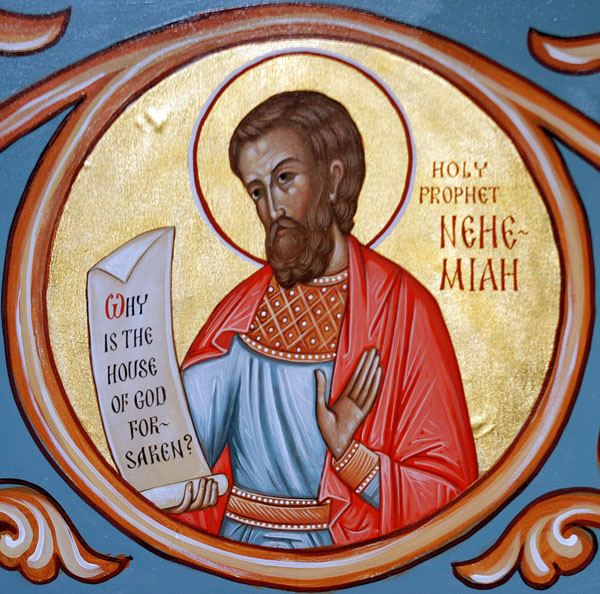
Orthodox icon of Nehemiah

Now the men and their wives raised a great outcry against their fellow Jews. Some were saying, “We and our sons and daughters are numerous; in order for us to eat and stay alive, we must get grain.”

Others were saying, “We are mortgaging our fields, our vineyards and our homes to get grain during the famine.”

Still others were saying, “We have had to borrow money to pay the king’s tax on our fields and vineyards. Although we are of the same flesh and blood as our fellow Jews and though our children are as good as theirs, yet we have to subject our sons and daughters to slavery. Some of our daughters have already been enslaved, but we are powerless, because our fields and our vineyards belong to others.”

When I heard their outcry and these charges, I was very angry. I pondered them in my mind and then accused the nobles and officials. I told them, “You are charging your own people interest!” So, I called together a large meeting to deal with them and said: “As far as possible, we have bought back our fellow Jews who were sold to the Gentiles. Now you are selling your own people, only for them to be sold back to us!” They kept quiet because they could find nothing to say.

So, I continued, “What you are doing is not right. Shouldn’t you walk in the fear of our God to avoid the reproach of our Gentile enemies?I and my brothers and my men are also lending the people money and grain. But let us stop charging interest! Give back to them immediately their fields, vineyards, olive groves and houses, and also the interest you are charging them—one percent of the money, grain, new wine and olive oil.”

“We will give it back,” they said. “And we will not demand anything more from them. We will do as you say.”

Then I summoned the priests and made the nobles and officials take an oath to do what they had promised. I also shook out the folds of my robe and said, “In this way may God shake out of their house and possessions anyone who does not keep this promise. So may such a person be shaken out and emptied!”

At this the whole assembly said, “Amen,” and praised the Lord. And the people did as they had promised. (New International Version)

There is nothing pleasant about poverty – especially the circumstances and events which create it. Probably worse than being poor is feeling locked into poverty with no way out.

Nehemiah was a faithful follower of God. He was taken into exile, along with many of his fellow countrymen, when the Babylonians conquered Jerusalem and Judah. Yet, through his prayerful initiative, Nehemiah laid plans for a return to his homeland and rebuild the broken down wall which surrounded the city of Jerusalem. 

Once Nehemiah arrived and arranged for work teams to busy themselves on the wall, he discovered there was a whole lot more to rebuild than just a physical wall. A wall of separation existed between fellow Jews based on economics. There were some very real class differences. The poor were being taken advantage of. Their fellow Jews were exacting usury from them.

The response of Nehemiah to such a sticky situation is instructive for us. Notice how he handled it:

  • Nehemiah did not ignore the people problems and only focus on the physical wall. He firmly and squarely addressed what was happening and was downright angry about the circumstance of Jewish families essentially living in a state of slavery. 
  • Nehemiah was clear, concise, and direct about the nature of the problem. He threw himself into being part of the solution instead of only complaining about what was happening.
  • Nehemiah did not over-involve others in the process of handling the conflict but handled the issue by taking counsel with himself. 
  • Nehemiah attacked the problem without alienating others, while holding people accountable for their actions and their promises.

Today’s Old Testament lesson is something of a leadership case study in how to engage significant problems and conflict. So, it’s a lesson for us not to quickly skim over but to ponder, examine, and absorb Nehemiah’s dealing with the situation. 

We all need some guidance and direction when it comes to confronting the problems which surround us. Let this story serve us well in approaching issues with wisdom and sagacity.

Holy God, you have a special concern for those who are poor and needy. Enable us to live and speak wisely into the crucial needs which exist around us, so that justice is done, mercy is demonstrated, and humility is practiced, through Jesus Christ our Lord in the power of the Holy Spirit. Amen.

Why Is Our Ministry Important?

Welcome, friends! Luke 4:14-30 is the account of Jesus reading the words of Isaiah the prophet to proclaim good news to the poor, freedom for prisoners, recovery of sight for the blind, and release for prisoners. How Christ used those words caused a huge commotion, and still does. Let’s find out together what happened. Click the videos below and let us consider Jesus….

Pastor Tim Ehrhardt, Luke 4:14-30

Gracious God, you bring glad tidings to the poor, heal the brokenhearted and free prisoners from jails. Please come to us and send us out, as forgiven people, to the poor, the brokenhearted, and the imprisoned. Amen.

Psalm 72 – Justice and Righteousness

Give the king your justice, O God,
    and your righteousness to a king’s son.
May he judge your people with righteousness,
    and your poor with justice.
May the mountains yield prosperity for the people,
    and the hills, in righteousness.
May he defend the cause of the poor of the people,
    give deliverance to the needy,
    and crush the oppressor.

May he live while the sun endures,
    and as long as the moon, throughout all generations.
May he be like rain that falls on the mown grass,
    like showers that water the earth.
In his days may righteousness flourish
    and peace abound, until the moon is no more.

May he have dominion from sea to sea,
    and from the River to the ends of the earth.
May his foes bow down before him,
    and his enemies lick the dust.
May the kings of Tarshish and of the isles
    render him tribute,
may the kings of Sheba and Seba
    bring gifts.
May all kings fall down before him,
    all nations give him service.

For he delivers the needy when they call,
    the poor and those who have no helper.
He has pity on the weak and the needy,
    and saves the lives of the needy.
From oppression and violence he redeems their life;
    and precious is their blood in his sight.

Long may he live!
    May gold of Sheba be given to him.
May prayer be made for him continually,
    and blessings invoked for him all day long.
May there be abundance of grain in the land;
    may it wave on the tops of the mountains;
    may its fruit be like Lebanon;
and may people blossom in the cities
    like the grass of the field.
May his name endure forever,
    his fame continue as long as the sun.
May all nations be blessed in him;
    may they pronounce him happy.

Blessed be the Lord, the God of Israel,
    who alone does wondrous things.
Blessed be his glorious name forever;
    may his glory fill the whole earth.
Amen and Amen.

The prayers of David son of Jesse are ended. (New Revised Standard Version)

Today’s psalm is a prayer of King David – beseeching the Lord to help him rule with justice and righteousness – because G-d is just and right in all divine dealings with humanity.

“Justice” in the Old Testament is neither fairness nor the good being rewarded and the wicked punished. Rather, justice (Hebrew משפט, pronounced “mish-pot”) in its most basic sense is caring for the poor. A society is “just” to the degree in which every person has enough for the basic necessities of life and is lifted up as persons worthy of care and respect.

So, the way in which David measured his kingly rule was not by how big of an army he had, or how much gold there was in the royal treasury. Rather, a successful rule for David was measured by whether the interests of the poor were defended and provided for.  

A similar word to justice, “righteousness,” is neither some sort of smug godliness nor a sense of superior piety. Instead, righteousness (Hebrew צדקה pronounced “zed-a-ka”) is a relational term of being in sync with G-d and G-d’s ways. It works itself out in a philanthropic spirit of giving what is needed – both physically and spiritually – through acts of mercy such as forgiveness, debt relief, friendship, charity, etc.

Together, justice and righteousness are concerned for giving needed resources with a compassionate spirit of relationship. It seeks to meet the holistic needs of underprivileged people.

Psalm 72 is read in this Christian liturgical season of Christmas (December 25-January 5) because the celebration of the Christ child entering humanity gives great hope for the poor, the needy, the indigent, and all those who struggle to daily survive grinding situations of hardship and adversity.

This is why, when Jesus announced his earthly ministry, he made it clear the nature of that work would be upholding and extending justice and righteousness:

“The Spirit of the Lord is upon me,
    because he has anointed me
        to bring good news to the poor.
He has sent me to proclaim release to the captives
    and recovery of sight to the blind,
        to let the oppressed go free,
to proclaim the year of the Lord’s favor.” (Luke 4:18-19, NRSV)

The least, the lost, the lonely, and the lame have a champion – a Divine Advocate who will take up their cause and ensure they are treated as deserving human beings, with adequate care of both body and soul. Done properly, our living a just and right life requires we share compassion and empathy along with the monetary and physical resources.

“Whoever gives justice to the poor with a sour expression and in a surly manner, even if he gives a thousand gold pieces, loses his merit. One should instead give cheerfully and joyfully and empathize with him in his sorrow.”

Maimonides (1138-1204, C.E.)

Both the hand and the heart are always involved in biblical justice and righteousness. That way both the giver and the recipient benefit. Whereas the poor receive money or other material assistance, the donor receives the merit of sharing in G-d’s work.

So then, righteousness and justice involve giving assistance with the hand as well as encouragement with the mouth so that needs are met with no residual bitterness of heart.

Each of you should give what you have decided in your heart to give, not reluctantly or under compulsion, for God loves a cheerful giver. And God is able to bless you abundantly, so that in all things at all times, having all that you need, you will abound in every good work. As it is written:

“They have freely scattered their gifts to the poor;
    their righteousness endures forever.” (2 Corinthians 9:7-9, NIV)

May you know the joy and celebration of both giving and receiving with a grateful heart, attuned to the blessings of a generous G-d who stands behind it all.

James 1:9-16 – The Rich, the Poor, and God

Photo by Suliman Sallehi on Pexels.com

Believers in humble circumstances ought to take pride in their high position. But the rich should take pride in their humiliation—since they will pass away like a wildflower. For the sun rises with scorching heat and withers the plant; its blossom falls, and its beauty is destroyed. In the same way, the rich will fade away even while they go about their business.

Blessed is the one who perseveres under trial because, having stood the test, that person will receive the crown of life that the Lord has promised to those who love him.

When tempted, no one should say, “God is tempting me.” For God cannot be tempted by evil, nor does he tempt anyone; but each person is tempted when they are dragged away by their own evil desire and enticed. Then, after desire has conceived, it gives birth to sin; and sin, when it is full-grown, gives birth to death.

Don’t be deceived, my dear brothers and sisters. (New International Version)

The social milieu of the New Testament world was a society firmly stratified between the rich and the poor.  There were very few opportunities for uplift with the lower class. There were no laws protecting the rights of workers and the disadvantaged, and the rich often used and abused their power over them.

However, the Apostle James had a different angle, a divine perspective, on the situation.

The poor person is rich

The lowly poor person actually has a high position because their poverty enables an openness to God and leads them to rely on God’s enablement and provision.

Whenever you find yourself with few material possessions; struggle to keep food on the table; and find it difficult to pay the bills – then, you are stripped of the illusion of independence and are left vulnerable before God. In this state of humility, the believer cries to God. Trust becomes necessary for survival.

God cares about our poverty of spirit – our humble and contrite hearts. A person can be poor, but, at the same time, spiritually advantaged. We are loved by God neither because of wealth nor poverty; we are loved because that’s what God does.

It is possible to be poor, and not humble. Conversely, it is possible to be rich and trust God. Chronically complaining of a lack of funds and always desiring more money – or trying to act like we are not poor (or the rich trying to act poor) – will not get an exalted status with God.

The choice is: Will we pour our lives into things, or people? Will we define success as worldly wealth, or as acting justly, loving mercy, and walking humbly with our God?

It is quite possible to have very little, but to be rich in faith and relationships. 

The rich person is poor

Wealth is not bad, per se. There are plenty of godly and wealthy persons in Scripture, like Abraham and Job. The problem is people who rely on what they own rather than on God. (Luke 12:13-21) 

Anyone who trusts in things is the true underprivileged person. The lack of faith and humility makes them like a sirocco wind – a hot and humid southeast to southwest wind originating as hot, dry desert-air over North Africa, and blowing northward into the southern Mediterranean basin. 

The original readers knew all about these winds that could unpredictably come through their area and wither perfectly good and apparently strong plants.

The rich person who trusts in wealth is like that plant. It grows up, flourishes, and is beautiful. Yet, the next day, it is completely gone – annihilated by the hot wind. Like a cornfield in a massive hailstorm, or a flower in a severely hot sirocco wind, you can count on the biblical reality that the rich cannot stand in the judgment, if they are looking to wealth for power, control, attention, and status. 

Even though it might seem the rich person is exalted, and the poor person is in a low position, in the end, the rich will suffer, and the poor will be vindicated. Faith determines success – not money. (Luke 16:19-21)

The rich and the poor have this in common: the Lord made them both.

Proverbs 22:2, CEB

Blessed is the person who perseveres under a time of trial and testing of faith. God is pleased when we learn to endure hardship and let it mature us into better people. For such people, God promises to give the crown of life.  God sees your hardship and promises life. This hope helps sustain us over those times when we might wonder if the trial will ever end.

Sometimes, however, we face suffering not because of the circumstances which God brings in our lives, but because of our own unwise response to difficulty. We compound our problems by blaming our troubles on others and refusing to face-up to what God is trying to teach us. 

Our bruised hearts can send us desperately looking for someone to point the finger when we are confronted with our own trouble – even God.

“There are two eras in American history: the passing of the buffalo and the passing of the buck.”

Will Rogers

We are sometimes so desperate to justify ourselves that we make illogical and irrational statements, such as: 

  • “I would not worry about the future if I had just a little more money, and no health problems.”
  • “If you knew what I’ve been through, you would know that I could never forgive that person [or God].”
  • “I’ll never be happy as long as _______ is in my life.”
  • “I would be more generous if God gave me more money.”

So, what will it take to stop making excuses, blaming others, and start pleasing God instead of everyone else? What will it take to face down the difficult stuff you don’t like in your life?

Don’t blame God

God cannot be tempted. God hates injustice. It is a moral impossibility for God to even consider attempting to do evil because of perfect holiness. Since God cannot be tempted by evil, God therefore cannot tempt people toward evil.

We blame others because it is a cheap, easy, and pathetic way of absolving ourselves from responsibility, unwise choices, words, and actions. There are only two ways of living with guilt: either we humble ourselves through confession and repentance; or we blame it on someone else.

God tests our faith to improve our character and bring us toward greater spiritual maturity. God does not force us to make bad, immoral, or evil choices because of hard circumstances. God may have very well brought the trial and testing into our lives; but how we respond to it, is up to us.

The source of temptation is us

The real culprit behind temptation is one’s own personal desire or lust for something. It is our own strong intense have-to-do-it, have-to-say-it, and have-to-have-it mentality which is at the root of temptation. 

We all have legitimate needs and desires for love, security, companionship, and to make a difference in the world. Yet we can often seek illegitimate means to satisfy those needs. Temptation lures us to satisfy our legitimate needs in illegitimate ways, and then hooks us like a fish. 

The result of giving-in to temptation is ultimately death

The Apostle James used the familiar language of childbirth to convey the consequences of sinful desires. Temptation, like a smooth operator, comes along and gives us a slick pitch about how our troubles can be taken care of through blaming others, even God.

Then, all of sudden, like a lost and lonely person desiring to be satisfied, we entertain the idea and go to bed with the idea. We sin. Now it is within us. Like a fetus, the small sin grows inside us. Eventually, this pregnancy must end. But instead of giving birth to life, there is the agony of death.

If the result of the person who perseveres under trial and endures the testing of faith is being with and enjoying God forever, so the result of the person who chooses to fulfill evil desires through succumbing to temptation is separation from God – it is death.

Conclusion

Every one of us struggles in some way with temptation. We don’t all wrestle with the same demons, but we all are tempted in some manner. The cycle of guilt and separation from God can be broken through humility and submission to Christ. The good news is that the power of sin can be broken.

Don’t let anyone fool you by using senseless arguments [blame-shifting]. These arguments may sound wise, but they are only human teachings. They come from the powers of this world and not from Christ. God lives fully in Christ. And you are fully grown because you belong to Christ, who is over every power and authority. Christ has also taken away your selfish desires, just as circumcision removes flesh from the body. And when you were baptized, it was the same as being buried with Christ.  Then you were raised to life because you had faith in the power of God, who raised Christ from death. You were dead because you were sinful and were not God’s people. But God let Christ make you alive when he forgave all our sins. (Colossians 2:8-12, CEV)
