Don’t Show Favoritism (James 2:8-13)

Yes indeed, it is good when you obey the royal law as found in the Scriptures: “Love your neighbor as yourself.” But if you favor some people over others, you are committing a sin. You are guilty of breaking the law.

For the person who keeps all of the laws except one is as guilty as a person who has broken all of God’s laws. For the same God who said, “You must not commit adultery,” also said, “You must not murder.” So if you murder someone but do not commit adultery, you have still broken the law.

So whatever you say or whatever you do, remember that you will be judged by the law that sets you free. There will be no mercy for those who have not shown mercy to others. But if you have been merciful, God will be merciful when he judges you. (New Living Translation)

Playing favorites is always a bad thing; you can do great harm in seemingly harmless ways.

Proverbs 28:21, MSG

One of my bedrock foundational unshakable beliefs is that God’s big world spins on the axis of grace. Without grace we would all be living in some nightmarish dystopian novel just trying to survive. Grace is the force which overwhelms and overcomes everything. 

When I was growing up, we had a dog named Sam. Sam loved being on the farm. More than once he tussled with a skunk. In those times, I could barely get close enough to clean him up because he stunk so badly.  Favoritism stinks, and God has a hard time getting close to us when we show partiality to others. God is going to clean us up when smelling the stench of discrimination on us.

Showing favoritism to some over others is evidence the dog is running away from the bath of grace. To develop relationships and interact with people the way God wants us to, we must be free from prejudice.

Favoring the rich over the poor stinks because God cares about those trapped in poverty. When Jesus began his ministry, he lifted-up the importance of poor folk by placing himself in the position of extending grace to them:

The Spirit of the Sovereign Lord is on me, because the Lord has anointed me to proclaim good news to the poor. (Isaiah 61:1; Luke 4:18, NIV)

In the Old Testament, there are seven different words for the “poor” because poverty was a pervasive reality (and still is!). The various reasons for poverty range from being born into poverty, being lazy, or being oppressed and/or in slavery.

The types of poor persons run the gamut from simple beggars to the pious and humble poor. These spiritual poor persons were called in biblical times the anawim” (Hebrew עֲנָוִ֣ים). The anawim are humble and gentle folk caught in grinding poverty with no other option but to put their trust in God.

The mistreatment, exploitation, and inattention to the needs of the poor are a chief reason why Holy Scripture is filled with references about how to treat them. The anawim are dear and near to the heart of God:

“Poor persons will never disappear from the earth. That’s why I’m giving you this command: you must open your hand generously to your fellow Israelites, to the needy among you, and to the poor who live with you in your land.” (Deuteronomy 15:11, CEB)

“If you hire poor people to work for you, don’t hold back their pay whether they are Israelites or foreigners who live in your town. Pay them their wages at the end of each day because they live in poverty and need the money to survive. If you do not pay them on time, they will complain about you to the Lord, and he will punish you.” (Deuteronomy 24:14-15, CEV)

Listen to this, you who rob the poor
    and trample down the needy!
You can’t wait for the Sabbath day to be over
    and the religious festivals to end
    so you can get back to cheating the helpless.
You measure out grain with dishonest measures
    and cheat the buyer with dishonest scales.
And you mix the grain you sell
    with chaff swept from the floor.
Then you enslave poor people
    for one piece of silver or a pair of sandals.

Now the Lord has sworn this oath
    by his own name, the Pride of Israel:
“I will never forget
    the wicked things you have done!” (Amos 8:4-7, NLT)

Nothing gets God’s hackles up more than unjust and unfair favoritism which is devoid of mercy and grace toward the poor. It all stinks to high heaven, and when God smells it, divine egalitarian power is not far behind.

It is the poor in spirit with no trust in physical resources who will enter the kingdom of heaven. The humble person gives grace to another, even though the person cannot offer something in return.

It’s easy to be merciful to people who have a deal with you about scratching each other’s backs. However, it is altogether a different thing to be gracious simply because it’s the right thing to do and pleases the heart of God. 

God cares about the condition of our souls and not the balance of our bank accounts. Inattention to the poor and needy only betrays a heart of unjust favoritism – a materialistic heart full of greed. Does money change you?

“Most people are convinced that gaining a lot of money … wouldn’t change who they are as people. Yet, a mounting body of research is showing, wealth can actually change how we think and behave—and not for the better. Rich people have a harder time connecting with others, showing less empathy to the extent of dehumanizing those who are different from them. They are less charitable and generous. They are less likely to help someone in trouble. And they are more likely to defend an unfair status quo. If you think you would behave differently in their place, meanwhile, you are probably wrong: These are not just inherited traits but developed ones. Money, in other words, changes who you are.”

Boston Globe, 2012

The University of Minnesota’s Carlson School of Management found in their research that even the mere suggestion of getting more money makes people less friendly, less sensitive to others, and more likely to view some groups of people as inferior to others. 

Another series of studies from the University of California at Berkley concluded that wealthier people tend to be less compassionate toward others in a bad situation than people from lower-class backgrounds. Their research concluded:

“If you win the lottery and you want to avoid becoming an insensitive jerk, there is a simple solution: Give at least half the money away.” 

Some poor people, as in the days of the Apostle James, are willing to put up with being treated unfairly so they might get a piece of the rich person’s pie. Favoritism ignores the sin in others to gain something from them. God says that is stinking thinking.

Favoritism is a violation of God’s law. The entire law is summed up in two commands: Love God and love neighbor. Favoritism violates our neighbor, and therefore, is sinful disobedience of God. Any needy human we encounter is our neighbor – no matter their social or economic status, their ethnicity, race, gender, or anything that identifies them as different. They are to be helped when we can do so.

We are to speak and act with mercy because we will eventually have to face the Judge. God is always watching us – every word and every action. Judge Jesus will respond to how we have treated each person we encountered and how we talked about other people when they were not around. We will all appear before Christ at the end of the age and must give an account of ourselves. (2 Corinthians 5:10)

Words are important, so they ought to be full of grace, seasoned with salt. Showing mercy instead of favoritism is the way love expresses itself.  Mercy is best given when we have first received it ourselves from God. A heart touched by the grace of the Lord Jesus is one which will stand in the judgment.

We rid ourselves of favoritism’s stench through the cleansing bath of God’s mercy in Jesus Christ. There is grace available if we receive it. God is the expert in transforming lives, renewing minds, and putting to death the pride of favoritism. The work is done with needed grace and compassionate mercy.

So, make it your goal to be a grace-giver, to have a willing heart that seeks to emulate the mercy of Christ. The bath of mercy and grace takes away the stank of prideful favoritism and leaves us with the sweet aroma of love, justice, peace, and joy in the Holy Spirit.

May it be so to the glory of God. Amen.

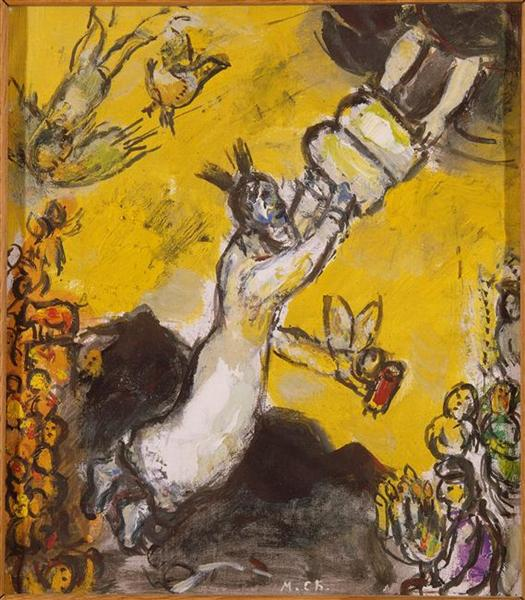
A Call to Truth and Justice (Exodus 23:1-9)

Moses Receives the Law, by Marc Chagall, 1963

“You must not pass along false rumors. You must not cooperate with evil people by lying on the witness stand.

“You must not follow the crowd in doing wrong. When you are called to testify in a dispute, do not be swayed by the crowd to twist justice. And do not slant your testimony in favor of a person just because that person is poor.

“If you come upon your enemy’s ox or donkey that has strayed away, take it back to its owner. If you see that the donkey of someone who hates you has collapsed under its load, do not walk by. Instead, stop and help.

“In a lawsuit, you must not deny justice to the poor.

“Be sure never to charge anyone falsely with evil. Never sentence an innocent or blameless person to death, for I never declare a guilty person to be innocent.

“Take no bribes, for a bribe makes you ignore something that you clearly see. A bribe makes even a righteous person twist the truth.

“You must not oppress foreigners. You know what it’s like to be a foreigner, for you yourselves were once foreigners in the land of Egypt. (New Living Translation)

On Mount Sinai, God gave Moses the Ten Commandments. These laws are basic ethical commands given to the people in their relationship to God and to one another. Following those Ten Words, the next several chapters of Exodus provide detailed instructions and commands for the Israelites in their own social, economic, and cultural context.

Today’s Old Testament lesson is part of this sequence of specific laws for the Israelites. These laws all have to do with being honest in legal matters. There is to be no perversion of justice through perjury, favoritism, bending to dishonest pressure, bribery, and false charges. What’s more, there must be no overlooking of the poor and powerless; and no disregard for the immigrant and foreigner.

All the sequences of commands – covering Exodus chapters 20-25 – are connected back to the basic Ten Commandments. The laws about justice and injustice are the fleshing-out of the ninth command to not testify falsely against your neighbor.

In other words, we are not to lie in public, especially when a person’s life or livelihood is at stake. We are to practice right relations with others; and do justice for all persons without prejudice or favoritism. We do this because God shows no favoritism and judges rightly with proper justice.

He will not judge by what he sees with his eyes,
    or decide by what he hears with his ears;
but with righteousness he will judge the needy,
    with justice he will give decisions for the poor of the earth. (Isaiah 11:3-4, NIV)

The Lord is a just God – it is inherent to the divine character. Therefore, our actions, as people created in the image of God, are to always be just, right, and truthful. There is a special place in God’s heart for the poor and powerless, and so, we ought also to consider their needs and treat them well and with respect – because true religion gives to those who we know cannot pay us back.

This, then, also is why immigrants and foreigners are mentioned. They need proper justice, and not negligence on our part to provide them with what they need. Throughout Holy Scripture we are admonished to not oppress the stranger from another place.

For through him [Christ] we both have access to the Father by one Spirit. Consequently, you are no longer foreigners and strangers, but fellow citizens with God’s people and also members of his household, built on the foundation of the apostles and prophets, with Christ Jesus himself as the chief cornerstone. (Ephesians 2:18-20, NIV)

The Lord watches over the foreigner
    and sustains the fatherless and the widow,
    but he frustrates the ways of the wicked. (Psalm 146:9, NIV)

Jesus picked up on the basic commands of God in his Sermon on the Mount – which, in many ways, is a restatement of the Ten Commandments by getting to the heart of them. Concerning the matter of giving false pledges, he said:

“Again you have heard that it was said to those who lived long ago: Don’t make a false solemn pledge, but you should follow through on what you have pledged to the Lord… Let your yes mean yes, and your no mean no. Anything more than this comes from the evil one. (Matthew 5:33, 37, CEB)

In court, we offer an oath, swearing that we will tell the truth and only the truth – and no lying. This is the only way that injustice can be avoided and justice can be established.

“I swear on a stack of Bibles I won’t…” “I will, if I get around to it….” These are a few of the caveats we give when making a promise or oath. Oaths communicate our truthful intentions of being above board with a high level of integrity.

It’s not okay when we bear false testimony concerning an event or incident that has taken place. There is no excuse for saying something is truthful when you know it isn’t quite true or all true. That makes us liars.

The Lord detests lying lips, but he delights in people who are trustworthy. (Proverbs 12:22, NIV)

Jesus wants us to clarify our values of right and wrong; make wise decisions; identify what we know is truth and error; and follow through on speaking the truth in love.

Any human society cannot stand unless it is committed to justice for all. People everywhere have a universal need for communities and nations which pursue truth, justice, benevolence, and integrity for everyone within their sphere of influence and responsibility.

Almighty God, who created us in your own image: Grant us grace to fearlessly contend against evil; and to make no peace with oppression, so that we may reverently use our freedom. Help us to employ that freedom in the maintenance of justice in our communities and among the nations, to the glory of your holy Name; through Jesus Christ our Lord, who lives and reigns with you and the Holy Spirit, one God, now and forever. Amen.

Receiving Blessings or Woes? (Luke 6:17-26)

Ethiopian artist depiction of Jesus teaching

He went down with them and stood on a level place. A large crowd of his disciples was there and a great number of people from all over Judea, from Jerusalem, and from the coastal region around Tyre and Sidon, who had come to hear him and to be healed of their diseases. Those troubled by impure spirits were cured, and the people all tried to touch him, because power was coming from him and healing them all.

Looking at his disciples, he said:

“Blessed are you who are poor,
    for yours is the kingdom of God.
Blessed are you who hunger now,
    for you will be satisfied.
Blessed are you who weep now,
    for you will laugh.
Blessed are you when people hate you,
    when they exclude you and insult you
    and reject your name as evil,
        because of the Son of Man.

“Rejoice in that day and leap for joy, because great is your reward in heaven. For that is how their ancestors treated the prophets.

“But woe to you who are rich,
    for you have already received your comfort.
Woe to you who are well fed now,
    for you will go hungry.
Woe to you who laugh now,
    for you will mourn and weep.
Woe to you when everyone speaks well of you,
    for that is how their ancestors treated the false prophets. (New International Version)

There are double meanings throughout these words of Christ for us today; the expressions used by Jesus are specifically meant to be understood in two ways.

In order to speak to the people, Jesus went down with them and stood on a level place. In other words, the actual act of doing this is also to be understood as a means of identifying with others and getting on their level. The Lord intends not to speak down to people but to relate with folks alongside them.

The blessing of God is provided, up close and personal, not from afar. The word “blessed” is much more than a reference to physical health and wealth; it also refers to enjoying God’s stamp of approval on the whole of your life – body, mind, emotions, and spirit. And that is also what healing does for us; it effects the entirety of our being and not just one dimension of it.

To be “blessed” does not mean an absence of struggle. Indeed, blessings can and do rest upon us, even though we may be on the unfortunate end of someone’s hatred, exclusion, and defamation. It is to live through opposition, aware that our struggles are temporary and that our reward is great in heaven.

To have a “woe” pronounced means the opposite of blessing – to have God’s disapproval. It is to experience a curse – body, mind, emotions, and spirit – in the holistic sense.

The woeful may not experience apparent discomfort during this life. They mistake their wealth, their stuff, and their high connections as approval from God. However, they will find a fiery existence awaiting them. Apart from repentance and faith in becoming poor in spirit, their end is sure.

We are being led and guided to choose the way of blessing – and to avoid the path of woe.

Poverty, hunger, and weeping, on one level, are broad social categories. At another level, they are spiritual categories which describe the true follower of Jesus.

Christ’s church includes people who are poor, hungry, and weeping – in the full sense of the term. They, therefore, rely upon the community of the redeemed sharing all things in common as their means of provision. (Acts 2:44-45; 4:34)

We really need to avoid the temptation to make complex situations simple. To look upon those who now have wealth, eat well, laugh, and enjoy high standing, as under a curse from God, makes us simpletons who likely don’t understand what’s going on.

Others may make direct associations with wealth as blessing, which it may or may not be. And the same can be said for poverty and hunger – the presence of it doesn’t necessarily mean either blessing or woe.

The watershed issue is what we do with the life we have been given. Do the rich rely upon wealth or on God? Do the poor seek the Lord or just try to look for patrons who will help them? And do we all accept where we are right now and look to use whatever we have, and whoever we are, to benefit the benevolent and gracious kingdom of God?

We all may come from different places, have differing experiences, and be at various points along the continuum of poverty and wealth. Yet, we are all human and we are all in this life together.

So, we need to make the best of it with each other – instead of continually being at cross purposes with one another through simple stereotypes and hackneyed approaches based in little research or rational thought.

Jesus is leading us to a place of abundance, peace, and blessing – if we have ears to hear and minds receptive to his leading. It’s a place of healing; and not a place of woe. It is the realm of God, in which morality, ethics, kindness, and joy abound forever and ever.

Help us, O God, to heal those who are broken in body or spirit, and to turn their sorrow into joy. Grant this, Father, for the love of your Son, who for our sake became poor, Jesus Christ our Lord, who with you and the Holy Spirit are one God, now and forever. Amen.

Remember the Poor and Needy (Deuteronomy 24:17-25:4)

Harvest in Provence by Vincent Van Gogh, 1888

Do not deprive the foreigner or the fatherless of justice or take the cloak of the widow as a pledge. Remember that you were slaves in Egypt and the Lord your God redeemed you from there. That is why I command you to do this.

When you are harvesting in your field and you overlook a sheaf, do not go back to get it. Leave it for the foreigner, the fatherless and the widow, so that the Lord your God may bless you in all the work of your hands. When you beat the olives from your trees, do not go over the branches a second time. Leave what remains for the foreigner, the fatherless and the widow. When you harvest the grapes in your vineyard, do not go over the vines again. Leave what remains for the foreigner, the fatherless and the widow. Remember that you were slaves in Egypt. That is why I command you to do this.

When people have a dispute, they are to take it to court and the judges will decide the case, acquitting the innocent and condemning the guilty. If the guilty person deserves to be beaten, the judge shall make them lie down and have them flogged in his presence with the number of lashes the crime deserves, but the judge must not impose more than forty lashes. If the guilty party is flogged more than that, your fellow Israelite will be degraded in your eyes.

Do not muzzle an ox while it is treading out the grain. (New International Version)

In an ideal world, we would all use our common inner sense of justice, fairness, and kindness; we would pay attention to our conscience. Yet, as you and I know all too well, we are far from living in an idyllic setting.

Instead, we live in a fundamentally broken world – complete with injustice, disagreements, disputes, petty squabbles, and blatant insensitivity to others.

It seems we shouldn’t have to be told how to concern ourselves for the common good of all persons; yet that’s exactly what needs to happen. So, the Lord made it plain what the expectations are for meeting societal needs. And it’s already inside of us; we just need to recognize it’s there, tap into it, and obey our better angels.

The Lord expects:

  • No favoritism, cronyism, and isolationism. Immigrants, foreigners, and folks different from us are to be treated with equal justice and sensitivity. Cliques which are hawkish about keeping certain persons out of their group is mostly selfish and sometimes mean-spirited; and it’s always a sort of discrimination which God expects us to avoid.
  • Attention to the poor among us. In the ancient world, and still is some parts of our world today, when the crops are harvested, the needy would tag behind the harvesters in order to pick up what was left behind. Basic human kindness tells us that not only do we let them do this, but we also purposely leave a bit for them to get for themselves and their families. In our modern era, practices of exorbitant interest and unfair housing need to be replaced with concern for the less fortunate. Wealth is meant to be shared, not hoarded. To not do so is to steal from the poor.
  • Punishments which fit the crime. Inequitable societies are rife with kangaroo courts and unjust laws which favor a particular group of persons. It’s humiliating for a minority prisoner to serve a much longer sentence than a person who is in the majority of society… and we wonder why some folks are so angry sometimes. Good grief.
  • Inclusion. Concern for the common good of society doesn’t exclude folks we don’t like or don’t understand. The reason we are not to “muzzle an ox while its treading out the grain” is that they’re doing a job and they don’t need any hindrances to their work. Placing restrictions or extra rules on one group over another just because of race, ethnicity, religion, gender, or class is sinfully exclusionary.

The bottom line is that God cares about persons trapped in poverty. 

In the Old Testament, there are seven different words for the “poor.” The range of meanings includes those who are poor because of laziness, those born into poverty, those who are poor because of inhuman oppression or slavery, simple beggars, and the pious humble poor – who have no choice but to put their trust in God because of their grinding poverty.

The Law was quite clear about how to treat the poor:

Since there will never cease to be some in need on the earth, I therefore command you, “Open your hand to the poor and needy neighbor in your land.” (Deuteronomy 15:11, NRSV) 

The mistreatment, exploitation, and just plain inattention to the poor and needy were a chief reason God sent the prophets to Israel: 

Listen to me, you who walk on helpless people,
    you who are trying to destroy the poor people of this country, saying,
“When will the New Moon festival be over
    so we can sell grain?
When will the Sabbath be over
    so we can bring out wheat to sell?
We can charge them more
    and give them less,
    and we can change the scales to cheat the people.

We will buy poor people for silver,
    and needy people for the price of a pair of sandals.
    We will even sell the wheat that was swept up from the floor.”

The Lord has sworn by his name, the Pride of Jacob, “I will never forget everything that these people did. (Amos 8:4-7, NCV) 

The major theme of Deuteronomy is remembering. Don’t ever forget where you came from so that the memory of your past helps shape what kind of person you are in the present.

We must be reminded that it is the poor in spirit who enter the kingdom of heaven, not the proud spirit who forgets the poor. 

The humble person offers grace to people who cannot offer her something in return. It’s one thing to be merciful to people who will turn around later and scratch our backs. But it’s an altogether different thing to show mercy, regardless of whether they can pay you back. 

We are to speak and act with mercy to all persons, without prejudice. 

Eventually, an idyllic world will come. Until that time, we are to speed its coming by showing basic human kindness and compassion to the least among us.

Lord God, you give honor to the least, those who are forgotten, overlooked and misjudged. You came to give first place to the last, those left behind, misunderstood and undervalued. You came to give a warm welcome to the lost, those who are orphaned, abandoned and destitute. Help us to be your ears to listen to their cries; your voice speaking out love and acceptance; your feet walking beside those in need; and your hands to clothe, feed and shelter them. Lord, in your mercy, hear our prayer. Amen.