Remember the Poor and Needy (Deuteronomy 24:17-25:4)

Harvest in Provence by Vincent Van Gogh, 1888

Do not deprive the foreigner or the fatherless of justice or take the cloak of the widow as a pledge. Remember that you were slaves in Egypt and the Lord your God redeemed you from there. That is why I command you to do this.

When you are harvesting in your field and you overlook a sheaf, do not go back to get it. Leave it for the foreigner, the fatherless and the widow, so that the Lord your God may bless you in all the work of your hands. When you beat the olives from your trees, do not go over the branches a second time. Leave what remains for the foreigner, the fatherless and the widow. When you harvest the grapes in your vineyard, do not go over the vines again. Leave what remains for the foreigner, the fatherless and the widow. Remember that you were slaves in Egypt. That is why I command you to do this.

When people have a dispute, they are to take it to court and the judges will decide the case, acquitting the innocent and condemning the guilty. If the guilty person deserves to be beaten, the judge shall make them lie down and have them flogged in his presence with the number of lashes the crime deserves, but the judge must not impose more than forty lashes. If the guilty party is flogged more than that, your fellow Israelite will be degraded in your eyes.

Do not muzzle an ox while it is treading out the grain. (New International Version)

In an ideal world, we would all use our common inner sense of justice, fairness, and kindness; we would pay attention to our conscience. Yet, as you and I know all too well, we are far from living in an idyllic setting.

Instead, we live in a fundamentally broken world – complete with injustice, disagreements, disputes, petty squabbles, and blatant insensitivity to others.

It seems we shouldn’t have to be told how to concern ourselves for the common good of all persons; yet that’s exactly what needs to happen. So, the Lord made it plain what the expectations are for meeting societal needs. And it’s already inside of us; we just need to recognize it’s there, tap into it, and obey our better angels.

The Lord expects:

  • No favoritism, cronyism, and isolationism. Immigrants, foreigners, and folks different from us are to be treated with equal justice and sensitivity. Cliques which are hawkish about keeping certain persons out of their group is mostly selfish and sometimes mean-spirited; and it’s always a sort of discrimination which God expects us to avoid.
  • Attention to the poor among us. In the ancient world, and still is some parts of our world today, when the crops are harvested, the needy would tag behind the harvesters in order to pick up what was left behind. Basic human kindness tells us that not only do we let them do this, but we also purposely leave a bit for them to get for themselves and their families. In our modern era, practices of exorbitant interest and unfair housing need to be replaced with concern for the less fortunate. Wealth is meant to be shared, not hoarded. To not do so is to steal from the poor.
  • Punishments which fit the crime. Inequitable societies are rife with kangaroo courts and unjust laws which favor a particular group of persons. It’s humiliating for a minority prisoner to serve a much longer sentence than a person who is in the majority of society… and we wonder why some folks are so angry sometimes. Good grief.
  • Inclusion. Concern for the common good of society doesn’t exclude folks we don’t like or don’t understand. The reason we are not to “muzzle an ox while its treading out the grain” is that they’re doing a job and they don’t need any hindrances to their work. Placing restrictions or extra rules on one group over another just because of race, ethnicity, religion, gender, or class is sinfully exclusionary.

The bottom line is that God cares about persons trapped in poverty. 

In the Old Testament, there are seven different words for the “poor.” The range of meanings includes those who are poor because of laziness, those born into poverty, those who are poor because of inhuman oppression or slavery, simple beggars, and the pious humble poor – who have no choice but to put their trust in God because of their grinding poverty.

The Law was quite clear about how to treat the poor:

Since there will never cease to be some in need on the earth, I therefore command you, “Open your hand to the poor and needy neighbor in your land.” (Deuteronomy 15:11, NRSV) 

The mistreatment, exploitation, and just plain inattention to the poor and needy were a chief reason God sent the prophets to Israel: 

Listen to me, you who walk on helpless people,
    you who are trying to destroy the poor people of this country, saying,
“When will the New Moon festival be over
    so we can sell grain?
When will the Sabbath be over
    so we can bring out wheat to sell?
We can charge them more
    and give them less,
    and we can change the scales to cheat the people.

We will buy poor people for silver,
    and needy people for the price of a pair of sandals.
    We will even sell the wheat that was swept up from the floor.”

The Lord has sworn by his name, the Pride of Jacob, “I will never forget everything that these people did. (Amos 8:4-7, NCV) 

The major theme of Deuteronomy is remembering. Don’t ever forget where you came from so that the memory of your past helps shape what kind of person you are in the present.

We must be reminded that it is the poor in spirit who enter the kingdom of heaven, not the proud spirit who forgets the poor. 

The humble person offers grace to people who cannot offer her something in return. It’s one thing to be merciful to people who will turn around later and scratch our backs. But it’s an altogether different thing to show mercy, regardless of whether they can pay you back. 

We are to speak and act with mercy to all persons, without prejudice. 

Eventually, an idyllic world will come. Until that time, we are to speed its coming by showing basic human kindness and compassion to the least among us.

Lord God, you give honor to the least, those who are forgotten, overlooked and misjudged. You came to give first place to the last, those left behind, misunderstood and undervalued. You came to give a warm welcome to the lost, those who are orphaned, abandoned and destitute. Help us to be your ears to listen to their cries; your voice speaking out love and acceptance; your feet walking beside those in need; and your hands to clothe, feed and shelter them. Lord, in your mercy, hear our prayer. Amen.

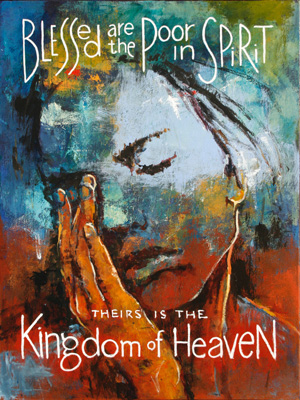
Matthew 5:3 – Blessed are the Poor in Spirit

The Beatitudes of Christ (Matthew 5:1-12) are not a knee-jerk, random collection of pithy phrases from Jesus on what constitutes approval from God.  They intentionally build upon each other.  If the Sermon is the cornerstone of Christ’s teaching, and the Beatitudes are the cornerstone of the Sermon, then poverty of spirit is the cornerstone of the Beatitudes.  This Beatitude is foundational to the Christian life. So, what does it mean to be “poor in spirit”? 

“Poor” comes from the word “beggar.” And why does any beggar beg? Because they are in need. Beggars are desperate and destitute, knowing they need help just to survive another day. A beggar begs because he cannot rely on reciprocity; he has absolutely nothing to give in return.

Jesus was saying to the crowd following him, that true followers have a realization of their spiritual bankruptcy and have no shame in begging God to act on their behalf. The truth is that we are all spiritually destitute before God and stand in stark need of divine resources to help us. 

In reality, we have nothing of worth to give or offer to God. And we can gain nothing apart from God. Therefore, we must realize who we are and take the position of humility, not pride, and look to God.

To understand our poverty of spirit is to see that we are stripped of all self-righteousness, and absolutely need God. Knowing and understanding our spiritual bankruptcy is to see sin for what it really is. So, how do you know when you are poor in spirit?

  • The spiritual beggar makes no deals with God because they have nothing to bargain with. There is no ground from which to leverage anything.
  • The spiritual beggar doesn’t complain because they realize they don’t deserve anything. Instead, there is praise to God for such incredible grace in providing their needs.
  • Spiritual beggars are always begging, that is, praying all the time. Beggars don’t pray because it is an effective strategy to further their agenda. They pray because, if they don’t, they won’t make it!
  • Spiritual beggars take Christ on his terms, not theirs. The beggar will do anything Jesus says because he knows his situation is desperate. He has an inner attitude of total dependence upon God. Without humility before God, the spiritual beggar discerns he is hopeless. There is no room for the pride that tries to posture and position to get what I want, because the spiritual beggar knows he has none of this.
  • Spiritual beggars realize the more you learn, the more you don’t know – that you are dependent on a holy God and Holy Scripture, and not your own ideas, thoughts, convictions, and opinions. So, you willingly take the posture of listening instead of always talking.
  • The spiritual beggar knows no enemies. The late Henri Nouwen said, “Poverty is the inner disposition that allows us to take away our defenses and convert our enemies into friends. We can only perceive the stranger as an enemy as long as we have something to defend.” Those who are poor in spirit are not anxiously clinging to their stuff, their money, or their good name. They have nothing of their own; it all belongs to God for divine purposes.

Only the poor in spirit will enter the kingdom of heaven. The way is narrow and only a few are willing to truly humble themselves before God and take the posture of a beggar. If we think we are above this, then we have gone the broad way of destruction that many will find.

Humility knows that God is God, and I am not. Therefore, we orient our lives around this reality. Just as we need to respect the law of gravity and submit to its presence and reality, so it is most necessary and important to accept God’s rule and reign in this world and submit to its constant force. This is simply the way of wisdom.

We do not presume to come to you, O merciful Lord, trusting in our own righteousness, but in your abundant and great mercies. We are not worthy so much as to gather up the crumbs under your table; but you are the same Lord whose character is always to have mercy. Grant us, therefore, gracious Lord, to be intimately close to your dear Son Jesus Christ, and to identify with him in his death so that our sinful bodies may be made clean by his body, and our souls washed through his most precious blood. May we forever dwell in Christ, and he in us.  Amen.

*Above painting by Hyatt Moore

Matthew 5:1-12 – The Beatitudes of Jesus

Sermon-on-the-Mount
A Bengali depiction of Christ’s Sermon on the Mount

Now when Jesus saw the crowds, he went up on a mountainside and sat down. His disciples came to him, and he began to teach them. He said: 

“Blessed are the poor in spirit, 
    for theirs is the kingdom of heaven. 
Blessed are those who mourn, 
    for they will be comforted. 
Blessed are the meek, 
    for they will inherit the earth. 
Blessed are those who hunger and thirst for righteousness, 
    for they will be filled. 
Blessed are the merciful, 
    for they will be shown mercy. 
Blessed are the pure in heart, 
    for they will see God. 
Blessed are the peacemakers, 
    for they will be called children of God. 
Blessed are those who are persecuted because of righteousness, 
    for theirs is the kingdom of heaven. 

“Blessed are you when people insult you, persecute you and falsely say all kinds of evil against you because of me. Rejoice and be glad, because great is your reward in heaven, for in the same way they persecuted the prophets who were before you. (NIV) 

Just as God’s Law was given on a mountain (The Ten Commandments) so the law was restated on a mountain by Jesus (Sermon on the Mount). I believe that arguably one of the most important and impacting portions of Holy Scripture are the Beatitudes of Jesus, which serve as the foundation to all of Christ’s teaching. These Beatitudes are not simply a random collection of pithy phrases from Jesus on what constitutes approval from God. They intentionally build upon each other and describe true righteousness.  

Blessed are the poor in spirit.   

This Beatitude is the spiritual base to the Christian life.  Most of the original crowd listening to Jesus thought they were on the outside of the kingdom, on the margins of true religion. Instead, Jesus told them they have a place as poor and pitiable people. To be “poor in spirit” means one is a spiritual beggar who recognizes they have nothing to offer God. It is seeing oneself, one’s sin, and one’s life as spiritually bankrupt apart from God. Beggars have no ability to strike deals; they have nothing to leverage with; and, realize they deserve nothing. Beggars do one thing continually: they beg. The proud person would never be caught begging for anything. Yet, the humble spiritual beggar constantly prays because they need God! They discern that without God there is no hope. The kingdom of heaven belongs to the penitent and not the proud. 

Blessed are those who mourn. 

This is the emotional response of acknowledging one’s spiritual poverty.  Grief and lament have a central place in Christian theology and life. To avoid it, work around it, or short-circuit its process is to refuse Christ because there is no righteousness apart from mourning over sin. Crying, weeping, and even intense tears are important and necessary. To experience personal grief over one’s sins and the sins of the church and the world is a Beatitude of Jesus. You neither need position, power, privilege, nor pedigree to be a mourner. All can mourn. This is the door by which we enter the kingdom of God. 

Blessed are the meek. 

A meek spirit is the result of realizing our poverty of spirit and practicing grief and lament. At the heart of what it means to be meek is a spirit of non-retaliation. When we are flat on our backs before God, there is no place to look but up. Thus, there is no ability to look down on others. To be meek is to be broken before God. A meek person takes personal responsibility for their attitudes and actions. The meek have no need to retaliate, even when egregiously wronged, because they fully entrust themselves to God alone who judges the living and the dead. Ironically, brokenness is the path to righteous wholeness. 

Blessed are those who hunger and thirst for righteousness. 

Only those who know their poverty of spirit, personally grieve over sin, and are truly humble/meek end up longing for righteousness. This is much more than just desire; this is the recognition that without God I will not make it. I cannot be righteous without Jesus. Simply put, righteousness is a right relationship with God and others. That is what happens when a person is meek. Such a person knows she cannot make things right by herself; she needs help, specifically, God’s help. If we ever have the thought that we can live most days of our lives without God, we do not yet know true righteousness. People who understand their great need for Jesus are easy to spot. They crave and devour God’s Word as their daily food; and they cannot stop blabbering on about Jesus. 

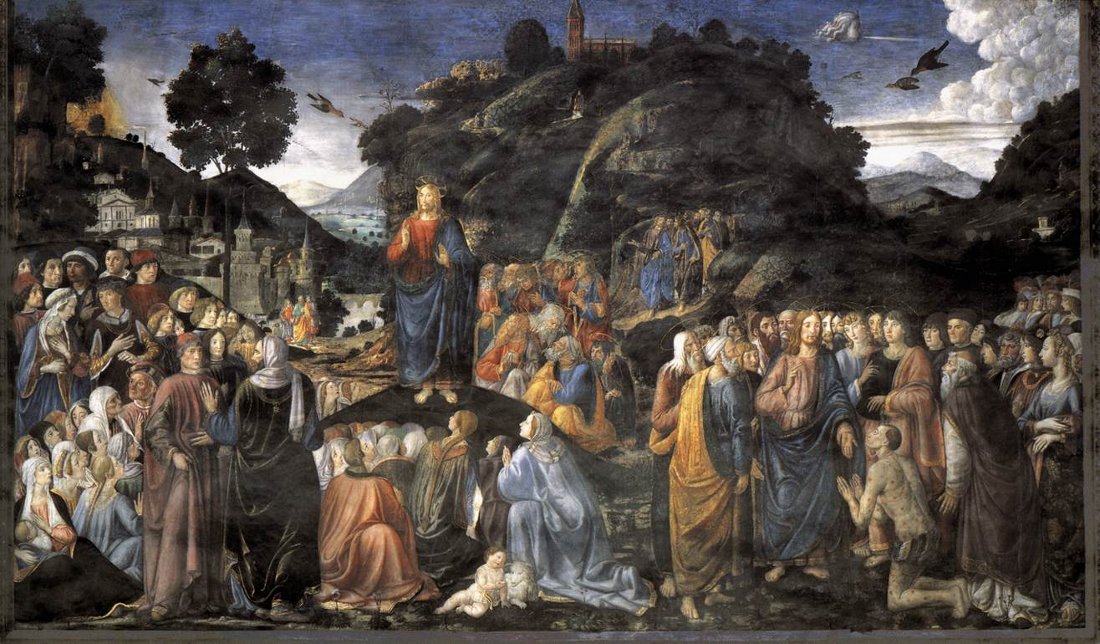
Sermon on the Mount
A fresco of the Sermon on the Mount on the northern wall of the Sistine Chapel.

There are three practices of living that arise from being filled with God’s righteousness.  They are the next three Beatitudes of mercy, purity, and peacemaking. These cannot be conjured up by our own will. They organically grow within us and are freely expressed because of what God is doing in our lives. You cannot force them any more than you can force a stalk of corn to grow on your terms. Instead, you work with the unforced rhythms of God’s grace and allow his righteousness to take root in you. Below the soil the activity of spiritual poverty, mourning, and humility takes place. Then, when the plant breaks the soil and flowers, it produces mercy, purity, and peace-making. 

Blessed are the merciful.  

Mercy begins with a disposition of the heart that seeks to be generous. Mercy is a loving response to someone or a group of people in misery. We accept them and help them because we ourselves have been there. Mercy looks for ways to come alongside others and help, rather than pile expectations and burdens on others without mentoring them in the ways of God. 

Blessed are the pure in heart. 

Purity also results from true righteousness. A stalk of corn might look good, but if you shuck it and it is filled with worms, it isn’t going to be worth much. Legalistic righteousness is concerned to look good, is obsessed with performance, perfection, and possessions. Conversely, the righteousness of God fills our hungry hearts and makes us pure and holy, set apart for his use. 

Blessed are the peacemakers.  

Peacemakers are people who find themselves caught in the middle and want to live righteously with the mercy and purity that God has provided for them. Peace is only realized through peacemakers. It seems we all desire peace, yet, peacemakers are hard to come by. It’s a tough gig. Peacemakers exist through being characterized by the earlier Beatitudes. To achieve peace, one must first be at peace with God and self – which is why we need the cross of Jesus Christ. 

Blessed are those who are persecuted because of righteousness.  

When a person lives in this righteousness as presented by Jesus, there will be persecution. Folks who are offended by even slight criticisms are usually the ones who are privileged and in power. They have not yet learned the ways of Jesus. Pettiness is nothing more than a sign of unrighteousness. Yoking up with Jesus, following him, and living into his words and ways has always been risky and dangerous. The Beatitudes of Jesus are not characteristics that lead to power, prestige, or possessions, but likely just the opposite. 

The former Pope Benedict XVI, explained Christ’s Beatitudes this way: “The Beatitudes, spoken with the community of Jesus’ disciples in view, are paradoxes – the standards of the world are turned upside down as soon as things are seen in their right perspective, which is to say, in terms of God’s values, so different from those of the world. It is precisely those who are poor in worldly terms, those thought of as lost souls, who are truly fortunate ones, the blessed, who have every reason to rejoice and exult in their suffering. The Beatitudes are promises resplendent with the new image of the world and humanity inaugurated by Jesus.” 

Those who are in Jesus Christ become living beatitudes, walking, talking blessings to the world.  Those who live with Jesus in his kingdom have a destiny to be witnesses to another subversive, yet wonderful, way of life, where the last are first and the greatest are the least. 

O Lamb of God, that takes away the sins of the world, have mercy upon me. 

O Lamb of God, that takes away the sins of the world, have mercy upon me. 

O Lamb of God, that takes away the sins of the world, grant me your peace. 

Poverty of Spirit

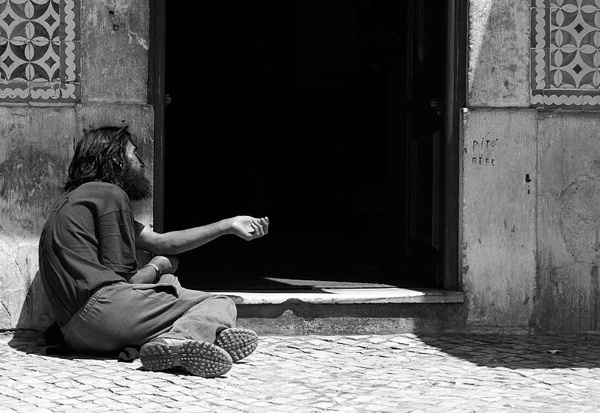
A beggar in BelÈm, Lisbon. He sat there for hours without moving.

I like having conversations with people… most of the time.  Yet, I don’t like being in a discussion where I’m wondering if the person has an agenda.  That causes me to have my antenna up concerning his/her motives or attitude.  Maybe, like me, you’ve had that moment either within a conversation or afterward where you realize, “Gosh, that dude was a real schmuck.  He was just preening and posturing to get something.”  Most of us aren’t schmucks.  You are probably reading this because you want to do what is right, just, and good.  When it comes to Christian spirituality and discipleship, we would like God’s stamp of approval on our lives.  We want to walk in the words and ways of Jesus, and not be “that guy” who is obnoxious or contemptible.

The Beatitudes of Jesus (Matthew 5:1-12) tell us what being “blessed” by God looks like.  The Beatitudes were countercultural to the prevailing religious milieu of Christ’s day, and, even today, are often not the kinds of characteristics which a lot of people embody.  In other words, the Beatitudes are not really on a lot of folks’ radar.

God cares not only for what we do, but why we do it.  Our attitudes are just as important to him as our actions.  Obeying God, honoring your parents, submitting to a boss, or listening to a teacher might be actions we do, but if we do them with a begrudging spirit which believes that we could do everything better than all these other persons, then pride has reared its sinister head.  In such times, we are more in league with the ancient Pharisees than with Jesus.

But I am confident of better things in your case.  Pursuing true righteousness – a right relationship with God and with others – is what brings real and lasting joy.  Whereas the Pharisees based their righteousness on outward appearances and pious behaviors, the true follower of Jesus adopts inner attitudes of humility which result in outward gestures of genuine love.  Being a conformist to a prevailing form of outward Christianity is useless, because our standard of righteousness as Christians is not what everybody else is doing, but what Christ has done.

The bedrock attitude of a Christian is humility, and this is what the first Beatitude establishes.  “Blessed are the poor in spirit,” Jesus said, “for theirs is the kingdom of heaven” (Matthew 5:3).  Christians are spiritual beggars, the ones who acknowledge their great need, and are desperate for Jesus.  A beggar begs because he/she cannot simply meet their own need, and they have no means to reciprocate and give anything in return.

John Chrysostom quote

In saying that the poor in spirit are blessed, Jesus is saying that his followers have an awareness that they are spiritually bankrupt before God and stand in stark need of him.  An urgency of longing for God is at the heart of a spiritual beggar.

It isn’t hard to notice a person who is poor in spirit because true humility stands out in a culture of pride.  A spiritual beggar:

  • Doesn’t try and make slick deals with God, because they have nothing to bargain with; instead, they are content with unconditional surrender to a God of grace and mercy.
  • Doesn’t complain, because they realize they don’t deserve anything; instead, they incessantly praise God for his incredible grace to them.
  • Prays a lot, because a beggar is always begging; they pray, not because it is an effective strategy to get what they want, but because they are destitute without God.
  • Takes Christ on his terms, without acting like a peacock to get noticed, because a beggar has no position or pedigree to rely upon.
  • Realizes that the more they learn, the more they don’t know; therefore, they rely completely on God without being stubbornly independent – they listen to Scripture rather than talk all the time.
  • Knows no enemies because having lots of stuff and superior status only engenders defending turf and maintaining position.

The late Henri Nouwen once said: “Poverty is the inner disposition that allows us to take away our defenses and convert our enemies into friends.  We can only perceive the stranger as an enemy as long as we have something to defend.”  Those who are poor in spirit are not anxiously clinging to their stuff, their money, their good name, or their supposed right to be in control.

Only the poor in spirit will enter the kingdom of heaven.  The way is narrow, and only a few are willing to truly humble themselves before God and take the posture of a beggar.  To think we do not need to bow to such a lowly activity of begging belies that we believe we are above such things – which is the broad open way of destruction that many will find.

The only way to enter God’s kingdom is through humility.  The Lord’s realm is populated with those who are lowly.  Many times we might think that the most spiritual among us are those that give.  Yet, it could very well be that much of the giving is meant to maintain personal independence, an inordinate position over another person, and the status of not being in need.  Receiving with open hands can be a much harder thing to do, because it communicates to another that we are in need – and our pride doesn’t like that.

So, it is my hope for you today that you will know the blessing of being a spiritual beggar.  May you realize that your poverty of spirit is a blessed narrow way toward the wealth of imputed righteousness.  May you enjoy the kingdom of God, bask in the grace given by God, and receive all God’s good gifts with gratitude.