How Do You Want To Be Remembered?

Someday when I am dead and buried, I would be fine with my gravestone stating, “He was humble and wise.” For I have always sought (however imperfectly) to embrace and live a life characterized by poverty of spirit, largeness of heart, and a sage mind.

Yet, most of all, I’d like to be remembered by the phrase, “He loved God.” The Great Command of Jesus to love God and each other is something I pray and seek in my daily life. And I hope that at the end of my earthly life, the love of God within me has made the world a better place.

In saying this, it means I forsake a lot of other ambitions to be remembered by. I don’t really care if I am remembered for any other virtues or abilities other than love, humility, and wisdom.

For the times that I have unknowingly pursued other things above what is of concern to my Lord Jesus, I admit and renounce those things. Because that is what humility and love does. And it’s the wisest thing a person could do.

That is in direct contrast and opposition to worldly ambitions for wealth and financial resources, power and authority, attention and greatness. Such desires arise from pride, not humility. With arrogance, ignorance and hate are not far behind.

Such virtue is itself the good life. And it is not out of touch for any of us. For Christ himself repeatedly told and reminded his disciples that the kingdom of God is near, so near as to be within us.

“The time has come, and God’s kingdom is near. Change the way you think and act, and believe the Good News.” (Mark 1:15, God’s Word Translation)

“The Kingdom of God is near you now.” (Luke 10:9, New Living Translation)

And we are told to make God’s kingdom a priority. We are to humble ourselves before God and seek the reign of God and the values of how God operates, rather than putting all our equity into material possessions.

“Seek first the kingdom of God and his righteousness, and all these things (material resources) will be given to you as well.” (Matthew 6:33, New International Version)

The super-rich of this world have a super difficult time ever humbling themselves to anyone, including God, because they can so easily rely upon their vast earthly resources.

“Truly I tell you, it will be hard for a rich person to enter the kingdom of heaven. Again I tell you: It is easier for a camel to go through the eye of a needle than for someone who is rich to enter the kingdom of God.” (Matthew 19:23-24, New Revised Standard Version)

God’s kingdom is not something that is so far out of touch for us, or way out there somewhere, as if we could not, and therefore need not, pay much attention to it. No, it is much closer than any of us realize.

You and I have the light within us. For some people (maybe most people) this light has diminished to a tiny little flame or spark. They themselves either cannot or will not perceive there is something right and good that exists down deep in this soul created in the image and likeness of God.

Phrases such as “Let us rely upon our better angels,” and “Get in touch with our nobler instincts,” are more modern ways of expressing that there is inherent worth within us that we can tap into. It doesn’t even take a Christian or a religious person to recognize this reality.

We really do have a higher self, a conscience containing a moral compass, a given benevolent nature, altruistic impulses, and a compassionate side to us. Will we seek this part of ourselves? Will we tap into it? Will we allow it to come out into the world in order to bless it, not curse it?

Yet, as we know all too well, we also a have within us a depraved part which wants to rule over others and acquire as much wealth and power as possible. As with most things, we ourselves are a paradoxical conundrum of competing desires.

How do you want to be remembered? We can pursue the kingdom of God within us, or we can seek the kingdoms of this world outside of us. It’s your choice. But you will need help, if going after such things as humility, wisdom, and love as your way of life – not only help from God, but also help from others.

“Ask, and it will be given to you; search, and you will find; knock, and the door will be opened for you. For everyone who asks receives, and everyone who searches finds, and for everyone who knocks, the door will be opened. Is there anyone among you who, if your child asked for bread, would give a stone? Or if the child asked for a fish, would give a snake? If you, then, who are evil, know how to give good gifts to your children, how much more will your Father in heaven give good things to those who ask him!

“In everything do to others as you would have them do to you, for this is the Law and the Prophets. (Matthew 7:7-12, New Revised Standard Version)

What is true of you, that you would like engraved on your gravestone? How do you want to be remembered? That’s what we need in this world, for this time and for this place.

The Servant of the Lord (Isaiah 42:5-9)

This is what God the Lord says—
the Creator of the heavens, who stretches them out,
    who spreads out the earth with all that springs from it,
    who gives breath to its people,
    and life to those who walk on it:
“I, the Lord, have called you in righteousness;
    I will take hold of your hand.
I will keep you and will make you
    to be a covenant for the people
    and a light for the Gentiles,
to open eyes that are blind,
    to free captives from prison
    and to release from the dungeon those who sit in darkness.

“I am the Lord; that is my name!
    I will not yield my glory to another
    or my praise to idols.
See, the former things have taken place,
    and new things I declare;
before they spring into being
    I announce them to you.” (New International Version)

For those who serve the God of Scripture, there is work to be done.

According to Scripture, people are created in the image and likeness of God (Genesis 1:26-27). As the only creatures on earth with the divine stamp of God’s image, humanity’s purpose is to reflect and work toward that which characterizes God:

  • Be holy because God is holy. That is, set apart your life for good and right purposes, and not for ill. Devote yourself to being above board in everything, and work for the common good of all persons.
  • Love one another as God has loved you. Since the Lord demonstrated a sacrificial and unconditional love toward you, so do the same for others. Love God. Love your neighbor.
  • Do justice because God is just. God is concerned that everyone on planet earth has what they need – both physically and spiritually – to live and thrive in this world. Ensure that people’s needs are met, without any prejudice or favoritism.

The servant of God has a mandate to be a covenant and light for people. Since God makes and keeps promises to people; and since the Lord is light without any darkness, so God’s servant is to embrace and embody a steadfast commitment to continually doing good.

We are meant to be a blessing to people on this earth – and not a curse. (Galatians 3:8)

I don’t have much stomach for fellow believers who think they are responsible to let people know how sinful they really are. Such supposed messengers end up puking the “good news” on others, often leaving people in such a bad state that they want nothing to do with religion.

Any sort of forceful verbiage, or manipulative gaslighting of others, does not in any way reflect the God whom I serve; I view such underhanded methods as inconsistent with Scripture. Besides, the Lord certainly doesn’t need any of us, as if God is dependent on people’s gospel witness.

Instead, the Lord graciously cuts us in on the benevolent and gracious divine action that is being accomplished in the world. That God allows me to be a mouthpiece is a privilege and a responsibility. So, I will steward that trust well by using words that build up and encourage, without verbally accosting another in the name of serving God.

In the ancient world, the poor often found themselves in prison through the inability to pay off a debt. Part of the servant’s work is to cancel debt, thus providing freedom and a further means to work and support family. For the Christian, this is an elementary part of our prayers:

And forgive us our debts, as we also have forgiven our debtors. (Matthew 6:12, NIV)

Those words of Jesus are meant to uphold the ethical teachings of the Law:

At the end of every seven years you must cancel debts… There need be no poor people among you, for in the land the Lord your God is giving you to possess as your inheritance, he will richly bless you, if only you fully obey the Lord your God and are careful to follow all these commands I am giving you today. For the Lord your God will bless you as he has promised, and you will lend to many nations but will borrow from none. You will rule over many nations but none will rule over you.

If anyone is poor among your fellow Israelites in any of the towns of the land the Lord your God is giving you, do not be hardhearted or tightfisted toward them. Rather, be openhanded and freely lend them whatever they need. (Deuteronomy 15:1, 4-8, NIV)

Holiness, love, and justice are done by paying attention to the neediest of persons around us. The Lord’s servant can bring light because God is against the darkness. And the reason debts are cancelled (both real economic and spiritual forgiveness) is so that the monetary poor, and the poor in spirit, are liberated.

God is attentive to the vulnerable and needy; it is the Lord’s will that no one lives under the oppression of debilitating debt.

The work of the humble servant brings dignity, honor, and respect to human beings, thus honoring God and showing to the world what sort of God the Lord is – a gracious and merciful God who has a zeal for justice and for right relations in society. The Servant of the Lord, the ultimate Servant, is described in this way by the prophet:

Of the greatness of his government and peace there will be no end. He will reign on David’s throne and over his kingdom, establishing and upholding it with justice and righteousness from that time on and forever. The zeal of the Lord Almighty will accomplish this. (Isaiah 9:7, NIV)

Our Father in heaven,
hallowed be your name.
Your kingdom come,
your will be done,
    on earth as it is in heaven.
Give us this day our daily bread,
and forgive us our debts,
    as we also have forgiven our debtors.
And lead us not into temptation,
    but deliver us from evil. Amen.

Receiving Blessings or Woes? (Luke 6:17-26)

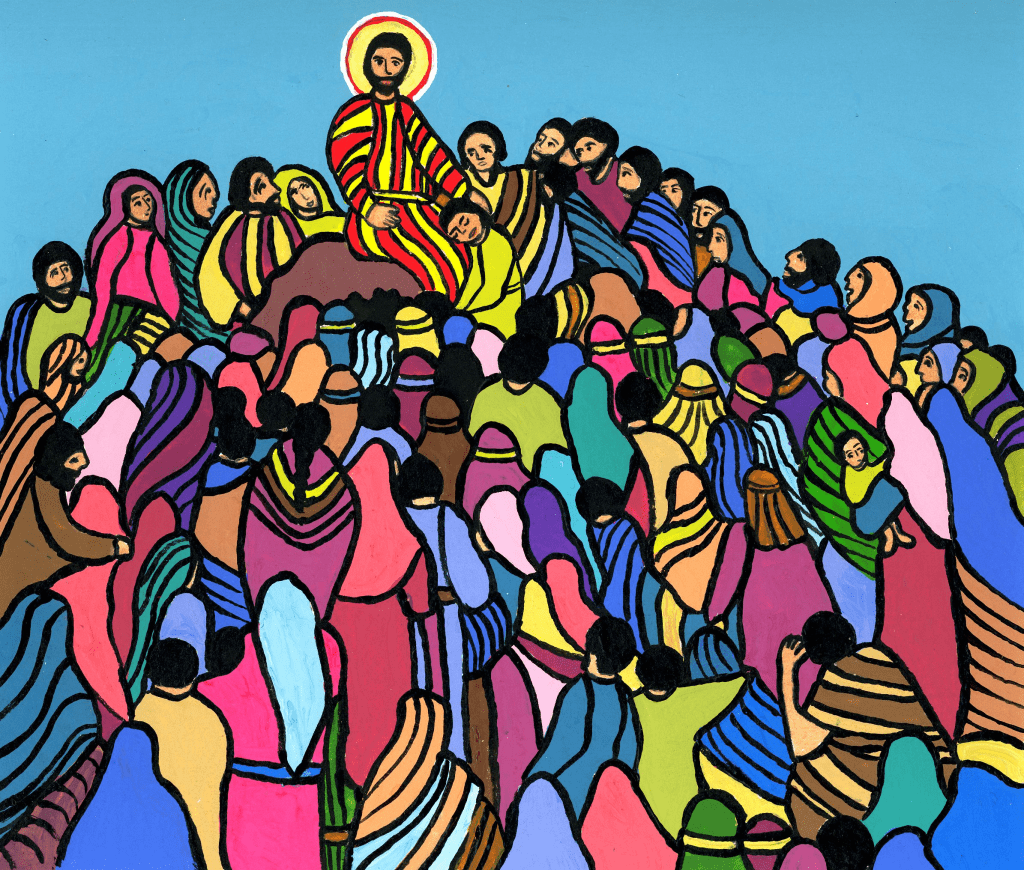
Ethiopian artist depiction of Jesus teaching

He went down with them and stood on a level place. A large crowd of his disciples was there and a great number of people from all over Judea, from Jerusalem, and from the coastal region around Tyre and Sidon, who had come to hear him and to be healed of their diseases. Those troubled by impure spirits were cured, and the people all tried to touch him, because power was coming from him and healing them all.

Looking at his disciples, he said:

“Blessed are you who are poor,
    for yours is the kingdom of God.
Blessed are you who hunger now,
    for you will be satisfied.
Blessed are you who weep now,
    for you will laugh.
Blessed are you when people hate you,
    when they exclude you and insult you
    and reject your name as evil,
        because of the Son of Man.

“Rejoice in that day and leap for joy, because great is your reward in heaven. For that is how their ancestors treated the prophets.

“But woe to you who are rich,
    for you have already received your comfort.
Woe to you who are well fed now,
    for you will go hungry.
Woe to you who laugh now,
    for you will mourn and weep.
Woe to you when everyone speaks well of you,
    for that is how their ancestors treated the false prophets. (New International Version)

There are double meanings throughout these words of Christ for us today; the expressions used by Jesus are specifically meant to be understood in two ways.

In order to speak to the people, Jesus went down with them and stood on a level place. In other words, the actual act of doing this is also to be understood as a means of identifying with others and getting on their level. The Lord intends not to speak down to people but to relate with folks alongside them.

The blessing of God is provided, up close and personal, not from afar. The word “blessed” is much more than a reference to physical health and wealth; it also refers to enjoying God’s stamp of approval on the whole of your life – body, mind, emotions, and spirit. And that is also what healing does for us; it effects the entirety of our being and not just one dimension of it.

To be “blessed” does not mean an absence of struggle. Indeed, blessings can and do rest upon us, even though we may be on the unfortunate end of someone’s hatred, exclusion, and defamation. It is to live through opposition, aware that our struggles are temporary and that our reward is great in heaven.

To have a “woe” pronounced means the opposite of blessing – to have God’s disapproval. It is to experience a curse – body, mind, emotions, and spirit – in the holistic sense.

The woeful may not experience apparent discomfort during this life. They mistake their wealth, their stuff, and their high connections as approval from God. However, they will find a fiery existence awaiting them. Apart from repentance and faith in becoming poor in spirit, their end is sure.

We are being led and guided to choose the way of blessing – and to avoid the path of woe.

Poverty, hunger, and weeping, on one level, are broad social categories. At another level, they are spiritual categories which describe the true follower of Jesus.

Christ’s church includes people who are poor, hungry, and weeping – in the full sense of the term. They, therefore, rely upon the community of the redeemed sharing all things in common as their means of provision. (Acts 2:44-45; 4:34)

We really need to avoid the temptation to make complex situations simple. To look upon those who now have wealth, eat well, laugh, and enjoy high standing, as under a curse from God, makes us simpletons who likely don’t understand what’s going on.

Others may make direct associations with wealth as blessing, which it may or may not be. And the same can be said for poverty and hunger – the presence of it doesn’t necessarily mean either blessing or woe.

The watershed issue is what we do with the life we have been given. Do the rich rely upon wealth or on God? Do the poor seek the Lord or just try to look for patrons who will help them? And do we all accept where we are right now and look to use whatever we have, and whoever we are, to benefit the benevolent and gracious kingdom of God?

We all may come from different places, have differing experiences, and be at various points along the continuum of poverty and wealth. Yet, we are all human and we are all in this life together.

So, we need to make the best of it with each other – instead of continually being at cross purposes with one another through simple stereotypes and hackneyed approaches based in little research or rational thought.

Jesus is leading us to a place of abundance, peace, and blessing – if we have ears to hear and minds receptive to his leading. It’s a place of healing; and not a place of woe. It is the realm of God, in which morality, ethics, kindness, and joy abound forever and ever.

Help us, O God, to heal those who are broken in body or spirit, and to turn their sorrow into joy. Grant this, Father, for the love of your Son, who for our sake became poor, Jesus Christ our Lord, who with you and the Holy Spirit are one God, now and forever. Amen.

Christ’s Beatitudes (Matthew 5:1-12)

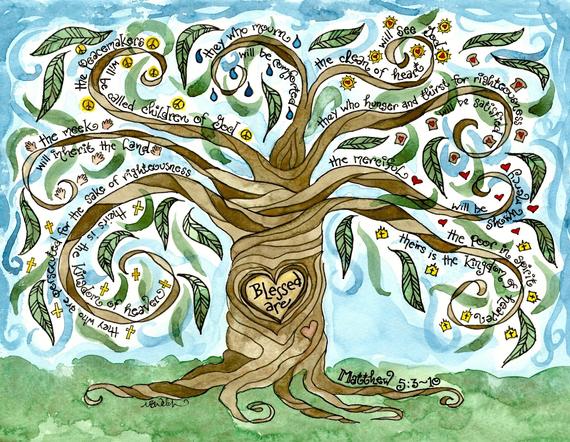
Sermon on the Mount by Gisele Bauche

When Jesus saw the crowds, he went up the mountain, and after he sat down, his disciples came to him. And he began to speak and taught them, saying:

“Blessed are the poor in spirit, for theirs is the kingdom of heaven.

“Blessed are those who mourn, for they will be comforted.

“Blessed are the meek, for they will inherit the earth.

“Blessed are those who hunger and thirst for righteousness, for they will be filled.

“Blessed are the merciful, for they will receive mercy.

“Blessed are the pure in heart, for they will see God.

“Blessed are the peacemakers, for they will be called children of God.

“Blessed are those who are persecuted for the sake of righteousness, for theirs is the kingdom of heaven.

“Blessed are you when people revile you and persecute you and utter all kinds of evil against you falsely on my account. Rejoice and be glad, for your reward is great in heaven, for in the same way they persecuted the prophets who were before you. (New Revised Standard Version)

God’s Law (The Ten Commandments) was given on a mountain. That Law was restated and reframed on a mountain by Jesus in his Sermon on the Mount.

I believe that arguably one of the most important and impactful portions of Holy Scripture are the Beatitudes of Jesus, which serve as the foundation to all of Christ’s teaching.

Christ’s Beatitudes are not simply a random collection of pithy phrases from Jesus on what constitutes approval and blessing from God. They intentionally build upon each other and describe the nature of true righteousness.

The Poor in Spirit

Spiritual poverty, not wealth, is the spiritual base to the Christian life. Most of the original crowd listening to Jesus thought they were on the outside of the kingdom, on the margins of true religion. But Jesus told them they have a place in God’s reign as poor and pitiable people.

To be “poor in spirit” is to be a spiritual beggar who recognizes they have nothing to offer God. It is seeing oneself, one’s sin, and one’s life as spiritually bankrupt apart from God.

Beggars have neither the leverage nor the ability to strike deals with anybody; and so, they do one thing: beg continually.

The proud person would never be caught begging for anything. Yet, the humble spiritual beggar constantly prays because they need God. They discern that without God there is no hope. The kingdom of heaven belongs to the penitent and not to the proud.

The Mourners 

Mourning is the emotional response of acknowledging one’s spiritual poverty. 

Grief and lament have a central place in Christian theology and life. To avoid it, work around it, or short-circuit its process is to refuse Christ; there is no righteousness apart from mourning over sin. Crying, weeping, and even intense tears are important and necessary.

To experience personal grief over one’s sins and the sins of the church and the world is a Beatitude of Jesus. You neither need position, power, privilege, nor pedigree to be a mourner. All can mourn. This is the door by which we enter the kingdom of God.

The Meek

A meek and gentle spirit is the result of realizing poverty of spirit and practicing lament.

At the heart of what it means to be meek is a spirit of non-retaliation. Whenever we are flat on our backs before God, there is no place to look but up. Thus, there is no ability to look down on others.

To be meek is to be broken and moldable before God. A meek person takes personal responsibility for their attitudes and actions. The meek have no need to retaliate, even when egregiously wronged, because they fully entrust themselves to God alone who judges the living and the dead.

Ironically, brokenness is the path to righteous wholeness.

The Hungry and Thirsty

Only those who know their poverty of spirit, personally grieve over sin, and are gentle, end up longing for righteousness.

The desire for righteousness is a recognition that without God I will not make it. I cannot be righteous without Jesus. Simply put, righteousness is a right relationship with God and others.

Those who hunger and thirst for God’s righteousness know they cannot make things right by themselves; they need God’s help.

If we think we can live most days of our lives without God, we do not yet know true righteousness. People who understand their great need for Jesus are easy to spot. They crave and devour God’s Word as their daily food; and they cannot stop blabbering on about Jesus.

There are three practices of living that arise from being filled with God’s righteousness: mercy, purity, and peacemaking. These Beatitudes cannot be conjured up by our own will; instead, they organically grow within us and are freely expressed because of what God is doing in our lives.

You cannot force them any more than you can force a stalk of corn to grow on your terms. Rather, you work with the unforced rhythms of God’s grace and allow righteousness to take root in you.

Down below in the soil, spiritual poverty, mourning, and humility germinate. Then, when the plant breaks the soil and flowers, it produces mercy, purity, and peace-making.

The Merciful 

Mercy begins with a heart that seeks to be generous; it is a loving response to someone or a group of people in misery. We accept them and help them because we ourselves have been there.

The merciful person looks for ways to come alongside others and help, rather than pile expectations and burdens on others without mentoring them in the ways of God.

The Pure In Heart

Purity also results from true righteousness. A stalk of corn might look good, but if you shuck it and it’s filled with worms, it’s not worth much. Legalistic righteousness is concerned to look good; it’s obsessed with performance, perfection, and possessions.

Conversely, the righteousness of God fills our hungry hearts and makes us pure and holy, set apart for good use.

The Peacemakers 

Those who make peace intentionally put themselves in the middle of trouble because they want to live righteously with the mercy and purity that God has provided for them.

Peace is realized through peacemakers. It seems we all desire peace, and yet, peacemakers are hard to come by. It’s a tough gig. To achieve peace, one must first be at peace with God and self – which is why we need the cross of Jesus Christ.

The Persecuted 

Living righteously, as presented by Jesus, tends to bring persecution; and the persecuted consider it a small price to pay for realizing God’s justice in the world.

Folks who are offended by even slight criticisms are usually the ones who are privileged and in power. They have not yet learned the ways of Jesus. Pettiness is nothing more than a sign of unrighteousness.

Yoking up with Jesus, following him, and living into his words and ways has always been risky and dangerous. The Beatitudes of Jesus are not characteristics that lead to power, prestige, or possessions, but likely just the opposite.

“The Beatitudes, spoken with the community of Jesus’ disciples in view, are paradoxes – the standards of the world are turned upside down as soon as things are seen in their right perspective, which is to say, in terms of God’s values, so different from those of the world. It is precisely those who are poor in worldly terms, those thought of as lost souls, who are truly fortunate ones, the blessed, who have every reason to rejoice and exult in their suffering. The Beatitudes are promises resplendent with the new image of the world and humanity inaugurated by Jesus.”

Pope Benedict XVI

Truly righteous persons become living Beatitudes; they are walking, talking blessings to the world. They abide with Christ and are witnesses to a subversive, yet wonderful, way of life, where the last are first and the greatest are the least.

O Lamb of God, that takes away the sins of the world, have mercy upon me.

O Lamb of God, that takes away the sins of the world, have mercy upon me.

O Lamb of God, that takes away the sins of the world, grant me your peace.