Labor and Building the Temple (1 Kings 5:13-18)

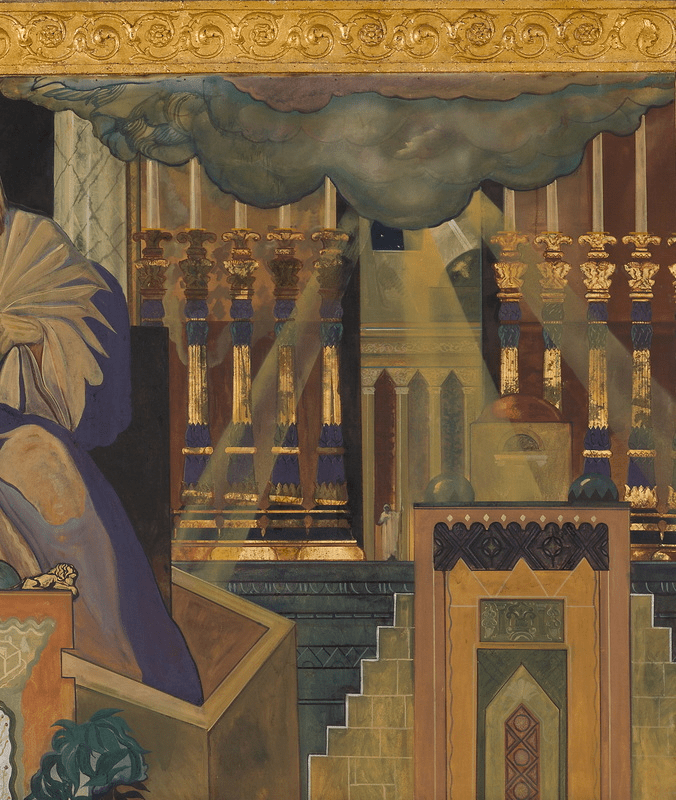
Mural of King Solomon and building the Temple, Wilshire Boulevard Temple, Los Angeles

Solomon ordered 30,000 people from all over Israel to cut logs for the temple, and he put Adoniram in charge of these workers. Solomon divided them into three groups of 10,000. Each group worked one month in Lebanon and had two months off at home.

He also had 80,000 workers to cut stone in the hill country of Israel, 70,000 workers to carry the stones, and over 3,000 assistants to keep track of the work and to supervise the workers. He ordered the workers to cut and shape large blocks of good stone for the foundation of the temple.

Solomon’s and Hiram’s men worked with men from the city of Gebal, and together they got the stones and logs ready for the temple. (Contemporary English Version)

A lot of labor went into construction of the temple in Jerusalem. King Solomon raised a massive workforce, and placed them under the command of Adoniram. The work was not voluntary, but compulsory; no tribe or citizen in Israel or Judah had a choice of whether to labor in the forest and the quarry, or not.

This treatment of the Israelite people, in being required to work in Lebanon one month out of every three months, became a significant reason for the kingdom’s split after Solomon’s death. (1 Kings 11:26-28; 12:1-16)

There was an even larger group of workers to quarry and dress the stones in the hill country. The workforce was likely made up of both Jewish and non-Jewish persons, because of the needed manpower.

King Solomon was a master administrator. All of the planning, and movement of supplies and people, was a major endeavor to pull off. And this gets to the nub of working relations, both then and now.

Cedars of Lebanon, in “The Land of the Book,” by W.M. Thomson, 1894

Oftentimes, what looks good on paper, and makes sense to those in charge, is short-sighted. The actual people who will do the work are rarely consulted. This is especially strange and unacceptable in this day and age.

If companies can put a lot of time, energy, and expenditures into marketing focus groups to determine things like what color to use on packaging in order to sell more, then it is curious that no time and energy is placed into communication and interaction with workers.

It is sad and tragic that the corporation with high levels of effective engagement between management and employees is so very rare.

At the core of it all, I believe, is our anthropological view. Show me a workplace with sour relations and strained negotiations, and I will show you a management and executive team who use workers as replaceable parts in a machine.

But show me a company that discerns people as inherently worthy of respect and kindness, and I will show you a place where effective communication flows freely, and worker satisfaction is high.

Furthermore, our anthropology determines how we treat safety on the job. Rather than putting some safe policies in place because of government oversight and pressure, a view of people as important above all else will ensure that both the physical and psychological environment are secure – and they will take a zero tolerance approach to any and all unsafe practices, in order to preserve human dignity and life.

Therefore, why we do what we do is just as important as what we do.

And the only effective way to answer the why is through a broad and involved connection with a diversity of people within an organization. There is absolutely no substitute for this. Taking shortcuts only leads to ineffectiveness, and more importantly, to human duress and harm.

In order to achieve such an ambitious goal of constructing a temple – along with a palace and administrative buildings – a large corporate government was required to make it all happen.

Essentially, King Solomon enacted a massive administration akin to ancient Egypt and their construction of pyramids. With such a government came classes and ranks and opportunities. Frankly, it was a lot like a totalitarian regime, in which the major function was to bless what was happening.

This resulted in a humungous structure and system that became intolerant of any alternative thinking. Thus, the kingdom (the government) was prepared to crush anything or anyone that threatened the established status quo of how to operate. This is why the Old Testament prophets were not viewed well by the state, and many of them were killed.

So, if you have been following me through these reflections on King Solomon over the past several days, you may wonder if I like him, or loathe him. The fact of the matter is that Solomon, like us, is a complicated person. He tends to get hailed as the wisest person who ever lived, to the neglect of some of his unwise choices. For many, Solomon too easily gets off the hook.

Along with all of Solomon’s grandeur and sagacity, he also had a slave labor force that toiled in quarries, forests, and mines. He was given to excess in most things, and didn’t seem to have a stop button. And, later in life, he honored forbidden gods with sinister sacrifices at shrines on the outskirts of Jerusalem.

The truly wise person in the room will view Solomon in his totality; will have a broader and more contextual view of work and labor; and will discern people as majestic creatures in God’s image, who also have a tragically twisted heart which can easily be prone to foolishness and harming others.

So, as we remember the temple Solomon built, we can keep in mind its beauty and architectural wonder, and the skill needed to make it happen, as well as the thousands of people who endured harsh and sometimes inhumane treatment.

Looking at history from only one angle is really not seeing history at all. We need a full-orbed understanding of people, their situations, the context of events, and the challenges they faced. Otherwise, we’ll get a sanitized version which only ends up demeaning everyone.

Lord God Almighty, who has made all the peoples of the earth for your glory, to serve you in freedom and in peace: Give to the people of this world a zeal for justice and the strength of forbearance, so that we may use our liberty in accordance with your gracious will; through Jesus Christ our Lord, who lives and reigns with you and the Holy Spirit, one God, now and forever. Amen.

Giving Freely for a Worthy Project (Exodus 25:1-22)

Gathering To Build the Tabernacle, by Yoram Raanan

The Lord said to Moses, “Tell the Israelites to bring me an offering. You are to receive the offering for me from everyone whose heart prompts them to give. These are the offerings you are to receive from them: gold, silver and bronze; blue, purple and scarlet yarn and fine linen; goat hair;ram skins dyed red and another type of durable leather; acacia wood; olive oil for the light; spices for the anointing oil and for the fragrant incense; and onyx stones and other gems to be mounted on the ephod and breast-piece.

“Then have them make a sanctuary for me, and I will dwell among them. Make this tabernacle and all its furnishings exactly like the pattern I will show you.

“Have them make an Ark of acacia wood—two and a half cubits long, a cubit and a half wide, and a cubit and a half high. Overlay it with pure gold, both inside and out, and make a gold molding around it. Cast four gold rings for it and fasten them to its four feet, with two rings on one side and two rings on the other. Then make poles of acacia wood and overlay them with gold. Insert the poles into the rings on the sides of the ark to carry it. The poles are to remain in the rings of this ark; they are not to be removed. Then put in the ark the tablets of the covenant law, which I will give you.

“Make an atonement cover of pure gold—two and a half cubits long and a cubit and a half wide. And make two cherubim out of hammered gold at the ends of the cover. Make one cherub on one end and the second cherub on the other; make the cherubim of one piece with the cover, at the two ends. The cherubim are to have their wings spread upward, overshadowing the cover with them. The cherubim are to face each other, looking toward the cover. Place the cover on top of the ark and put in the ark the tablets of the covenant law that I will give you. There, above the cover between the two cherubim that are over the ark of the covenant law, I will meet with you and give you all my commands for the Israelites. (New International Version)

Israel gathers to bring gifts for the construction of the Tabernacle

Details matter. Typically, when something is important to someone, they go into great detail about it. It won’t do for them to ignore the nuances of what they care about. So when God goes into intricate detail about the construction of the portable sanctuary, the Tabernacle, the people can take notice that this has great significance.

The Israelities were delivered from Egyptian slavery. Now, in the desert of the Sinai peninsula, they are to worship in a particular way with certain sacred objects for its use. The sacred tent, the Tabernacle, was the center of Israel’s religious life while wandering in the years between Egypt and the Promised Land. It became God’s dwelling place amongst the people – the place where sacrifices were offered and Moses their leader communicated with the Lord.

The instruction manual given to Moses from God for the holy implements of worship was very specific and involved a lot of people. It was such an important and technical project that it required the participation of all the people. In a national-level sort of fundraiser, God asked Moses to ask the Israelites to bring their contributions and donations as freewill offerings for the work to be done.

Moses went up Mount Sinai to meet with God. The expressed purpose was to provide divine instructions concerning the law, worship, and how to live in the Promised Land once they get there. Since the Tabernacle was a central part of the nation’s covenant with God, the Lord sought to communicate how everything was to be built.

But before it could all happen, there needed to be a collection of the materials for construction. And it was not something to be taxed or required; it was an ask. The true heart of righteousness is that giving is an opportunity to help and do the right thing; it’s a privilege.

Righteousness is a healthy dynamic of freely giving, and thus, freely receiving. It benefits everyone – both giver and receiver. The wise and righteous person understands that it is the giver who benefits most.

When everyone has an opportunity to give, all persons are of equal status; there is no charity because the whole community acts as one person together in ensuring needs are satisfied.

If everyone gives, then we benefit from living in a society where everyone’s needs are met, and none are in want. The truly righteous society that is full of justice and goodness is the one in which everyone is privileged, and everyone receives the benefits of giving.

In the New Testament, the Apostle Paul picked up on this form of right living and described it to the Corinthian Church:

“And now, brothers and sisters, we want you to know about the grace that God has given the Macedonian churches. In the midst of a very severe trial, their overflowing joy and their extreme poverty welled up in rich generosity. For I testify that they gave as much as they were able, and even beyond their ability.

Entirely on their own, they urgently pleaded with us for the privilege of sharing in this service to the Lord’s people. And they exceeded our expectations: They gave themselves first of all to the Lord, and then by the will of God also to us… For if the willingness is there, the gift is acceptable according to what one has, not according to what one does not have.” (2 Corinthians 8:1-5, 12, NIV)

Paul went on to encourage the believers that each individual should give what they have decided in their heart to give, not reluctantly or under compulsion. Why? Because God loves a cheerful giver, and not a reluctant miser. (2 Corinthians 9:7)

If something is important enough to warrant a full detailed and technical plan, then it’s worthy enough to allow others to freely give for that project as they so desire.

Everyone is blessed when we know what has to be done, and are willing to freely give what we possess to make that important thing happen.

Lord of our lives, teach us how to use our money and our possessions. Deliver us from stinginess and wasteful extravagance; inspire our giving with the spirit of true generosity. Help us always to remember your generous love for us, that we may be wise and faithful stewards of the good gifts you have given us. Amen.

Hold It Loosely (Exodus 1:1-7)

When Jacob went to Egypt, his son Joseph was already there. So Jacob took his eleven other sons and their families. They were: Reuben, Simeon, Levi, Judah, Issachar, Zebulun, Benjamin, Dan, Naphtali, Gad, and Asher. Altogether, Jacob had 70 children, grandchildren, and great-grandchildren who went with him.

After Joseph, his brothers, and everyone else in that generation had died, the people of Israel became so numerous that the whole region of Goshen was full of them. (Contemporary English Version)

Exodus is the second book of the Bible, and the second of five books known as the “Pentateuch” by Christians, and the “Torah” by Jews. The first book, Genesis, ended with the story of Joseph – who was one of the 12 patriarchs. God established a covenant with Abraham, the father of Judaism, and promised him land and descendants – even though he did not have a son. God miraculously gave Abraham and Sarah a biological son, Isaac, who grew up to be the father of Jacob, or Israel, Joseph’s father.

The stories in Genesis surrounding Abraham, Isaac, Jacob, and Joseph were filled with wonderings of whether God’s promise would ever survive, or not. Yet, it did. Joseph, in the ultimate reversal of fortunes, went from the lowest person in Egypt to it’s highest official. Through Joseph, the brothers and their families ended up relocating to Egypt because of a severe famine.

Present-day land of Goshen, Egypt

As time moved on, Joseph, his brothers, and all that generation died. In contrast to the extended family of Jacob, 70 of them, who initially went to Egypt, the opening of of Exodus relays an exponential growth in numbers of Israelites.

God was faithfully and tirelessly preserving the covenant and the promise for Israel. When the people went to Egypt, God assured them they need not be afraid. The Lord will make them a great nation, will be with them, and shall lead them back out again. (Genesis 46:1-4)

The opening of Exodus not only connects us with events in the latter part of Genesis, but also hearkens back to it’s very beginning, when God spoke to the first human couple. The Lord gave them a five-fold blessing, consisting of commands to 1) be fruitful 2) multiply 3) fill the earth 4) subdue it, and 5) have dominion over it. (Genesis 1:28)

Following the Flood, God blessed Noah, repeating the commands to be fruitful, multiply, and fill the earth (Genesis 9:1). Later, God spoke to Abraham, promisingto make him fruitful (Genesis 17:5-9). Moving into Exodus, we see a fulfillment of the commands and the promise taking shape, stating that the descendants of Israel were fruitful and multiplying, so that the land was filled with them.

It was this very blessing of progeny, and the fertile increase of descendants, which sets up the entire book of Exodus. The great and growing numbers of Israelites became a source of concern and fear amongst the Egyptians. It wasn’t long before the Jews were seen as another source of slave labor.

Sometimes, we must bear in mind and remember that great blessing also has an underbelly of great blight. Only God and relationships last forever; everything else is temporary, including our earthly blessings.

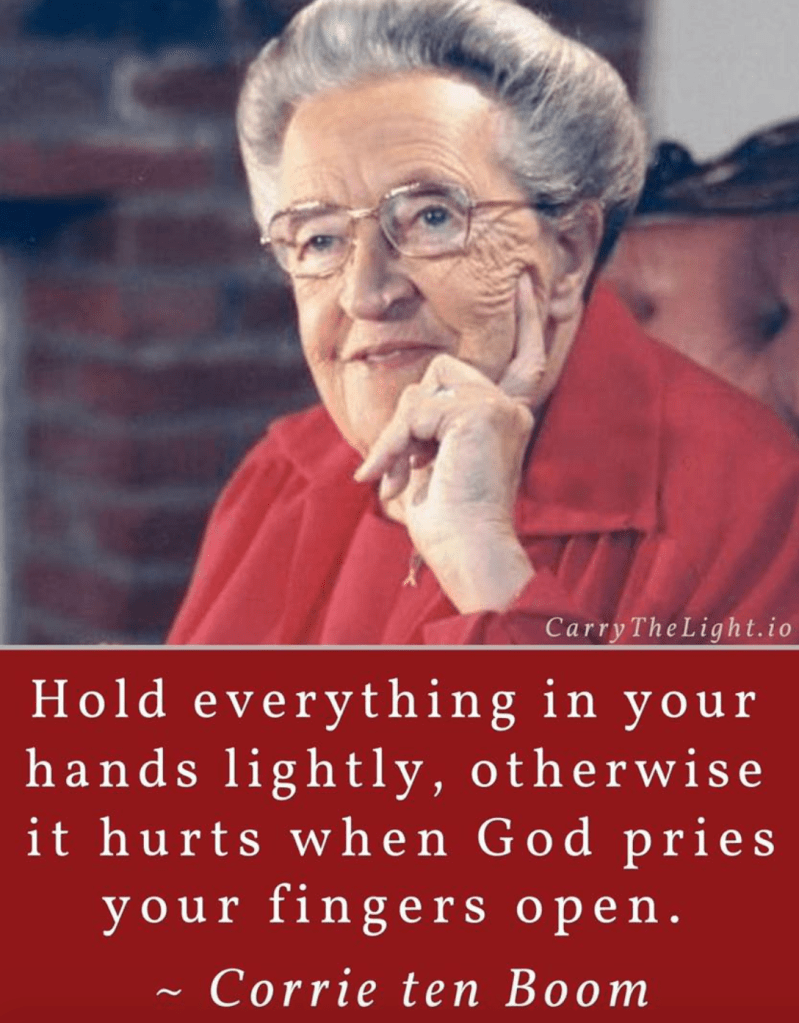
Therefore, it is wise to hold all things loosely, with open hands, and not with clenched fists that believes possessing things in this moment will be permanent. The following are some things to remember:

Remember who is in control

When things are going well, it may create the illusion that I am in charge of the blessing. But, in reality, it was given to you, and it can be taken away, as well.

The only thing you can control are your thoughts, feelings, emotions, choices, actions and the story you are telling yourself about what happened in the past, is happening now, and will happen tomorrow.

We all have our personal invisible backpacks to carry. That backpack is ours, and nobody else’s. Others have their own burdens to carry, which are individual to them. They aren’t yours to carry. Their stories aren’t yours to tell.

God is the Sovereign of the universe, and controls all things. That is God’s burden to carry. Not yours. Carrying the world on your shoulders isn’t your job. So, hold loosely whatever happens on this earth, whether for good or ill. 

Remember that life is both planning and improvisation

We have an agenda, make our plans, and put things in place. Yet, in the execution of doing it, we have to move with whatever circumstances and conditions arise – with whatever life throws our way – and then adjust our expectations.

Remember it’s both in planning and in improvising. The Israelites laid plans to go to Egypt, went there, and then had to deal with changing conditions once they were there. All planning and no improvising is unrealistic; and all improvisation with no plan is flying by the seat of your pants and living in a dream world which doesn’t exist.

What’s more, it might be your plan, or your group’s plan, but it’s not everybody’s plan. They have the freedom to say, “No thank you.” So, be careful to not marry yourself to a particular outcome. Release the urge to cling or obsess about certain expectations. Hold your plans loosely, and plan to improvise.

Remember to cooperate with God

In reality, there is a divine/human cooperative which exists on the earth. Ideally, we are to work together, me doing my part, and God handling the rest. And the both of us constantly must be in dialogue with each other.

When we align with this truth, and participate with God and integrate this cooperative into daily life, then we begin to relax, breathe, move with confidence, and speak with purpose. Head, heart, and gut are no longer disparate parts within me, but work together in a harmonious sync with the Lord.

If this is a challenge for you, set aside some time and be in nature. Look around you and observe all the life thriving right in front of you. Connecting with what is alive connects us to the universal Love which exists everywhere. And that Love can help us and heal us – if we will but let it.

I can hold things loosely because I know the internal pressure of “getting it right” isn’t mine to carry. I can cooperate with God, relax, do my best, and trust.

Blessings are wonderful and abound everywhere. Yet, adversity, acrimony, and even abuse still lurk about in this old fallen world. So, may you learn to hold all things loosely, and live as you know you can, and ought. Amen.

The Plan Comes Together (Genesis 24:10-52)

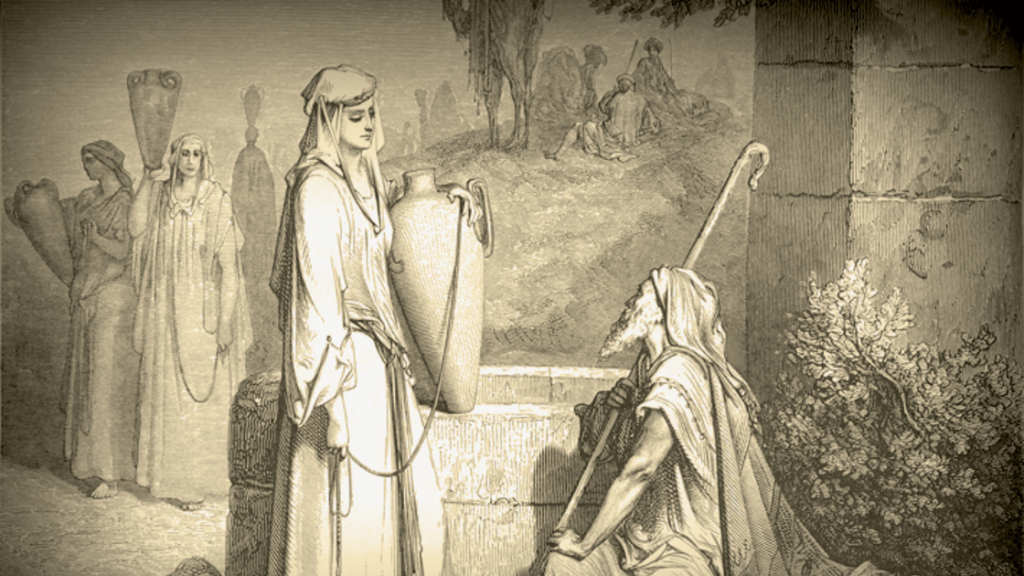
Rebekah and Abraham’s servant, an engraving by Gustave Dore (1832-1883)

Reading Holy Scripture is important. And the way we read it is significant. For the past several years, I have personally made it a practice to always read from the Bible out loud. There is something deeply powerful and impactful about the experience of reading aloud God’s Word.

I also try and read Scripture carefully and slowly. I deliberately make choices about my tone and inflexion, paying attention to which words are emphasized. I try to communicate as best I can the spirit and intent of the words.

I encourage you today to read aloud (and listen to) today’s Old Testament lesson. Take your time. Read it at your own pace. Notice which words you tend to accent, and what the Spirit may be saying to you in the reading…

Soon after that, the servant loaded ten of Abraham’s camels with valuable gifts. Then he set out for the city in northern Syria, where Abraham’s brother Nahor lived.

When he got there, he let the camels rest near the well outside the city. It was late afternoon, the time when the women came out for water. The servant prayed:

You, Lord, are the God my master Abraham worships. Please keep your promise to him and let me find a wife for Isaac today. The young women of the city will soon come to this well for water, and I’ll ask one of them for a drink. If she gives me a drink and then offers to get some water for my camels, I’ll know she is the one you have chosen and that you have kept your promise to my master.

While he was still praying, a beautiful unmarried young woman came by with a water jar on her shoulder. She was Rebekah, the daughter of Bethuel, the son of Abraham’s brother Nahor and his wife Milcah. Rebekah walked past Abraham’s servant, then went over to the well, and filled her water jar. When she started back, Abraham’s servant ran to her and said, “Please let me have a drink of water.”

“I’ll be glad to,” she answered. Then she quickly took the jar from her shoulder and held it while he drank. After he had finished, she said, “Now I’ll give your camels all the water they want.” She quickly poured out water for them, and she kept going back for more, until his camels had drunk all they wanted. Abraham’s servant did not say a word, but he watched everything Rebekah did, because he wanted to know for certain if this was the woman the Lord had chosen.

The servant had brought along an expensive gold ring and two large gold bracelets. When Rebekah had finished bringing the water, he gave her the ring for her nose and the bracelets for her arms. Then he said, “Please tell me who your father is. Does he have room in his house for me and my men to spend the night?”

She answered, “My father is Bethuel, the son of Nahor and Milcah. We have a place where you and your men can stay, and we also have enough straw and feed for your camels.”

Then the servant bowed his head and prayed, “I thank you, Lord God of my master Abraham! You have led me to his relatives and kept your promise to him.”

Rebekah ran straight home and told her family everything. Her brother Laban heard her tell what the servant had said, and he saw the ring and the bracelets she was wearing. So Laban ran out to Abraham’s servant, who was standing by his camels at the well. Then Laban said, “The Lord has brought you safely here. Come home with me. There’s no need for you to keep on standing outside. I have a room ready for you in our house, and there’s also a place for your camels.”

Abraham’s servant went home with Laban, where Laban’s servants unloaded his camels and gave them straw and feed. Then they brought water into the house, so Abraham’s servant and his men could wash their feet. After that, they brought in food. But the servant said, “Before I eat, I must tell you why I have come.”

“Go ahead and tell us,” Laban answered.

The servant explained:

I am Abraham’s servant. The Lord has been good to my master and has made him very rich. He has given him many sheep, goats, cattle, camels, and donkeys, as well as a lot of silver and gold, and many slaves. Sarah, my master’s wife, didn’t have any children until she was very old. Then she had a son, and my master has given him everything. I solemnly promised my master that I would do what he said. And he told me, “Don’t choose a wife for my son from the women in this land of Canaan. Instead, go back to the land where I was born and find a wife for my son from among my relatives.”

I asked my master, “What if the young woman refuses to come with me?”

My master answered, “I have always obeyed the Lord, and he will send his angel to help you find my son a wife from among my own relatives. But if they refuse to let her come back with you, then you are freed from your promise.”

When I came to the well today, I silently prayed, “You, Lord, are the God my master Abraham worships, so please lead me to a wife for his son while I am here at the well. When a young woman comes out to get water, I’ll ask her to give me a drink. If she gives me a drink and offers to get some water for my camels, I’ll know she is the one you have chosen.”

Even before I had finished praying, Rebekah came by with a water jar on her shoulder. When she had filled the jar, I asked her for a drink. She quickly lowered the jar from her shoulder and said, “Have a drink. Then I’ll get water for your camels.” So I drank, and after that she got some water for my camels. I asked her who her father was, and she answered, “My father is Bethuel the son of Nahor and Milcah.” At once I put the ring in her nose and the bracelets on her arms. Then I bowed my head and gave thanks to the God my master Abraham worships. The Lord had led me straight to my master’s relatives, and I had found a wife for his son.

Now please tell me if you are willing to do the right thing for my master. Will you treat him fairly, or do I have to look for another young woman?

Laban and Bethuel answered, “The Lord has done this. We have no choice in the matter. Take Rebekah with you; she can marry your master’s son, just as the Lord has said.” Abraham’s servant bowed down and thanked the Lord. (Contemporary English Version)

How was your experience in reading this story out loud? What did the Spirit bring to you through it? Will you share your experience with us?…