Filled with Divine Fullness (Colossians 2:6-15)

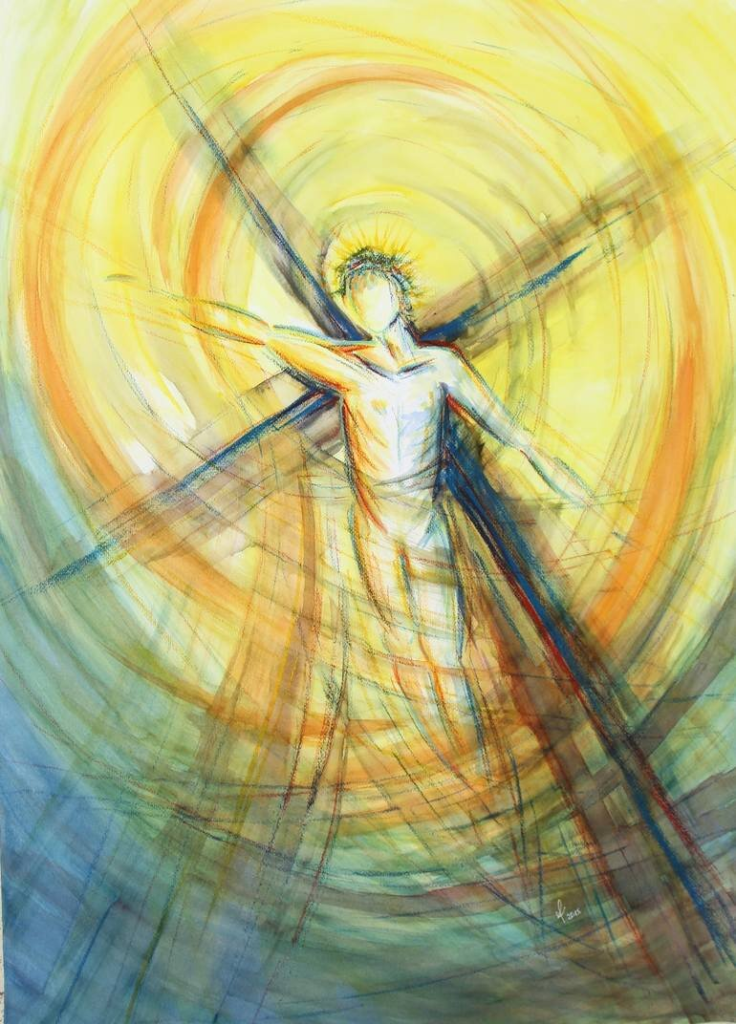
Resurrection, by Oliver Pfaff

As you therefore have received Christ Jesus the Lord, continue to walk in him, rooted and built up in him and established in the faith, just as you were taught, abounding in thanksgiving.

Watch out that no one takes you captive through philosophy and empty deceit, according to human tradition, according to the elemental principles of the world, and not according to Christ. 

For in him the whole fullness of deity dwells bodily, and you have come to fullness in him, who is the head of every ruler and authority. In him also you were circumcised with a spiritual circumcision, by the removal of the body of the flesh in the circumcision of Christ; when you were buried with him in baptism, you were also raised with him through faith in the power of God, who raised him from the dead. 

And when you were dead in trespasses and the uncircumcision of your flesh, God made you alive together with him, when he forgave us all our trespasses, erasing the record that stood against us with its legal demands. He set this aside, nailing it to the cross. He disarmed the rulers and authorities and made a public example of them, triumphing over them in it. (New Revised Standard Version)

On the television gameshow “Let’s Make a Deal,” selected members of the studio audience are offered something of value, and then given a choice of whether to keep it or exchange it for a different item.

The game’s drama is that the other item is hidden from the person until that choice is made. The participant does not know if the alternative item is of equal or greater value; or an item purposely chosen to be of little or no value.

The “deal” with Christianity is that Christians already have something of significant value. But they often lose it by going after something they aren’t even sure they actually want, or not.

Followers of Jesus have been given a valuable gift. And the Apostle Paul’s exhortation to the Church at Colossae was to go ahead and keep going with the prize you already possess.

Believers in Jesus have received him. Therefore, the believer is not to trade the words and ways of Jesus, and the redemption secured in Christ, for something else.

Having been redeemed by the Cross of Christ, believers are deeply rooted in Jesus. They are on a firm foundation of faith. Christians possess a faith full of hope and love.

So then, believers are encouraged by the Apostle Paul to take everything they have been taught, and everything they have received, and run with it.

It doesn’t matter what is behind another door, or what is on the other side of the curtain; grab ahold of what you possess in Jesus Christ. Stop considering a better way to live, and start living the life that’s been given to you.

Allow gratitude and thanksgiving to arise within you, and to come forth out of you. Quit looking how much greener the grass is on the other side of the fence. That pasture isn’t really greener; and there is not really a better way.

Many people have become disillusioned with institutional religion. They’ve had it with church. So, some of them end up throwing out the baby with the bath water, entertaining all sorts of ideas and approaches other than the grace-filled Christianity they once received.

Unfortunately, there are plenty of spiritual charlatans who seek to bedazzle people with fine sounding words. But it’s all nothing but a bunch of pseudo-intellectual philosophical babble.

Yet, because the messenger appears confident and makes grand pronouncements, they let themselves be captured, and go with it. And there are others who become enamored with endless theological talk, that has neither any real effect on one’s daily life, nor eternal life.

The Apostle was warning the Colossian believers about getting lost in the myriad traditions and superstitions that have an absence of Christ in the middle of them.

The way of Jesus has Christ directly and purposefully at the core of one’s life. Anything less is to make a deal and see what is behind another door.

The way of Jesus has very little to do with a particular theological tradition about the end times, or a certain literal interpretive stance, or a liturgical or non-liturgical approach to the Christian life.

Everything of God is right, just, and good. And according to Christianity, it comes through the person and work of Jesus, through Christ’s words and ways as expressed in the New Testament Gospels.

It seems to me that the Apostle Paul would be aghast today at how many supposed Christian believers worship him and his epistles! Instead of giving their full adoration to Christ.

The last word doesn’t come from Paul, but from Jesus. Keep in mind that Paul worshiped Christ, and did not point people to himself as the be-all-end-all of any philosophical approach.
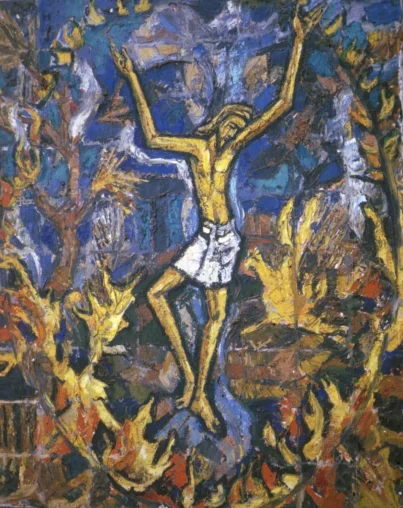
Jesus the Dancer, by Jyoti Sahi

Everything the Christian needs is within the fullness of Jesus Christ.

All things are empty without Christ, including the vast universe. The power and authority of Christ extends over all things and all people everywhere. Paul was insistent on this in all of the churches he established.

Thus, Christians must enter into the fullness of their Lord Jesus.

You can spend a lifetime, even an eternity after death, trying to figure out how God works, but you will never get to the end of it. God’s arm has that long of a reach. The fullness of Jesus is that big and filling. The strength of the Spirit is that powerful.

The heart and center of Christianity has nothing to do with circumcision, modes of baptism, keeping long lists of laws, or maintaining multiple spiritual practices. Because the Christian is already in, and already united with Christ.

This is why Paul prayed for believers to explore and realize what they already have in Christ, so that, with the eyes of their heart enlightened, they may perceive what is the hope to which God has called them, the riches of God’s glorious inheritance among the saints, and the immeasurable greatness of divine power for those who believe. (Ephesians 1:18-19)

The Christian has been spiritually raised from the dead, just as Christ was physically raised from death to life. And believers will also be physically raised, as Jesus was, if they have the spiritual eyes to see it.

Think of all those times in the past when you were stuck, and living a dead-end existence. Remember how God made you alive in Christ. All of your guilt and shame forgiven. All the stuff that kept you down and out, all that kept you from God, was nailed to the Cross of Christ.

The malevolent forces of this world have been stripped of their power, and can be seen as the sham they actually are.

It will not be nearly as valuable nor practical – not even close.

Being grounded in the person and work of Christ is where it’s at, my friend.

Watch out that nobody comes along and tries to sway you from Jesus. Don’t make any deals. You and I have Jesus. He is all we need.

Lord Jesus, you are worthy of our adoration, affection, and allegiance. Because of you, we don’t have to guess what God is like; there is no need to create our own image of God. Everything we need to know about God is revealed in and through you. Along with the Father and the Spirit, you have always existed in perfect relationship and unimaginable wonder.

Blessed Holy Trinity, the God whom I serve, may your divine dance of Father, Son, and Spirit pulsate within me, and flow out of me in a trust that you are enough. Then I will know that I, too, am enough as I avoid the false philosophies and promises of this world.

Almighty God, you fill the center of my being, so that I can let You be You, and so, be content and at peace, despite the alternative voices that chatter constantly around me. May your will be done, today and every day, to the glory of Jesus Christ my Lord. Amen.

Effective Communication (Acts 17:16-31)

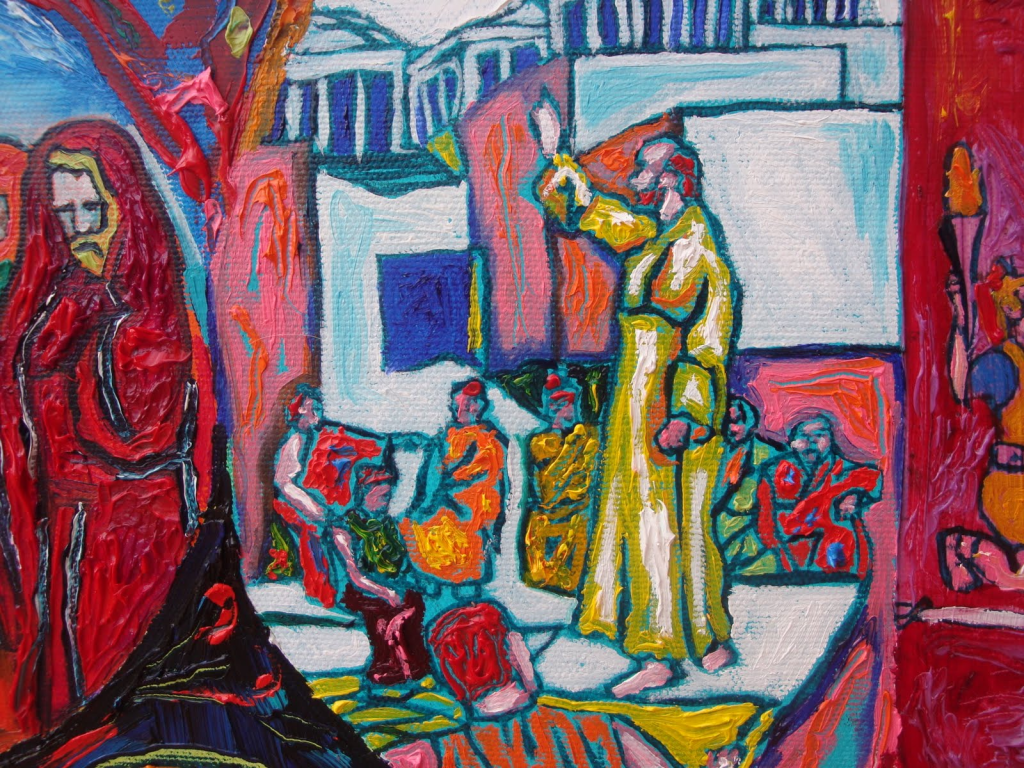
St. Paul preaching at the Areopagus in Athens, by Kennedy A. Paizs

While Paul was waiting for them in Athens, he was deeply troubled by all the idols he saw everywhere in the city. He went to the synagogue to reason with the Jews and the God-fearing Gentiles, and he spoke daily in the public square to all who happened to be there.

He also had a debate with some of the Epicurean and Stoic philosophers. When he told them about Jesus and his resurrection, they said, “What’s this babbler trying to say with these strange ideas he’s picked up?” Others said, “He seems to be preaching about some foreign gods.”

Then they took him to the high council of the city. “Come and tell us about this new teaching,” they said. “You are saying some rather strange things, and we want to know what it’s all about.” (It should be explained that all the Athenians as well as the foreigners in Athens seemed to spend all their time discussing the latest ideas.)

So Paul, standing before the council, addressed them as follows: “Men of Athens, I notice that you are very religious in every way, for as I was walking along I saw your many shrines. And one of your altars had this inscription on it: ‘To an Unknown God.’ This God, whom you worship without knowing, is the one I’m telling you about.

“He is the God who made the world and everything in it. Since he is Lord of heaven and earth, he doesn’t live in man-made temples, and human hands can’t serve his needs—for he has no needs. He himself gives life and breath to everything, and he satisfies every need. From one man he created all the nations throughout the whole earth. He decided beforehand when they should rise and fall, and he determined their boundaries.

“His purpose was for the nations to seek after God and perhaps feel their way toward him and find him—though he is not far from any one of us. For in him we live and move and exist. As some of your own poets have said, ‘We are his offspring.’ And since this is true, we shouldn’t think of God as an idol designed by craftsmen from gold or silver or stone.

“God overlooked people’s ignorance about these things in earlier times, but now he commands everyone everywhere to repent of their sins and turn to him. For he has set a day for judging the world with justice by the man he has appointed, and he proved to everyone who this is by raising him from the dead.” (New Living Translation)

Ancient ruins of Athens, Greece

The city of Athens was a major intellectual center in the ancient world. Ideas, philosophy, reason, rhetoric, and debate were standard fare amongst the citizens. At the time of the Apostle Paul’s arrival in the city, Greece knew next to nothing about Christianity.

Paul’s response to what he saw and felt in the city dictated what he did and said. And those words were wise and impactful for the people of Athens. The Apostle’s interaction with the philosophers was like a seminar in how to communicate with folks who believe and live very differently than ourselves.

Observation

Paul entered the city and made a simple observation: Athens is full of idols. Out of all the observations Paul could have made, this one would not likely be made by most people visiting the city. Athens was a glorious place with its unparalleled architecture. The Acropolis and the Agora were resplendent with the arts and democracy.

For all its physical beauty and brilliance, the one thing Paul homed-in on was the idols. This would have struck many folks as odd – something like focusing on the dog collar instead of the dog. Yet, Paul was using more than his physical eyes – his spiritual sight was making a big observation – that Athens was very much a religious place.

Feeling

The Apostle felt troubled and distressed. Paul was disturbed down deep in his gut with the spiritual state of this renowned city-state. The sheer volume of idols and the practice of idolatry did not sit well with him. He experienced feelings of pity mixed with anger.

Paul handled his emotions well. By freely acknowledging them, he was then able to choose his response. Had he not done so, it’s likely Paul might have gone on some frustrating tirade, thereby never truly connecting relationally with the people. There’s nothing wrong with being irritated or exasperated; it’s what we do with those feelings that’s important.

Need

Emotions, not thoughts, move us to act. Paul knew why he was feeling disturbed, and decided not to stuff those feelings. Instead, he stepped out and addressed the great need he was observing.

Paul decided to meet the Athenians on their turf and on their level by reasoning with them every day in the great buildings and open spaces of the city.

While in Athens, it seems that Paul, understandably, utilized the Socratic method of dialogue – involving questions and answers. It’s impressive that throughout the Acts of the Apostles, Paul demonstrated a deft ability to communicate and connect with a broad range of people.

Appeal

Paul wasn’t interacting and dialoging just for the fun of it; he wanted to make an appeal, a request for people to seriously consider the Christian good news of Jesus Christ’s resurrection as a viable philosophy of life. He made a widespread appeal to Jews, Greeks, and passers-by, as well as philosophers.

Since the massive intellect of Paul could handle any reasoned debate, he was invited to the Areopagus, which was the place where the best-of-the-best carried-on their discussions.

Paul’s address to them was incredibly cogent and well-reasoned – finding common ground from which to debate. While doing so, he maintained outward grace amidst his inward disturbance.

Conclusion

The late British exegete, John R.W. Stott, reflected on today’s New Testament lesson and gave us words which are still relevant for us in these contemporary times:

“Why is it that, in spite of the great needs and opportunities of our day, the church slumbers peacefully on, and that so many Christians are deaf to Christ’s commission, and dumb with tongues-tied in testimony? The major reason is this: We do not speak as Paul spoke because we do not feel as Paul felt. We have never had his indignation. Divine jealousy has not stirred within us. We constantly pray, ‘Hallowed be Thy Name,’ yet we do not seem to mean it… Paul saw people created in the image and likeness of God giving to idols the homage which was due to God alone… and he was deeply pained by it.”

May the good news of Jesus Christ be so pressed into our minds, hearts, and guts that what comes out of us is deep compassion, wise dialogue, and an effective ministry of communication with others. Amen.

1 Corinthians 1:18-31 – The Sixth Sense of Spirituality

For the message of the cross is foolishness to those who are perishing, but to us who are being saved it is the power of God. For it is written:

“I will destroy the wisdom of the wise;
    the intelligence of the intelligent I will frustrate.”

Where is the wise person? Where is the teacher of the law? Where is the philosopher of this age? Has not God made foolish the wisdom of the world? For since in the wisdom of God the world through its wisdom did not know him, God was pleased through the foolishness of what was preached to save those who believe. Jews demand signs and Greeks look for wisdom, but we preach Christ crucified: a stumbling block to Jews and foolishness to Gentiles, but to those whom God has called, both Jews and Greeks, Christ the power of God and the wisdom of God. For the foolishness of God is wiser than human wisdom, and the weakness of God is stronger than human strength.

Brothers and sisters, think of what you were when you were called. Not many of you were wise by human standards; not many were influential; not many were of noble birth. But God chose the foolish things of the world to shame the wise; God chose the weak things of the world to shame the strong. God chose the lowly things of this world and the despised things—and the things that are not—to nullify the things that are, so that no one may boast before him. It is because of him that you are in Christ Jesus, who has become for us wisdom from God—that is, our righteousness, holiness and redemption. Therefore, as it is written: “Let the one who boasts boast in the Lord.” (New International Version)

Although a lot of people are not religious, I believe every person on planet earth is spiritual. By that I mean we all intuitively know deep in our gut that there are bigger things going on in this world beyond our own existence – that there is a transcendent Someone who is higher than us whom we can connect to and helps us connect with one another as humans.

If our epistemology (the study of how we as humans know things) doesn’t allow for transcendent reality, then it is a deficient and truncated philosophy (the study of truth, knowledge, and conduct); it will not be able to accommodate spiritual realities.

There are times you have no explanation for what is happening – no words to describe the experience you went through. That’s because your five senses (taste, sight, touch, smell, and sound), although alert and reliable with taking-in all kinds of sensory data, are simply inadequate to explain the transcendent situation.

I was once talking with an agnostic (a person who denies that ultimate knowledge can be found, or that knowledge can be located ultimately with a god). This particular guy became a father for the first time. He was fresh off the incredible experience of being in the room with his wife when she gave birth to their son. 

Bill (not his real name) was flush with enthusiasm. He took in the sight of his newborn baby boy, held him and touched him for the first time, and joyfully listened to his very first screams of new life in this great big world.  Bill described it all to me with such awe and reverence. 

Then, Bill said something to me that I haven’t forgotten: “I don’t know how to explain it, Tim. Something spiritual happened when my son was born, something I can’t put into words. All I can say is that I experienced something that was not of this world.”

Something not of this world. That was Bill’s way of saying that he had no mental categories from which to draw from to give him any kind of sensory explanation to the awesome reality of being there at childbirth. 

Our five senses are vital, critical, and significant; yet they do not tell the whole story. As important as our ability to taste, see, touch, smell, and hear is, there are other ways of knowing and experiencing life.

Faith and spirituality are the sixth sense which enable us to discern and know things about ourselves, this world, and God – things that we would not know with only our five senses. 

There is a spiritual reality which transcends the physical. The soul, whether we acknowledge we have one or not, is the place of communion with this unseen reality. The inner person is where we meet-up with God and find a vast world of spiritual resources which boggle the five senses. Somehow, we know this is true, even if we have no language to explain it.

Jesus once said that it is the Spirit who gives life; human strength isn’t even a factor (John 6:63). In other words, God is Spirit, and the One who gives meaning, connection, relationship, and even physical life. Human abilities cannot ultimately do this. Yes, we do have biological explanations for human attraction, marriage, and where babies come from; yet this is not the whole story. 

There is a transcendent reality behind it all that gives life meaning and purpose. There are times, once-in-awhile, when the unique, the astonishing, and the beautiful grab us.

Our souls spring to life. We “see” the transcendent and get an awesome glimpse of this place where the physical and the spiritual “touch.”

We “taste” that the Lord is good, and “hear” the call to a deeper experience of recognizing the care and compassion of Christ. 

We take in a deep breath and “smell” the aroma of him who created us in his image and likeness.

Let your senses draw in all the wonderful information it can. And don’t stop there. Allow your soul to drink in the spiritual dimension of wisdom, and feed your inner person with Jesus Christ, who saves us from the sinful and the mundane, and lifts us to the world of the Spirit where there is life, hope, and infinite love.

Holy God, your knowledge of me exceeds what I grasp or see in any moment; you know me better than I know myself. Now, help me to trust in your mercy, to see myself in the light of your holiness, and grant me the grace that I may have true contrition, make an honest confession, and find in you forgiveness and perfect remission. Amen. – A prayer of St. Augustine

Psalm 53 – Is God Gone?

Bilious and bloated, they gas,
   “God is gone.”
It’s poison gas—
    they foul themselves, they poison
Rivers and skies;
    thistles are their cash crop.
God sticks his head out of heaven.
    He looks around.
He’s looking for someone not stupid—
    one man, even, God-expectant,
    just one God-ready woman.

He comes up empty. A string
    of zeros. Useless, un-shepherded
Sheep, taking turns pretending
    to be Shepherd.
The ninety and nine
    follow the one.

Don’t they know anything,
    all these predators?
Don’t they know
    they can’t get away with this,
Treating people like a fast-food meal
    over which they’re too busy to pray?

Night is coming for them, and nightmare—
    a nightmare they’ll never wake up from.
God will make hash of these squatters,
    send them packing for good.

Is there anyone around to save Israel?
    God turns life around.
Turned-around Jacob skips rope,
    turned-around Israel sings laughter.
(The Message)

In 1888, the German philosopher Friedrich Nietzsche published his book, “The Antichrist.” Nietzsche used the phrase, “God is dead,” to express his idea that the Enlightenment, with its thorough rejection of all things subjective and intuitive, and the embrace of everything objective and observable, had eliminated the possibility of the existence of God.

Nietzsche simply named what a modern progressive society had become: drained of divine mystery. He wrote:

“God is dead. God remains dead. And we have killed him. How shall we comfort ourselves, the murderers of all murderers? What was holiest and mightiest of all that the world has yet owned has bled to death under our knives: Who will wipe this blood off us? What water is there for us to clean ourselves? What festivals of atonement, what sacred games shall we have to invent? Is not the greatness of this deed too great for us? Must we ourselves not become gods simply to appear worthy of it?”

Friedrich Nietzsche

This was the nineteenth century equivalent of making the psalmist’s observation that there is a philosophy extant which states, “There is no God.” He’s gone. And humanity has replaced him with themselves.

Unlike Nietzsche, however, the psalmist takes the perspective not of the human but of God. The Lord looks about for someone wise, someone who truly takes notice to see with spiritual eyes, hear with spiritual ears, discern a spiritual touch, smell the aroma of God, and taste that the Lord is good – rather than relying solely on the five senses.

So, where is God? In the grave? No, he is risen, just as he said.

Just because there seems to be an absence of good in the world, doesn’t mean it isn’t there – or that God is gone.

Any fool can make bold proclamations when they are an epistemology all to themselves.

From God’s perspective, anyone can use their five physical senses. To only use them, and completely ignore other ways of knowing, is, well, plain stupid.

Where is God? Not hanging out with fools, drinking cheap dandelion wine and smoking nasty inexpensive cigars. Rather, the Lord is in the company of the righteous with wise persons who discern God’s presence.

Things are not always what they seem. Violence and oppression in the world are not signaling God is on vacation, doesn’t care, or simply doesn’t exist, at all. We must see beyond or through the world’s crud to a Divine Being who is there, reachable, and very much, cares about the state of humanity.

All our posturing and preening to appear we have it all together is nothing more than a poorly produced television reality show to God. So, if the Lord chooses to change the channel, it doesn’t translate that he isn’t viewing the screen. Only a fool believes no one is watching.

If we ignore God, perhaps we shouldn’t be surprised or upset when divine Skittles don’t come raining down from heaven for us to enjoy.

Instead, we are to attend to the spiritual life. There are divine resources available if we will use them. Though they are abundant and free, we still have to ask and receive them with the humility which comes from realizing we aren’t the center of the universe.

Nietzsche is not exactly a person that many Christians would typically acknowledge, let alone refer to, and, for good reason. And yet, he understood that when God is removed from societal norms, it leaves us with a nihilist worldview (the belief that nothing has any inherent importance, and that life lacks purpose).

Christianity and/or a focus on the spiritual life can be, and is, I believe, an antidote to the despair of meaninglessness. If God is truly the ground of moral reality and gives real shape to human purpose, then we have a way to center ourselves. Yet, if God is ignored to the point of being “dead” then there is nothing substantial for humanity to orient their lives around.

Try as we might to create, as Nietzsche did, an Übermensch (superman) in the form of the radically independent and strong person to fill the enormous spiritual void of God’s death, it is merely a façade covering our weakness and foolishness as creatures.

I suggest we consider the psalmist as a reliable source of knowledge – that God is a force for justice and for good in the world – and that we explore what this means for us in our respective lives, families, communities, as well as in our public discourse and personal philosophy.

Is God gone? Not really. We humans just tend to give him the stiff arm.

Almighty God, you called your church to be one, holy, universal and missional people. By your grace you have given us new life in Jesus Christ, and by your Spirit you have called us to proclaim his name throughout the nations. Awaken in us such a love for you and your world that we may boldly proclaim Jesus Christ by word and deed. May all people everywhere come to know you and Christ’s power to save. Amen.