To Forgive Is Divine (Genesis 50:15-26)

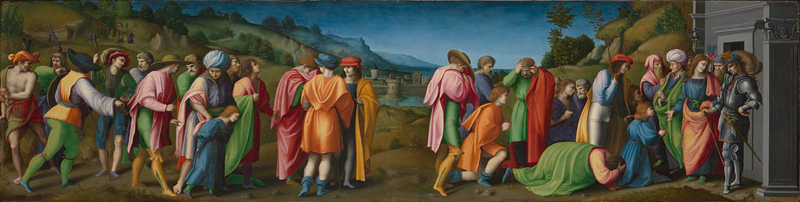
Joseph pardons his brothers, by Bacchiacca (1495-1557) http://www.nationalgallery.org.uk/paintings/NG1219

When Joseph’s brothers realized that their father was now dead, they said, “What if Joseph bears a grudge against us, and wants to pay us back seriously for all of the terrible things we did to him?” So they approached Joseph and said, “Your father gave orders before he died, telling us, ‘This is what you should say to Joseph. “Please, forgive your brothers’ sins and misdeeds, for they did terrible things to you. Now, please forgive the sins of the servants of your father’s God.”’” Joseph wept when they spoke to him.

His brothers wept too, fell down in front of him, and said, “We’re here as your slaves.”

But Joseph said to them, “Don’t be afraid. Am I God? You planned something bad for me, but God produced something good from it, in order to save the lives of many people, just as he’s doing today. Now, don’t be afraid. I will take care of you and your children.” So he put them at ease and spoke reassuringly to them.

Thus Joseph lived in Egypt, he and his father’s household. Joseph lived 110 years and saw Ephraim’s grandchildren. The children of Machir, Manasseh’s son, were also born on Joseph’s knees. Joseph said to his brothers, “I’m about to die. God will certainly take care of you and bring you out of this land to the land he promised to Abraham, to Isaac, and to Jacob.” Joseph made Israel’s sons promise, “When God takes care of you, you must bring up my bones out of here.” Joseph died when he was 110 years old. They embalmed him and placed him in a coffin in Egypt. (Common English Bible)

“All people commit sins and make mistakes. God forgives them, and people are acting in a divine way when they forgive.”

Alexander Pope, “An Essay on Criticism”

If there was anyone who had a supposed right to be bitter and unforgiving, it would be Joseph. His brothers had hated him, left him for dead, sold him into slavery, and lied to their father Jacob about him. For years, Joseph languished in servitude and prison – for no fault of his own.

And yet, Joseph was able to discern that it wasn’t his place to be the judge. At the end of his life, he had the perspective and the insight to understand that all the hardship earlier in his life was noticed by God, and then bent for good and divine purposes in the saving of many lives.

If we can keep in mind that it is God’s business to run the world, and our business to forgive others, then life will go a lot better for everyone.

Many people live discontented lives because they say to themselves, “I will not forget what you did, and I will not forgive.” Persistent thoughts of revenge only serve as a cancer that destroys the mind’s thoughts, erodes the soul, and hinders the heart’s ability to love. 

But people who practice forgiveness are much less likely to be hateful, hostile, and belligerent toward others. They are healthier and happier, and more at peace.

I’ve had many people tell me over the years, “But you don’t know what I’ve been through.” My typical response is, “You don’t know what I’ve been through, either. You may not even believe some of the things I have experienced, and some of the things that have happened to me and were said to me. So, can I tell you what I have done to forgive those who have sinned against me?”

1. When I am trying to forgive someone, I pray for them.

It’s hard to keep resenting someone and wish them ill, whenever you are praying for them on a regular basis. Joseph was the victim of his brothers’ abuse. If there was ever a dysfunctional family to grow up in, it was Joseph’s. Being sold into slavery by your own brothers and being the target of their derision would cause anyone to be upset. But, many years later, Joseph chose to forgive his brothers. He acted with their best interests at mind. He prayed for them and did not actively work against them. What’s more, he saw the hand of God in it all.

2. I write a letter of forgiveness (which I may or may not send).

In the letter I write in full detail how the person hurt me. I leave nothing out. I express exactly how it made me feel, and how it affected my life. Then, I express forgiveness and say that I will not hold the offense over their head. The following is a five-step process for forgiving others using the acrostic REACH:

Recall 

Name the hurt, and name it squarely. Don’t fudge by saying it’s not that bad, or as bad as others have experienced. Call it what it is: deceit, stealing, harassment, assault, abuse, adultery, verbal shaming, murder, etc. 

The Truth and Reconciliation Commission in South Africa after apartheid was based on providing full disclosure of all crimes. Those that stepped forward, giving a complete account of their actions, were offered a full pardon. 

Archbishop Desmond Tutu, who led the commission, was most struck by how many people wanted to hear what had happened to their loved ones from the perpetrators themselves so that they could know whom to forgive. Methinks we have much to learn from our African brothers and sisters.

Empathize

Try and see the offense from the other person’s perspective. Attempt to put yourself in the other’s shoes. This does not mean we paper over the offense; it just means we don’t demonize another as a monster. That only feeds and fuels our own lack of forgiveness. When we view others as non-human, then we feel no responsibility to forgive.

Altruistic

Choose to do the right thing and treat the other person well, not necessarily because they deserve it, but because it is within your control to extend grace. Again, this is what Joseph chose to do with his brothers. He gave them words of assurance, and promises of taking care of them and their children.

Commit

Commit to practicing forgiveness. Make the decision to do it. Don’t wait too long for your feelings to catch up to you.  

Bear with each other and forgive one another if any of you has a grievance against someone. Forgive as the Lord forgave you.

The Apostle Paul (Colossians 3:13, NIV)

Hold

Hold on to your forgiveness. Just because you make the decision to forgive does not mean you’ll never have to do it again. Once you have forgiven, let it be a stake in the ground in which you look back to it again and again, saying, “I forgave him/her, and I will not let the enemy of my soul keep trying to make me bitter about it all over again.” 

One of the reasons we repeat the Lord’s Prayer Sunday after Sunday in my church is to keep forgiving those who have sinned against us.

3. I talk to a trusted friend, mentor, or counselor about my effort to forgive.

Many people get stuck and have an inability to forgive because they don’t seek a wise person to help them walk through the process of forgiving. 

The easy path is to complain about the offense to someone we know who will react with the same level of disgust and spirit of revenge that we ourselves have in our hearts. But that only reinforces the bitterness. We must have someone who can offer us what we need to hear, and not only what we want to hear.

Forgiveness is at the heart of the gospel, and, so, ought to be at the core of a healthy spiritual life. It is always open season on offering grace, forgiveness, and reconciliation. To see all of life from a divine perspective is to forgive.

Pray like this:

Our Father who is in heaven,

uphold the holiness of your name.

Bring in your kingdom

so that your will is done on earth as it’s done in heaven.

Give us the bread we need for today.

Forgive us for the ways we have wronged you,

just as we also forgive those who have wronged us.

And don’t lead us into temptation,

but rescue us from the evil one.

If you forgive others their sins, your heavenly Father will also forgive you. But if you don’t forgive others, neither will your Father forgive your sins. (Matthew 6:9-15, CEB)

Have a Piece of Humble Pie (Romans 9:14-29)

What can we say—that God is unfair? That’s unthinkable! For example, God said to Moses, “I will be kind to anyone I want to. I will be merciful to anyone I want to.” Therefore, God’s choice does not depend on a person’s desire or effort, but on God’s mercy.

For example, Scripture says to Pharaoh, “I put you here for this reason: to demonstrate my power through you and to spread my name throughout the earth.” Therefore, if God wants to be kind to anyone, he will be. If he wants to make someone stubborn, he will.

You may ask me, “Why does God still find fault with anyone? Who can resist whatever God wants to do?”

Who do you think you are to talk back to God like that? Can an object that was made say to its maker, “Why did you make me like this?” A potter has the right to do whatever he wants with his clay. He can make something for a special occasion or something for everyday use from the same lump of clay.

If God wants to demonstrate his anger and reveal his power, he can do it. But can’t he be extremely patient with people who are objects of his anger because they are headed for destruction? Can’t God also reveal the riches of his glory to people who are objects of his mercy and who he had already prepared for glory? This is what God did for us whom he called—whether we are Jews or not.

As God says in Hosea:

“Those who are not my people
I will call my people.
Those who are not loved
I will call my loved ones.
Wherever they were told,
‘You are not my people,’
they will be called children of the living God.”

Isaiah also says about Israel:

“Although the descendants of Israel are
as numerous as the grains of sand on the seashore,
only a few will be saved.
The Lord will carry out his sentence on the land,
completely and decisively.”

This is what Isaiah predicted:

“If the Lord of Armies hadn’t left us some descendants,
we would have been like Sodom and Gomorrah.” (God’s Word Translation)

In Christianity, humility is a virtue. Yet, sometimes Christians forget this, and they have to eat some humble pie.

In other words, there are times we need to be put in our place. It would go a lot better for us if we could just cultivate a humble spirit, rather than have humility forced upon us under embarrassing conditions.

The Apostle Paul realized he needed to make the Roman Church eat some humble pie. They were acting arrogant. The Jewish Christians and the Gentile Christians each thought they were better than the other. So, Paul reminded them both who was really in charge of things.

The proud person’s cry, when things don’t go their way, is “It’s not fair!” That’s because they believe they deserve to have something, to be on top, to call the shots on how things ought to go.

Paul was particularly hard on his fellow Jewish Christians, probably because he was quite familiar with their mindset about Gentiles (non-Jewish persons). The Jews tended to feel superior over Gentiles, and thus, to believe that they have the high ground and the right to trump Gentile thinking.

But Paul also took the Gentile Christians to task. They had a nasty habit of rolling their eyes whenever their Jewish sisters and brothers talked. The Gentiles mostly saw the Jews as hopelessly stuck in their old traditions and ways of doing things. And so, they believed new leadership was needed, wanting those crusty old guys out.

Therefore, each group – both the Jewish Christians and the Gentile Christians – had some major hang up’s about who should be in the Church and heading things up, and who should be out.

The Apostle (bless his exasperated heart) didn’t take sides. That’s because he knew that both groups were being knuckleheads. Each of them needed to get out of their pride. So, Paul cut them each some humble pie and dished it out.

Who is in and who is out is none of their concern. And what’s more, you’re never going to really know why some are in and some are out. The reason is that God is going to do what God is going to do. None of the petty posturing amongst each other means anything. In truth, everything is based on God’s call, and not on human decision, race, ethnicity, gender, politics, or anything else. It all comes down to God, not us.

God makes decisions and extends calls to people, all the time, that we don’t like. And Paul knew this. It is, in fact, what kept him humble. Paul understood he didn’t deserve a thing from God; everything good thing he had came from the Lord.

In his conversion from Jewish Saul to Christian Paul, the Apostle felt the sting of rejection from both groups. The Jews saw him as a traitor, a turncoat. The Gentiles didn’t trust him and wouldn’t accept him. But Paul, having had to eat humble pie himself – dished out by Jesus himself – learned to be patient and gentle. (Acts 9:1-5)

Yet, Paul had his boundaries and his limits. And the Roman Church crossed them. It was time for the entire church to hear a “suck it up, buttercup,” speech.

For the Jewish Christians, they were never “in” just because they were Abraham’s descendants. Abraham was called by God; therefore, everyone is called by God and not the other way around – and God calls whomever God chooses to call. There was nothing in Abraham to warrant a good choice. But God chose him anyway. And if God wants to take some of the Jews, the “chosen” people out, God will do it, because God isn’t accountable to us.

For the Gentile Christians, they weren’t brought “in” because of their own choice. Before they ever had a chance to choose God, God chose them. They were lost in darkness, far from God. But God, by sheer mercy and grace, called the Gentiles. And now that the Gentiles are “in” they can just as easily be “out” if God so chooses.

“The wonder is not that some are saved and others not, but that anybody is saved at all. If we receive what we deserve (judgment) or if we receive what we do not deserve (mercy), then in neither case is God unjust.”

John R.W. Stott

All of this is more than a bunch of power politics from the ancient world; these same dynamics impact us today in quite similar ways.

Any group of people who enjoy privilege over another group needs a slice of humble pie. Any group who continually disparages those in authority also needs a slice of humble pie.

In reality, there are times when every single one of us – including every community, institution, organization, corporation, and nation – needs a stiff reminder of who we really are, why we are really here, and what we are really supposed to be doing.

To eat humble pie means to acknowledge one’s mistake or wrongdoing and accept the humiliation that goes with that acknowledgement. We need to confess our sins and complicity in a host of the world’s ills. And we need to acknowledge that our awful predicaments aren’t just somebody else’s fault; we caused the crud.

We need the humility to ask for help; the humility to work with others very different from ourselves; and the humility to realize we could make the same mistakes again, if not for the grace of God.

Amongst us humans, we are all a community of equals. Yet, amongst God, none of humanity is equal to divinity. A clay pot has neither the right nor the ability to question the potter; they aren’t on the same level.

To enjoy divine privileges never gives us the right to show human prejudice. So let us be people who help one another live according to justice, mercy, and humility – for these are the very things which God calls us to embrace. (Micah 6:8)

Disturb us, Lord, when we are too well pleased with ourselves, and so, disparage others.
Disturb us, Lord, when with the abundance of things we possess, we lose our perspective and believe we are the masters of our own fate.

Disturb us, Lord, to dare more boldly by doing justice, loving mercy, and walking humbly with Jesus, in the enablement of the Holy Spirit. Amen.

Never a Dull Moment (Acts 28:1-10)

Miracle of St. Paul on the Island of Malta, by David Teniers, c.1620

Once safely on shore, we found out that the island was called Malta. The islanders showed us unusual kindness. They built a fire and welcomed us all because it was raining and cold. Paul gathered a pile of brushwood and, as he put it on the fire, a viper, driven out by the heat, fastened itself on his hand. When the islanders saw the snake hanging from his hand, they said to each other, “This man must be a murderer; for though he escaped from the sea, the goddess Justice has not allowed him to live.” But Paul shook the snake off into the fire and suffered no ill effects. The people expected him to swell up or suddenly fall dead; but after waiting a long time and seeing nothing unusual happen to him, they changed their minds and said he was a god.

There was an estate nearby that belonged to Publius, the chief official of the island. He welcomed us to his home and showed us generous hospitality for three days. His father was sick in bed, suffering from fever and dysentery. Paul went in to see him and, after prayer, placed his hands on him and healed him. When this had happened, the rest of the sick on the island came and were cured. They honored us in many ways; and when we were ready to sail, they furnished us with the supplies we needed. (New International Version)

There never seemed to be a dull moment in the life of the Apostle Paul. Throughout his life, he experienced all sorts of extreme circumstances, having survived as if he had the nine lives of a cat.

Once, when in the town of Lystra, Paul had such an impact on the people through his gift of healing, that the crowd believed he must be one of the gods; and they tried to worship him. But when Paul resisted, and a rival group from another town came along and turned the crowd, Paul was stoned and left for dead by the very people who tried to venerate him. (Acts 14:8-20)

So, it’s almost as if today’s New Testament lesson was just another day at the office for the Apostle Paul. After a suspenseful sea voyage, and then the wreck of a Roman prison ship, the drama of Paul’s life just kept going.

One minute, the people on the island in which Paul was shipwrecked were convinced that he’s a murderer, and the next minute they’re ready to assign him as a god. Nobody I’ve ever known can elicit such opposite reactions in such a short period of time – more than once. But that’s our Apostle Paul for you.

Circumstances are circumstances. But the way in which we interpret them is another thing. Take, for instance, the word “change.” For some, change is a wonderful word which brings thoughts of healing and hope. For others, change is a dirty word to be resisted, conjuring up feelings of fear and anxiety.

For one group, never-a-dull-moment is exciting and adventurous. For another group, never-a-dull-moment is nerve wracking and to be avoided at all costs.

Opposite reactions of a group of people comes from the different perspectives of change they see. It isn’t helpful to talk about who is right and who is wrong; the real trick is in how we choose to look at a thing.

I had only one grandparent when I was growing up. My Grandma was seventy-nine years old when I was born, and she lived to be ninety-seven. Even though I always knew her as an old lady, she had a lot of spunk in all ninety-five pounds of her. 

She had an old wooden cutting board in her kitchen. I’m not sure how old it was, but it was likely purchased from Methuselah’s Kitchen Outlet. It was cracked and falling apart. The board had deep furrows in it from the thousands of cuts made on it. Grandma liked her cutting board.

For Mother’s Day one year, my Dad bought her a nice brand new cutting board. And what did my Grandma do?  She put the new board in the back of her cupboard and continued using her nasty old cutting board. 

Whenever my Mom or sisters were in her house and helped her in the kitchen, they were not about to touch that old board; the thing was a bacteria trap. But Grandma didn’t care about bacteria or that it was falling apart. 

My Dad asked her why she did not use her new cutting board. She simply answered, “Oh, it’s much too nice to use.” But we all knew that was Grandma’s way of saying that she liked her nasty old cutting board, didn’t think it was all that bad, and wasn’t getting rid of it.

It seems we all have a bit of Grandma in us, bless her stubborn old heart. We like the way they do things, and really don’t see what another person sees. We don’t see that no one else has an emotional attachment to our cutting board. Sometimes we don’t realize how overwhelming and even intimidating our ways can be for someone else. 

Just imagine being in a new place with people you don’t know. Are you nervous? Does it help to have someone you know bring you and introduce you to people? Is it beneficial to have someone let you know what is happening and what is going on? 

Many years ago, I remember walking into a beautiful new church building, sitting down, and seeing a huge old pulpit that was literally falling apart. Since I’ve been around a lot of churches, I quickly discerned it was likely the old pulpit from the old church building. And, I discovered, it was. But, honestly, I had zero emotional attachment to that pulpit, and it was a distraction because it just looked like a big old ratty collar on a new puppy.

The point is thisOur view of change – whether to do it, or not, to embrace or resist – must be motivated by a solid set of values and a worthy purpose.

Paul put up with a lot, experienced a lot, and never had a dull moment. And he did it without bellyaching. That’s because he was continually focused on his ultimate purpose and values.

Our purpose, like Paul’s, is the Great Commission, to make disciples. (Matthew 28:18-20)

Our values, likewise, are the Great Commandment, to love God and neighbor. (Matthew 22:36-40)

Since our purpose is disciple-making, then we are always to make decisions based upon that standard. Since our values are loving others, then we always know how to go about our purpose.

If any faith community is helping people grow spiritually, then there is no need to change. But if a Christian community has not seen a person come to faith in Christ in the last year, that’s a significant reason to change. If a church has not seen anyone come to Christ in the last five years, then that church is eating meat prepared on a cutting board full of bacteria, and it’s making everyone sick.

Have we taken the old cutting board for granted, and just expect other people to use it if they are in our kitchen? Or do we have a vision, a motivation, and a driving desire to see all sorts of people find new life in Jesus Christ? 

If you don’t like empty seats, or the way things are, then the biblical solution is to change – specifically to change practices, speech, and daily behavior to reach others with the good news of grace. Change, or the lack thereof, for any other reason, is a bad reason to change.

Just so you know, after about a year of sitting in my Grandma’s cupboard, my Dad took out the new cutting board, put it on the kitchen counter and threw away the old board. 

It was about time. Never a dull moment with Grandma around.

Gracious God, we thank you that in love and mercy, you reached out to us. When we were dead in our sins, you sent Jesus to die in our place. Thank you that he humbled himself, even to death on a cross. And thank you that you have a heart that seeks the lost. 

Merciful Lord, please give us hearts that care for people in darkness. Teach us to care for them as you do. Thank you for including us in the mission of reaching other people for your name. Grow us to care for humanity, for the people who haven’t yet come to know and trust in you. Amen.

Do You Really Know? Probably Not (Job 38:22-38)

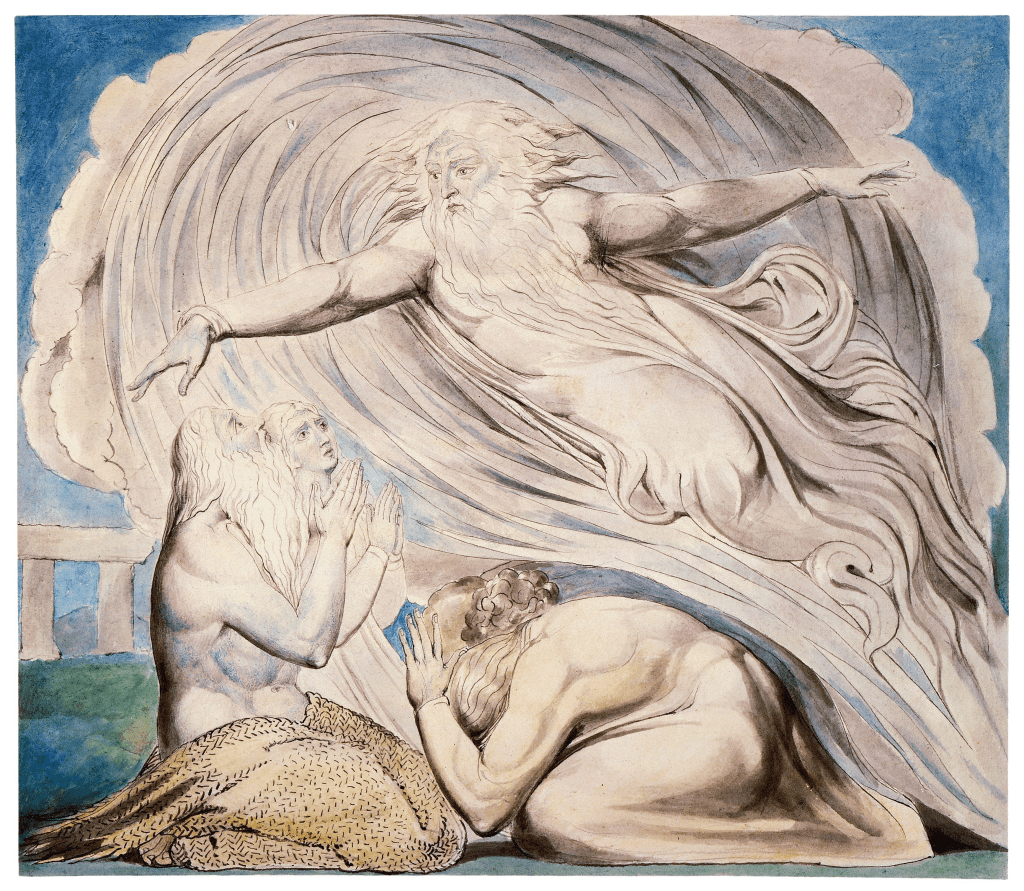
God Answers Job Out of the Whirlwind, by William Blake, 1826

“Have you entered the storehouses of the snow
    or seen the storehouses of the hail,
which I reserve for times of trouble,
    for days of war and battle?
What is the way to the place where the lightning is dispersed,
    or the place where the east winds are scattered over the earth?
Who cuts a channel for the torrents of rain,
    and a path for the thunderstorm,
to water a land where no one lives,
    an uninhabited desert,
to satisfy a desolate wasteland
    and make it sprout with grass?
Does the rain have a father?
    Who fathers the drops of dew?
From whose womb comes the ice?
    Who gives birth to the frost from the heavens
when the waters become hard as stone,
    when the surface of the deep is frozen?

“Can you bind the chains of the Pleiades?
    Can you loosen Orion’s belt?
Can you bring forth the constellations in their seasons
    or lead out the Bear with its cubs?
Do you know the laws of the heavens?
    Can you set up God’s dominion over the earth?

“Can you raise your voice to the clouds
    and cover yourself with a flood of water?
Do you send the lightning bolts on their way?
    Do they report to you, ‘Here we are’?
Who gives the ibis wisdom
    or gives the rooster understanding?
Who has the wisdom to count the clouds?
    Who can tip over the water jars of the heavens
when the dust becomes hard
    and the clods of earth stick together? (New International Version)

The older I get, and the more understanding I gain, the more I realize how little knowledge I truly possess.

When I was eighteen years old, I thought I had the world pretty much figured out. Since then, it’s all been downhill. With each passing year, my ignorance seems to grow. I suppose this all really makes some sense when talking about God’s upside-down kingdom.

There’s so much of life that is a mystery; and as we accumulate our life experiences, it seems all, not just some, of life is a mystical encounter. In other words, the more discernment I gain, I discover I know a lot less than I thought I did.

God Answers Job from the Whirlwind, by William Blake, c.1804

It seems as if the biblical character of Job found this out the hard way. If there is any person in Holy Scripture that would be wise and understanding, its him. God speaks highly of Job in the Bible.

Regarding the upcoming destruction of Jerusalem, God said, “even if these three men—Noah, Daniel and Job—were in it, they could save only themselves by their righteousness, declares the Sovereign Lord.” (Ezekiel 14:14)

Job is held up as the model of patience under suffering: “As you know, we count as blessed those who have persevered. You have heard of Job’s perseverance and have seen what the Lord finally brought about. The Lord is full of compassion and mercy.” (James 5:11)

Yet, with all of Job’s integrity, patience, and righteousness, his understanding barely moves the Richter Scale of God’s expansive knowledge.

We might be somewhat familiar with the story of Job. Being a conscientious follower of God, Job is careful to live uprightly. He acknowledges God in all things and worships him alone. Yet, suffering befell him – for no other reason than that God allowed it. Job knew fully well that there was no personal sin behind his awful ordeal of grief and grinding pain.

So, Job contended with God. For an agonizing thirty-five chapters (Job 3:1-37:24) Job questions God and respectfully takes him to task – as Job’s supposed friends questioned him and assume his guilt. Through it all God is there… silent… saying nothing.

The Desperation of Job, by William Blake, 1821

Then, just when we think God is paying no attention whatsoever, the Lord suddenly speaks.

And what is so remarkable about God’s speech is that for four chapters (Job 38:1-41:34) the Lord gives no answers. It’s all rhetorical questions. God said, “Brace yourself like a man; I will question you and you shall answer me.” (Job 38:3)

It becomes abundantly clear after just a few questions that it would be impossible for any human being to even come close to having the understanding God has. And that was the whole point.

God is God, and we are not. Our questions, however legitimate, real, and raw they are, come from a very puny perspective. Turns out, we just don’t know as much as we think we do.

To Job’s credit, he keeps his mouth shut and listens. At the end of the questioning, Job responds in the only wise way one could, after such an encounter: “Surely I spoke of things I did not understand, things too wonderful for me to know.” (Job 42:3)

None of this means that, for us, we need to face our hardships and our sufferings with a stoic keep-a-stiff-upper-lip approach. Trapped grief will inevitably come out sideways and only cause more hurt. I believe God allowed Job to express his terrible physical, emotional, and spiritual pain for chapter after chapter because he needed to.

Only when God sensed it was the proper timing did he jump in and bring the perspective Job then needed. And even after being challenged by God about his vantage point, Job still did not receive answers as to why he had to endure the awfulness of loss beyond what most of us could comprehend.

Maybe we lack being able to understand, even if God directly answered all our questions. Most likely, God protects us from knowing things that might bring irreparable damage to our human psyches. Again, this is all pure conjecture. Which leaves us with perhaps one of our greatest challenges as human beings:

We must eventually come to the place of being comfortable with mystery – and even embracing it. We simply will not have all things revealed to us that we want to know. And that’s okay.

There is yet one more comment to observe about God’s questioning of Job: God is sarcastic. Sarcasm often gets a bad rap, much like anger does, because it is so often associated with unacknowledged emotions and/or expressing our feelings in an unhelpful way.

Yet, there the sarcasm is, with the God of the universe. I take some odd comfort in knowing that God can be snarky at times – in a good way.

Anytime we try to pin God down to some tidy understandable categories, the Lord typically colors outside our human contrived lines and demonstrates to us that the divine cannot be contained in our ramshackle box.

I like it that God is playful, wild, and free to be God – even if there are times it may bug me.

God is unbound by any human knowledge, understanding, ideas, or plans. God will do what God will do. God will be who God will be. “I AM who I AM.” Now that’s a God I can put my trust in.

O Lamb of God that takes away the sins of the world, have mercy upon me.

O Lamb of God that takes away the sins of the world, have mercy upon me.

O Lamb of God that takes away the sins of the world, grant me your peace. Amen.