
Who Is Jesus? (Luke 2:22-40)

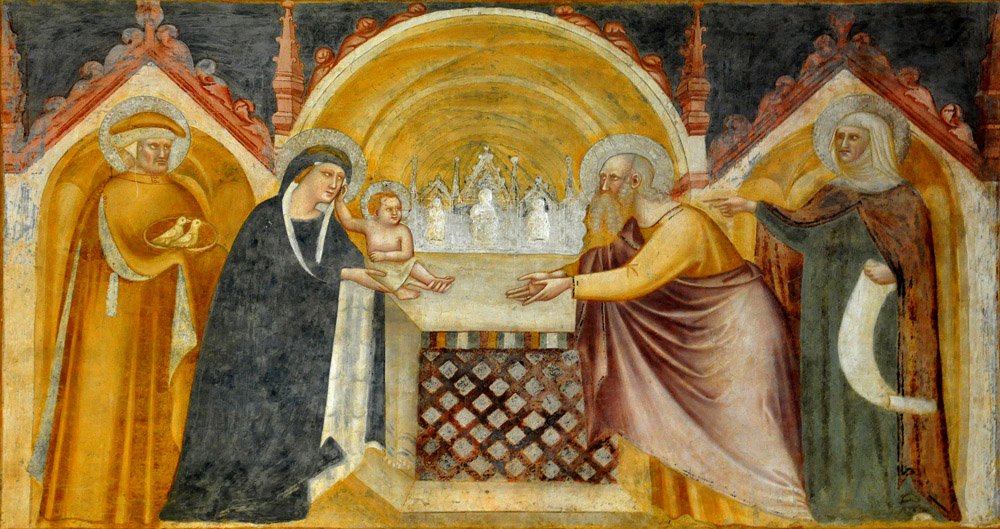
The Presentation in the Temple, 14th century fresco in Pomposa Abbey, Codorigo, Italy

When the time came for the purification rites required by the Law of Moses, Joseph and Mary took him to Jerusalem to present him to the Lord (as it is written in the Law of the Lord, “Every firstborn male is to be consecrated to the Lord”), and to offer a sacrifice in keeping with what is said in the Law of the Lord: “a pair of doves or two young pigeons.”

Now there was a man in Jerusalem called Simeon, who was righteous and devout. He was waiting for the consolation of Israel, and the Holy Spirit was on him. It had been revealed to him by the Holy Spirit that he would not die before he had seen the Lord’s Messiah. Moved by the Spirit, he went into the temple courts. When the parents brought in the child Jesus to do for him what the custom of the Law required, Simeon took him in his arms and praised God, saying:

“Sovereign Lord, as you have promised,
    you may now dismiss your servant in peace.
For my eyes have seen your salvation,
    which you have prepared in the sight of all nations:
a light for revelation to the Gentiles,
    and the glory of your people Israel.”

The child’s father and mother marveled at what was said about him. Then Simeon blessed them and said to Mary, his mother: “This child is destined to cause the falling and rising of many in Israel, and to be a sign that will be spoken against, so that the thoughts of many hearts will be revealed. And a sword will pierce your own soul too.”

There was also a prophet, Anna, the daughter of Penuel, of the tribe of Asher. She was very old; she had lived with her husband seven years after her marriage, and then was a widow until she was eighty-four. She never left the temple but worshiped night and day, fasting and praying. Coming up to them at that very moment, she gave thanks to God and spoke about the child to all who were looking forward to the redemption of Jerusalem.

When Joseph and Mary had done everything required by the Law of the Lord, they returned to Galilee to their own town of Nazareth. And the child grew and became strong; he was filled with wisdom, and the grace of God was on him. (New International Version)

The Gospel accounts of Matthew, Mark, Luke, and John actually contain very little information about the childhood of Jesus. That’s because the Gospels are not biographies – in the sense we think of them – but rather they are narratives that seek to answer a fundamental question about faith and life on this earth: Who is this Jesus?

C.S. Lewis went about exploring that very question. He reasons with us in his classis work, Mere Christianity:

“I am trying here to prevent anyone saying the really foolish thing that people often say about Him: I’m ready to accept Jesus as a great moral teacher, but I don’t accept his claim to be God. That is the one thing we must not say. A man who was merely a man and said the sort of things Jesus said would not be a great moral teacher. He would either be a lunatic — on the level with the man who says he is a poached egg — or else he would be the Devil of Hell. You must make your choice. Either this man was, and is, the Son of God, or else a madman or something worse. You can shut him up for a fool, you can spit at him and kill him as a demon or you can fall at his feet and call him Lord and God, but let us not come with any patronizing nonsense about his being a great human teacher. He has not left that open to us. He did not intend to.”

C.S. Lewis, Mere Christianity

St. Luke’s account of Christ’s childhood stories, seeks to make some important theological points about Jesus:

  • born a Jew amongst devout religious Jews in a thoroughly Jewish society, under Roman authority (Luke 2:1-7)
  • born of a woman, born under the law (Galatians 4:4-5)
  • obedient to his heavenly Father (Luke 2:49; Mark 3:35)
The Presentation in the Temple, 14th century marble statue in the National Museum of the Middle Ages, Paris, France

So, as such, the presentation of Jesus in Jerusalem at the temple is motivated by specific requirements of the law of Moses:

The Lord said to Moses, “Say to the Israelites: ‘A woman who becomes pregnant and gives birth to a son will be ceremonially unclean for seven days…. On the eighth day the boy is to be circumcised. Then the woman must wait thirty-three days to be purified from her bleeding. She must not touch anything sacred or go to the sanctuary until the days of her purification are over….

“‘When the days of her purification for a son… are over, she is to bring to the priest at the entrance to the tent of meeting a year-old lamb for a burnt offering and a young pigeon or a dove for a sin offering….

“‘These are the regulations for the woman who gives birth to a boy… But if she cannot afford a lamb, she is to bring two doves or two young pigeons, one for a burnt offering and the other for a sin offering. In this way the priest will make atonement for her, and she will be clean.’” (Leviticus 12:1-8, NIV)

What’s more, every first-born male (as Jesus was) specifically belongs to the Lord, and is set apart.

The Lord said to Moses, “Consecrate to me every firstborn male. The first offspring of every womb among the Israelites belongs to me… you are to give over to the Lord the first offspring of every womb….”

“In days to come, when your son asks you, ‘What does this mean?’ say to him, ‘With a mighty hand the Lord brought us out of Egypt, out of the land of slavery. When Pharaoh stubbornly refused to let us go, the Lord killed the firstborn of both people and animals in Egypt.

This is why I sacrifice to the Lord the first male offspring of every womb and redeem each of my firstborn sons.’ And it will be like a sign on your hand and a symbol on your forehead that the Lord brought us out of Egypt with his mighty hand.” (Exodus 13:1-2, 12, 14-16, NIV)

Luke was making the connection that when Joseph and Mary presented Jesus to the Lord in Jerusalem, they were essentially dedicating his life to God. Jesus will be the means of redemption for all the people.

Mary would have remembered the words the angel Gabriel told her, that her son will not only be holy, but also be called the Son of God. The life of Jesus – conception, birth, and presentation at the temple – is demonstrably dedicated fully and completely to his heavenly Father. Deliverance for both Jews and Gentiles is focused in the person of Jesus.
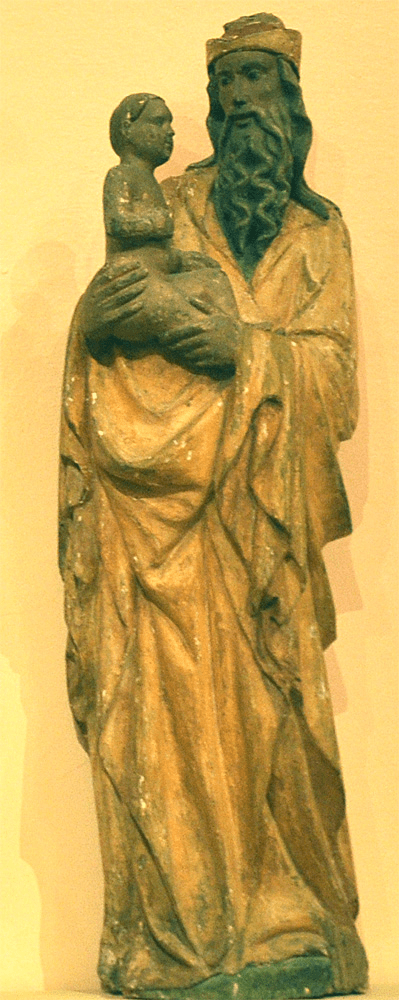
Simeon and the Child Jesus, 16th century statue in Zadar, Croatia

Simeon and Anna show up at the presentation of Jesus as devout Jews who are awaiting the fulfillment of God’s promises of consolation and redemption for Israel.

“I, the Lord, have called you in righteousness;
    I will take hold of your hand.
I will keep you and will make you
    to be a covenant for the people
    and a light for the Gentiles.” (Isaiah 42:6, NIV)

Break forth; shout together for joy,
    you ruins of Jerusalem,
for the Lord has comforted his people;
    he has redeemed Jerusalem.
The Lord has bared his holy arm
    before the eyes of all the nations,
and all the ends of the earth shall see
    the salvation of our God. (Isaiah 52:9-10, NRSV)

Simeon and Anna became the spokespersons for the redemption that is to come through Jesus. They both got a glimpse of the salvation that would, one day, reveal itself to the whole world. Forgiveness of sins, deliverance from death and hell, and freedom from guilt and shame all become laser focused on the suffering servant of God.

Who is Jesus? He is the ultimate meaning of Christmas, the incarnation of the Son of God, the Savior of the world. Amen.

Jesus Is Greater (Hebrews 1:5-14)

Christ the Redeemer, in Rio de Janeiro, Brazil

For to which of the angels did God ever say,

“You are my Son;
    today I have become your Father”?

Or again,

“I will be his Father,
    and he will be my Son”?

And again when God brings his firstborn into the world, he says,

“Let all God’s angels worship him.”

In speaking of the angels he says,

“He makes his angels spirits,
    and his servants flames of fire.”

But about the Son he says,

“Your throne, O God, will last for ever and ever;
    a scepter of justice will be the scepter of your kingdom.
You have loved righteousness and hated wickedness;
    therefore God, your God, has set you above your companions
    by anointing you with the oil of joy.”

He also says,

“In the beginning, Lord, you laid the foundations of the earth,
    and the heavens are the work of your hands.
They will perish, but you remain;
    they will all wear out like a garment.
You will roll them up like a robe;
    like a garment they will be changed.
But you remain the same,
    and your years will never end.”

To which of the angels did God ever say,

“Sit at my right hand
    until I make your enemies
    a footstool for your feet”?

Are not all angels ministering spirits sent to serve those who will inherit salvation? (New International Version)

The people were weary. They were good and faithful Jews in Jerusalem, just trying to worship God and live their lives in faith, patience, and righteousness. And then, through incredible events, they came to believe that Jesus is the promised Messiah. They placed all their hopes and their very lives upon him.

And then, persecution broke out against the believers in Jesus. They were scattered. They fled Jerusalem. The people found themselves as Christian refugees in strange Gentile countries. In those places, they faced hardship and disrespect, not only for being Jews, but for being Christians. In many cases, their families disowned them; and the laws of the land were not good to them.

The believers started off well. But over time, the difficulty began to get to them. The people started wondering if all this commitment to Jesus Christ was worth it, or not. Their spiritual resolve was slowly ebbing away.

The author of Hebrews insists, biblically, that Jesus is superior over everything and everyone. The author stepped into the flagging believers’ situation, and went about answering that question of whether Jesus is truly all he’s cracked up to be. And he began the comparisons of superiority with Jesus over the angels.

Jesus Christ is greater than the angels

Jesus is the Son – the Son of God – which is a way of saying that Jesus is God. And he proved it through his life and ministry, his death and resurrection, his ascension and glorification.

When Jesus began his earthly ministry, he was sent into the desert for 40 days and nights. That experience demonstrated his true muster. Christ fully identified with the people, accomplished what no other human did, and became the pioneer of our salvation.

In bringing many sons and daughters to glory, it was fitting that God, for whom and through whom everything exists, should make the pioneer of their salvation perfect through what he suffered. Both the one who makes people holy and those who are made holy are of the same family. So Jesus is not ashamed to call them brothers and sisters. (Hebrews 2:10-11, NIV)

Jesus Christ has greater dignity than the angels

Unlike angels, Jesus, the Son, is worthy of worship. Angels may be exalted and immortal beings, but they are creatures, just like us humans. Jesus, however, as God, was there at creation. What’s more, Jesus presently holds all things together.

The Son is the image of the invisible God, the firstborn over all creation. For in him all things were created: things in heaven and on earth, visible and invisible, whether thrones or powers or rulers or authorities; all things have been created through him and for him. He is before all things, and in him all things hold together. (Colossians 1:15-17, NIV)

Jesus Christ has a greater status than the angels

Times change. Circumstances change. People are fickle. What is celebrated today is condemned tomorrow, and vice versa. But God never changes in the basic divine character. And God is eternal. Therefore, the Lord Jesus is a solid rock from which to construct a firm spiritual life.

Jesus Christ is the same yesterday and today and forever.

Hebrews 13:8, NIV

Jesus Christ has a greater function than the angels

As the Son of God, Jesus is the sovereign ruler over all things. We do not simply make him the Lord of our lives; he already is that. We just need to acknowledge this reality, submit to Christ’s authority, and persevere in faith. We must continually remember this, or we will become spiritually weary.

So do not throw away your confidence; it will be richly rewarded.

You need to persevere so that when you have done the will of God, you will receive what he has promised. For,

“In just a little while,
    he who is coming will come
    and will not delay.” And,

“But my righteous one will live by faith.
    And I take no pleasure
    in the one who shrinks back.”

But we do not belong to those who shrink back and are destroyed, but to those who have faith and are saved. (Hebrews 10:35-39, NIV)

Christians are never defenseless in this world. God has not only provided salvation through the Son, but has also given the angels to help us sustain our commitment to Christ. God cares so much about us that he has enlisted millions of angels for our benefit, so that we can continue to live out the words and ways of Jesus till the very end of our earthly lives.

God of wonder and of joy: grace comes from you, and you alone are the source of life and love. Without you, we cannot please you; without your love, our deeds are worth nothing. Send your Holy Spirit, and pour into our hearts that most excellent gift of love, that we may worship you now with thankful hearts and serve you always with willing minds; through Jesus Christ our Lord. Amen.

A New Outlook on Life (2 Corinthians 5:17-22)

Therefore, if anyone is in Christ, the new creation has come: The old has gone, the new is here! All this is from God, who reconciled us to himself through Christ and gave us the ministry of reconciliation: that God was reconciling the world to himself in Christ, not counting people’s sins against them. And he has committed to us the message of reconciliation. We are therefore Christ’s ambassadors, as though God were making his appeal through us. We implore you on Christ’s behalf: Be reconciled to God. God made him who had no sin to be sin for us, so that in him we might become the righteousness of God. (New International Version)

Everyone sees things (and people) only in part. We all have our own unique perspective and take on life. And we interpret life from that particular angle.

God has brought us new life, and with it, a new outlook on life, made possible by the person and work of Jesus Christ.

The Apostle Paul gained a new orientation on his life because he encountered God’s love through Jesus Christ. And his experience of love caused Paul to live for Christ and not for himself. He gained a new perspective.

Conversion to Christ and following Jesus brings a new outlook on life that enables us to live a good and beautiful existence on this earth for the sake of the church and the world.

God brings a new outlook to us in three major ways. The way we look at ourselves, others, and God:

  • No longer do we need to compulsively demean ourselves, nor think of ourselves as better than we really are. Instead, encountering a new life in Christ, we see that we are truly loved by God and worthy of giving and receiving love. See what great love the Father has lavished on us, that we should be called children of God! And that is what we are!… This is how we know what love is: Jesus Christ laid down his life for us. (1 John 3:1, 16, NIV)
  • No longer do we view others as tools to take advantage of; and neither do we look merely at one’s outward appearance. Instead, experiencing new life helps us to see other people as spiritual persons, important to God and needing divine love, just like us. This is love: not that we loved God, but that he loved us and sent his Son as an atoning sacrifice for our sins. Dear friends, since God so loved us, we also ought to love one another. No one has ever seen God; but if we love one another, God lives in us and his love is made complete in us. (1 John 4:10-12, NIV)
  • No longer do we view Christ as merely a good teacher or a moral man. Instead, our new life gives us the lenses of seeing Jesus as Savior and Lord. This is how we know that we live in him and he in us: He has given us of his Spirit. And we have seen and testify that the Father has sent his Son to be the Savior of the world. If anyone acknowledges that Jesus is the Son of God, God lives in them and they in God. And so we know and rely on the love God has for us. God is love. Whoever lives in love lives in God, and God in them. This is how love is made complete among us so that we will have confidence on the day of judgment: In this world we are like Jesus. There is no fear in love. But perfect love drives out fear because fear has to do with punishment. The one who fears is not made perfect in love. (1 John 4:13-18, NIV)

With new life comes a new perspective that results in a new way of life. I was once walking with my late mother-in-law through an art museum. We came upon a piece of art that didn’t necessarily speak to me; and I really didn’t understand it. But my mother-in-law happened to know the artist who painted the picture. And she told me about the person, why she painted it, and what she was trying to convey with her art. This information completely changed the way I saw the painting.

As we progressively get to know God, it really ought to transform how we view the Lord and look at Holy Scripture. And when we discover God in Christ, we see a caring Lord who went out of the way to become one of us, become the pioneer of our salvation, and bring about redemption and reconciliation through an ignominious death on a cross.

God has deliberately sought us and brought us back into the divine dance through Christ – which is why we celebrate. And the highest form of celebration is imitation, that is, becoming ambassadors representing who Jesus is by being just like him.

We imitate Christ through our relationships. Whenever we act with humility, mourn over the world’s sin, deal with others according to grace and gentleness, seek right relationships and keep everything above board, are pure, merciful, and peacemaking in all our dealings, and love and pray for our enemies – then we are encountering God, imitating Christ, and living a new life from a new vantagepoint.

Because Christians have been reconciled to God through Jesus, it transforms how we see people and our desires in our relationships with them; and it changes our stance and perspective on the God who initiated and brought salvation and reconciliation to us. I want to:

  • Grow in a relationship with God through worship, prayer, and scripture reading
  • Grow in relationships with other Christians in fellowship, service, and love
  • Grow in relationships with my neighbors and everyone I encounter, to be an ambassador for Jesus, as if God were working through me to accomplish the compassionate loving of the world and demonstrating how to live a blessed and peaceful life.

In finding our true spiritual home, we find life. There’s nothing quite like being able to live a peaceful existence because of God’s reconciling work in Christ on our behalf.

Lord God, bring us together as one, reconciled with you and reconciled with each other. You made us in your likeness, and you gave us your Son, Jesus Christ. Enable us to know you and one another in the spirit of grace and love. Amen.

Access to God (Exodus 24:1-11)

Moses on Mount Sinai, by Jean-Leon Gerome, Moses on Mount Sinai, 1895

Then the Lord said to Moses, “Come up to the Lord, you and Aaron, Nadab and Abihu, and seventy of Israel’s elders, and worship from a distance. Only Moses may come near to the Lord. The others shouldn’t come near, while the people shouldn’t come up with him at all.”

Moses came and told the people all the Lord’s words and all the case laws. All the people answered in unison, “Everything that the Lord has said we will do.” Moses then wrote down all the Lord’s words. He got up early in the morning and built an altar at the foot of the mountain. He set up twelve sacred stone pillars for the twelve tribes of Israel. He appointed certain young Israelite men to offer entirely burned offerings and slaughter oxen as well-being sacrifices to the Lord. Moses took half of the blood and put it in large bowls. The other half of the blood he threw against the altar. Then he took the covenant scroll and read it out loud for the people to hear. They responded, “Everything that the Lord has said we will do, and we will obey.”

Moses then took the blood and threw it over the people. Moses said, “This is the blood of the covenant that the Lord now makes with you on the basis of all these words.”

Then Moses and Aaron, Nadab and Abihu, and seventy elders of Israel went up, and they saw Israel’s God. Under God’s feet there was what looked like a floor of lapis-lazuli tiles, dazzlingly pure like the sky. God didn’t harm the Israelite leaders, though they looked at God, and they ate and drank. (Common English Bible)

Mount Sinai, by Shlomo Katz (1937-1992)

We all know the experience of taking something for granted. Over time, we might fail to appreciate what we truly have and the privilege we enjoy – particularly when it comes to the spiritual life.

In Christianity, believers are invited to come boldly before God in order to receive grace and help in a time of need, because we have been granted access by means of Christ’s blood. (Hebrews 4:16)

What we may, however, lose sight of is that the ability to do this was achieved at a great cost.

For anyone to approach God, there are some things which need to be in place. Getting near to the Lord, without provision for it to happen, is like looking directly into the sun on a cloudless day and expecting to observe it. Some major filtering needs to occur if we’re going to gaze at the sun.

In today’s Old Testament lesson, God makes it possible for the ancient Israelites to come near and enjoy a special relationship with the divine by establishing a covenant. The Lord put everything in place which was needed for an ongoing divine/human connection.

There was a ratification ceremony of this covenant relationship, involving blood, pledges to obey the moral and ethical Law, and a singular devotion and commitment to God alone. It was all topped-off with a meal, eating and drinking in the presence of Yahweh their God. Every ritual was highly symbolic of establishing a tight link between God and God’s covenant people.

Who may ascend the mountain of the Lord?
    Who may stand in his holy place?
The one who has clean hands and a pure heart,
    who does not trust in an idol
    or swear by a false god. (Psalm 24:3-4, NIV)

The trouble is that we cannot make ourselves pure in order to approach a perfectly pure and holy Being. God comes to humanity in waves – over the years, centuries, and millennia – so that we might become ever more close and intimate, as in the original relationship in the Garden.

All of the Law, the sacrifices, and the experiences at the mountain, pointed forward to a much greater fulfillment of the divine/human relationship.

“The days are coming,” declares the Lord,
    “when I will make a new covenant
with the people of Israel
    and with the people of Judah.
It will not be like the covenant
    I made with their ancestors
when I took them by the hand
    to lead them out of Egypt,
because they broke my covenant,
    though I was a husband to them,”
declares the Lord.
“This is the covenant I will make with the people of Israel
    after that time,” declares the Lord.
“I will put my law in their minds
    and write it on their hearts.
I will be their God,
    and they will be my people.
No longer will they teach their neighbor,
    or say to one another, ‘Know the Lord,’
because they will all know me,
    from the least of them to the greatest,”
declares the Lord.
“For I will forgive their wickedness
    and will remember their sins no more.” (Jeremiah 31:31-34, NIV)

This new covenant finds its focus, according to the New Testament, in the person and work of Jesus Christ. Now, the ultimate access and approachability is accomplished by means of the suffering, death, burial, and resurrection of Christ.

Mount Calvary, by William H. Johnson, 1944

Christ did not enter by means of the blood of goats and calves; but he entered the Most Holy Place once for all by his own blood, thus obtaining eternal redemption. The blood of goats and bulls and the ashes of a heifer sprinkled on those who are ceremonially unclean sanctify them so that they are outwardly clean. How much more, then, will the blood of Christ, who through the eternal Spirit offered himself unblemished to God, cleanse our consciences from acts that lead to death, so that we may serve the living God!

For this reason Christ is the mediator of a new covenant, that those who are called may receive the promised eternal inheritance—now that he has died as a ransom to set them free from the sins committed under the first covenant….

When Moses had proclaimed every command of the law to all the people, he took the blood of calves, together with water, scarlet wool and branches of hyssop, and sprinkled the scroll and all the people. He said, “This is the blood of the covenant, which God has commanded you to keep.” In the same way, he sprinkled with the blood both the tabernacle and everything used in its ceremonies. In fact, the law requires that nearly everything be cleansed with blood, and without the shedding of blood there is no forgiveness.

It was necessary, then, for the copies of the heavenly things to be purified with these sacrifices, but the heavenly things themselves with better sacrifices than these. For Christ did not enter a sanctuary made with human hands that was only a copy of the true one; he entered heaven itself, now to appear for us in God’s presence. Nor did he enter heaven to offer himself again and again, the way the high priest enters the Most Holy Place every year with blood that is not his own. Otherwise Christ would have had to suffer many times since the creation of the world. 

But he has appeared once, for all, at the culmination of the ages to do away with sin by the sacrifice of himself. Just as people are destined to die once, and after that to face judgment, so Christ was sacrificed once to take away the sins of many; and he will appear a second time, not to bear sin, but to bring salvation to those who are waiting for him. (Hebrews 9:12-15, 19-28, NIV)

Believers in Jesus remember this covenant each time they gather at the Table, partaking of bread and cup, imbibing deeply of the grace given us.

We have no hoops to jump through; there are no gymnastics we need to perform in order to approach God. The way has been opened. The curtain has been torn. Access to God is available.

I arise early each morning, but it’s not to offer a blood sacrifice. Rather, I have the wonderful privilege of drawing near to God, and offering a sacrifice of praise. Doing this daily routine helps me to remember, and not take for granted, the incredible privilege I have of entering the Lord’s presence.

Gracious and merciful God, forgive me in any way that I have taken you for granted. I thank you for salvation and the spiritual blessings of your presence and power in my life. Help me to always be aware and grateful for Jesus Christ, who with you and the Holy Spirit are one God, now and forever. Amen.