Real Life (1 Thessalonians 3:6-13)

But Timothy has just now come to us from you and has brought good news about your faith and love. He has told us that you always have pleasant memories of us and that you long to see us, just as we also long to see you. Therefore, brothers and sisters, in all our distress and persecution we were encouraged about you because of your faith. 

For now we really live since you are standing firm in the Lord. How can we thank God enough for you in return for all the joy we have in the presence of our God because of you? Night and day we pray most earnestly that we may see you again and supply what is lacking in your faith.

Now may our God and Father himself and our Lord Jesus clear the way for us to come to you. May the Lord make your love increase and overflow for each other and for everyone else, just as ours does for you. May he strengthen your hearts so that you will be blameless and holy in the presence of our God and Father when our Lord Jesus comes with all his holy ones. (New International Version)

What does it mean to really live? Everyone has their own conceptions of what the good life is. But to live life to the full, to really live in sync with how life actually is (and is supposed to be) brings us true satisfaction, contentment, and meaning.

In the radical individualism of the West, it may seem foreign or strange to us that the Apostle Paul’s life was very much bound up in the lives of others – in the churches he established and with the believers who had come to faith in Christ. For Paul, to really live was to see spiritual growth and development in the places where he ministered.

The thing that really got Paul excited, what really melted his butter, was leading others to Christ, forming them into churches, and watching them carry out their missional mandate by doing the same things that he did with them. I can relate to Paul’s joy and satisfaction over Christian discipleship.

There’s nothing quite like mentoring others in the faith, helping them mature in that faith, and sending them out to live according to the model of faith that you’ve demonstrated for them. To see the Word of God take root in individuals and communities of people is like no other sort of joy and contentment.

In the midst of discouraging circumstances of persecution and distressing situations of opposition, it was gratifying, encouraging, and motivating for Paul to hear a good spiritual report from his protégé Timothy about the Thessalonian church’s faith.

Whether we acknowledge it or not, or like it or not, every one of us is inextricably connected to the other. And that is especially true in families, and in the family of God. The Thessalonian believers’ steadfast commitment to Christ and the Christian faith was a crucial and important dimension of Paul’s own persevering faith.

The Apostle had been on the front lines of faith – taking the good news of grace and forgiveness in Christ to the nations. To have his churches endure through all their own troubles and challenges is a great boon to Paul. They each derive confidence and inspiration from the other. Everyone’s faith is confirmed and strengthened when everyone is striving to live for Christ.

All the believers in Christ were really living because they stood firm in the Lord and were immovable in their faith commitments. Assurance and reassurance comes not in isolation, but through the interdependence and interaction with others who share the same values.

Parents don’t really live, unless they see their children living a life of abundant joy and satisfaction. And it’s the same with spiritual mothers and fathers; they truly live when their spiritual children are walking in faith and patience with the Lord.

This is why Paul was grateful and could not thank God enough for the Thessalonians’ life of faith. God’s powerful and gracious work in the church brought out all kinds of thanksgiving. With that sort of dynamic happening, Paul could face any tribulation with the confidence and trust needed to keep going.

Prayer is the logical response to a healthy spiritual and relational dynamic of faith. The greater the good relations, the greater the desire to come and keep imparting needed teaching and encouragement for the Christian life. In other words, spiritual growth begets spiritual growth.

The best way the Thessalonian converts and all the churches become rooted in faith is by God helping them to have their love increase and overflow for each other, and for everyone else. What’s more, God intends that the love Christians have for one another be a model and a witness to and for the world.

Christian community is the place we learn to love. As we practice again and again how to love one another in the church, we then take this love into the world in loving even our enemies. For if we are to follow our model and leader, Jesus Christ, then we will infuse each word and every action with the love of God in Christ – which is the light that draws others into a healthy spiritual and relational dynamic.

We must pray, as Paul did, for love to increase amongst us, so that our hearts are strengthened with genuine purity and holiness of life. For unless love grows and flowers, selfish desires will increase and turn our love inward to the point of taking love away from God and the world.

It is imperative that we have a genuinely loving stance toward each other as believers, and toward others in the world. Apart from this love – given graciously to us through the cross and resurrection of Christ – there is little hope for anything bad in this old fallen world to ever be better.

The bottom line is that churches wither and die because they lose sight of love; Christians lose faith and go their own way because they forget about love; and believers throughout the world continue on because loving prayers, loving ways, and loving words come their way, despite difficulty and hardship they face.

So, let us love one another as Christ loved us. For this is the way our faith is strengthened and our hope is kindled to keep enduring until Jesus returns to this earth and makes all things new and right. This is real life.

May almighty God give you grace to persevere with joy, so that the work of love begun in you may be completed, through Jesus Christ our Lord. Amen.

The End of the World (Matthew 24:1-14)

The Final Sign

Jesus left the temple and was walking away when his disciples came up to him to call his attention to its buildings. “Do you see all these things?” he asked. “Truly I tell you, not one stone here will be left on another; every one of them will be thrown down.”

As Jesus was sitting on the Mount of Olives, the disciples came to him privately. “Tell us,” they said, “when will this happen, and what will be the sign of your coming and of the end of the age?”

Jesus answered: “Watch out that no one deceives you. For many will come in my name, claiming, ‘I am the Messiah,’ and will deceive many. You will hear of wars and rumors of wars, but see to it that you are not alarmed. Such things must happen, but the end is still to come. Nation will rise against nation, and kingdom against kingdom. There will be famines and earthquakes in various places. All these are the beginning of birth pains.

“Then you will be handed over to be persecuted and put to death, and you will be hated by all nations because of me. At that time many will turn away from the faith and will betray and hate each other, and many false prophets will appear and deceive many people. Because of the increase of wickedness, the love of most will grow cold, but the one who stands firm to the end will be saved. And this gospel of the kingdom will be preached in the whole world as a testimony to all nations, and then the end will come. (New International Version)

I am a suspicious person when it comes to end-time gurus. I find most of them to be false teachers, trying to scare people into their own little group, like a bunch of nuts in a fruitcake.

Yet, Jesus is an end-time preacher, giving an answer to those who asked him about the future and how things will literally shake up and shake out at the end of the world. So, because I trust him when he lays out what will happen, I believe there is a time coming when there shall be a judgment of the living and the dead.

Christ’s disciples had heard Jesus pronounce doom on the Jerusalem temple, and wanted to know about when this was going to happen, along with the signs leading to it. Jesus then went on to tell them about a much bigger picture than what the disciples were asking for; Jesus described not only the end of the temple, but also the end of the world as we know it.

I often find myself warning people about buying into those who constantly and confidently talk of the end, as if they have the inside track on it. Jesus did the same; so I’ll take my cues from him. Notice the warnings he offered his disciples concerning signs of the end time:

Don’t let anybody fool you

Watch out for deceivers. False teachers are those who claim to be Christians and have insider information from all their great study. Stay clear of them. Their sense of superiority, because of their supposed knowledge, will trick many people. Don’t be fooled by them.

Don’t be afraid

Anyone who pays any sort of attention to the news – whether local, national, or international – is likely to be concerned about the state of our world. We may even become terrified. But Jesus wants us to avoid being fearful all the time. And that will only happen if we listen as much or more to him than we do people who whip up a frenzy and get us all upset – much like talk radio hosts do to their audiences; or hack preachers do to spiritually vulnerable Christians.

We can be wise and discerning without being fearmongers and constantly worried. In times of crisis and disaster, Christians really ought to be the calmest people on the planet.

Armies may surround me,
    but I won’t be afraid;
war may break out,
    but I will trust you. (Psalm 27:3, CEV)

Wars, rumors of wars, coups, famines, and earthquakes happen. All these, and more, are signs – just like a woman with labor pains, about to give birth. When we look ahead, we may feel apprehensive, upset, and afraid with pain. But our fear will eventually give way to joy. Before things get better, things will get a lot worse. Disaster and destruction will lead to the renewal of all things.

The world will hate you

Because there is fear and deception, the Church will become an oppressed victim. The world hates those who truly follow Christ. All that has been simmering underground will break out in persecution against believers.

So, it ought not surprise any Christian or any Church when there is intolerance and disdain against them. Anyone following Jesus should expect the same treatment he received in his last days on earth.

Many “Christians” will turn against each other and hate each other. They will drop out and refuse association with Christ or his Church. The outside pressure will become intense enough to force a crumbling of the Church on the inside. Parishioners will tear each other to pieces.

Unfortunately, the world’s hate leads to the church’s apostasy – a turning away from faith. And this situation is a ripe situation for false teachers to rise and have their way. People will glory in their shame.

The ones who stick it out will be saved

The true believer holds onto faith, despite the intense pressure of hatred. This isn’t salvation by works; it’s salvation by a faith that is authentic, genuine, and the real deal. This faith remains as a testimony to all that love still exists and will never be extinguished.

And then the end will come.

There shall always be the good news in the middle of all the terribly bad news. Divine sovereignty will always be above the world’s hate and disorder.

Therefore, let the believer be the herald of good news and give themselves to the mission of faith, grace, hope, and love in Christ. No matter where or when you locate the time of great tribulation, it is always open season on gospel proclamation.

God will make something out of nothing. Trouble, hardship, oppression, persecution, and death are the signs of the end. Now is the time for faith and patience. Now is the opportunity to love with the light that penetrates the darkness of hate.

Eternal God, you are the light of the minds that know you, the joy of the hearts that love you, and the strength of the wills that serve you. Grant us to know you that we may truly love you; to love you so that we may truly serve you, through Jesus Christ our Lord. Amen.
The Trumpets of Judgment (Revelation 8:6-9:12)

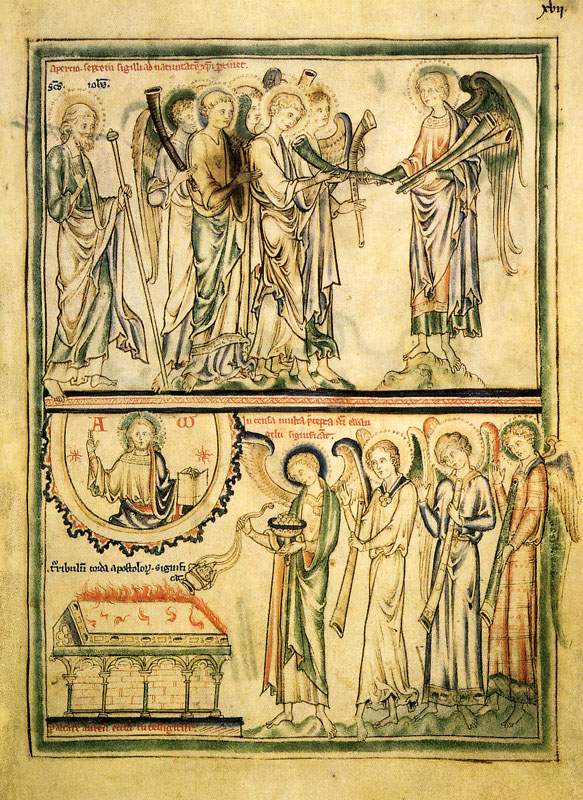
The seven angels with seven trumpets, and the angel with a censer, c. 1020 C. E.

Then the seven angels who had the seven trumpets prepared to sound them.

The first angel sounded his trumpet, and there came hail and fire mixed with blood, and it was hurled down on the earth. A third of the earth was burned up, a third of the trees were burned up, and all the green grass was burned up.

The second angel sounded his trumpet, and something like a huge mountain, all ablaze, was thrown into the sea. A third of the sea turned into blood, a third of the living creatures in the sea died, and a third of the ships were destroyed.

The third angel sounded his trumpet, and a great star, blazing like a torch, fell from the sky on a third of the rivers and on the springs of water—the name of the star is Wormwood. A third of the waters turned bitter, and many people died from the waters that had become bitter.

The fourth angel sounded his trumpet, and a third of the sun was struck, a third of the moon, and a third of the stars, so that a third of them turned dark. A third of the day was without light, and also a third of the night.

As I watched, I heard an eagle that was flying in midair call out in a loud voice: “Woe! Woe! Woe to the inhabitants of the earth, because of the trumpet blasts about to be sounded by the other three angels!”

The fifth angel sounded his trumpet, and I saw a star that had fallen from the sky to the earth. The star was given the key to the shaft of the Abyss. When he opened the Abyss, smoke rose from it like the smoke from a gigantic furnace. The sun and sky were darkened by the smoke from the Abyss. And out of the smoke locusts came down on the earth and were given power like that of scorpions of the earth. 

They were told not to harm the grass of the earth or any plant or tree, but only those people who did not have the seal of God on their foreheads. They were not allowed to kill them but only to torture them for five months. And the agony they suffered was like that of the sting of a scorpion when it strikes. During those days people will seek death but will not find it; they will long to die, but death will elude them.

The locusts looked like horses prepared for battle. On their heads they wore something like crowns of gold, and their faces resembled human faces. Their hair was like women’s hair, and their teeth were like lions’ teeth. They had breastplates like breastplates of iron, and the sound of their wings was like the thundering of many horses and chariots rushing into battle. They had tails with stingers, like scorpions, and in their tails they had power to torment people for five months. They had as king over them the angel of the Abyss, whose name in Hebrew is Abaddon and in Greek is Apollyon (that is, Destroyer).

The first woe is past; two other woes are yet to come. (New International Version)

Angels receiving seven trumpets, c. 1255 C.E.

Woah; this isn’t exactly some light bedtime reading. It has to do with the end of all things, with God’s judgment upon the earth. Seven angels with seven trumpets are about to sound them with disastrous results. The last three trumpets are also referred to as the three woes upon the earth.

The first four trumpets are bad, yet not nearly as terrible as the last three. The first four affect the natural world and one-third of the earth; whereas the last three directly impact the earth’s inhabitants and affect the entire world.

As hard as it may be to accept biblical readings like today’s, God is not only the author of abundant flourishing, but also of devastating destruction. And it’s in direct answer to the prayers of the saints. (Revelation 8:3)

Although hail and blood remind the biblical student of the plagues of judgment in ancient Egypt before the great exodus of Israelites, it’s the fire that does damage to the trees and grass of the earth. A third of the earth’s land resources are completely burned up.

The second angel blowing the second trumpet results in a great mountain being hurled into the sea. This is reminiscent, for those familiar with the Gospels, of Jesus stating that one with a small amount of faith can command a mountain to be thrown into the sea, and it will be done. (Mark 11:23)

Going back into the Old Testament, in the giving of the Law on the mountain, and with the disobedience of the people at the foot of the mountain, Mount Sinai was ablaze with fire and the glory of God. The New Testament scene in Revelation appears to be something of a Mount Sinai taken up and thrown into the sea – signifying that the grace of Christ has supplanted the curse of the law.

As a result of the second trumpet, a third of all the great oceans are destroyed.

Although C.S. Lewis gave the name “Wormwood” to a fictional agent of Satan, the Wormwood here is a messenger of God, a star that falls from the sky as a result of the third trumpet blown. A third of all the earth’s drinkable water becomes bitter because of the star – which seems to be a link to previous times of judgment from God:

“I will make them eat bitter food
    and drink poisoned water,
because from the prophets of Jerusalem
    ungodliness has spread throughout the land.” (Jeremiah 23:15, NIV)

“They have followed the stubbornness of their hearts; they have followed the Baals, as their ancestors taught them.” Therefore this is what the Lord Almighty, the God of Israel, says: “See, I will make this people eat bitter food and drink poisoned water. (Jeremiah 9:14-15, NIV)

There’s nothing that falls from the sky with the blast of the fourth trumpet. Yet a third of the sun, moon, and stars are dimmed. This is a portent that something worse is about to happen – which is what the “eagle” [vulture] announces against the earth’s inhabitants.

Another star falls to the earth, but with even more disaster than the previous star – opening a pit in the heart of the earth. Smoke comes billowing out, darkening the sun. Then, locusts with the stinging power of scorpions, come upon the land.

Rather than humans having authority to trample on snakes and scorpions, these demonic insects carry the ability and the authority to harm humanity – much like the great locust horde of judgment during the time of the prophet Joel (Joel 2:1-11). The difference with John’s Apocalypse is that these are a demonic host with Apollyon the Destroyer leading them.

The previous judgments were from above; this first woe is from below – connecting the powers of death, destruction, and the grave together with the force of evil. It’s a time of sheer torture; a traumatic five months of horrendous agony.

Conclusion

None of these terrible scenes of judgment are meant to scare the hell out of anybody and put the fear of heaven into them. Instead, the New Testament book of Revelation (also known as the Apocalypse of John) is meant for devoted believers in Jesus to be encouraged that an end is coming. They can persevere in following Jesus because it will be worth it.

The hardships, difficulties, and persecutions experienced – for following the words and ways of Jesus – will not last; a time is coming soon when God will judge the living and the dead. Evil will be dealt its final blow. And we will enter a realm of unending peace with the God for whom we have given our all.

Therefore, since we are receiving a kingdom that cannot be shaken, let us be thankful, and so worship God acceptably with reverence and awe, for our “God is a consuming fire.” (Hebrews 12:28-29; Deuteronomy 4:24)

May the Lord answer you in the day of trouble!
    The name of the God of Jacob protect you!
May he send you help from the sanctuary
    and give you support from Zion.
May he remember all your offerings
    and regard with favor your burnt sacrifices. Selah

May he grant you your heart’s desire
    and fulfill all your plans. Amen. (Psalm 20:1-4)

Remember… (1 Thessalonians 2:9-13)

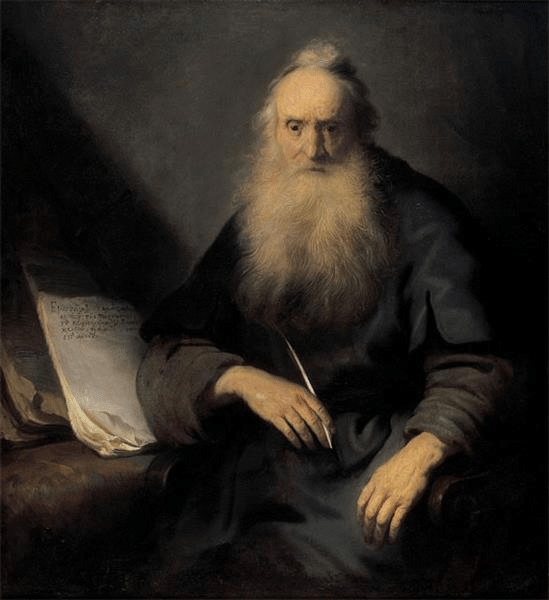
St. Paul writing to the Thessalonians, by Jan Lievens, c.1629

Surely you remember, brothers and sisters, our toil and hardship; we worked night and day in order not to be a burden to anyone while we preached the gospel of God to you. You are witnesses, and so is God, of how holy, righteous and blameless we were among you who believed. For you know that we dealt with each of you as a father deals with his own children, encouraging, comforting and urging you to live lives worthy of God, who calls you into his kingdom and glory.

And we also thank God continually because, when you received the word of God, which you heard from us, you accepted it not as a human word, but as it actually is, the word of God, which is indeed at work in you who believe. (New International Version)

The Christian believers in Thessalonica were becoming discouraged. The church sincerely believed that Jesus was coming soon… any day he could show up!

But as time went on, and Jesus was still nowhere to be seen…

the Thessalonians began losing their spiritual resolve…

started wondering if they had missed out on something…

began doubting if it was all real…

started slipping spiritually.

Missed expectations can be difficult to deal with. Maybe we have been praying for someone or something for so long that we wonder if it will really happen; or secretly question if something is wrong with us. Yet, maybe God simply wants us to wait… to be patient and to persevere… maybe the answer is closer than we think.

Since the church was becoming discouraged, the Apostle Paul reminisced with them. He wanted them to remember and not forget about what God had done in their lives. The Thessalonians desperately needed a faith for the long haul.

Remembering is a prominent theme in Scripture. Well over a hundred times we are told to remember:

  • God’s covenant and actions on behalf of people
  • Those less fortunate than us
  • Important people in our lives who influenced us in our journey of faith

In order to steel the church for a faith that lasts a lifetime, Paul reminded them of his own example, his own character, his ministry among them, and how they initially came to faith.

Paul was trying to inspire the believers with his own model of faithfulness, so that they would persevere in their Christian lives and not give up. He reminded them of his hard work in order to preach the gospel to them. The picture that Paul painted for them is having done whatever it took to make the good news of Jesus Christ known to the Thessalonians. 

Who were the people in your life that went out of their way to communicate the gospel to you both with words and with actions? 

Who were those persons who labored behind the scenes in prayer so that you and others would know Jesus? 

If any of those persons are still around, and you know where they are, remember them. Drop them a note. Express to them a simple thank you for their influence in your life. In doing so, you will not only encourage that person, but it will help you remember and re-engage with something in your life that you may have forgotten or taken for granted.

Paul was not shy about reminding the Thessalonians concerning the way in which he interacted with them. He did this not because he was trying to illicit some praise for himself, but because he wanted the church to emulate his character. 

That particular character is described as holy, righteous, and blameless. And we are to emulate Paul in these character qualities. These three words refer to the full range of relationships we encounter on a daily basis: with God, the church, and the community. 

Holiness in our relationship with God means that we have been set apart completely in Christ, so that we say and do nothing impure. 

Righteousness in our interactions with fellow believers in Jesus means we are in right relationship with them, so that there is nothing that hinders or stands between us. 

Blamelessness in our relations with the world means that the ways we live and work among outsiders are ethical and consistent with being a Christian.

Paul described his ministry as one of encouraging, comforting, and urging the believers to live lives worthy of God. He expected the Thessalonians to live into their callings as believers in Jesus. 

Encouragement refers to the ministry of coming alongside others and telling them what they need to do both in teaching and by example. Comfort refers to consoling others with the gospel. The word “urge” in the NIV is the word for “witnessing” which is a reference to the reality that Paul was constantly living his life in such a way that proclaimed Jesus to others.

The Thessalonians had received the Word of God; and this was an occasion to thank God for it. Each time we recall and remember what God has done for us through others and through God’s Word, we need to offer thanks. God’s Word is implanted within us, then takes root, grows, and produces a harvest of righteousness for those who have been disciplined by it.

We must remember those who brought us the Word of God; and to remember how they treated us, and what they did for us. Then, we must be obedient to what we learn. 

There are several needs we have as followers of Christ: 

  • intimate relationships in the church
  • to be mentored, and mentor others, in the faith
  • the power of God’s Word
  • our callings as Christians 

We forget these needs too easily – which is why repetition is a good thing. For example, each time we celebrate a baptism, it causes us to remember our own baptisms, and to live into our callings as Christians. Or when we move through the worship liturgy, we remember our sinfulness, God’s forgiveness, and our responsibility to live according to God’s Word. 

Our lives, our work, and our worship might seem plain and ordinary. However, the majority of life is lived in the mundane. The tangible reminders we can put in front of us are important, so that we never forget the spiritual experiences God has given us. (i.e. Deuteronomy 27:2-3)

We are meant to live our Christian lives in a vital connection with Christ and other believers. We will continue to persevere and thrive in the faith, when we remember those who have gone before us, and allow those here in the present to journey with us along this road of faith.

Blessed God, continue the good work begun in me; that increasing daily in wholeness and strength, I may rejoice in your goodness; and so order my life always to think and do that which pleases you, through Jesus Christ our Redeemer. Amen.