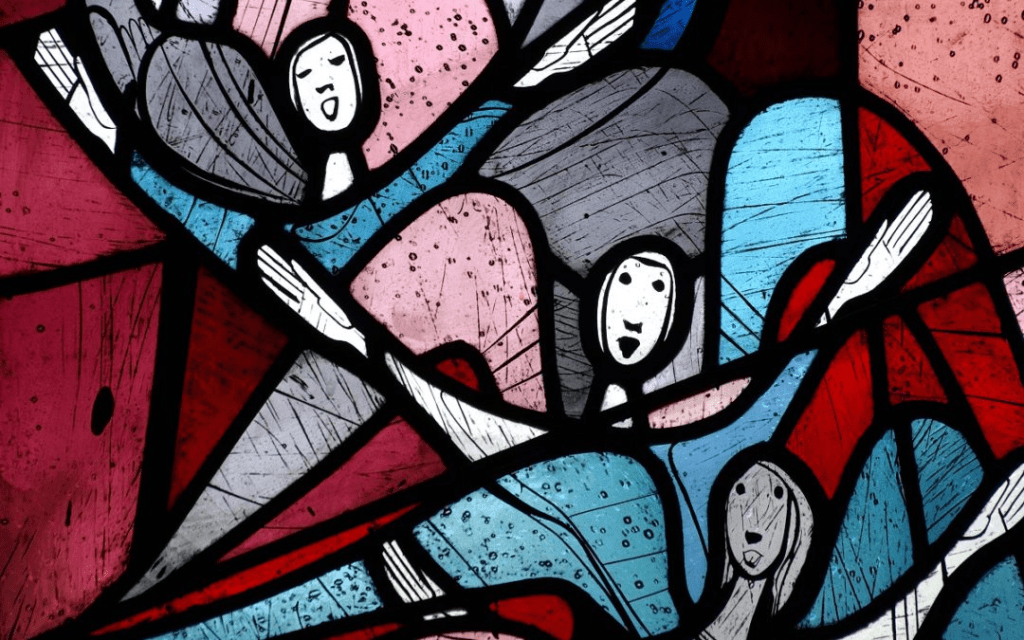
The Time Is Near (Revelation 22:8-21)

“The Time Is Near, Revelation 22:10-12” by Anthony Falbo, 2019

I, John, am the one who heard and saw these things. And when I had heard and seen them, I fell down to worship at the feet of the angel who had been showing them to me. But he said to me, “Don’t do that! I am a fellow servant with you and with your fellow prophets and with all who keep the words of this scroll. Worship God!”

Then he told me, “Do not seal up the words of the prophecy of this scroll, because the time is near. Let the one who does wrong continue to do wrong; let the vile person continue to be vile; let the one who does right continue to do right; and let the holy person continue to be holy.”

“Look, I am coming soon! My reward is with me, and I will give to each person according to what they have done. I am the Alpha and the Omega, the First and the Last, the Beginning and the End.

“Blessed are those who wash their robes, that they may have the right to the tree of life and may go through the gates into the city. Outside are the dogs, those who practice magic arts, the sexually immoral, the murderers, the idolaters and everyone who loves and practices falsehood.

“I, Jesus, have sent my angel to give you this testimony for the churches. I am the Root and the Offspring of David, and the bright Morning Star.”

The Spirit and the bride say, “Come!” And let the one who hears say, “Come!” Let the one who is thirsty come; and let the one who wishes, take the free gift of the water of life.

I warn everyone who hears the words of the prophecy of this scroll: If anyone adds anything to them, God will add to that person the plagues described in this scroll. And if anyone takes words away from this scroll of prophecy, God will take away from that person any share in the tree of life and in the Holy City, which are described in this scroll.

He who testifies to these things says, “Yes, I am coming soon.”

Amen. Come, Lord Jesus.

The grace of the Lord Jesus be with God’s people. Amen. (New International Version)

“St. John the Divine” by David Raber, 2013. The top corners are the Greek letters Alpha and Omega, representing the Beginning and the End; the corresponding letters in Hebrew are at the bottom corners. The Apostle John holds a scroll, a symbol of Christ as the Lamb of God who takes away the sins of the world.

The very last chapter of the big thick Bible let’s us know that the time is near for the end of the world as we know it. Jesus himself tells us that he is coming soon. That might sound weird, considering we are reading Christ’s words two millennia later. There’s nothing soon about 2,000 years in the past. So, how can the time of Christ’s return be “soon?”

Time is viewed differently by God than by us, especially in this modern and/or postmodern era. Whereas we orient ourselves around chronological time by measuring minutes and hours, the Lord is much more event oriented.

Throughout Holy Scripture we have major events of creation, fall, and redemption. Now, there is only one event left on God’s celestial timetable: Christ coming to judge the living and the dead, and the full establishment of a world without any sin or Satan. In that sense, the time is near and very soon.

“Time” itself is really a human yardstick. It’s merely the relationship between events – and we humans like our measurements and metrics. Yet, the Lord is above time. God simultaneously sees the past, present, and future. And when all things are eventually made right, there will be no need for time anymore because all events have run their course.

But how does any of that stuff about time help me in the here-and-now?

We still have time. As long as it is still Today, everyone has the opportunity to change, to do better, to “come” to the eternal wellspring of living water.

None of our lives can ever be reduced to a single event or action. The screw-up or outright sin that we did back there in our lives doesn’t define us. If it did, all of us would be soundly condemned. Instead, it is the habitual offenders, the ones who repeatedly and intentionally do wrong and/or chronically ignore their fellow humanity (and God); it is they who shall be on the outside of a restored Paradise.

So, it’s not too late. The call is out. Jesus himself invites everyone who hears to come.

And since the call is out there, ringing in history for the past two-thousand years, a warning is there for those who either subtract or add to the simple invitation.

Yet no matter the past guilt nor the present moment, grace is the final word. It is, quite literally, the final verse of the Bible.

In a book filled with a vision of end time judgment, it is divine graciousness which has the ultimate and final say. Even with a world under a curse, and with the earth facing judgment, divine blessings abound. The word “blessing” in Scripture simply means to have God’s stamp of approval. Within John’s Apocalypse, we have several instances of blessing:

God blesses (approves) the one who reads the words of this prophecy to the church, and he blesses all who listen to its message and obey what it says, for the time is near. (Revelation 1:3, NLT)

Then I heard a voice from heaven say, “Put this in writing. From now on, the Lord will bless everyone who has faith in him when they die.” The Spirit answered, “Yes, they will rest from their hard work, and they will be rewarded for what they have done.” (Revelation 14:13, CEV)

“Keep watch! I come unannounced, like a thief. You’re blessed if, awake and dressed, you’re ready for me. Too bad if you’re found running through the streets, naked and ashamed.” (Revelation 16:15, MSG)

Then the angel said to me, “Write the following: Blessed are those who are invited to the banquet at the wedding celebration of the Lamb!” He also said to me, “These are the true words of God.” (Revelation 19:9, NET)

Blessed and holy are those who share in the first resurrection. Over these the second death has no power, but they will be priests of God and of Christ, and they will reign with him a thousand years. (Revelation 20:6, NRSV)

“Listen, I am coming soon! Great blessings belong to the one who obeys the words of prophecy in this book.”

Jesus (Revelation 22:7, ERV)

God’s grace allows us to have solidarity with one another as believers throughout the world, no matter the culture, no matter the church or particular Christian tradition.

Grace strengthens us to persevere and labor in hope, no matter the naysayers around us.

Grace gives us courage to face both our present troubles and future uncertainties, no matter the anxiety which fills the earth.

The presence of God is grace. Christ is alive and will come very soon. Be ready, my friends. The time is near.

May you walk in a manner worthy of our spiritual calling and draw near to Christ so you can triumph over the sufferings of this present time.

May you taste and see the goodness of the Lord and be assured of God’s great love for you.

And may the blessing of almighty God – Father, Son, and Spirit – abide with you always. Amen.

A Living Hope (1 Peter 1:3-9)

Let us give thanks to the God and Father of our Lord Jesus Christ! Because of his great mercy he gave us new life by raising Jesus Christ from death. This fills us with a living hope, and so we look forward to possessing the rich blessings that God keeps for his people. He keeps them for you in heaven, where they cannot decay or spoil or fade away. They are for you, who through faith are kept safe by God’s power for the salvation which is ready to be revealed at the end of time.

Be glad about this, even though it may now be necessary for you to be sad for a while because of the many kinds of trials you suffer. Their purpose is to prove that your faith is genuine. Even gold, which can be destroyed, is tested by fire; and so your faith, which is much more precious than gold, must also be tested, so that it may endure. Then you will receive praise and glory and honor on the Day when Jesus Christ is revealed. 

You love him, although you have not seen him, and you believe in him, although you do not now see him. So you rejoice with a great and glorious joy which words cannot express, because you are receiving the salvation of your souls, which is the purpose of your faith in him. (Good News Translation)

There’s no need for hope if everything’s going just the way you like it. I remember when I was a college undergraduate, I hoped for Christ’s return toward the end of every semester. The prospect of all those final exams and the pressure of grades had me longing for heaven.

But that’s life. Maturity, resilience, perseverance, and just about every virtue you can think of comes as a result of life’s trials and sufferings. The Christian has hope, precisely because things aren’t the way they’re supposed to be.

Faith has to be tried and tested. And hard circumstances are the way of purifying it. Like gold being purged of any dross by being exposed to extreme heat, so our faith becomes strong, robust, and genuine by the purgative fires of life’s many large and small sufferings.

The whole point of it all is to make us people worthy of our spiritual calling. Resurrection only happens because there’s been a death. Glory is only realized through suffering.

New life, the Christian life, isn’t a matter of making a new set of resolutions, as if it were nothing more than aspirations at the beginning of a calendar year. Rather, Christian faith is a response to the mercy of God in Jesus Christ.

One of my all-time favorite stories is Victor Hugo’s Les Miserables. It’s a story of grace and new life, of a hopeless man given the chance at hope.

The main character is Jean Valjean, who spends nineteen years in jail for stealing a loaf of bread for his starving family. The experience in prison caused him to become a bitter and cynical man. After his release, Jean Valjean has nowhere to go. 

In desperation, he seeks lodging one night at the home of a Catholic bishop, who treats him with genuine kindness, which Valjean sees only as an opportunity to exploit. In the middle of the night, he steals the bishop’s silver and skedaddles. 

The next day, however, Valjean is caught by the police. When they bring him back to the bishop’s house for identification, the police are surprised when the bishop hands two silver candlesticks to Jean, implying that he had given the stolen silver to him, saying, “You forgot these.” 

After dismissing the police, the bishop turns to Jean Valjean and says, “I have bought your soul for God.” In that moment, by the bishop’s act of mercy, Valjean’s bitterness is broken. Hope springs to life.

Jean Valjean’s forgiveness is the beginning of a new life. The bulk of Victor Hugo’s novel demonstrates the utter power of a redeemed life. Jean chooses the way of mercy, as the bishop had done. Valjean raises an orphan, spares the life of a parole officer who spent fifteen years hunting him, and saves his future son-in-law from death, even though it nearly cost him his own life. 

“Jean Valjean, my brother, you no longer belong to what is evil but to what is good. I have bought your soul to save it from black thoughts and the spirit of perdition, and I give it to God.” ― Victor Hugo, Les Misérables

Throughout Jean Valjean’s new life, there are trials and temptations all along the way. Yet, mercy keeps his faith strong, and hope kindled. Whereas before, Valjean responded to mercy with a brooding melancholy and inner anger, now – after being shown grace – he responds to each case of unjust suffering with gratitude, deeply thankful for the chance to live a new life full of grace.

Hope is kept alive because of suffering. Faith is strengthened by means of adversity. And both originate because of mercy and grace.

Christianity is a worldview perspective that enables one to rejoice in difficulty. For the Christian, there is no empty meaningless grief; there is the hope that our suffering means something. Like the athlete who endures all the painful practice in order to realize a future hope, so the believer in Jesus goes into strict training for the development of faith – all in the confident expectation of a fulfilled salvation.

It’s a hard lesson to learn, this seemingly weird alchemy of faith, suffering, hope, joy, and new life. And every generation of Christians needs to experientially discover it. Each believer eventually learns, in the crucible of hard circumstances, that the promises of God are the ballast to persevere in faith and patience throughout life.

Christian hope is a confident expectation that the promises of God will be completely realized.

A Christian’s salvation encompasses past, present, and future.

We were saved back there in the past when Christ died on the cross for us. We were crucified with him.

We are presently being saved from the world, the sinful nature, and the devil, through the sanctifying work of the Spirit in making us holy.

And we will be saved in the future when Christ returns to judge the living and the dead. Then, our salvation will be fully realized. Since that hasn’t happened yet, we have hope to sustain us.

It was hope that sustained me in college. I endured all the hours of study, all the exams, all the various courses taken, with the confident expectation that I would someday walk across that stage, receive my diploma, and graduate with my intended degree.

We ourselves, who have the first fruits of the Spirit, groan inwardly as we wait eagerly for our adoption to sonship, the redemption of our bodies. For in this hope we were saved. But hope that is seen is no hope at all. Who hopes for what they already have? But if we hope for what we do not yet have, we wait for it patiently. (Romans 8:23-25, NIV)

The Christian’s hope for ultimate deliverance is imperishable, undefiled, and unfading. This means we can live through a difficult day or week or month or a year, or even decades, with spiritual endurance. Our goal shall come in all its fullness. 

Then I saw a new heaven and a new earth, for the first heaven and the first earth had passed away, and the sea was no more. And I saw the holy city, the new Jerusalem, coming down out of heaven from God, prepared as a bride adorned for her husband. And I heard a loud voice from the throne saying,

“See, the home of God is among mortals.
He will dwell with them;
they will be his peoples,
and God himself will be with them and be their God;
he will wipe every tear from their eyes.
Death will be no more;
mourning and crying and pain will be no more,
for the first things have passed away.” (Revelation 21:1-4, NRSV)

Eventually, suffering will have done its work and we will be with Christ forever. Until that day, let us explore all that God has for us, embracing both the meaning and the mystery of faith. 

Since our salvation is assured, let us live with confidence and run the race marked out for us.

Heavenly Father, you created us and lovingly care for us. We accept all our sufferings willingly, and as truly obedient children we submit ourselves to your holy will. Give us the strength to accept your loving visitation to us through adversity, and never let us grieve your heart by giving-in to impatience. We offer you our pains to be used for your honor and glory, through Jesus Christ our Lord, in the strength of the Holy Spirit. Amen.

What’s the Point of All This Suffering? (2 Thessalonians 1:3-12)

We ought always to thank God for you, brothers and sisters, and rightly so, because your faith is growing more and more, and the love all of you have for one another is increasing. Therefore, among God’s churches we boast about your perseverance and faith in all the persecutions and trials you are enduring.

All this is evidence that God’s judgment is right, and as a result you will be counted worthy of the kingdom of God, for which you are suffering. God is just: He will pay back trouble to those who trouble you and give relief to you who are troubled, and to us as well. This will happen when the Lord Jesus is revealed from heaven in blazing fire with his powerful angels. He will punish those who do not know God and do not obey the gospel of our Lord Jesus. They will be punished with everlasting destruction and shut out from the presence of the Lord and from the glory of his might on the day he comes to be glorified in his holy people and to be marveled at among all those who have believed. This includes you because you believed our testimony to you.

With this in mind, we constantly pray for you, that our God may make you worthy of his calling, and that by his power he may bring to fruition your every desire for goodness and your every deed prompted by faith. We pray this so that the name of our Lord Jesus may be glorified in you, and you in him, according to the grace of our God and the Lord Jesus Christ. (New International Version)

There are 66 books in the Bible. Every one of them, without exception, addresses human suffering. What’s the point of all this suffering? Isn’t salvation supposed to deliver me from all that mess? Why should I even read this dumb blog post?

All of the Apostle Paul’s epistles (a fancy way of saying “letters”) contain a perspective on suffering. And Paul’s reasoning and understanding of suffering goes like this:

  1. Jesus suffered. Throughout his earthly ministry, Christ endured opposition, trouble, and malevolence, especially in a cruel crucifixion and death. Yet, his suffering was the means of redeeming the world.
  2. Christians suffer. Throughout our earthly ministry, we will endure opposition, trouble, and malevolence; especially in a commitment to live the words and ways of Jesus. Yet, our suffering is the means of participating with Christ in redeeming the world.
  3. Suffering is mandatory. It is a significant means of spiritual growth for the Christian. And it is an important way of displaying Christianity’s virtues to a spiritually lost world.
  4. Misery is optional. There’s no solid biblical reason to become miserable or nihilistic with all the seemingly random suffering of the world. It’s hubris to think that my perspective on the subject of suffering and God is the right one.
  5. God is just. And Jesus is the rightful Judge of malevolent troublemakers.
  6. Christians, too, are to be just. Christians, however, are not the rightful judges; thus, there is to be neither executing of judgment on troublemakers nor any judgmentalism in Christ’s church.
  7. Suffering before glory. We are not above our Lord. Jesus rose from death, ascended to heaven, and is glorified. It had to happen that way. It has to happen that way for us, too. There must be suffering before there is glory.
  8. Suffering is temporary. Just like their Lord, Christians, too, shall rise from death, ascend to heaven, and participate in God’s glory. The suffering is for but a moment, but the glory is everlasting.

This reality of suffering and its purpose begs several questions of us. If this is all true (which it is) then:

  • Why do Christians spend so much of their spiritual energy praying and working toward avoiding suffering at any and all costs?
  • What does this tell us about ourselves?
  • Where do we feel the pull to resist change?
  • Will we allow suffering to be our teacher, or not?
  • How might our suffering bring justice and righteousness to a lost world?

Suffering is the mechanism by which spiritual growth is activated. If Christians never faced suffering, there would be no need for faith. That’s because faith is not static but active; it is meant to be regularly used, and if it is not, then belief atrophies and is worth nothing. Much like a muscle, faith needs daily exercise.

Furthermore, the Christian’s exercise of faith is not only for personal spiritual wellness but also for the benefit of others. To put the matter another way, Christians put blood, sweat, and tears into justice for the common good of everyone – thereby putting themselves in a position to be leveled with unjust vitriol. Whenever we challenge the power of another’s unjust actions, the inevitable consequence is fireworks in the form of catching some suffering.

This is why suffering for the right reasons is a sign of God’s grace in one’s life. We aren’t supposed to suffer because of our own stupidity and bad decisions; we are to suffer by our advocacy of the  powerless and the voiceless, thus redeeming time, energy, and resources for God’s kingdom. And it won’t be just a little bit of suffering; it will be a lot.

“If we are to enter God’s kingdom, we must pass through many troubles.”

Acts 14:22, CEB

We may get rather impatient with all this suffering. Yet, it’s also a sign and demonstration of God’s great patience – not wanting anyone to perish but all to enter eternal life. The least we can do is endure hardship for the sake of another’s life.

The Lord isn’t slow to do what he promised, as some people think. Rather, he is patient for your sake. He doesn’t want to destroy anyone but wants all people to have an opportunity to turn to him and change the way they think and act. (2 Peter 3:9, GW)

And if we persevere to the end, we will be vindicated; and malevolent troublemakers will have to contend with God. When we see the injustice of evil winning and good people suffering, it’s easy to get discouraged. But it won’t always be this way. Evil is temporary. Love is eternal.

There must be suffering. Yet, there will also be glory. Our trials and tribulations are but for a moment. But God’s favor lasts forever.

So then, earnest and heartfelt prayer is in order and always in season:

Great God of justice and righteousness, we pray that you will make us perfectly fitted for what you have called us to be. We ask that you fill our good ideas and acts of faith with divine energy so that it all amounts to something. May you cause our lives to honor the name of Jesus; and may we soon experience the day when Christ honors us. Your grace is sufficient for us – whether in good times or bad, through Jesus Christ our Lord in the power of the Holy Spirit. Amen.

Live Into Your Calling (2 Peter 1:1-11)

Simon Peter, a servant and apostle of Jesus Christ,

To those who through the righteousness of our God and Savior Jesus Christ have received a faith as precious as ours:

Grace and peace be yours in abundance through the knowledge of God and of Jesus our Lord.

His divine power has given us everything we need for a godly life through our knowledge of him who called us by his own glory and goodness. Through these he has given us his very great and precious promises, so that through them you may participate in the divine nature, having escaped the corruption in the world caused by evil desires.

For this very reason, make every effort to add to your faith goodness; and to goodness, knowledge; and to knowledge, self-control; and to self-control, perseverance; and to perseverance, godliness; and to godliness, mutual affection; and to mutual affection, love. For if you possess these qualities in increasing measure, they will keep you from being ineffective and unproductive in your knowledge of our Lord Jesus Christ. But whoever does not have them is nearsighted and blind, forgetting that they have been cleansed from their past sins.

Therefore, my brothers and sisters, make every effort to confirm your calling and election. For if you do these things, you will never stumble, and you will receive a rich welcome into the eternal kingdom of our Lord and Savior Jesus Christ. (New International Version)

The deepest yearning in every human soul is to become whole again, to return to their spiritual source, to experience belonging and union with the Beloved.

In the beginning, all of creation was a vessel filled with divine light. Then, it broke, and the shards of holiness were strewn across the earth. Those broken pieces are all around us. Sometimes, maybe oftentimes, we don’t see them because of our own darkness.

My friends, we have a simple but profound task: To bend down, find the broken shards, and pick them up.

This work of making a real and lasting contribution to humanity confirms our vocational calling and is made possible by divine power.

And yet, so many of us feel like a tiny Who on a speck of dust, with such a small insignificant voice, that nobody can hear us.

But somebody does hear us – and that somebody has very large elephant ears which are attuned to listen.

A person’s a person, no matter how small. A person has light, no matter how dim.

A great deception which befalls humanity is the lie that we aren’t enough – that somehow we lack voice and light in our core personhood.

This leads to another deceitful thought: God is holding out on me; I got the short end of things; I was never given the sort of voice which can be heard, or the kind of light which can burn bright.

Those deceiving vampires only suck the life out of us. What we need, instead, is to imbibe deeply of robust theology which empowers us to live faithfully in this world of corruption.

We have everything we need to grow in grace; God’s provision for us is total and complete.

By grace, we can discern between truth and error; endure hostility and hardship; persevere with patience as we await the new heaven and new earth; and confront anything in this present life with confidence and hope. We can do it because we’ve been equipped for it all.

Core to all this provision is the very life of Christ. Jesus is the source of the power; and his is the grace needed to live life to the full. The same resurrection power which raised Christ from the grave is available and provided to us.

God’s supply for us is sufficient. It is enough. We have everything we need to walk with boldness through any dark alley. The believer’s confidence is in carrying the cross – which keeps the deceiving vampires of guilt, shame, doubt, and distrust at bay.

Sheer cognitive belief, however, is insufficient. It’s only half the equation. The other half is to let our light shine, be the salt of the earth, and take up the gifts given us by God and use them.

Therefore, put significant energy into your faith development through knowing your call to bless the world and not curse it.

Confidently using faith, fully participate in God’s divine power through the qualities of:

  • Goodness. Cultivation of moral excellence is both helpful and needed in all our relationships. Goodness is like a seed planted. It proper amounts of water and sun, as well as continual tending to keep the weeds away.
  • Knowledge. There are two words in the ancient Greek for knowledge: one is a reference to acquiring information; and the other refers to actively using the information provided. The Apostle Peter uses the latter – an experiential knowledge which is wise, discerning, and discreet.
  • Self-Control. This is the ability to get a grip on yourself, to avoid controlling others and focus on all things within your own control. Ultimate control belongs to God; self-control belongs to you and me.
  • Perseverance. To see the big picture, to look ahead and keep your eye on the goal, is the lived practice of endurance. Everyone has patience. The real issue is whether we will tap into it, or not.
  • Godliness. The heart of godliness is a growing awareness of self, others, and God – rightly relating to them all with wholeness and integrity.
  • Mutual Affection. Basic human kindness is the basis of any healthy community and every relationship.
  • Love. This is the Christian’s consummate virtue. Whereas affection is to be mutual, love can always be done whether someone loves us back, or not. Genuine love can be directed at the unlovely, even enemies.

Effectiveness in living a virtuous life is not a matter of more but better.

It doesn’t happen on an industrial scale with a mass production of spiritual resources for the busy Christian consumer.

Rather, it occurs in the soil of God’s grace, mostly below the surface of the ground, slowly but surely germinating with faith, rising in hope, and producing a harvest of love that blesses both church and world.

A little bit of Jesus is enough to turn the world upside-down. You don’t need a big loaf of bread; a miniscule communion wafer will do.

A tiny mustard seed of faith can move a mountain.

A kernel of goodness can produce a harvest of righteousness.

A bit of knowledge and awareness can uproot the weeds of bigotry and hate.

A grain of self-control can grow into a field of peace.

A simple insight can create a cascade of transformation.

A single act of kindness can alter the course of another’s life forever.

A few seconds of attention can change the world.

A teensy amount of love can feed everyone on the earth.

We have everything we need to realize the new society Christ has made possible. We are in want of nothing. We are enough because Christ is enough. So, live into your calling with courage and confidence.

Heavenly Father, you are the One ever-present on this earth in your only Son and through your Spirit:
May your Name be shown forth as holy through us, your people.
May your gracious and benevolent reign come, establishing peace and justice, hope and life; and may your moral and ethical will be done, here on earth, as it is always done in heaven.
Give us what we need for today; and adjust our vision into a clear 20/20 awareness of others’ needs.

Forgive us of our great and many sins, for the immoral and unethical things we have said and done, and for the good words and good deeds we have failed to say and do; forgive us, just as we forgive those who have egregiously sinned against us.

Don’t let us amble down a dark path of temptation, of hardening our hearts and closing our minds; but instead, deliver us from the machinations of evil, and set our feet upon the lighted path of righteousness.

To You, everlasting God, belongs all sovereign decrees of  justice and truth;
To You, almighty God, belongs all powerful deeds of righteousness and goodness;
To You, holy God, belongs all glorious displays of love and compassion;

Through Jesus Christ, your Son, our Lord, who with You and the blessed Holy Spirit are one God, now and forevermore. Amen.