How Long, O Lord? (Psalm 13)

No Immediate Relief, by Melani Pyke

How long, O Lord? Will you forget me forever?
    How long will you hide your face from me?
How long must I bear pain in my soul
    and have sorrow in my heart all day long?
How long shall my enemy be exalted over me?

Consider and answer me, O Lord my God!
    Give light to my eyes, or I will sleep the sleep of death,
and my enemy will say, “I have prevailed”;
    my foes will rejoice because I am shaken.

But I trusted in your steadfast love;
    my heart shall rejoice in your salvation.
I will sing to the Lord
    because he has dealt bountifully with me. (New Revised Standard Version)

Faith is more than the mind’s affirmation of theological beliefs. Faith is also visceral, an expression from deep in the gut about what is going on around us. For faith to be truly faith, it needs to hold the whole person, not merely the brain.

Today’s psalm is the reaction of a person of faith to God when the world as they knew it was crumbling and broken. This is a psalm of lament which moves and deepens the faith of the worshiper. When the world around us changes and all seems horribly awry, we understandably become disoriented – we lose our normal bearings and feel confused and lost.

One of the simplest observations we can make about this psalm, along with all psalms of lament, is that, whether the content is ethically pure or not, the words of the psalmist directed toward God reflect the pain and agony of people in the middle of world-shattering circumstances.

In such dire situations, there are no simplistic answers or easy diagnoses of problems. Complicated layers of grief exist, and mere cerebral responses will always fall short of adequately being in the present moment, sitting with emotions, and getting in touch with the gut.

I am leery of folks who quickly affirm trust in God when a terrible event has just occurred. Bypassing the gut and the heart cannot bring a whole person response to that event and will inevitably result in a cheap faith which cannot support the immensity of the situation.

Even worse, it leads to a bootstrap theology where people are expected to pull themselves up in a free-willpower way that is impossible to achieve. Sometimes failure of faith comes not because of a person’s weakness, but because the faith being espoused is not faith, at all.

Biblical faith expresses weakness, need, help, curiosity, and doubt with a healthy dose of emotional flavor and visceral reaction.

If we had just one psalm of lament as an example, that would be enough. Yet, in fact, we have dozens of them, with more sprinkled throughout the entirety of Holy Scripture. We even have a book of the Bible given completely to lamenting a loss, Lamentations, which is a deep reflection of the prophet Jeremiah’s grief.

So, let us now be honest with ourselves and each other. All of us, at one time or another, have given a cry of “How long, O Lord!”

There are times when our prayers seem unheard and unnoticed, as if they only bounce off the ceiling and fall flat. There are hard circumstances which continue to move along unabated with evil seeming to mock us. We long for divine intervention, we long for deliverance, we long for healing – and when it does not come our disappointment and frustration boils over into an unmitigated cry of wondering where God is in all the thick crud.

Whenever a person and/or a group of people are traumatized, not once but over-and-over again, how can we not cry aloud, “How long, O Lord!?”

When despair settles in the spirit, disappointment seeps in the soul, and depression becomes our daily bread, how can we not muster up the voice that yells, “How long, O Lord!?”

Wherever powerful people cause the lives of others to be downtrodden and despised, how can we not scream, “How long, O Lord!?”

When the covert actions of others demean and denigrate, leaving us with private pain which no one sees, how can we not bring forth the words, “How long, O Lord!?”

If you have never uttered this kind of wondering about God, then perhaps a profound disconnect with your own spirit exists. A full-orbed faith names the awful events and situations and sits with the feelings surrounding those events with God.

Psalm 13 is important because it gives us words when the bottom falls out of our lives and everything is upside-down.

This psalm helps us admit that life is not as well-ordered as a simple Sunday School faith may pretend. The psalm acknowledges that life is terribly messy, and the psalmist protests to heaven that this quagmire of injustice is plain unfair. What’s more, this psalm helps move the sufferer to a new place.

God is big enough to handle everything we throw at him — our pain, our anger, our questions, our doubts. Genuine biblical faith is comfortable challenging God. And God is there, listening, even if we cannot perceive it. Just because we might need to endure adversity does not mean there is something wrong with us, or God.

We likely will not get an answer to our “how long?” We will get something else: mercy. Mercy is compassion shown to another when it is within one’s power to punish. If we widen our horizon a bit, we will observe a God who cares:

“The Lord isn’t slow to keep his promise, as some think of slowness, but he is patient toward you, not wanting anyone to perish but all to change their hearts and lives.” (2 Peter 3:9, CEB)

The only thing better than the joy of personal salvation is the joy of many people’s deliverance and collective emancipation. Patience, perseverance, and endurance through hardship will require expressions of faith with words of affirmation along with words of agony. And the psalms help us with both.

Lord God Almighty, I pray for the forgotten and the unseen – the stranger, the outcast, the poor and homeless – may they be remembered and seen by you.

Merciful God, I pray for those who struggle with mental illness, anxiety, depression, and suicidal ideation – may there be resources to help, enough staff employed, and finances given, toward mental health services. May there be basic human kindness available for the hurting.

Compassionate God, I pray for those who wrestle with sorrow – may they know your comfort within the dark thoughts which currently seem to triumph.

Attentive Lord, I pray for the crestfallen and the ones considered fallen by those around them – may they receive your restoration and reconciling grace. Protect them from judgment and shield them with your mercy.

Lord of all creation, I trust in your steadfast love and rely upon your infinite grace. May our tears turn to songs of joy, to the glory of Jesus Christ. Amen.

Persevere (Revelation 2:8-11)

“Write this letter to the angel of the church in Smyrna. This is the message from the one who is the First and the Last, who was dead but is now alive:

“I know about your suffering and your poverty—but you are rich! I know the blasphemy of those opposing you. They say they are Jews, but they are not, because their synagogue belongs to Satan. Don’t be afraid of what you are about to suffer. The devil will throw some of you into prison to test you. You will suffer for ten days. But if you remain faithful even when facing death, I will give you the crown of life.

“Anyone with ears to hear must listen to the Spirit and understand what he is saying to the churches. Whoever is victorious will not be harmed by the second death. (New Living Translation)

It’s one thing to get a letter from someone prominent or famous. It’s quite another thing to receive a letter from Jesus. The unique thing about chapters two and three of Revelation, is that Jesus himself addresses seven distinct churches. 

Today’s New Testament lesson is directed to the church at Smyrna, which was a large and beautiful port city in the ancient world. Jesus was letting the believers in Smyrna know they were about to experience severe persecution. 

However, they need not be fearful, and can remain faithful, because their Lord knows all about suffering. The church’s perseverance under such trouble would result in the crown of life, given to them by Jesus himself. This was surely an encouragement to the believers as they underwent difficulty.

The congregation at Smyrna was facing imprisonment for their faith; and, for some, even death. The heart of the message by Jesus is to remain faithful, to persevere through the trouble. 

The agora of ancient Smyrna, in Izmir, Turkey

There will always be cowards and those with weak faith who will fold when the going gets tough. Yet, persecution and hardship have a way of purging the individual soul and the collective church of its dross. Suffering is inevitable and usually out of our jurisdiction; but how we handle the adversity when it comes is completely under our own control.

Few of us will ever likely face a hardship that could result in martyrdom. Knowing there are brothers and sisters in the faith throughout the world who do face hardship for their devotion and beliefs, puts our own troubles in a different light.

The daily irritations and trials that God puts in our way to refine us and shape our faith certainly seem small compared to imprisonment and martyrdom. Yet, no matter who we are and where we are located on this earth, whether facing uncommon hardship or banal difficulty, the afflictions of both body and soul come to us as opportunities to lean into faith, and to love Jesus to the end.

The Lord is not looking for perfect people, just faithful followers willing to endure suffering with the truth that Christ stands with us. 

Whatever our current circumstances may be, and wherever we find ourselves, Jesus offers us his perspective on it. Christ knows precisely what is going on and understands the spiritual resources you and I possess for each adverse situation we encounter.

In fact, few of us really discern the largess of internal resources within us, because of Christ’s redemptive work and the Spirit’s abiding presence – not to mention the very personhood God graciously gave us in the womb before we were even born. Even though it seems that, at times, we lack strength, wisdom, and courage for what is ahead – Jesus has supreme confidence in us to maintain faith, and to endure through our afflictions.

Life is not a sprint; life is a marathon. And to finish the race we need to be in good spiritual health.

Perseverance of the saints happens as we run step after step with boldness, despite fear of an unknown future around the bend. This requires the equipment of risk, vulnerability, accountability, and steadfast love, which is both received and given.

Perhaps most of all, it requires keeping our heads up and running toward the promise of reward at the finish. The crown of life is an image of both congratulation and celebration of a race well-run and the enjoyment of unending communion with our Lord, for whom we have endured so much.

When all is said and done, at the end of the age, we will look back in hindsight and see that it was really Jesus who, all along, was fortifying us to keep standing and keep going. Christ is so vested in us that he continually ensures our ultimate victory through a constant presence of help and encouragement. The heritage of both Reformation and Holy Scripture testify to this truth:

“All our progress and perseverance are from God.” John Calvin

“I’m sure about this: the one who started a good work in you will stay with you to complete the job by the day of Christ Jesus.” (Philippians 1:6, CEB)

Grant, O God, that we may never lose the way through our self-will, and so end up in the far countries of the soul; that we may never abandon the struggle, but that we may endure to the end, and so be saved; that we may never drop out of the race, but that we may ever press forward to the goal of our high calling; that we may never choose cheap and passing things, and let go the precious things that last forever; that we may never take the easy way, and so leave the right way; that we may never forget that sweat is the price of all things, and that without the cross, there cannot be the crown.

So keep us and strengthen us by your grace that no disobedience and no weakness and no failure may stop us from entering into the blessedness which awaits those who are faithful in all the changes and chances of life, down even to the gates of death; through Jesus Christ our Lord. Amen.

William Barclay, Prayers for the Christian Year

Encourage One Another (1 Thessalonians 3:1-5)

So when we could stand it no longer, we thought it best to be left by ourselves in Athens. We sent Timothy, who is our brother and co-worker in God’s service in spreading the gospel of Christ, to strengthen and encourage you in your faith, so that no one would be unsettled by these trials. For you know quite well that we are destined for them. In fact, when we were with you, we kept telling you that we would be persecuted. And it turned out that way, as you well know. For this reason, when I could stand it no longer, I sent to find out about your faith. I was afraid that in some way the tempter had tempted you and that our labors might have been in vain. (New International Version)

If life were always a bowl of cherries, we would not continually need to be encouraged. But, as you well know, we all need encouragement in order to keep going, be patient, and persevere through the hard slogs of this life.

The Apostle Paul, although sometimes coming across as a driven Type A sort of personality in Scripture, was nonetheless sensitive and attentive to the spiritual and emotional needs of the churches in his care. And because of that concern, he sent his young protégé, Timothy, to encourage the believers in Thessalonica and support them in their efforts to live a faithful life.

Encouragement is a vital practice for all people; it isn’t optional. To need encouragement is not a sign of weakness, any more than needing food is. Ideally, encouragement happens daily, just as much as we need three square meals a day. (Hebrews 3:12-14)

The church is to be a community of mutual support for one another. The world can be a tough, unfriendly, and lonely place. It’s easy to get hurt.

The word “encourage” is a beautiful word (Greek: παρακαλέω and English transliteration: parakaleo). It is actually two words smashed together (compound word) to communicate a wonderful truth. “Para” means to come alongside. It’s a word found in many of our English words (i.e., parachute, paramedic, etc.). The other half of the word, kaleo, means “to call out,” that is, to exhort someone to do something. 

When we put those two words together, parakaleo means to exhort someone to do something by coming alongside them and helping them to do it. Therefore, we do the dual work of saying helpful words and backing it up with helpful actions.

We are to do the patient work of building up and strengthening the faith of each other. Not everything goes according to plan in life; there are unforeseen delays and issues and problems which causes us to find creative work arounds. At other times, we just have to submit to the wait and not become upset or discouraged about it.

When it comes to faith, we are not to give up when things don’t go as we think they should, or as planned. In stressful situations, we must avoid tearing down one another. And we are not to look at other people as objects to be “fixed” when they don’t perform, or do, or say, what we want them to. 

Everyone needs a continual stream of encouragement to keep going so that we do not lose heart or lose hope. If we are in the habit of only pointing out things to others we don’t like, or consistently feel the need to correct people, then we really must say at least five encouraging things for every single complaint. 

“Do you see how everywhere Paul puts the health of the community into the hands of each individual?  Encourage one another and build each other up. Do not then cast all of the burden on your teachers, and do not cast everything on those who have authority over you. You are able to edify one another…. If you are willing, you will have more success with one another than we (pastors) can have. You have been with one another a longer time and know more about one another’s affairs. You are not ignorant of one another’s failings and have more freedom of speech, love, and intimacy. You have more ability than we do to reprove and exhort. I am only one person. You are many. You will be able to be teachers to one another.”

Saint John Chrysostom, 4th century Bishop of Constantinople

We encourage and edify one another with Christ – who is both our example and our substitute. Jesus is our example of leaving the comfort of heaven and coming alongside us in our human condition; he lived the holy life we could not live, and so, is our substitute. 

Jesus came alongside us and taught us how to live by showing the way of love and taking care of the sin issue once for all. After rising from the dead and ascending to heaven, we now have the hope that Christ will return.  Then we will no longer have to deal with the world, the flesh, and the devil dogging us at every turn, seeking to discourage us. 

The three indispensable elements of the Christian life are faith, hope, and love. We need all three in order to be encouraged and strengthened in faith.

For faith to be strong, it needs exercise through continual repetitions of handling hard and challenging circumstances.   

For hope to flourish, we need the confident expectation that God will make good on all divine promises.

For love to abound, it needs to become the very air we breathe. Love is to be so common and routine for us that we put it on every day just as we put on our clothes. We love one another by encouraging each other through meeting needs. We love each other enough to say what needs to be said, and back it up with help so that they will not become discouraged but will persevere and keep going.

The Holy Spirit of God is referred to by Jesus as the Paraclete – the noun form of the word for encouragement.  The Spirit is the one who comes alongside us and teaches us all things by helping us. The Spirit’s work is to sanctify us and make us holy. 

God does not shout commands from heaven; the Lord comes alongside us by means of the Spirit to help us live the Christian life. And that is how believers are to function – pointing one another to Christ, exhorting and helping and edifying each other until the Lord Jesus comes again. 

Almighty God, by your Word you laid the foundations of the earth, set the boundaries of the sea, and still the wind and waves. Surround us with your grace and peace, and preserve us through all the vicissitudes of this life. By your Spirit, lift up those who have fallen, strengthen those who work to rescue or rebuild, and fill us with the hope of your new creation; through Jesus Christ our Lord. Amen.

Trust the Promises (Joshua 3:1-17)

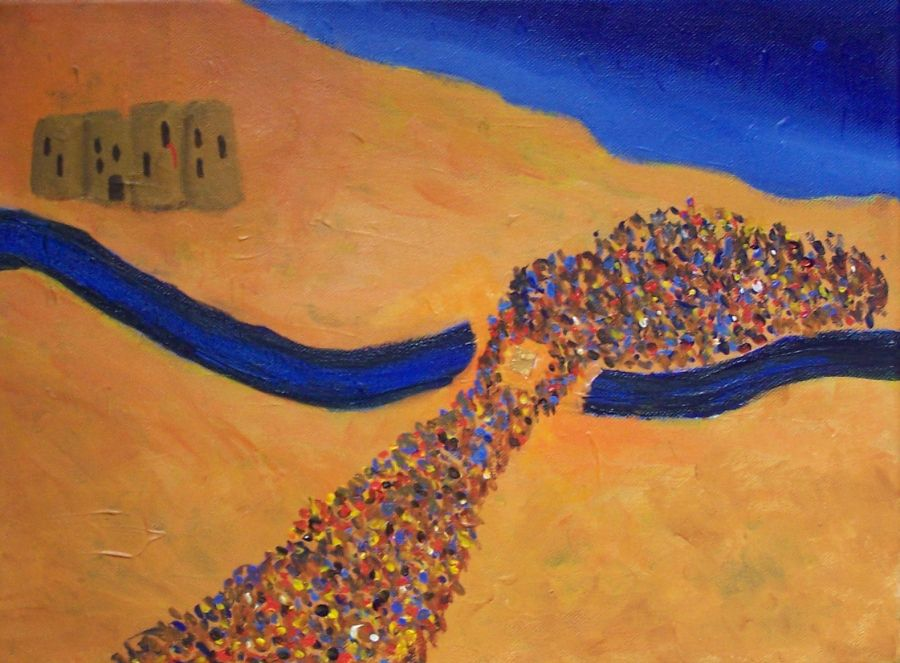
Crossing the Jordan River, by Yoram Raanan

Early in the morning Joshua and all the Israelites set out from Shittim and went to the Jordan, where they camped before crossing over. After three days the officers went throughout the camp, giving orders to the people: “When you see the ark of the covenant of the Lord your God, and the Levitical priests carrying it, you are to move out from your positions and follow it. Then you will know which way to go, since you have never been this way before. But keep a distance of about two thousand cubits between you and the ark; do not go near it.”

Joshua told the people, “Consecrate yourselves, for tomorrow the Lord will do amazing things among you.”

Joshua said to the priests, “Take up the ark of the covenant and pass on ahead of the people.” So they took it up and went ahead of them.

And the Lord said to Joshua, “Today I will begin to exalt you in the eyes of all Israel, so they may know that I am with you as I was with Moses. Tell the priests who carry the ark of the covenant: ‘When you reach the edge of the Jordan’s waters, go and stand in the river.’”

Joshua said to the Israelites, “Come here and listen to the words of the Lord your God. This is how you will know that the living God is among you and that he will certainly drive out before you the Canaanites, Hittites, Hivites, Perizzites, Girgashites, Amorites and Jebusites. See, the ark of the covenant of the Lord of all the earth will go into the Jordan ahead of you. Now then, choose twelve men from the tribes of Israel, one from each tribe. And as soon as the priests who carry the ark of the Lord—the Lord of all the earth—set foot in the Jordan, its waters flowing downstream will be cut off and stand up in a heap.”

So when the people broke camp to cross the Jordan, the priests carrying the ark of the covenant went ahead of them. Now the Jordan is at flood stage all during harvest. Yet as soon as the priests who carried the ark reached the Jordan and their feet touched the water’s edge, the water from upstream stopped flowing. It piled up in a heap a great distance away, at a town called Adam in the vicinity of Zarethan, while the water flowing down to the Sea of the Arabah (that is, the Dead Sea) was completely cut off. So the people crossed over opposite Jericho. The priests who carried the ark of the covenant of the Lord stopped in the middle of the Jordan and stood on dry ground, while all Israel passed by until the whole nation had completed the crossing on dry ground. (New International Version)

400 years of Egyptian slavery. Then deliverance from bondage. Another 40 years of wandering around the desert. It might have seemed to the ancient Israelites that getting to the Promised Land would never happen.

How can we know God is with us? Will divine promises really hold up? Can I keep trusting in the Lord, even though it is taking so darned long to get where I need to be?

Through yet another miracle of the parting of the waters and walking on dry land to get to the other side, Joshua and people of Israel (and us) are given a visual, tactile, experiential way of trusting God. By this indelible encounter, the people will know that the living God is among them, and without fail, the Lord will drive out all obstacles and opposition to entering and taking the land.

All the dramatic events that occurred were for the sake of the people, so that they would know that God is with them and will give them victory. To heighten the experience, the Jordan River was at flood stage at the time of the crossing. If you have ever been on the bank of a raging river, you know how significant a miracle this really was to behold. 

Today, we may not have the experience of seeing a rushing river stop and crossing over on dry ground; yet we have these stories that bear witness to the truth that God is among us, that God will do what was promised, and that God will give us victory.

Know that the victory came after a long liminal period of moving from one reality to another. A “liminal space” (an intermediate position characterized by transition, a place where things are either coming or going) is where the Israelites had to hang out for a very long time. Now, the promises were about to be realized.

Miracles and wonders and victories are neither easy nor cheap. They come as a result of significantly hard movements from the past into the future. In other words, our present experiences can be quite adverse and difficult. If we lose where we’ve come from, and where we’re going, we may too easily lose heart or become afraid and simply give up all hope.

That’s why God gives divine promises, so that we will be sustained with God’s words until the promised time is realized. It’s our job to encourage one another and remind each other of those promises; they are meant to buoy up our flagging spirits when things get rough.

So, keep looking and praying for that miracle. Just understand that you may need to persevere in faith, patience, and holiness for a while before it happens.

Blessed and holy God, continue the good work begun in me, so that I may increase daily in wholeness, integrity, and strength. I rejoice in your goodness and think and do that which pleases you, through Jesus Christ our Redeemer. Amen.