
The Trumpets of Judgment (Revelation 8:6-9:12)

The seven angels with seven trumpets, and the angel with a censer, c. 1020 C. E.

Then the seven angels who had the seven trumpets prepared to sound them.

The first angel sounded his trumpet, and there came hail and fire mixed with blood, and it was hurled down on the earth. A third of the earth was burned up, a third of the trees were burned up, and all the green grass was burned up.

The second angel sounded his trumpet, and something like a huge mountain, all ablaze, was thrown into the sea. A third of the sea turned into blood, a third of the living creatures in the sea died, and a third of the ships were destroyed.

The third angel sounded his trumpet, and a great star, blazing like a torch, fell from the sky on a third of the rivers and on the springs of water—the name of the star is Wormwood. A third of the waters turned bitter, and many people died from the waters that had become bitter.

The fourth angel sounded his trumpet, and a third of the sun was struck, a third of the moon, and a third of the stars, so that a third of them turned dark. A third of the day was without light, and also a third of the night.

As I watched, I heard an eagle that was flying in midair call out in a loud voice: “Woe! Woe! Woe to the inhabitants of the earth, because of the trumpet blasts about to be sounded by the other three angels!”

The fifth angel sounded his trumpet, and I saw a star that had fallen from the sky to the earth. The star was given the key to the shaft of the Abyss. When he opened the Abyss, smoke rose from it like the smoke from a gigantic furnace. The sun and sky were darkened by the smoke from the Abyss. And out of the smoke locusts came down on the earth and were given power like that of scorpions of the earth. 

They were told not to harm the grass of the earth or any plant or tree, but only those people who did not have the seal of God on their foreheads. They were not allowed to kill them but only to torture them for five months. And the agony they suffered was like that of the sting of a scorpion when it strikes. During those days people will seek death but will not find it; they will long to die, but death will elude them.

The locusts looked like horses prepared for battle. On their heads they wore something like crowns of gold, and their faces resembled human faces. Their hair was like women’s hair, and their teeth were like lions’ teeth. They had breastplates like breastplates of iron, and the sound of their wings was like the thundering of many horses and chariots rushing into battle. They had tails with stingers, like scorpions, and in their tails they had power to torment people for five months. They had as king over them the angel of the Abyss, whose name in Hebrew is Abaddon and in Greek is Apollyon (that is, Destroyer).

The first woe is past; two other woes are yet to come. (New International Version)
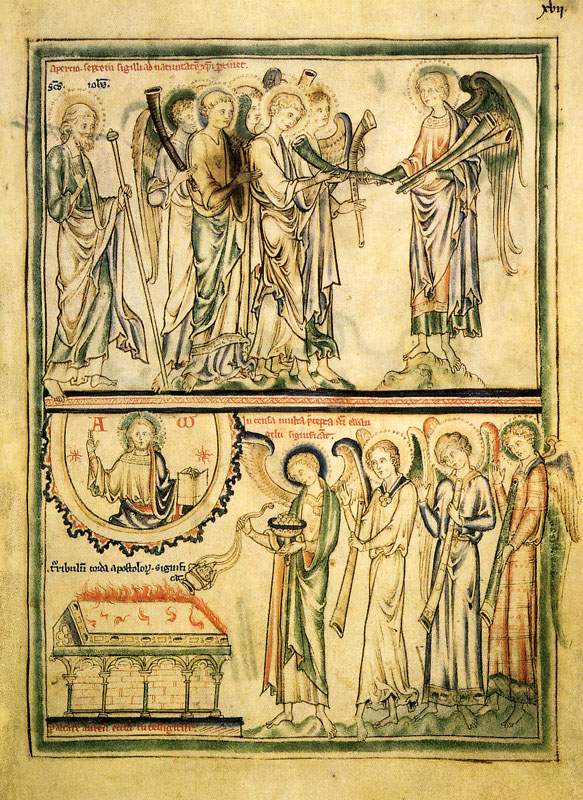
Angels receiving seven trumpets, c. 1255 C.E.

Woah; this isn’t exactly some light bedtime reading. It has to do with the end of all things, with God’s judgment upon the earth. Seven angels with seven trumpets are about to sound them with disastrous results. The last three trumpets are also referred to as the three woes upon the earth.

The first four trumpets are bad, yet not nearly as terrible as the last three. The first four affect the natural world and one-third of the earth; whereas the last three directly impact the earth’s inhabitants and affect the entire world.

As hard as it may be to accept biblical readings like today’s, God is not only the author of abundant flourishing, but also of devastating destruction. And it’s in direct answer to the prayers of the saints. (Revelation 8:3)

Although hail and blood remind the biblical student of the plagues of judgment in ancient Egypt before the great exodus of Israelites, it’s the fire that does damage to the trees and grass of the earth. A third of the earth’s land resources are completely burned up.

The second angel blowing the second trumpet results in a great mountain being hurled into the sea. This is reminiscent, for those familiar with the Gospels, of Jesus stating that one with a small amount of faith can command a mountain to be thrown into the sea, and it will be done. (Mark 11:23)

Going back into the Old Testament, in the giving of the Law on the mountain, and with the disobedience of the people at the foot of the mountain, Mount Sinai was ablaze with fire and the glory of God. The New Testament scene in Revelation appears to be something of a Mount Sinai taken up and thrown into the sea – signifying that the grace of Christ has supplanted the curse of the law.

As a result of the second trumpet, a third of all the great oceans are destroyed.

Although C.S. Lewis gave the name “Wormwood” to a fictional agent of Satan, the Wormwood here is a messenger of God, a star that falls from the sky as a result of the third trumpet blown. A third of all the earth’s drinkable water becomes bitter because of the star – which seems to be a link to previous times of judgment from God:

“I will make them eat bitter food
    and drink poisoned water,
because from the prophets of Jerusalem
    ungodliness has spread throughout the land.” (Jeremiah 23:15, NIV)

“They have followed the stubbornness of their hearts; they have followed the Baals, as their ancestors taught them.” Therefore this is what the Lord Almighty, the God of Israel, says: “See, I will make this people eat bitter food and drink poisoned water. (Jeremiah 9:14-15, NIV)

There’s nothing that falls from the sky with the blast of the fourth trumpet. Yet a third of the sun, moon, and stars are dimmed. This is a portent that something worse is about to happen – which is what the “eagle” [vulture] announces against the earth’s inhabitants.

Another star falls to the earth, but with even more disaster than the previous star – opening a pit in the heart of the earth. Smoke comes billowing out, darkening the sun. Then, locusts with the stinging power of scorpions, come upon the land.

Rather than humans having authority to trample on snakes and scorpions, these demonic insects carry the ability and the authority to harm humanity – much like the great locust horde of judgment during the time of the prophet Joel (Joel 2:1-11). The difference with John’s Apocalypse is that these are a demonic host with Apollyon the Destroyer leading them.

The previous judgments were from above; this first woe is from below – connecting the powers of death, destruction, and the grave together with the force of evil. It’s a time of sheer torture; a traumatic five months of horrendous agony.

Conclusion

None of these terrible scenes of judgment are meant to scare the hell out of anybody and put the fear of heaven into them. Instead, the New Testament book of Revelation (also known as the Apocalypse of John) is meant for devoted believers in Jesus to be encouraged that an end is coming. They can persevere in following Jesus because it will be worth it.

The hardships, difficulties, and persecutions experienced – for following the words and ways of Jesus – will not last; a time is coming soon when God will judge the living and the dead. Evil will be dealt its final blow. And we will enter a realm of unending peace with the God for whom we have given our all.

Therefore, since we are receiving a kingdom that cannot be shaken, let us be thankful, and so worship God acceptably with reverence and awe, for our “God is a consuming fire.” (Hebrews 12:28-29; Deuteronomy 4:24)

May the Lord answer you in the day of trouble!
    The name of the God of Jacob protect you!
May he send you help from the sanctuary
    and give you support from Zion.
May he remember all your offerings
    and regard with favor your burnt sacrifices. Selah

May he grant you your heart’s desire
    and fulfill all your plans. Amen. (Psalm 20:1-4)

Persevere (Revelation 2:8-11)

“Write this letter to the angel of the church in Smyrna. This is the message from the one who is the First and the Last, who was dead but is now alive:

“I know about your suffering and your poverty—but you are rich! I know the blasphemy of those opposing you. They say they are Jews, but they are not, because their synagogue belongs to Satan. Don’t be afraid of what you are about to suffer. The devil will throw some of you into prison to test you. You will suffer for ten days. But if you remain faithful even when facing death, I will give you the crown of life.

“Anyone with ears to hear must listen to the Spirit and understand what he is saying to the churches. Whoever is victorious will not be harmed by the second death. (New Living Translation)

It’s one thing to get a letter from someone prominent or famous. It’s quite another thing to receive a letter from Jesus. The unique thing about chapters two and three of Revelation, is that Jesus himself addresses seven distinct churches. 

Today’s New Testament lesson is directed to the church at Smyrna, which was a large and beautiful port city in the ancient world. Jesus was letting the believers in Smyrna know they were about to experience severe persecution. 

However, they need not be fearful, and can remain faithful, because their Lord knows all about suffering. The church’s perseverance under such trouble would result in the crown of life, given to them by Jesus himself. This was surely an encouragement to the believers as they underwent difficulty.

The congregation at Smyrna was facing imprisonment for their faith; and, for some, even death. The heart of the message by Jesus is to remain faithful, to persevere through the trouble. 

The agora of ancient Smyrna, in Izmir, Turkey

There will always be cowards and those with weak faith who will fold when the going gets tough. Yet, persecution and hardship have a way of purging the individual soul and the collective church of its dross. Suffering is inevitable and usually out of our jurisdiction; but how we handle the adversity when it comes is completely under our own control.

Few of us will ever likely face a hardship that could result in martyrdom. Knowing there are brothers and sisters in the faith throughout the world who do face hardship for their devotion and beliefs, puts our own troubles in a different light.

The daily irritations and trials that God puts in our way to refine us and shape our faith certainly seem small compared to imprisonment and martyrdom. Yet, no matter who we are and where we are located on this earth, whether facing uncommon hardship or banal difficulty, the afflictions of both body and soul come to us as opportunities to lean into faith, and to love Jesus to the end.

The Lord is not looking for perfect people, just faithful followers willing to endure suffering with the truth that Christ stands with us. 

Whatever our current circumstances may be, and wherever we find ourselves, Jesus offers us his perspective on it. Christ knows precisely what is going on and understands the spiritual resources you and I possess for each adverse situation we encounter.

In fact, few of us really discern the largess of internal resources within us, because of Christ’s redemptive work and the Spirit’s abiding presence – not to mention the very personhood God graciously gave us in the womb before we were even born. Even though it seems that, at times, we lack strength, wisdom, and courage for what is ahead – Jesus has supreme confidence in us to maintain faith, and to endure through our afflictions.

Life is not a sprint; life is a marathon. And to finish the race we need to be in good spiritual health.

Perseverance of the saints happens as we run step after step with boldness, despite fear of an unknown future around the bend. This requires the equipment of risk, vulnerability, accountability, and steadfast love, which is both received and given.

Perhaps most of all, it requires keeping our heads up and running toward the promise of reward at the finish. The crown of life is an image of both congratulation and celebration of a race well-run and the enjoyment of unending communion with our Lord, for whom we have endured so much.

When all is said and done, at the end of the age, we will look back in hindsight and see that it was really Jesus who, all along, was fortifying us to keep standing and keep going. Christ is so vested in us that he continually ensures our ultimate victory through a constant presence of help and encouragement. The heritage of both Reformation and Holy Scripture testify to this truth:

“All our progress and perseverance are from God.” John Calvin

“I’m sure about this: the one who started a good work in you will stay with you to complete the job by the day of Christ Jesus.” (Philippians 1:6, CEB)

Grant, O God, that we may never lose the way through our self-will, and so end up in the far countries of the soul; that we may never abandon the struggle, but that we may endure to the end, and so be saved; that we may never drop out of the race, but that we may ever press forward to the goal of our high calling; that we may never choose cheap and passing things, and let go the precious things that last forever; that we may never take the easy way, and so leave the right way; that we may never forget that sweat is the price of all things, and that without the cross, there cannot be the crown.

So keep us and strengthen us by your grace that no disobedience and no weakness and no failure may stop us from entering into the blessedness which awaits those who are faithful in all the changes and chances of life, down even to the gates of death; through Jesus Christ our Lord. Amen.

William Barclay, Prayers for the Christian Year

Final Exhortations on the Christian Life (Hebrews 13:1-16)

Forever Hebrews, by Anthony Falbo

Keep on loving one another as brothers and sisters. Do not forget to show hospitality to strangers, for by so doing some people have shown hospitality to angels without knowing it. Continue to remember those in prison as if you were together with them in prison, and those who are mistreated as if you yourselves were suffering.

Marriage should be honored by all, and the marriage bed kept pure, for God will judge the adulterer and all the sexually immoral. Keep your lives free from the love of money and be content with what you have, because God has said,

“Never will I leave you;
    never will I forsake you.”

So we say with confidence,

“The Lord is my helper; I will not be afraid.
    What can mere mortals do to me?”

Remember your leaders, who spoke the word of God to you. Consider the outcome of their way of life and imitate their faith. Jesus Christ is the same yesterday and today and forever.

Do not be carried away by all kinds of strange teachings. It is good for our hearts to be strengthened by grace, not by eating ceremonial foods, which is of no benefit to those who do so. We have an altar from which those who minister at the tabernacle have no right to eat.

The high priest carries the blood of animals into the Most Holy Place as a sin offering, but the bodies are burned outside the camp. And so Jesus also suffered outside the city gate to make the people holy through his own blood. Let us, then, go to him outside the camp, bearing the disgrace he bore. For here we do not have an enduring city, but we are looking for the city that is to come.

Through Jesus, therefore, let us continually offer to God a sacrifice of praise—the fruit of lips that openly profess his name. And do not forget to do good and to share with others, for with such sacrifices God is pleased. (New International Version)

Whenever I read this final chapter in the New Testament book of Hebrews, it gives me the feel of a parent blurting out a bunch of loving exhortations before the kids leave.

Throughout this incredible letter to a group of struggling Jewish Christians, the author of Hebrews offered a mix of pastoral encouragement along with pointed spiritual warnings. Now, after doing his best to demonstrate that Jesus is worth holding on to, the author exhorts the people with several practical instructions to help focus them for a life of guidance and direction in the ways of Christianity.

Keep on Loving Each Other

Love is the distinguishing characteristic of a Christian. A group of people can only persevere if they encourage one another daily with a combination of cheerleading and rebuke. The big idea is that everyone must hold each other accountable for living the Christian life.

Show Hospitality to Strangers

The word for hospitality literally means “love of stranger.” It’s the opposite of xenophobia (fear of the other). Hospitality is an expression of love for Christ in meeting the needs of people we don’t even know. Why do it? One good reason is that they just might be angels.

Remember Prisoners and Mistreated Persons

In the ancient world, there was no state-supported prison system. Incarcerated persons were completely dependent upon the mercy of their family and friends for food and relational connection. In the case of those who were truly alone, the church extended needed benevolence to them. Otherwise, prisoners would languish and eventually die.

Furthermore, we are to be observant of those who endure suffering from mistreatment. Why? Because the believers were in that position, too. Instead of “looking out for number one,” the church was to engage the community and not be isolated from its needs.

Honor the Institution of Marriage

God cares about how we honor our commitments. Ideally, couples are to keep their relationship pure without adulterating themselves with others. They submit to one another out of reverence for Christ. And they keep their promises to each other, no matter what circumstances they find themselves in.

In God’s economy, there’s no such thing as “free love” in the sense that we can have multiple partners without any sort of consequence or fallout. Friends with benefits is a misnomer. Random sex is oxymoronic. And casual lovers are in huge denial. There is a high cost to it all.

Don’t Love Money

This, of course, is a tricky one. We need money. Everyone must use money. But the love of money sets us on a dark path from which few are able to return. The best way (and really the only way) of avoiding the money pit is to be content with what you have.

Gratitude and thanksgiving has the power to grant us a happy life, even though it may be a very simple one. The only permanent things in the universe are relationships – everything else will burn.

Remember Your Leaders

Recall those persons who were good examples in both their speech and action. And imitate their faith. I wonder how many of us could say that to another person – to mimic our own life. If you’re like me, one of the things which stick out to you about respected leaders in your life, is their passion and desire in living for Christ. And, like Jesus, they were never fickle, but were always consistent and unwavering in their commitments.

Don’t Be Carried Away by Different Teachings

The basic message of the gospel has not changed: There is still good news of great joy for all who believe, because Jesus has taken care of the sin issue once for all through his singular sacrifice. And Jesus will sustain us by means of the Holy Spirit graciously given us. There’s no need to look elsewhere for our needs to be met.

Bear Christ’s Disgrace

Go to Jesus outside the camp – or in other words – live a holy life. Live into the words and ways of Christ. In doing so, we will actually end up being ridiculed, even abused. In concluding the Beatitudes in the Sermon on the Mount, Jesus promised that living a holy life of humility, righteousness, mercy, purity and peacemaking will result in persecution. (Matthew 5:10-12)

So, why live this way? Because it is the path to our eternal inheritance. The broad road leads to destruction, but the narrow way of holiness brings us to eternal life.

Continually Offer to God a Sacrifice of Praise

Praise comes from a heart full of gratitude for deliverance from sin, death, and hell – for salvation from all the guilt and shame of things done and things left undone. Praise is our sacrifice, not animals. In a world where many people want followers of Jesus to keep their mouths shut, those devoted to Christ find themselves incessantly chattering about Jesus because of their union with him.

Be Benevolent

Part of offering a sacrifice of praise is using our time and resources for the benefit of blessing the church and the world. We aren’t simply consumers who receive salvation and blessing from God; we are also producers who thoughtfully and compassionately give of our gifts, talents, time, and money for those in need of grace and love.

Conclusion

Why are we to obey these various exhortations from the author of Hebrews? Because we were purchased at a price – the precious blood of Jesus Christ. And as a result of receiving such a grace from God, the believer willingly gives themselves to becoming holy, serving faithfully, and offering compassionate spiritual care in the name of Christ.

For love is always the true litmus test of every genuine follower of Jesus, and the thing which gives motivation and shape to each exhortation.

Amen. May it be so, to the glory of God.

A (Needed) Perspective on the Christian Life (Acts 27:39-44)

Paul’s Shipwreck, by Ludolf Backhuysen (1630–1708)

When daylight came, they did not recognize the land, but they saw a bay with a sandy beach, where they decided to run the ship aground if they could. Cutting loose the anchors, they left them in the sea and at the same time untied the ropes that held the rudders. Then they hoisted the foresail to the wind and made for the beach. But the ship struck a sandbar and ran aground. The bow stuck fast and would not move, and the stern was broken to pieces by the pounding of the surf.

The soldiers planned to kill the prisoners to prevent any of them from swimming away and escaping. But the centurion wanted to spare Paul’s life and kept them from carrying out their plan. He ordered those who could swim to jump overboard first and get to land. The rest were to get there on planks or on other pieces of the ship. In this way everyone reached land safely. (New International Version)

Saul was an up and rising star among the Jewish Pharisees. He was committed to his religion to the point of approving the death of the first Christian martyr, Stephen. Saul saw followers of Jesus as an aberration to Judaism, and did whatever he could to stamp out the sect.

During one of his travels to do just that, he was confronted by a vision of Christ himself, who said to Saul, “Why do you persecute me?” (Acts 9:4-5) For days Saul was blind, mimicking his spiritual blindness. Both his physical and spiritual eyesight were restored when he came to faith in Christ and began following the words and ways of Jesus. His name changed from Saul to Paul the Apostle.

Paul’s conversion was a complete transformation of life. Yet, this in no way meant that the rest of his life was all rainbows and butterflies. Just the opposite. Saul the Persecutor ended up becoming Paul the Persecuted One.

With the same drive and desire that he once had to do away with Christians altogether, so now the Apostle Paul put all that energy into proclaiming the good news of grace and forgiveness in Jesus Christ his Savior and Lord. And, as one might expect, this put Paul in the crosshairs of his former partners, the Jewish Pharisaical leadership. They now despised Paul.

The Jewish religious authorities hated Paul so much that they made sure to stir up trouble for him everywhere he went, even when it was way out in the Gentile sticks of Galatia and the Gentile strongholds of Greece. And that is essentially why Paul landed in prison. He was portrayed as a rebel and a troublemaker, an enemy of the social order (even though Paul himself was actually a citizen of Rome).

As a Roman citizen, Paul invoked his right to appeal to Caesar. And so, he was put on a Roman prison ship, bound from Palestine to Italy. And that is where we pick up today’s New Testament lesson.

Paul had been through an awful lot of adversity, hardship, and persecution. His faith had become so robust that a terrible storm and a shipwreck could not at all wreck his commitment to Christ. In fact, it only strengthened it.

It’s not always easy to see, but Paul’s words to the Roman Christians are true, even for us today:

And we know that God causes everything to work together for the good of those who love God and are called according to his purpose for them.

The Apostle Paul (Romans 8:28, NLT)

This is an understanding of God, a deep theological perspective, which is informed by years of walking with Jesus in the crucible of suffering and difficulty. It discerns the Lord as caring and loving, even when it appears on the surface that God is mean and capricious.

Many Christians today tend to believe that the redemption which Christ secured is a mere life insurance policy for heaven. And, if it has anything to do with the here-and-now, it means we ought to have all our desires met for earthly peace and abundance. If that were true, both Jesus and Paul were miserable failures as godly people.

God, however, cares about our salvation, our wholeness and integrity as people on this earth. Yes, we have eternal life, yet that life has already begun, and we are to live into it now.

Christianity is a paradoxical faith. The way to gain your life is to lose it. The path to glory is through suffering.

This, my friends, means that we do not gain a good and blessed life by attempting to make everything in life go our way, without any difficulty. Instead, the good life comes by acknowledging the grit and grist of life. It is in the full acceptance of suffering, persecution, illness, death, and our own psychological infirmities that leads us into becoming who God wants us to be – and thus more open to what joy really is.

On the practical level, this means that our failures, our missed expectations, and our dashed hopes are very important pieces to our faith and it’s development. All of this is what awakens us to compassion – both for others and ourselves.

So then, Paul’s perspective on all the difficulties in his life is that they are significant spiritual incubators of faith for him. Paul accepted his sufferings and hardships – and more than that – he valued them for the ways they developed his faith in God and ability to minister to others.

As one old Rabbi once put it:

“There are many rooms in God’s castle. There is, however, one key that opens every room, and that key is a broken heart.”

Ba’al Shem Tov (1698-1760)

Sovereign God, let our love be genuine; help us to hate what is evil, and to hold on to what is good; and empower us to love one another with mutual affection. Strengthen our spirits so that we might serve our Lord Jesus. With you as our faith, we choose to rejoice in hope; be patient in affliction; and persevere in prayer, by means of your blessed Holy Spirit. Amen.