The Lord Is My Shepherd (Psalm 23)

Psalm 23, by Cliff Gleason

The Lord is my shepherd;
    I have all that I need.
He lets me rest in green meadows;
    he leads me beside peaceful streams.
    He renews my strength.
He guides me along right paths,
    bringing honor to his name.
Even when I walk
    through the darkest valley,
I will not be afraid,
    for you are close beside me.
Your rod and your staff
    protect and comfort me.
You prepare a feast for me
    in the presence of my enemies.
You honor me by anointing my head with oil.
    My cup overflows with blessings.
Surely your goodness and unfailing love will pursue me
    all the days of my life,
and I will live in the house of the Lord
    forever. (New Living Translation)

This is one of the best known places in the Bible – even for people who are not religious. And that is for good reason. The psalm is timeless in it’s relating to us in our human condition. It taps into our human need for a compassionate presence, secure protection, and abundant provision. I believe that, most of all, Psalm 23 effectively goes to our inner selves and reminds us of our greatest need: God.

My underlying conviction concerning this wonderful psalm is that the reason we adore it so much is because we humans have an innate primal desire for God. Whether we are consciously religious or not, our deepest longing is for connection with the Divine.

Much of humanity, it seems to me, have repressed this desire. Many people bury this longing underneath multiple layers of other interests and competing desires. Others experience the primal desire for God as a yearning for wholeness, completion, or fulfillment.

Yet, regardless of how particular individuals or groups may frame it, humanity’s basic need is to love and be loved – to move ever closer to the source of love. This inner craving is the essence of the human spirit, and it is captured well in a biblical psalm which pictures a person who settled into the God who is Love.

“Our hearts are forever restless until we rest in God.”

St. Augustine

With Psalm 23, our human longing is spelled out in a mere 50 or so words – we can imagine not only being transported, but also being actually transformed into an enjoyable divine/human relationship, set within an idyllic landscape of settled peace, safety, and strength.

Serenity for our anxious racing thoughts becomes a real hope, for there is a shepherd who protects the human flock and ensures that they have everything they need.

It is understandable that the relationship between God and humans is likened to that of a shepherd and sheep. In reality, sheep need a shepherd. They require someone to look out for them and provide for them. Sheep, in my opinion, are not stupid and clueless; they are skittish animals who only function well if they are non-anxious and at peace.

The presence of a caring shepherd makes all the difference. And, more than that, the shepherd does a myriad of needed things for the sheep that they are not able to do themselves, such as protecting them from wolves, finding adequate pasture to feed upon, and relieving them of the intestinal gas from eating all that grass which would literally kill them without the shepherd’s intervention.

Whereas human shepherds may or may not be faithful in their duties and extend genuine care to the flock, God is always present and loving. Moving to the rich pasture of the New Testament, Jesus is described as the Good Shepherd who will care for and preserve the sheep in every way needed. (John 10:1-21)

Psalm 23, by Cliff Gleason

Indeed, with Jesus as the consummate shepherd, people want for nothing and have everything they need. No wolf can snatch them out of his hand, and the mundane tasks of washing their feet is lovingly done for them. With Jesus, the deep yearning of the inner person becomes satisfied; the soul is restored.

Even the implements of a rod and a staff are used for good, and not for ill. An unfaithful shepherd will likely beat the sheep and berate them, only concerned for fleecing them to sell their wool on the market. But Jesus uses the rod to guide and direct in the way we ought to go, for our benefit and well-being. And the staff – the shepherd’s crook – is benevolently used to rein in the strays who don’t realize how in danger they’re in.

Truly, discipline and encouragement are not mutually exclusive concepts; they instead go together as two forms of loving leadership and care. Only those who take the time and effort to correct another are the ones who really care enough to do so.

In the shepherd’s presence, we can exist with a sense of security, even though there is danger all around us. Our longing for peace, and to be secure within oneself, is not a pipe dream, but a real possibility. To be provided for by God in the face of hard circumstances strengthens faith, awakens hope, and fosters love. It becomes an overflowing feast of the soul.

And this goodness is not fleeting. It can be a continuous present reality. Since God is good, all the time, and there is never a time when God is not good, we are continually and actively pursued and shepherded by goodness and not by harm, all the days of our lives.

The threat of death – and even death itself – cannot thwart the avenues of righteousness from being available to us. We can walk the true path toward inner peace and fulfillment, of genuine connection with God and others, without moral or spiritual harm.

There are good and right paths of life. Those avenues are guarded by a gracious God; they will never be destroyed or damaged. If the psalm is correct, and if my core convictions are right, then there is no longer any reasonable or justified basis for fear.

A good care-taking Shepherd is protecting the flock, and providing the sheep with everything they need. We can live a morally strong, ethically sound, and eminently happy life, without being constantly afraid.

Blessed and Good Shepherd of all, by laying down your life for the flock, you reveal your love for all. Lead us from the place of death to the place of abundant life, so that guided by your care for us, we may rightly offer our lives in love for you and our neighbors. Amen.

Learning to Trust (Psalm 4)

Answer me when I cry out, my righteous God!
    Set me free from my troubles!
        Have mercy on me!
        Listen to my prayer!

How long, you people,
    will my reputation be insulted?
How long will you continue
    to love what is worthless
    and go after lies?
Know this: the Lord takes
    personal care of the faithful.
The Lord will hear me
    when I cry out to him.
So be afraid, and don’t sin!
    Think hard about it in your bed
    and weep over it!
Bring righteous offerings,
    and trust the Lord!

Many people say,
    “We can’t find goodness anywhere.
    The light of your face has left us, Lord!”
But you have filled my heart with more joy
    than when their wheat and wine are everywhere!
I will lie down and fall asleep in peace
    because you alone, Lord, let me live in safety. (Common English Bible)

The psalmist, David, was a man after God’s own heart. But that did not mean that he was inoculated from trouble and hardship.

David had a lot of adversity and much difficulty throughout his life. So, it only made sense to him to cry out to the Lord for deliverance and help. God had helped David in the past, and David was confident that the Lord would help him yet again.

We all find ourselves in a tight spot, between a rock and hard place, at times. It’s what we do when we are in that position that is critical. David had a history of looking to God, seeking God’s grace, and soliciting answers to prayer.

David, the psalmist, was a real victim of slander and lies. More than once in his life, he had people out to get him, to actually take his life. Whatever your understanding of stress is, it doesn’t get much more stressful than someone hunting you down like an animal to literally kill you. I’m sure that many times David wondered how long this surreal madness was going to go on.

Whenever we are especially stressed, it can be hard to even breathe. If we aren’t mindful of ourselves, we will take lots of short staccato breaths that only feed anxious signals to the brain. It leaves us in a perpetual state of hypervigilance, almost unable to pray and have thoughts of God.

But we absolutely need to take deep breaths and trust in God’s sustaining presence. We’ll never get to sleep, nor stay at rest, without a sense of the divine presence.

Insomnia happens for a lot of reasons. Many people have diagnosed sleep disorders that are very real medical conditions. Others can’t get a good night’s rest because of poor sleep hygiene by not planning for adequate sleep, drinking too much caffeine during the day, inattention to a healthy diet, or a host of other habits. Some have issues of chronic pain which can make it difficult to sleep well.

And then there are yet others who suffer from racing thoughts, anxiety, and depression. The stress of their waking life is so significant that several hours of deep sleep seems only like some pipe dream. It’s impossible to sleep when the weight of the day is pressing on you. Finding a sense of calm before bed isn’t easy—especially when you can’t unplug from the demands of your day.

I am wondering if many of us will even allow ourselves to unplug and establish some quiet wind-down time. Reading a real book – not one on a backlit tablet device – or talking with a friend or family member are simple ways of easing our anxiety and letting rest come.

The psalmist, David, had a regular practice of meditating on Scripture, recalling the events of God, and expressing gratitude and praise for answered prayer. Each of us has a built-in spiritual rhythm just like we have a circadian rhythm. Always trying to buck those God-given rhythms will inevitably result in being “off,” at the least, and experiencing debilitating depression, at the worst.

Yet, when we learn to move with the unforced rhythms of grace, there is a groove we slip into which serves us well. In other words, what I am trying to say, is that by allowing ourselves to be human, we can discover health.

David neither had delusions, nor illusions, about his enemies, friends, others, and himself. He didn’t try to be somebody he was not. Instead, David had firm and confident convictions about God and the place of prayer.

By taking in a steady diet of David’s psalms, we can learn to hold together both faith and doubt, confidence and confusion, perseverance and perplexity, in ways which strengthens our faith.

Everyone of us who desire God must learn to trust; and it’s in the school of hard knocks where our faith is developed in order to sustain us for a lifetime of service and resilience.

There will always be those who believe ill of us through slander, lies, or outright oppression. In such times, let’s cry out to God for both peace and guidance; and ask the Lord for help in learning to breathe, lie down, and get some rest.

As our trust develops, we may even find the grace and courage to confront our oppressors, so that they can seek their own peace with God.

May Christ be with you, and within you;
May Christ go before you, and linger behind you;
May Christ be on your right, and on your left;
May Christ hover above you, and bring support beneath you;
May the Lord Jesus Christ completely and thoroughly surround you, now and forever. Amen.

Jesus Shows Up (John 20:19-31)

The Doubt of St. Thomas, by He Qi

It was still the first day of the week. That evening, while the disciples were behind closed doors because they were afraid of the Jewish authorities, Jesus came and stood among them. He said, “Peace be with you.”After he said this, he showed them his hands and his side. When the disciples saw the Lord, they were filled with joy.Jesus said to them again, “Peace be with you. As the Father sent me, so I am sending you.”Then he breathed on them and said, “Receive the Holy Spirit.If you forgive anyone’s sins, they are forgiven; if you don’t forgive them, they aren’t forgiven.”

Thomas, the one called Didymus, one of the Twelve, wasn’t with the disciples when Jesus came.The other disciples told him, “We’ve seen the Lord!”

But he replied, “Unless I see the nail marks in his hands, put my finger in the wounds left by the nails, and put my hand into his side, I won’t believe.”

After eight days his disciples were again in a house and Thomas was with them. Even though the doors were locked, Jesus entered and stood among them. He said, “Peace be with you.” Then he said to Thomas, “Put your finger here. Look at my hands. Put your hand into my side. No more disbelief. Believe!”

Thomas responded to Jesus, “My Lord and my God!”

Jesus replied, “Do you believe because you see me? Happy are those who don’t see and yet believe.”

Then Jesus did many other miraculous signs in his disciples’ presence, signs that aren’t recorded in this scroll. But these things are written so that you will believe that Jesus is the Christ, God’s Son, and that believing, you will have life in his name. (Common English Bible)

Mosaic of Doubting Thomas, Cathedral of Monreale, Italy

When Jesus shows up, there is peace. Wherever Jesus goes, the Spirit of God is there. When Jesus appears, people believe.

The Meeting

After the crucifixion of Christ, the disciples were huddled together, mostly in fear of being found out and put out by the religious authorities. Out of nowhere, Jesus showed up, smack in the middle of the anxious group of men.

Christ in the center makes all the difference. From this central place, Jesus bestowed to the disciples his peace. The very first word the risen Christ spoke to his disciples was neither a command to stop being afraid, nor a rebuke for sitting around and doing nothing, or disappointment because they all ran away in the final hour of need at the crucifixion.  

Instead, the first word of Christ was a gift of peace. The presence and peace of Christ melted the disciples’ fear. Christ-centered peace is graciously given; and so, it only makes sense to gratefully receive it.

The Reality

Jesus showed up, then showed off his hands and his side. He was not fabricated out of the disciples’ imagination; he was not some ghostly apparition. Rather, Christ was standing in the middle of them, very real, very physical, and very alive.

Christ gave his disciples real truth: actual wounded hands and side, on a real body. Christ is risen and alive – not just spiritually, but physically. Since the resurrection of Jesus really happened, then nothing else matters; our joy is complete. We have what we need.

The Mission

As Jesus was sent by the Father, so Jesus sent his disciples; and he is still sending us, his disciples, out into the world. Just as Jesus came not to condemn the world but to save it, so we go out with words of grace and peace. The church exists for the life of the world – to bless it with the presence and peace of Christ.

“Whoever believes in me does not believe in me only, but in the one who sent me. The one who looks at me is seeing the one who sent me. I have come into the world as a light, so that no one who believes in me should stay in darkness.” (John 12:44-46, NIV)

Our spiritual DNA makes us little Christ’s walking around, doing the will of God, for the benefit of a world in darkness. We bear the name of Christ: Christians, proclaiming a message of life, delighting in God and creation; and not destroying the earth and its inhabitants.

The Gift

We are not alone. The Holy Spirit has been graciously given to us by Jesus. Although our mission is a big one, our resource for accomplishing it is even bigger. Jesus gives the Spirit in the same way he gives himself – as a sheer gift with no strings attached. Just as God breathed life into the very first people on earth, so Jesus breathes on the disciples and gives them new life and a new heart.

I will give you a new heart and put a new spirit in you; I will remove from you your heart of stone and give you a heart of flesh. And I will put my Spirit in you and move you to follow my decrees and be careful to keep my laws… and you will be my people, and I will be your God. (Ezekiel 36:26-28, NIV)

The Privilege

Christ has redeemed us, forgave us of our guilt and shame. Now, we pass on the forgiveness to others. The special mission of the Church is giving Jesus to others with grace and peace, so that they may believe he is truly the risen Lord; and so, receive Jesus, the Spirit, forgiveness, and purpose in life, with Christ at the center of all things.

For the one whom God has sent speaks the words of God, for God gives the Spirit without limit. The Father loves the Son and has placed everything in his hands. Whoever believes in the Son has eternal life, but whoever rejects the Son will not see life, for God’s wrath remains on them.” (John 3:34-36, NIV)

The Appearance

When Jesus appears, its good if we also show up to see him. It seems Thomas was late for church and missed the beginning of the service. He wasn’t with the other gathered disciples. Nobody knows where he was or what he was doing. But the important thing is that he did eventually show up, because showing up is the beginning of a changed life.

The Witness

After Jesus showed up, the disciples bore witness to what they saw and heard to Thomas. Yet Thomas, bless his doubting heart, wasn’t having it. He’s a realist. He wants proof, some actual physical evidence. Thomas was clearly a tactile learner because he needs some touch to believe any of this crazy talk of his disciple brothers.

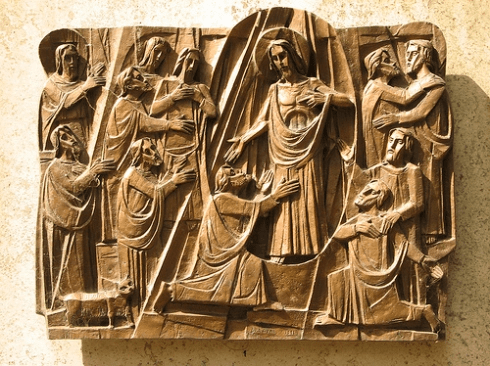
The Risen Lord appears to St. Thomas and the apostles, Catacombs of St. Callixtus, Rome, Italy

Sometimes Thomas gets a bad rap, but he is really our Everyman. Doubt and skepticism are an important part of a full-orbed and honest faith. Jesus gave Thomas some space, time, and respect to begin wrapping his head and heart around this new reality of resurrection. I wonder if we all can do the same with others.

The Middle

A second time, Jesus showed up in the middle of the disciples. The Word became flesh and dwelt among us – and didn’t become a ghost and hang out in secret places. Once again, peace is given by Jesus to his followers. Both appearances happen on a Sunday (which is why Christians worship on Sunday); and both meetings are literally Christ-centered (which every Christian meeting is supposed to be). Every Sunday; and Christ in the middle. Keep those two together forever, and you cannot go wrong.

The Invitation

There’s no beating around the bush with Jesus. He immediately engaged Thomas and invited him to touch the wounds on his very real body. Christ knew Thomas’ hangup, and went right to it. Thomas wanted evidence; Jesus offered it. If we get anything out of this encounter, it’s that the risen Christ honors honest doubt.

The evidence is here. Now believe it, and stop disbelieving. We have documentary evidence of the Old and New Testaments; the Church’s witness in Creeds, Confessions, and contemporary narratives of changed lives; and the internal testimony of the Holy Spirit. Therefore, look into them carefully and draw a sound conclusion.

The Confession

“My Lord and my God!” That’s the confession and the conclusion Thomas drew from the evidence – not only that Jesus is real, alive, existed, a good teacher; or other people’s Lord and God – but that he is my Lord and my God.

Jesus cared enough for Thomas to specifically meet him personally at his point of need. The grace of God keeps coming and never runs out. Jesus is filled up to the full in both grace and truth.

The Believer

Thomas had the physical evidence. But it doesn’t take that to truly believe. God blesses those who’ve never seen nor touched, but still believe. Jesus was thinking of you and me, and not only the people in front of him at the time. The Lord Jesus blesses us with the gift of peace, grace, and faith.

Though you have not seen him, you love him; and even though you do not see him now, you believe in him and are filled with an inexpressible and glorious joy, for you are receiving the end result of your faith, the salvation of your souls. (1 Peter 1:8-9, NIV)

The Conclusion

All this is for our benefit, so that we, too, may believe that Jesus is the Christ, the Son of the living God. Since Jesus is alive, he continues to bless us with his presence, power, and peace. Jesus is with us:

  • through the Word of God, giving us his peace, showing up and meeting needs people.
  • at the Table in the sacrament of communion, bringing grace and forgiveness
  • in the person of the Holy Spirit, enabling and energizing us for mission and ministry to the world

It’s a life worth living, a Christ-centered life, full of God’s blessing. Amen.

Accept the Situation (Jeremiah 30:12-22)

“This is what the Lord says:

“‘Your wound is incurable,
    your injury beyond healing.
There is no one to plead your cause,
    no remedy for your sore,
    no healing for you.
All your allies have forgotten you;
    they care nothing for you.
I have struck you as an enemy would
    and punished you as would the cruel,
because your guilt is so great
    and your sins so many.
Why do you cry out over your wound,
    your pain that has no cure?
Because of your great guilt and many sins
    I have done these things to you.

“‘But all who devour you will be devoured;
    all your enemies will go into exile.
Those who plunder you will be plundered;
    all who make spoil of you I will despoil.
But I will restore you to health
    and heal your wounds,’
declares the Lord,
‘because you are called an outcast,
    Zion for whom no one cares.’

“This is what the Lord says:

“‘I will restore the fortunes of Jacob’s tents
    and have compassion on his dwellings;
the city will be rebuilt on her ruins,
    and the palace will stand in its proper place.
From them will come songs of thanksgiving
    and the sound of rejoicing.
I will add to their numbers,
    and they will not be decreased;
I will bring them honor,
    and they will not be disdained.
Their children will be as in days of old,
    and their community will be established before me;
    I will punish all who oppress them.
Their leader will be one of their own;
    their ruler will arise from among them.
I will bring him near and he will come close to me—
    for who is he who will devote himself
    to be close to me?’
declares the Lord.
“‘So you will be my people,
    and I will be your God.’” (New International Version)

Jeremiah, by Marc Chagall, 1956

Once in a while, I get a response from a patient in the hospital who was given a poor diagnosis, or a very challenging prognosis, that goes something like this: “These doctors are always focusing on the negative. I’m only going to listen to the positive. I don’t need all that negative talk and energy.”

I believe in things like hope, optimism, and confidence. Yet, those qualities can only be acquired through the purgative force of hard circumstances and suffering. That means, in order to truly embrace the positive and encouraging, we need to first sit with the negative and discouraging realities in front of us.

Bottom line: It hurts to heal. Cuts need peroxide. Serious wounds need to be vacuumed. Severe internal issues require a surgery – being opened up – with a surgical knife, in order to get the body in a position to heal itself.

I find it curious that so many folks who believe in the Bible have never read the Old Testament prophets.

And very few preachers have never even given a sermon from the prophets. “It’s too gloom and doom, too negative. I focus on the positive and build up the church with New Testament truth!”

So, how’s that working for you? If there is a spiritual cancer that needs removal, it’s going to take some pain and hard treatment. And that is a lot of “negative” stuff.

There wouldn’t be a New Testament without an Old. I am suggesting that perhaps one reason why there is so much spiritual immaturity amongst many churches and Christians is that there is a lot of biblical illiteracy, due to the neglect of the prophets.

Without the prophets, we do not get a true feel for the pathos of God; that is, the Lord’s spiritual and emotional energy against injustice and oppression. And, practically speaking, it leaves us with neither resources nor skills to cope with adversity and trouble when it comes.

What do you do when you – or someone you love – hears that they have an incurable disease or condition?

Those without a solid grounding in the biblical prophets will likely want to rush to the places in Scripture that talk of answers to prayer and miracles and resurrections. But little do they realize that one cannot experience life apart from death, that there is no resurrection without a crucifixion, no positive glory without negative suffering.

No healing can take place if there is no pain of a cross.

Conversely, those who have become familiar with the message of the prophets are sure to respond to the incurable situation with expressions of personal grief and public lament, with humility and submission to the will of God.

Prayers will arise from deep within them that are grounded in the justice of God, and rely upon the promises of God. They will look to their inner spirit, without outwardly blaming God and medical staff for being uncaring and negative.

And, most of all, the spiritually and prophetically aware person will lean into their prodigious support system of a loving and gracious God, as well as the many persons who want to help.

The mature believer engages in a combination of submission and subversion – submitting completely to the will and ways of God, while simultaneously praying against the unfairness of disease, disaster, and death.

Healing and restoration will happen. The kicker is that we just don’t know the timing of any of it. We may not realize healing until the next life. Then again, we might experience a dramatic restoration of health and happiness, far beyond what we could ever ask or imagine.

The wise person learns to be patient, and wait for the proper time. They are comfortable with whatever timetable the Lord has for them. For what is most important to them is that they are close to the God who is near to the brokenhearted.

If we are guilty, we admit it, and seek to repair whatever damage may have been done. And if we are innocent, well then, we admit that we are not our own, but belong, both body and soul, to our faithful Creator.

Even in pain, we rest; even though suffering, we are at peace.

Accept the situation as it is, and not as you want it to be.

O God of love, you are the true sun of the world, evermore risen and never going down: We pray you to shine in our hearts and drive away the darkness of sin and the mist of error. We pray that we may, this day and all our lives long, walk without stumbling in the way you have prepared for us, which is Jesus Christ our Lord; who lives and reigns with you and the Holy Spirit, one God in glory everlasting. Amen. – A prayer of Erasmus of Rotterdam (1466-1536)