The Thundering Voice of the Lord (Psalm 29)

Ascribe to the Lord, O heavenly beings,
    ascribe to the Lord glory and strength.
Ascribe to the Lord the glory of his name;
    worship the Lord in holy splendor.

The voice of the Lord is over the waters;
    the God of glory thunders,
    the Lord, over mighty waters.
The voice of the Lord is powerful;
    the voice of the Lord is full of majesty.

The voice of the Lord breaks the cedars;
    the Lord breaks the cedars of Lebanon.
He makes Lebanon skip like a calf
    and Sirion like a young wild ox.

The voice of the Lord flashes forth flames of fire.
The voice of the Lord shakes the wilderness;
    the Lord shakes the wilderness of Kadesh.

The voice of the Lord causes the oaks to whirl
    and strips the forest bare,
    and in his temple all say, “Glory!”

The Lord sits enthroned over the flood;
    the Lord sits enthroned as king forever.
May the Lord give strength to his people!
    May the Lord bless his people with peace! (New Revised Standard Version)

I grew up in rural middle America, on the land, and working the land. All of that outdoor work of the farmer makes one very attuned to the weather. In fact, my dad could often predict a coming thunderstorm with an almost precise accuracy.

There is something of a weather report from the psalmist in today’s lesson. He describes a powerful storm forming and moving its way inland from over the sea. It does its damage as a result of high winds, incredible lightning, and of course, the loud rumble of thunder. It is this thunderous display of strength that is the voice of the Lord.

Seven times in Psalm 29 the psalmist repeats the phrase, “the voice of the Lord.” There’s a lot more going on than a meteorological thunderstorm; behind the storm is theological Being who controls all things. The Lord God almighty is not your run-of-the-mill ordinary local deity.

Israel did not have multiple gods of thunder, lightning, clouds, and rain; they worshiped Yahweh, one God, who was Lord of the entire storm, as well as the whole world. The point of the psalmist is that no one, no other god, can compete with this awesome God of Israel.

Yet, despite the theological reality of Israel and their God, there was an entire panoply of gods that the Canaanites worshiped in ancient Palestine. The Canaanite god Baal is mentioned many times in the Old Testament. Baal was the lord of the storm, the god who hung out in the clouds and brought needed rain for the crops to grow.

What’s more, ancient Israel was continually tempted toward the worship of Baal. There were even those who gave the ancient god credit for the harvest of crops. But the psalmist will have none of that business. The real lord of the storm, the actual power behind everything in the universe, is Yahweh.

This is why there is the invitation to praise the Lord. And it isn’t just people who are invited; the heavenly beings are called upon to praise. It’s likely that the psalmist is putting those pagan gods in their place by encouraging them to recognize who is really in charge and in control of all things.

Whatever is going on with the psalmist’s intention, there is clearly a universal and cosmic call to acknowledge the majesty and sovereignty of Yahweh and offer appropriate praise for the One who is over everything.

The description of the powerful thunderstorm is presented as evidence of Yahweh’s power, glory, and sovereignty. It’s as if the entire earth is a temple, with every creature on earth called upon to offer up their praise and honor. Beings in both heaven and earth join together in a great universal choir of praise to the God who makes all things possible.

Even when the rains turn into a flood and brings chaos, God is over those chaotic waters, as well. It is the Lord who brings order from chaos, and who tames the mighty waters. In the New Testament, Jesus demonstrated this godly power in front of the fearful disciples:

A great windstorm arose, and the waves beat into the boat, so that the boat was already being swamped. But he was in the stern, asleep on the cushion, and they woke him up and said to him, “Teacher, do you not care that we are perishing?” And waking up, he rebuked the wind and said to the sea, “Be silent! Be still!” Then the wind ceased, and there was a dead calm. He said to them, “Why are you afraid? Have you still no faith?” And they were filled with great fear and said to one another, “Who then is this, that even the wind and the sea obey him?” (Mark 4:37-41, NRSV)

God, as absolute Sovereign, is able to provide peace and well-being from fearful hearts and anxious minds. And this is something to celebrate, to offer gratitude to God for such absolute authority.

People today may not be tempted to worship Baal; but in the middle of our fear and anxiety of life’s many storms, we might search for help and deliverance from the stock market, technology companies, a capitalist economy, social networking, or our own hard work and ingenuity.

Those things may easily become the gods we worship – offering our time, commitment, money, and emotional energy to them – and leaving God in the dugout of our lives to be available, just in case, as a pinch-hitter. But this approach never accounts for the inevitable game being rained out – perhaps permanently.

Just as the wise person saves their money for the inevitable rainy day, so the spiritual person who is aware of God’s authority and power will wisely invest their time and energies into discovering this God. They will engage in spiritual practices designed for relatable connection.

The believer realizes that, although today might be bright and sunny, there will be a damaging thunderstorm in the future for which preparations must be made now.

The voice of the Lord can be a reassuring presence and a healing balm; or it can be a fearful and devastating experience. How you see it and prepare for it makes a big difference.

Glorious God, I worship and praise you in response to your voice. I join with all the voices of the earth, together with all the voices of the heavens, to praise your glorious name; and to bow down in awe before your mighty power. Amen.

Speak To the Dry Bones (Ezekiel 37:1-14)

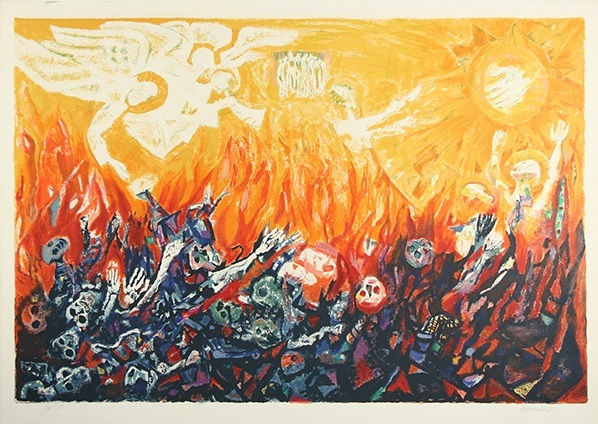
Valley of the Dried Bones, by Abraham Rattner (1895–1978)

The power of the Lord came over me. The Lord brought me out by his Spirit and put me down in the middle of a valley. The valley was filled with bones. He led me all around them. I saw that there were very many bones at the bottom of the valley, and they were very dry.

Then he asked me, “Son of man, can these bones live?”

I answered, “Only you know, Almighty Lord.”

Then he said to me, “Prophesy to these bones. Tell them, ‘Dry bones, listen to the Lord’s word. This is what the Almighty Lord says to these bones: I will cause breath to enter you, and you will live. I will put ligaments on you, place muscles on you, and cover you with skin. I will put breath in you, and you will live. Then you will know that I am the Lord.’ ”

So I prophesied as I was commanded. While I was prophesying, suddenly there was a rattling noise, and the bones came together, one bone attaching itself to another. As I looked, I saw that ligaments were on them, muscles were on them, and skin covered them. Yet, there was no breath in them.

Then the Lord said to me, “Prophesy to the breath! Prophesy, son of man. Tell the breath, ‘This is what the Almighty Lord says: Come from the four winds, Breath, and breathe on these people who were killed so that they will live.’ ”

So I prophesied as he commanded me, and the breath entered them. Then they came to life and stood on their feet. There were enough of them to form a very large army.

The Lord also said to me, “Son of man, all the people of Israel are like these bones. The people say, ‘Our bones are dry, and our hope has vanished. We are completely destroyed.’ So prophesy. Tell them, ‘This is what the Almighty Lord says: My people, I will open your graves and take you out of them. I will bring you to Israel. Then, my people, you will know that I am the Lord, because I will open your graves and bring you out of your graves. I will put my Spirit in you, and you will live. I will place you in your own land. Then you will know that I, the Lord, have spoken, and I have done it, declares the Lord.’ ” (God’s Word Translation)

Dry. It might be good for humor or a martini. Dry, however, doesn’t feel good when it’s a time of spiritual dryness.

Perhaps you are dry. It seems the entire world is dry. Wars, conflict, death, violence, uncertainty, unrest, and upset people everywhere is evidence that there is dryness across the earth. Many institutions, organizations, companies, and faith communities have become so withered and dry, that they have folded and died.

The hard circumstances of our world, stress in our families, and challenging personal lives may easily create anxiety, and, so, parch our souls and leave our spirits bone dry. There is, however, a God who can breathe new life into us and move us from old-worn ruts in our thinking, feeling, and behaving, to renewed ways of being in the world. 

The prophet Ezekiel’s vision is a promise and a hope of resurrection, revival, and new life. Regardless of who we are and the situations in front of us, we are all displaced people – cast out of Eden and in need of restoration. 

We, along with the ancient Israelites, are in exile and long to return to our true home with God. Along with St. Augustine we declare that our “hearts are forever restless until they find their rest in God.”

Maybe you are presently experiencing the dry bones of hopelessness and despondency. Perhaps you are in a dark night of the soul where all of life seems like one huge rut. It could be you are wondering if God is really listening, or is even there at all, because of the dry bones surrounding you.

In my work as a hospital chaplain I often encounter patients who are, ironically, bone dry from too much drinking. Their alcoholism is like a massive desert littered with thousands of dry bones. Attempting to reanimate themselves while dulling the pain of incredibly hard dry circumstances, they drink liter after liter of “spirits” to replace the dead spirit inside them. Some become so dry and dead inside their immaterial selves, that they seek to end their material lives through suicide.

But it need not be this way. We might believe we will be able to live life and pursue God better without danger or hardship – that somehow difficulty is not to be part of life. The dry bones exist, however, as an opportunity for God to give life. That’s why Alexander Solzhenitsyn’s reaction to his exile in a Soviet labor camp in Siberia was to bless it, because it was there he said:

“I discovered that the meaning of earthly existence lies not, as we have grown used to thinking, in prospering, but in the development of the soul.”

Alexander Solzhenitsyn

God not only gives life; God restores life. And this is an important truth to know and remember in the inevitable dry times of our lives. God is not only a helper; the Lord reanimates us from spiritual rigor mortis to lively resurrection through breathing on us. And this is done for a reason. Jesus came to his disciples after his resurrection and said:

God resuscitates us for a purpose, so that we might be a blessing to the world. Faith is not only a possession to keep, but a gift to give. We glorify God in loving one another and loving the world as Jesus did.  God could have resurrected the bones without Ezekiel. Instead, the Lord used Ezekiel and had him participate in the revival by speaking to the bones. 

Such a challenge to speak to the dry bones can seem overwhelming to us. What do you do when your life is upended, even shattered – when such a profound change comes to you that it is impossible for your life to be as it was? 

The questions and commands of God seemed totally absurd to Ezekiel, speaking to dead dry bones. Yet methinks we ought to operate more in the realm of the absurd than in the realm of the safe routine.

Perhaps we ought to expect our faith to be exercised and look for God to breathe new life into the dead and decaying. To believe that something, someone, or even myself can change is to have internalized this amazing story of dry bones living again. 

Our self-imposed graves cannot hold us because God is among us.

We need a genuine heaven-sent, Spirit-breathed, glorious reanimation in which God sends reviving grace and raises the dead. 

Lord of Resurrection, please be attentive to our prayers; and make what is impossible possible:

For those without hope – feeling dried up and cut off from you – open their graves and bring them back to the land of the living.

For those spiritually oppressed – held captive by sin – release them from their chains and let them go! For those who weep – lost and lifeless in a tomb of fear and shame – give them the peace of your presence, and show them what your love can do.

For those complacent – withering on the vine, and living a dull dry existence without any spiritual vigor – awaken them, O Lord! Breathe into them new life!

Pour out your Spirit, gracious God, and awaken all kinds of people to a revival of obedience, love, and courage.

May your people be so full of your Spirit that life comes rolling off our tongues and the strength of life empowers our hands for service. Amen.

I Am Coming to You (John 14:18-31)

Upper Room, by Gail Meyer

“I will not leave you orphaned; I am coming to you. In a little while the world will no longer see me, but you will see me; because I live, you also will live. On that day you will know that I am in my Father, and you in me, and I in you. They who have my commandments and keep them are those who love me, and those who love me will be loved by my Father, and I will love them and reveal myself to them.” 

Judas (not Iscariot) said to him, “Lord, how is it that you will reveal yourself to us and not to the world?” Jesus answered him, “Those who love me will keep my word, and my Father will love them, and we will come to them and make our home with them. Whoever does not love me does not keep my words, and the word that you hear is not mine but is from the Father who sent me.

“I have said these things to you while I am still with you. But the Advocate, the Holy Spirit, whom the Father will send in my name, will teach you everything and remind you of all that I have said to you. Peace I leave with you; my peace I give to you. I do not give to you as the world gives. Do not let your hearts be troubled, and do not let them be afraid. You heard me say to you, ‘I am going away, and I am coming to you.’

“If you loved me, you would rejoice that I am going to the Father, because the Father is greater than I. And now I have told you this before it occurs, so that when it does occur you may believe. I will no longer talk much with you, for the ruler of this world is coming. He has no power over me, but I do as the Father has commanded me, so that the world may know that I love the Father. Rise, let us be on our way.” (New Revised Standard Version)

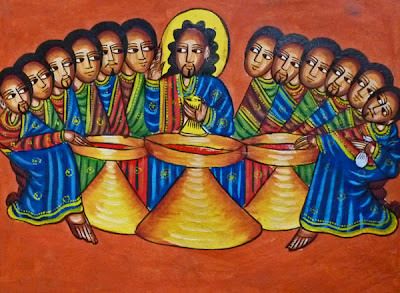
Ethiopian Orthodox Church depiction of the Last Supper in the Upper Room

“He’s leaving!? What!? Huh!?” Although Jesus had tried to prepare the disciples for his impending cross and resurrection, they didn’t quite catch on. It was in the Upper Room, in their final meal together, that Jesus made it plain he was leaving and going back to the Father. (John 14:1-17)

There was both confusion and distress amongst the men. Anticipatory grief had suddenly smacked them like a golf club upside the head. Dizzied and dazed with thoughts that their Lord would no longer be with them, Jesus sought to assure them that this would be temporary.

Christ is coming, again. In fact, three comings are to be realized:

  • Rising from death and appearing to the disciples
  • Sending the Spirit as the continuing presence of Christ on earth
  • Returning at the end of the age to judge the living and the dead

Jesus was caring for his followers, including us, by providing future hope.

That is just what happened with the first two comings. Christians everywhere celebrate the rising of Christ from death, his ascension into heaven, and the giving of the Holy Spirit at Pentecost. The Christian tradition holds that the Spirit – the Paraclete, Advocate, Comforter, and Counselor – is now presently with us.

Although the world no longer sees Jesus, believers see him with eyes of faith, hope, and love. Christians intuitively perceive another spiritual dimension in which Christ is beside them in the person of God’s Spirit. Some things can’t be intellectually explained. They just are.

Meanwhile, while Christians everywhere await the return of Christ to this earth, they are busy loving their Lord through obedience to his commands. And his command is to love one another as he demonstrated his love for them. Love and obedience go hand in hand. To know the love of God in Christ is to willingly give oneself to obey the merciful Lord.

We are not left alone to fumble around on this earth, trying to love in our own strength or ability. The Spirit is present, helping us to do loving work. There is real spiritual assistance in applying Christ’s teaching to the practical aspects of life in the here-and-now. Such constructive down-to-earth support gives Christians a sense of peace and integrity of living.

Worldly peace, which typically uses war to try and end war, has merely the absence of conflict as its goal. However, the peace of Christ is intensely personal and has the goal of unity, harmony, and love. It is his very own peace. Through Christ’s suffering and death, he absorbed in himself the malice and hatred of others and introduced a true and settled peace.

The profound absence of love, the rebellion of humanity against concern for the common good of all, and the shame of selfishness that damns the world, is overthrown by the obedience and self-sacrifice of Jesus. The world will learn this – either by discovering the love of Christ now or, at the end of the age, with the return of Christ.

Jesus came in the past through the incarnation and resurrection. Jesus is presently here in the person of the Holy Spirit. Jesus will come again in the future to judge the living and the dead.

These comings are for us and for our deliverance from all that is unjust and broken in this world. We are not alone. There is ever-present help. This is the basis of the Christian’s confidence.

Come, Holy Spirit, and fill the hearts of your faithful with divine love. Come as the wind that blows, come as the fire that refines, come as the dew that refreshes. Convict, convert and consecrate us until we are wholly yours, through Jesus Christ, our Lord. Amen.

Persecuted (Acts 8:1b-8)

A scene from the movie, “Paul, Apostle of Christ,” in which Saul sought to wipe out Christians beginning with the stoning of Stephen

On that day a great persecution broke out against the church in Jerusalem, and all except the apostles were scattered throughout Judea and Samaria. Godly men buried Stephen and mourned deeply for him. But Saul began to destroy the church. Going from house to house, he dragged off both men and women and put them in prison.

Those who had been scattered preached the word wherever they went. Philip went down to a city in Samaria and proclaimed the Messiah there. When the crowds heard Philip and saw the signs he performed, they all paid close attention to what he said. For with shrieks, impure spirits came out of many, and many who were paralyzed or lame were healed. So there was great joy in that city. (New International Version)

Just because Christians experience the blessing of God through new life in Christ, does not mean that the rest of this earthly life will be bunnies and unicorns without any hardship.

Sometimes we forget that rabbits and horses produce manure, and we’ll have to muck out the barn. And even more than that, blessings from God are not limited to an abundance of earthly resources; blessing also comes through suffering. Jesus said:

“Great blessings belong to those who suffer persecution for doing what is right. God’s kingdom belongs to them.

“People will insult you and hurt you. They will lie and say all kinds of evil things about you because you follow me. But when they do that, know that great blessings belong to you. 

“Be happy about it. Be very glad because you have a great reward waiting for you in heaven. People did these same bad things to the prophets who lived before you.” (Matthew 5:10-12, ERV)

Saul was an up and coming Jewish Pharisee. He was intelligent, driven, and pious. Saul had the pedigree, passion, and position to go a long way and make a big splash in Judaism. And he was more than ready to do whatever it took to stamp out a heretical and dangerous sect of Jesus followers – even to the point of giving approval to the stoning of the Christian Stephen; and leading a persecution against believers like him.

Jesus not only promised abundant and eternal life to his followers, but he also promised that the cost of Christian discipleship would be persecution. Believers in Jesus Christ can expect to suffer in this life for their faithful commitment. Yet, because Christ overcame the world, we too, can accept, cope, and transcend any persecution and trouble we face in our embrace of faith. Jesus said:

“The world will make you suffer. But be brave! I have defeated the world!” (John 16:33b, GNT)

Even though the unity the believers enjoyed together in Jerusalem was disrupted and destroyed by the leadership of Saul, God bent the adverse situation toward blessing. Christians were flung all over the known world. In their going, they obeyed the words of their Lord Jesus to proclaim the message they so wholeheartedly embraced.

When Jesus came near, he spoke to them. He said, “All authority in heaven and on earth has been given to me. So wherever you go, make disciples of all nations: Baptize them in the name of the Father, and of the Son, and of the Holy Spirit. Teach them to do everything I have commanded you.

“And remember that I am always with you until the end of time.” (Matthew 28:18-20, GW)

The ancient prophesies were becoming realized. Grace, mercy, and peace were overcoming bitterness, judgment, and enmity toward one another. Even though persecution was happening, there was now a very different response to it, which will lead to a new outcome. In the last days…

The Lord will mediate between nations
    and will settle international disputes.
They will hammer their swords into plowshares
    and their spears into pruning hooks.
Nation will no longer fight against nation,
    nor train for war anymore. (Isaiah 2:4, NLT)

Suffering can be tolerated, even embraced, whenever we are aware that it can lead us to peace and joy – both personally and communally. Instead of evil taking root amongst a people, good seeds can be planted in the heart of humanity. And when those seeds are watered and nurtured, they grow to become a blessing for the world.

Finally, Jesus said, “What is God’s kingdom like? What story can I use to explain it? It is like what happens when a mustard seed is planted in the ground. It is the smallest seed in all the world. But once it is planted, it grows larger than any garden plant. It even puts out branches that are big enough for birds to nest in its shade.” (Mark 4:30-32, CEV)

Spiritual growth is built into Christianity. The faith formation and development of both individual believers and churches is important. Without it, Christians devolve into cliques of special interest groups.

But with it, Christianity becomes a blessing to the world, that is, if believers focus on producing and harvesting the spiritual fruit of love, joy, peace, patience, kindness, generosity, faithfulness, gentleness, and self-control. (Galatians 5:22-23)

Whenever and wherever believers and followers of Jesus are spiritually growing in their faith, they become like exorcists who organically purge unhealthy institutional systems of their moral corruption, selfishness, idolatry, hate, in-fighting, obsessions, bitterness, rage, competitive oppositions, conflict, and polarizing group rivalries. (Galatians 5:19-21)

Christianity is meant to bring joy and healing of both body and soul. If it doesn’t do this, then it has become just another unjust and unhealthy organization that is in need of purging its impurities; and embracing its mandate to uphold the common good of all persons through proclamation of good news and committed to a lifestyle of loving one another as Christ has loved us.

For people pay attention to that which is right, just, and good – because righteousness, justice, and goodness are in everyone’s spiritual DNA.

Almighty and gracious God of all:
Remember Christ, your Son, who is peace itself,
and who has washed away our hatred with his blood.
Because you love all men and women everywhere,
look with mercy on all who are engaged in battles of the flesh and the spirit.
Banish the violence and evil within all combatants of both body and soul
so that one day, we may all deserve to be called your sons and your daughters.
Grant this through Christ our Lord, in the enablement of the Spirit. Amen.