Psalm 128 – Obey and Enjoy Happiness

Around Your Table by Melani Pyke

Happy are those who respect the Lord and obey him.
You will enjoy what you work for,
    and you will be blessed with good things.
Your wife will give you many children,
    like a vine that produces much fruit.
Your children will bring you much good,
    like olive branches that produce many olives.
This is how the one who respects the Lord
    will be blessed.
May the Lord bless you from Mount Zion;
    may you enjoy the good things of Jerusalem all your life.
May you see your grandchildren.

Let there be peace in Israel. (New Century Version)

Obedience and blessing go together like a hand in a glove. Holy Scripture consistently connects the call to obey the Lord with blessing from G-d. Indeed, in carefully observing wise and biblical instruction, one will typically enjoy divine favor and approval.

Keep in mind, however, this is not a math equation. Like 2+2=4 there are folks who expect a neat linear connection between their obedience and their blessing. In math theology, when a woman is unable to have children, or a child goes astray from their heritage, the parent concludes that they themselves must have been unfaithful to G-d’s law or are being punished. Conversely, with children who grow to be good citizens and respectful persons, the parents might conclude it was because of their superior observance to the spiritual life.

In both cases, parents take too much credit, either for a child’s wandering or success. As for kids going astray, even G-d had prodigal children, so cut ourselves some slack. As for children who maintain faithfulness, a lot of factors went into who they are. I suppose it is only natural to quickly assume we have far more control of than we really do.

This all cuts to the heart of biblical interpretation. If all Scripture is read literally, then we will likely see the Bible as a math equation where doing and saying the right things gets a predictable result of blessing. Yet, this mistakenly views promise and proverb as the same thing, and divine work with one person or group will be precisely the same for another. The wisdom literature of Scripture, which includes the psalms, were never designed as prescriptive decree but rather as the sage approach for work, worship, and family.

“Faith is only real when there is obedience, never without it, and faith only becomes faith in the act of obedience.”

Dietrich Bonhoeffer

Today’s psalm communicates the path of happiness coming through love and respect for G-d. It neither promises lots of kids, ensures money, nor guarantees smooth sailing. Rather, when one lives each day being cognizant and observant to center everything around the divine, then blessing and happiness will tend to follow.

Blessings and benedictions are given to sustain us in hope and confidence. The best things in life usually come through faith and family. So, when we choose to walk with G-d and travel down the ethical road, then life becomes full of peace and prosperity – perhaps not always in the manner we expect, yet blessing, nonetheless.

Humanity is hard-wired for blessing, for a steady diet of encouragement, acceptance, and approval from G-d and others. When this is withheld from us, unhappiness, even despair begins to settle. Giving and receiving blessing is at the heart of being fully human and alive. Our work and family life will likely be miserable if blessing is absent. Yet, with blessing, we have a sustainable form of happiness and enjoyment.

Most every good thing in life is obtained through a great deal of blood, sweat, and tears. Obedience is no easy task. It typically requires courage and is complicated in its application to life situations. Here are a few ways to maintain an obedient life to G-d:

  • Devote yourself to the daily reading of Scripture. One cannot obey that which is neither known nor remembered. A steady regimen of good old fashioned Bible reading is the best way to refresh the mind and incline the heart toward biblical commands. (Psalm 119:57-64)
  • Pray to listen and pay attention. There is more to prayer than petitions and praise. We must also practice silence and solitude so that we can give focused attention to hearing G-d, thus, obeying the Spirit. (Jeremiah 7:21-26)
  • Practice repentance. Being aware of our guilt and shame, acknowledging it, and naming it before G-d is the path of change – keeping us on the narrow road of obedience. (1 John 1:5-10)
  • Take the long view. Not all obedience is rewarded in this life but in the life to come. Perseverance and patience is needed to sustain obedience over the long haul of life. And, in the end, there are heavenly blessings awaiting us. (Hebrews 11:36-12:3)

Eternal God, by whose power we are created and by whose love we are redeemed, guide, strengthen, and bless us through your Spirit so that we may give ourselves to your service and live today in love to one another and to you, through Jesus Christ our Lord. Amen.


Luke 8:4-15 – Christ’s Parable of the Soils

While a large crowd was gathering and people were coming to Jesus from town after town, he told this parable: “A farmer went out to sow his seed. As he was scattering the seed, some fell along the path; it was trampled on, and the birds ate it up. Some fell on rocky ground, and when it came up, the plants withered because they had no moisture. Other seed fell among thorns, which grew up with it and choked the plants. Still other seed fell on good soil. It came up and yielded a crop, a hundred times more than was sown.”

When he said this, he called out, “Whoever has ears to hear, let them hear.”

His disciples asked him what this parable meant. He said, “The knowledge of the secrets of the kingdom of God has been given to you, but to others I speak in parables, so that,

“‘though seeing, they may not see;
    though hearing, they may not understand.’

“This is the meaning of the parable: The seed is the word of God. Those along the path are the ones who hear, and then the devil comes and takes away the word from their hearts, so that they may not believe and be saved. Those on the rocky ground are the ones who receive the word with joy when they hear it, but they have no root. They believe for a while, but in the time of testing they fall away. The seed that fell among thorns stands for those who hear, but as they go on their way they are choked by life’s worries, riches and pleasures, and they do not mature. But the seed on good soil stands for those with a noble and good heart, who hear the word, retain it, and by persevering produce a crop. (New International Version)

The Parable

“Whoever has ears, let them hear,” said Jesus. Truly hearing Christ’s words and listening with focused attention is paramount to the Christian life. Our ears are the soil of our lives. Ears attentive and devoted to listening to Jesus are good soil; ears distracted, inattentive, and stopped up with ear wax are bad soil. Receptive listening to the Word of God brings a fruitful harvest of righteousness, peace, and joy in the Holy Spirit. Genuinely believing what we hear from Jesus is crucial. God’s Word falls on four different soils….

  1. The seed on the path. A path is for walking, which is why the seed never takes root. Here there is no listening. When we act without listening, our actions will be misguided. 
  2. The seed on rocky soil.  Here there is no deep listening. A lack of attentive hearing results in a shallow person who perhaps relies more on Christian clichés or on their personality or abilities instead of the sown Word.
  3. The seed on the thorny soil. Here there is significant listening. However, there is too much listening to a cacophony of voices and not enough singular listening to the sown Word. Listening to the wrong voices will cause an unfruitful life. So, we must be careful to whom we are listening.
  4. The seed on good soil. A devoted listening to the Word without distraction leads to a productive, fruitful believer.

“There is a difference between listening and waiting for your turn to speak.”

Simon Sinek

The Nature of Parables

A parable is a genre of biblical literature. Parables are as much about concealing truth as they are conveying truth. A person must give focused attention to the story to learn from it, much like a good novel conveys truth about the human condition without being preachy or outright saying the truth. Or it’s much akin to a good movie relying on character development and the power of story for its message, instead of being a straightforward documentary.

Jesus neither strong-arms people nor puts them in a full nelson to force them into God’s will. We will miss out on God’s working, if we are looking for a big dramatic hoo-ha of an event. That’s because it comes as an awareness within people and works its way out. For those not intent on changing, they will find Christ’s words confusing. They might “hear” Jesus, yet fail to really listen, since they have their own ideas about how God ought to operate.

Yet, grace is still present. The very fact that Jesus addressed the crowd of people demonstrates he cared enough to communicate. He could have said, “Hey, you guys, get lost, I’m just going to interact with people who really listen to me.” Instead of coming at the crowd and bursting through the front door, Jesus mercifully came to them through the side door so that they would be able to receive the message. 

Puking the good news of Jesus all over people without really listening is a bad idea. Neither is being worried about saying something offensive, so nothing is said at all. A better approach is asking permission to tell your story of what Jesus means to you, or what you are learning from God’s Word.

The Parable Interpreted

The focus is the experience of the seed in a variety of soils. Outside powers acting on the Word – devouring birds, rocks, the burning sun, choking thorn-bushes – demonstrate the Word is central and needs to be received well:

  1. The path is the inability to hear God’s Word because of hard-heartedness. The devil snatches it before any real understanding can take place.
  2. The rocky soil is hearing just enough to respond with joy. But the person drops out when hard circumstances occur. “I didn’t sign up for this!” is their cry. They needed to count the cost of discipleship before responding to the message. This is merely a professing Christian, nothing more.  Rather than listening and internalizing the Word, there is only positive affirmation without any action or practice. So, tomorrow the message is gone and forgotten. When difficulty comes, there are no supporting words to draw from, so the person fades away, unable to navigate life successfully.
  3. The thorny soil also hears and responds to the message. This person is also a professing Christian, nothing more. The issue here is that they also listen to voices of worry and wealth. In a sort of spiritual attention-deficit-disorder, there is no ability to filter all the voices calling out, and so, no growth.
  4. Listening with the intention of understanding and putting into practice the message heard is what brings about fruit. Receiving the Word through careful listening brings about spiritual growth. God brings the growth when we focus on the Word. And when a whole group does this, then it creates a greenhouse effect in which people cannot help but grow in the Lord.

Conclusion to the Parable

The simple reception of God’s Word leads to fruitfulness. The first soil did not receive the Word, though it listened. The second received it with joy but under pressure let it go. The third received it with only one hand because the other hand was busy. Only the fourth soil received the Word with both hands.

Blessed is the one who does not walk in step with the wicked or stand in the way that sinners take or sit in the company of mockers, but whose delight is in the law of the Lord, and who meditates on his law, day and night. That person is like a tree planted by streams of water, which yields its fruit in season and whose leaf does not wither—whatever they do prospers. (Psalm 1:1-3, NIV)

The old adage that we were created with two ears and one mouth, so that we will listen twice as much talk, is a truism. It’s hard to receive any words of encouragement, help, or reproof if you’re tongue is flapping in the wind.

Careful listening, attention to memory, and patient application are the pathways to realizing an abundant spiritual harvest of righteousness and peace.

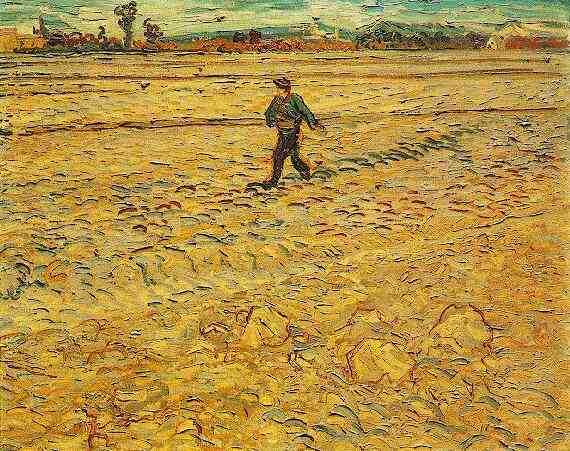
*Above paintings, The Sower by Vincent Van Gogh, 1881 & 1888

Hebrews 2:1-4 – Learning to Pay Attention

We must give our full attention to what we were told, so that we won’t drift away. The message spoken by angels proved to be true, and all who disobeyed or rejected it were punished as they deserved. So, if we refuse this great way of being saved, how can we hope to escape? The Lord himself was the first to tell about it, and people who heard the message proved to us that it was true. God himself showed that his message was true by working all kinds of powerful miracles and wonders. He also gave his Holy Spirit to anyone he chose to. (CEV)

My three girls all have attention deficit disorder (A.D.D.). You might think this is a disadvantage. Rather, since the biology of their brains do not have good filters for sifting out all the stimuli which they hear each day, each of them are much more intentional about picking out the voice they want to hear and engaging with it. Whereas you and I might take this for granted, my girls know the value of creating the skills to pay attention.

We stand at the cusp of Lent, just two days from now. A healthy way of looking at this important season in the Christian Year is that it is a time to listen. It is the opportunity and privilege of giving our complete attention to Jesus as we plod along the 40-day path to Easter. And we need to develop some solid skills in paying attention, whether we have A.D.D. or not.

The cost of not developing such skills is that we will drift away. Taking for granted that we are Christians, that we know something about salvation, and are basically good people, might only be setting us up for spiritual failure. That is, we think we already know about Christ’s person and work of salvation, so we fail to really pay attention. Bad idea.

Assuming we are paying attention is not the same thing as actually doing it. Assumptions lead to drifting away from truth. We are meant to have continual and constant reminders of Christ and his redemptive events. This is what Lent intends for us. To ignore the wisdom of two-thousand years of church practice puts us in a precarious position of being lost at sea.

For the next six weeks, make the choice that you will pay attention to Christ each day through the following:

  • Reading Scripture every day with a combination of standing and sitting, reading silently and out loud.
  • Holding a cross or other Christian reminder in your hand and feeling free to fidget with it.
  • Journaling your thoughts in a notebook.
  • Imposing time limits on yourself each day for the next 40 days.
  • Using different versions of the Bible to read throughout Lent.
  • Going outside occasionally and praying while walking.
  • Focusing on your breathing. Breathe out: “Speak Lord.” Breathe in: “I am listening.”
  • Drinking some coffee, tea, or something soothing.
  • Being mindful of distractions and acknowledging them without judging yourself.

The point is to have an intentional plan for paying attention. Do not assume you will be focused. May your journey with Jesus this season be a fresh experience in knowing him better.

Lord God, the world is rushing by. The days are sometimes a blur. But in those moments when I stop, time almost stands still. Keep my heart open to the simplicity of the day – to virtual interactions and connections with others without being distracted – and paying attention. Help me, Lord. Open my eyes. Open my ears. Open my heart to know you are with me, if I just pay attention. Amen.  

Judges 2:16-23 – Listen

From time to time, the Lord would choose special leaders known as judges. These judges would lead the Israelites into battle and defeat the enemies that made raids on them. In years gone by, the Israelites had been faithful to the Lord, but now they were quick to be unfaithful and to refuse even to listen to these judges. The Israelites would disobey the Lord, and instead of worshiping him, they would worship other gods.

When enemies made life miserable for the Israelites, the Lord would feel sorry for them. He would choose a judge and help that judge rescue Israel from its enemies. The Lord would be kind to Israel as long as that judge lived. But afterwards, the Israelites would become even more sinful than their ancestors had been. The Israelites were stubborn—they simply would not stop worshiping other gods or following the teachings of other religions.

The Lord was angry with Israel and said:

The Israelites have broken the agreement I made with their ancestors. They won’t obey me, so I’ll stop helping them defeat their enemies. Israel still had a lot of enemies when Joshua died, and I’m going to let those enemies stay. I’ll use them to test Israel, because then I can find out if Israel will worship and obey me as their ancestors did.

That’s why the Lord had not let Joshua get rid of all those enemy nations right away. (CEV)

Listening seems to be a lost art and a forgotten skill. Genuine focused attention on another person through careful listening takes practice. Maybe that is one reason there is a paucity of authentic hearing these days – it is just so doggone hard. Throw into the mix that a lot of folks like hearing their own voice, and you have a recipe for poor communication.

God is good at everything, especially listening.

The Lord is the Master Listener. In fact, God is so good at it that divine ears hear the prayers of people all over the world. The same careful attention is given to both the little girl in the West who intercedes for her parents and teddy bear at night, as well as halfway around the world with the national leader who requests wisdom for decisions in a heated meeting.

The Lord God Almighty is gracious, merciful, and kind, hearing us when we call, and listening when we our hearts long for the divine. God always bends low in a posture of listening to all creation. As creatures in the image of God, we were meant from the very beginning of creation to listen well. Yet, ever since humanity fell into disobedience, people have the tendency to talk more than they listen, to sometimes refuse to hear what another is saying. There are even those who ignore God’s speech.

The ancient Israelites in the book of Judges were fickle in their attention to God. When things were bad, they cried out to the Lord. Because God attentively listens, they were heard, and a merciful divine response came. However, when things were better, the people went about their business and forgot about God’s deliverance.

It was God who sent judges, rulers, and leaders, to the people for their own welfare. Instead of graciously receiving such a gift from God, the people were quick to be unfaithful and to refuse even to listen the divinely sent judges. Listening, really listening, was not a high value to the people. They talked and talked, incessantly droning on, and so could not hear what God through the divinely appointed rulers was saying.

We are to listen well because God listens well.

We are to pay attention and hear because we are designed by our Creator to do so. Perhaps our society would not be so perpetually upset and polarized if we would just take the time to take notice and take advice through a posture of humble hearing.

Try this little exercise of listening: Take just ten minutes and do not talk, read, check your phone, or do anything but just listen to the sounds around you…. What do you hear?… What do you think God is saying to you through those sounds?… How will you to respond?

Stillness reveals the secrets of eternity, allowing us to hear the still small voice of God. Sound is amplified through silence. If we desire a clear word from the Lord, then stillness and silence are the spiritual practices that will allow it to happen. Life’s most precious moments are not all loud or uproarious, for silence and stillness have their own virtues which connect us with the divine. Never underestimate the power of doing nothing.

God of all creation, you have made me with two ears for listening. Help me to so hear and distinguish you through creation and the voices of others so that I will follow Christ with confidence in my daily life. Almighty and everlasting God, you are always more ready to hear than we to pray, and to give more than we either desire or deserve. Pour upon us the abundance of your mercy, forgiving us those things of which our conscience is afraid, and giving us those good things for which we are not worthy to ask, except through the merits and mediation of Jesus Christ our Savior; who lives and reigns with you and the Holy Spirit, one God, forever and ever. Amen.