Forgotten, but Blessed (Genesis 40:1-23)

Joseph, the cupbearer, and the baker in prison, by Gerbrand van den Eeckhout, 1643

Sometime later, Pharaoh’s chief cupbearer and chief baker offended their royal master. Pharaoh became angry with these two officials, and he put them in the prison where Joseph was, in the palace of the captain of the guard. They remained in prison for quite some time, and the captain of the guard assigned them to Joseph, who looked after them.

While they were in prison, Pharaoh’s cupbearer and baker each had a dream one night, and each dream had its own meaning. When Joseph saw them the next morning, he noticed that they both looked upset. “Why do you look so worried today?” he asked them.

And they replied, “We both had dreams last night, but no one can tell us what they mean.”

“Interpreting dreams is God’s business,” Joseph replied. “Go ahead and tell me your dreams.”

So the chief cupbearer told Joseph his dream first. “In my dream,” he said, “I saw a grapevine in front of me. The vine had three branches that began to bud and blossom, and soon it produced clusters of ripe grapes. I was holding Pharaoh’s wine cup in my hand, so I took a cluster of grapes and squeezed the juice into the cup. Then I placed the cup in Pharaoh’s hand.”

“This is what the dream means,” Joseph said. “The three branches represent three days. Within three days Pharaoh will lift you up and restore you to your position as his chief cupbearer. And please remember me and do me a favor when things go well for you. Mention me to Pharaoh, so he might let me out of this place.For I was kidnapped from my homeland, the land of the Hebrews, and now I’m here in prison, but I did nothing to deserve it.”

When the chief baker saw that Joseph had given the first dream such a positive interpretation, he said to Joseph, “I had a dream, too. In my dream there were three baskets of white pastries stacked on my head. The top basket contained all kinds of pastries for Pharaoh, but the birds came and ate them from the basket on my head.”

“This is what the dream means,” Joseph told him. “The three baskets also represent three days. Three days from now Pharaoh will lift you up and impale your body on a pole. Then birds will come and peck away at your flesh.”

Pharaoh’s birthday came three days later, and he prepared a banquet for all his officials and staff. He summoned his chief cupbearer and chief baker to join the other officials. He then restored the chief cupbearer to his former position, so he could again hand Pharaoh his cup. But Pharaoh impaled the chief baker, just as Joseph had predicted when he interpreted his dream. Pharaoh’s chief cupbearer, however, forgot all about Joseph, never giving him another thought. (New Living Translation)

Joseph, the cupbearer, and the baker, by Alexander Ivanov (1806-1858)

It is a sinking (and stinking) feeling to be forgotten, as if no one cares. But we know God cares. And we also know Joseph did nothing wrong. How did he get to this point of being left in a prison? What’s up with that?

Joseph’s Story

The story of Joseph (Genesis 37, 39-50) is one of the longest narratives in the Old Testament. Joseph was next to the youngest of 12 sons born to their father Jacob. Rachel was Jacob’s favorite wife and Joseph’s mother – which also made Joseph one Jacob’s favorites. This didn’t go down well with the rest of the sons. Joseph’s brothers (unbeknownst by Jacob) sold him into slavery.

Joseph was taken to Egypt and became the servant of Pharaoh’s captain of the guard, Potiphar. Joseph distinguished himself as competent, skillful, and virtuous. It was actually his integrity which got him into prison. Refusing to sleep with Potiphar’s wife, she became an angry woman and accused Joseph of something he didn’t do. The captain promptly dispatched him to jail.

Human Hatred and Unfaithfulness

Joseph became a slave in Egypt because of jealousy, hatred, and lack of faithfulness on the part of Joseph’s brothers. They disowned him, sold him, and rid themselves of him. The brothers wanted to forget Joseph, and they did.

Furthermore, Joseph became a prisoner in Egypt because of anger, hate, and betrayal of faith. Potiphar’s wife didn’t get what she wanted from Joseph, so she lied and fumed, landing Joseph in a dank prison. He was left without another thought – forgotten and jailed for no fault of his own.

And just when we think the story might turn around, and Joseph will be freed from his unjust imprisonment, the chief cupbearer (wine steward) promptly forgot him and said nothing to Pharaoh after he was out of jail and restored to his position. Once again, Joseph is the undeserved recipient of unfaithfulness. He remains in prison for another two years. Oy.

As much as we might like to get past all these unjust and maddening situations, Holy Scripture does not let us off the hook so easily. We have to sit with Joseph for a while, and feel what he feels, experience what he experiences, so that we can learn our own lessons from him.

Whether we like it, or not, suffering is a reality. And yet, although sometimes forgotten by humanity, we are remembered by divinity….

Divine Presence in the Middle of Suffering

God is present with us through hardship and adversity. Joseph’s story sets up the contrast between fickle humans and a faithful God. A lot of people in Joseph’s life let him down. But God was there as the continual divine presence throughout every circumstance, both good and bad…

  • God gifted Joseph and had special plans for him. God was with Joseph in his dreams. (Genesis 37:5-11) 
  • God was with Joseph, so that he succeeded in everything he did; the Lord caused all that Joseph did to prosper. (Genesis 39:2-3)
  • God showed Joseph steadfast love, and gave him favor in the sight of the chief jailer. The jailer did not worry about anything, because the Lord was with Joseph and made him successful in all that he did. (Genesis 39:21, 23)
  • God was present with Joseph in helping him interpret dreams, even in difficult situations. (Genesis 40:8)

God’s presence makes a difference. The Lord met Joseph in his suffering – yet did not leave him there. God entered Joseph’s suffering, was present with him while in it, and eventually brought him out of it, to another and better place. And in the process, God blessed others through Joseph.

Not only did Joseph survive, but he also thrived in the middle of injustice. God quietly went about the business of using Joseph as an agent of blessing everywhere he was sent: To Potiphar and his household; to the chief jailer and all those in prison; and then to Pharaoh and all of Egypt.

In the end, even the conniving and caballing brothers receive blessing — through Joseph. In this way, the Lord was fulfilling the divine promise to Abraham — that he and Sarah and their descendants would be blessed; and that through them, all the nations of the earth would also be blessed.

God is present with those in suffering. Yet, the way God works almost never seems fast enough for those who are suffering. We, along with the psalm writers, cry out, “How long, O Lord!?”

In situations, such as Joseph’s, it won’t do to offer platitudes to “Let go, and let God,” “Everything works for good,” or “God never gives us more than we can handle.” Sheesh. I doubt anyone in life-or-death situations relies on nifty phrases. They want God, and they understandably want God now.

Whether quick or slow, hard or unbearable, the biblical promise nevertheless stills stands that God meets us in our suffering. And God does not leave us there. God also calls us and moves us to more pleasant places. And know this: In the process and in the journey, God will bless others through us.

O God:
Give me strength to live another day;
Let me not turn coward before its difficulties or prove passive to its duties;
Let me not lose faith in other people;
Keep me sweet and sound of heart, in spite of ingratitude, treachery, or meanness;
Preserve me from minding little stings or from giving them;
Help me to keep my heart clean, and to live so honestly and fearlessly that no outward failure can dishearten me or take away the joy of conscious integrity;
Open wide the eyes of my soul that I may see good in all things;
Grant me this day some new vision of truth;
Inspire me with a spirit of joy and gladness;
and make me the cup of strength to suffering souls;
in the name of the strong Deliverer, our Lord and Savior, Jesus Christ. Amen.

The Parable of the Mustard Seed (Mark 4:30-34)

Again he [Jesus] said, “What shall we say the kingdom of God is like, or what parable shall we use to describe it?It is like a mustard seed, which is the smallest of all seeds on earth. Yet when planted, it grows and becomes the largest of all garden plants, with such big branches that the birds can perch in its shade.”

With many similar parables Jesus spoke the word to them, as much as they could understand. He did not say anything to them without using a parable. But when he was alone with his own disciples, he explained everything. (New International Version)

Working with Seeds

I grew up on a rural Mid-West America farm. Working with seeds was our livelihood. Even though my farming father worried incessantly about the weather, there was one thing he was never anxious about: seeds.

My dad knew that when we planted seeds in the Spring, there would be a harvest in the Fall. That’s because he knew the seed already has within itself everything it needs to germinate, take root, grow, and produce a harvest. His role was simply to tend to it all by keeping the fields free of weeds, worms, and critters.

Since I was the youngest, I typically got the grunt work of our massive family garden. I was always excited when we planted things because I knew what was coming in a few months: some delicious veggies on my dinner plate which were fresh from the garden that I myself tended. I never wondered whether there would be food on the table, or not.

Seeds are, of course, small. If you think about it, they appear quite unimpressive. Yet, we know better. We understand that when planted, watered, and cultivated, those seeds turn into amazing plants. 

But it takes time. Even as dumb little kid, I clearly knew that my planting seeds would not result in seeing anything above ground the next day. I understood it would take a few weeks before new growth would break the ground.

Seeds and the Kingdom of God

The kingdom of God, Jesus told us, is like a mustard seed – a very small seed which can grow into a tree big enough for birds to nest. Unlike the mighty Roman Empire, or contemporary powerful national governments, the kingdom of God had humble beginnings. It grows, over a long period of time, to become a force greater than anything the world can produce.

While our world races forcefully on with the speed of the hare, Jesus is carefully and patiently building his Church at the pace of a tortoise. In the end, the kingdom of God will rule over all creation, while the kingdoms of this world shall no longer exist. 

Even though many of us now live in a society where quicker, faster, better, and stronger dominate everything, still the best things in life come as a result of tedious perseverance over an extended period of time. 

We are in such a hurry to accomplish our goals, make as much money as we can, and keep constant vigilance over our work. And for what purpose?

When we forget to slow down, or worse yet, believe slowness to be laziness and/or stupidity, there is a price to pay.

Lessons of the Seed

In graduate school, I typically read an average of 200 books per semester. Yes, you read that right. I had to keep up. I was on the clock with deadlines for papers and projects. In the factory, where I did a stent as a worker, I did piece work at the rate of 100 per hour for 8-10 hours. I had to go fast to survive and keep my job, let alone thrive. All of this, of course, impacted my mind, body, and emotions – in very uncaring ways. It was all done at the cost of my physical and mental health.

Indeed, our modern capitalist societies generate an unparalleled level of wealth and standard of living. But this has been achieved at the cost of devouring our planet faster than she can replenish herself. The stress we have put on mother earth we would never think of putting on our own mothers.

Even our attempts at leisure and self-care are anything but. We often end up racing to have as much fun and relaxation as we can cram into a few days or weeks of our “time off.” A return to the normal rat race has us telling each other, “I need a vacation from my vacation.”

There is such a thing as death by overwork. So, we desperately need to come back to the words and ways of Christ – to embrace the slow developing rhythms of grace. We need to age like a fine wine or an expensive bourbon, getting wiser as we get older.

Time is a precious gift given to us by a good and wise God. And that gift must be stewarded well. All the things that bind people together and make our lives worth living – family, faith, friendship, and community – all thrive on having copious amounts of time with each other (and God) in relational connection.

We are, I believe, in a pandemic of having no one to listen, of profound loneliness, and of incredible lostness of soul. The only real prescription for these debilitating maladies is slowing down and taking the time to be, and to be with each other.

Seeds are Slow

Instant gratification will not do the trick. We need to plant small seeds, and then take the time to nurture them and watch over them. While the rest of the world rages and roars on with their disease of speed, believers must carefully cultivate spiritual practices which foster healthy growth and development.

Whether we like it, or not, we serve a slow God. And what’s more, because slowness is built into the very nature of the world, decelerating our lives actually works. Life eventually becomes better, not worse.

You and I have the God-given right to determine our own pace and tempo – without anxious systems of power squeezing every ounce of speed and activity out of us, sucking our souls to serve a worthless idol.

I, for one, would not be opposed to creating a society known as “The Royal Order of Sloths,” or joining a group of slow walkers who label themselves as “Sauntering for Sanity,” or simply be straightforward with an organization known as “The Society for the Propagation of Slowness.”

That’s because the best things in life take time; and those things need us to slow ourselves enough to notice and enjoy them. Eventually, we shall find that the world is blessed because of our commitment to embracing the small and the slow.

Let us pray for all the world, and also for ourselves, knowing that what we ask in the name of the Lord, will be heard according to God’s mercy and patience.

Almighty God, we pray for faith, even as small as a mustard-seed, and for the love to nourish and nurture it, so that it may grow and flourish. We pray for the church throughout the world – that people of faith may work together in unity and in prayer to overcome evil and to promote true love among all people.

O Lord, you are the beginning of all our good, the wellspring of all our love and the source of all our freedom. Let your grace continue to work in us, that your will may be done through us, and that we may always rejoice in your presence. Lord, in your mercy, hear our prayer. Amen.

Endure Patiently to the End (Revelation 14:12-20)

God’s holy people must endure persecution patiently, obeying his commands and maintaining their faith in Jesus.

And I heard a voice from heaven saying, “Write this down: Blessed are those who die in the Lord from now on. Yes, says the Spirit, they are blessed indeed, for they will rest from their hard work; for their good deeds follow them!”

Then I saw a white cloud, and seated on the cloud was someone like the Son of Man. He had a gold crown on his head and a sharp sickle in his hand.

Then another angel came from the Temple and shouted to the one sitting on the cloud, “Swing the sickle, for the time of harvest has come; the crop on earth is ripe.” So the one sitting on the cloud swung his sickle over the earth, and the whole earth was harvested.

After that, another angel came from the Temple in heaven, and he also had a sharp sickle. Then another angel, who had power to destroy with fire, came from the altar. He shouted to the angel with the sharp sickle, “Swing your sickle now to gather the clusters of grapes from the vines of the earth, for they are ripe for judgment.” So the angel swung his sickle over the earth and loaded the grapes into the great winepress of God’s wrath. The grapes were trampled in the winepress outside the city, and blood flowed from the winepress in a stream about 180 miles long and as high as a horse’s bridle. (New Living Translation)

The Scripture meditations I offer each day are based in the daily readings of the Revised Common Lectionary. The readings are designed to move us through the whole of the Bible in a three year cycle. And they are arranged so that Thursday, Friday, and Saturday readings anticipate the Sunday scriptures, and the Monday, Tuesday, and Wednesday readings reflect on Sunday’s texts. Today’s New Testament lesson is such a reflection on Sunday’s Gospel reading of Christ’s Parable of the Weeds (Parable of the Wheat and Tares).

Jesus made it clear in the parable that it is not our job to weed out evil. This will be done by the angels at the end of the age. In Revelation, we look forward into the future as to what happens with the plants and the weeds. As you can readily see, it is a grim picture. Those who are visual learners, and picture the words in their minds, their stomachs might be turning after the reading of today’s text.

The entire book of Revelation was originally meant to encourage believers in Jesus to persevere, endure, and keep going in their commitment to Christ. As they were undergoing difficulty and even persecution for their faith, this apocalyptic vision of the Apostle John was to instill hope: It will not always be this way.

There is a time coming soon in which the problem of evil is taken care of, once and for all. Until that final day of judgment comes, we are to hold fast to our faith, and continue to keep the commandments of Christ.

The wrath of God has always been an issue with various people throughout history. In contemporary theology, it is common to have groups of folks polarized between either making God out to be constantly angry and looking to zap people; or dismissing God’s wrath altogether as some outdated and antiquated idea. Neither of these approaches will do.

God’s anger and wrath exist, yet is never divorced from God’s love. Rather than viewing wrath and love as two sides of the same coin, I believe a healthier and more biblical understanding is to discern God’s wrath as an expression of God’s love. I will explain….

When God bends to observe us in the world and sees injustice, war, poverty, oppression, trauma, and abuse from narcissistic people who exalt themselves above others and use them for selfish purposes, God is not okay with this!

Whenever God looks at the world and sees governments, institutions, corporations, and even churches which maintain structures that keep others from becoming all that God intends for them to become, divine compassion is stirred up, along with a determination to bring about justice and righteousness.

Only God has the combination of willingness, power, and ability to handle the evil of this world, in a way which is both just and loving.

I realize there are many times when we wonder if God is really watching, or not, and are curious if the Lord is aloof and uncaring to our plight. There is a day when the dramatic will happen, but that day is not today. For now, God is patiently and carefully working divine love into the fabric of this world, in such a way that it will not destroy the innocent and compromise the integrity of the righteous.

Until the time is ripe for God to act in a more decisive manner by equipping angels with scythes and bringing in the final harvest, we experience pain and hurt.

We sometimes are misjudged and misunderstood by others. We often get shafted by systems which are supposed to be helping us. We can, however, be assured that God is working behind the scenes, planting seeds of love and grace. The Lord is pastorally tending to our growth, till the time is right to gather the abundant crop.

Acting too soon, and going off half-cocked without enough information, is what we humans tend to do. Not so with God.

The fact of the matter is: Justice and injustice will co-exist side-by-side for a while. Righteousness and evil will be found together everywhere we go, including our own hearts – holding both our altruistic motives and our evil inclinations.

Sisters and brothers, let us endure, persevere, and be patient. God is good, and will not forget your deeds done in faith; your actions inspired by hope; and your work animated by love.

Lord Christ, you came into the world as one of us, and suffered as we do. As I go through the trials of life, help me to realize that you are with me at all times and in all things; that I have no secrets from you; and that your loving grace enfolds me for eternity. In the security of your embrace I pray. Amen.

The Parable of the Weeds (Matthew 13:24-30, 36-43)

Jesus told them another parable: “The kingdom of heaven is like a man who sowed good seed in his field. But while everyone was sleeping, his enemy came and sowed weeds among the wheat, and went away. When the wheat sprouted and formed heads, then the weeds also appeared.

“The owner’s servants came to him and said, ‘Sir, didn’t you sow good seed in your field? Where then did the weeds come from?’

“‘An enemy did this,’ he replied.

“The servants asked him, ‘Do you want us to go and pull them up?’

“‘No,’ he answered, ‘because while you are pulling the weeds, you may uproot the wheat with them. Let both grow together until the harvest. At that time I will tell the harvesters: First collect the weeds and tie them in bundles to be burned; then gather the wheat and bring it into my barn….’”

Then he left the crowd and went into the house. His disciples came to him and said, “Explain to us the parable of the weeds in the field.”

He answered, “The one who sowed the good seed is the Son of Man. The field is the world, and the good seed stands for the people of the kingdom. The weeds are the people of the evil one, and the enemy who sows them is the devil. The harvest is the end of the age, and the harvesters are angels.

“As the weeds are pulled up and burned in the fire, so it will be at the end of the age. The Son of Man will send out his angels, and they will weed out of his kingdom everything that causes sin and all who do evil. They will throw them into the blazing furnace, where there will be weeping and gnashing of teeth. Then the righteous will shine like the sun in the kingdom of their Father. Whoever has ears, let them hear. (New International Version)

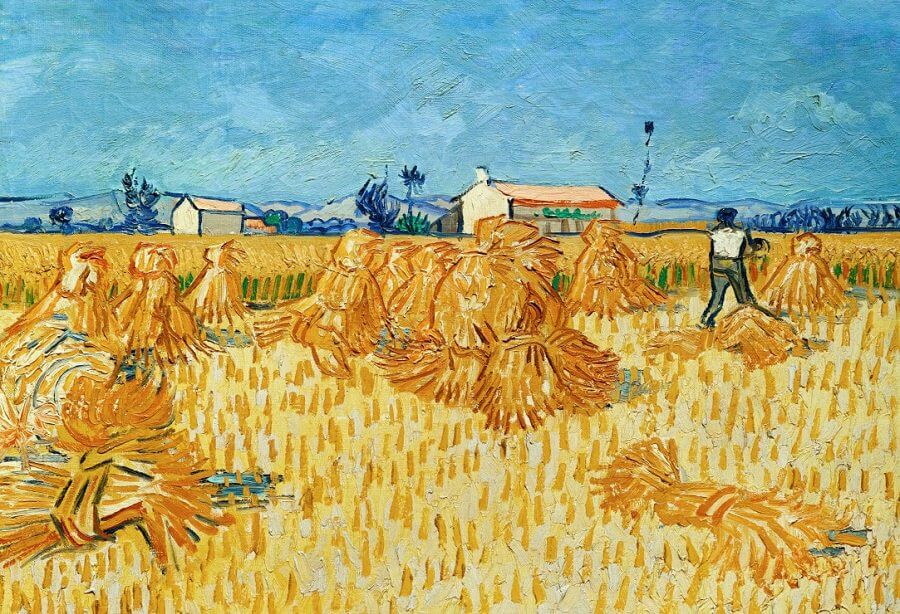
Harvest in Provence, by Vincent Van Gogh, 1888

People of every age struggle with the evil present in this world – and also within the church. For how do we make sense of those who profess Christ but have no fire and passion for their faith? How do we reconcile our own faith with folks in the church who seem to care more about getting their own way than about sacrificing themselves to reach people who do not know Christ. Jesus says, “He who has ears, let him hear.” In other words, listen!

Jesus has informed us that in this present evil age we live in, between his two advents of incarnation and Second Coming, not everything for Christians is going to be rainbows and unicorns.

There are competing pressures on the Church, and sometimes she will fail. The kingdom of God has broken into history and is present, but sin and evil is there, too. So, our focus must be on the hope we have when Christ comes again to judge the living and the dead.

In Christ’s parable of the weeds (or the parable of the wheat and the tares) the enemy of our souls seeks to distract the workers by overwhelming them with evil. If Satan cannot prevent God’s kingdom from being established in the human heart, the devil will try and corrupt the heart by throwing as much evil at it as he can. 

The devil has no problem with people saying they are Christians; the thing Satan has a problem with is people giving themselves unconditionally and unreservedly to God for kingdom business.

“Not everyone who says to me, ‘Lord, Lord,’ will enter the kingdom of heaven, but only the one who does the will of my Father who is in heaven.”

Jesus (Matthew 7:21, NIV)

Where did all these weeds come from?

I’ll frame this question in the modern form that many people have asked me over the years: “If God is a God of love, why is there so much evil in the world?” Or, “If this is Christ’s Church, why is it so messed up?”

Jesus is straightforward in his answer: An enemy did this. In other words, God didn’t plant evil – the source of evil comes from the devil, not God. God’s agenda is for the seed to take root in the human heart and grow into a full-fledged embodiment and commitment to the words and ways of Jesus.

When that growth doesn’t happen, the problem is not because God messed up; it’s because the devil has also done his own work of planting. And the devil wants the opposite of God: to have Christians nit-picking each other like a bunch of crazy chickens, and keeping a demonic pecking order; instead of being the continuing presence of Christ on this earth.

What do we do with all these weeds?

That is, how do we deal with wicked people?  The answer seems obvious: Pull the weeds up and get rid of them. Get rid of wicked people and their wicked behavior. Yet Jesus says in response to this line of reasoning in a clear and unequivocal answer of “No.” But why? Because doing violence to the weeds ends up doing violence to the wheat, as well.

Christ’s answer to the problem of evil is: Let God take care of it. Meanwhile, until that fully happens, we must co-exist with evil, rather than exterminate evil people.

There is always a temptation for believers to force people into the kingdom of God (e.g. the Spanish Inquisition). Yet, at the harvest (the final judgment at the end of the age) evil will be squarely dealt with. Judge Jesus will have the angels separate the wheat from the tares, and the weeds will be burned up.

This teaching from Jesus may open up a whole set of other questions, such as:

  • What am I supposed to do with evil? Just watch it happen? 
  • Am I to let that evil person just be evil? Shouldn’t I give them what they deserve?
  • Shouldn’t I at least tell evil people that they are no good rotten sinners? That they are going to hell because they are wicked?

This doesn’t mean we do nothing. Earlier in Matthew’s Gospel, Jesus has already said: Love your enemies and pray for those who persecute you. (Matthew 5:44)  We are to love and pray people into the kingdom, not force them in.

As for the evil, Jesus will decisively solve the problem of evil, not you, nor me! It isn’t our place to be judge, and if we make it our place, we’ll end up hurting and destroying our brothers and sisters.

Where is evil?

A sobering reality taught by Jesus in this parable is that it’s not a simple matter that we, the wheat are here, and they, the weeds, are over there. It is much more sinister than that; the enemy is within, not out there. 

We have no further to look than in our own hearts and within our own faith communities – which is why we need the lordship of Christ to completely overtake us. Evil is present in the Church, next to the good, seeking to:

  • discourage people in their commitment to Christ
  • offend and hurt others, particularly by overlooking and speaking ill of weaker people
  • step on others in order to get it’s way
  • be a stumbling block to those trying to do God’s will
  • promote ignorance of God’s Word, for no one can live by God’s will if they do not know what it is

The eventual end of sinister people is that, when Christ returns, they will be separated from the righteous and thrown into the fire, just like a harvester would do with a bunch of weeds. As the wicked went about their lives in anger, upsetting others in this life, so they will be tormented in the next.

Conclusion

We may expect God to handle evil in a hurry. But the kingdom of God doesn’t work that way; it’s intended to be planted in the ground, and takes time to grow. While it’s growing, evil is there, like a weed.

Whenever things go sideways because of wickedness, we might expect God to act quickly and drastically to uproot the evil. We may confuse God’s slowness as being uncaring, when in reality it means that God is patient, and desires people to change. And change always begins with you and me.

God Almighty, Creator of heaven and earth, we are a complacent people. While you desire us to be a beacon of light to a world in need, we are preoccupied with all the weeds in the field. We are sorry for the madness unleashed through our own selfish desires. May you plant the seed of love in our hearts for all people, not just our friends. And we shall commit to watering and nurturing that seed with your Word, through Jesus Christ our Lord. Amen.