Embrace the Change, Slowly (Exodus 24:12-18)

Moses receives the law from God on Mount Sinai, by Unknown artist, 1877

The Lord said to Moses, “Come up to me on the mountain and wait there; I will give you the tablets of stone, with the law and the commandment, which I have written for their instruction.” So Moses set out with his assistant Joshua, and Moses went up onto the mountain of God. To the elders he had said, “Wait here for us, until we come back to you. Look, Aaron and Hur are with you; whoever has a dispute may go to them.”

Then Moses went up on the mountain, and the cloud covered the mountain. The glory of the Lord settled on Mount Sinai, and the cloud covered it for six days; on the seventh day he called to Moses out of the cloud. Now the appearance of the glory of the Lord was like a devouring fire on the top of the mountain in the sight of the Israelites. Moses entered the cloud and went up on the mountain. Moses was on the mountain for forty days and forty nights. (New Revised Standard Version)

The Lord graciously entered into a covenant with the ancient Israelites. Following this, Moses was summoned to come up the mountain into God’s presence. There he would receive the tablets of stone with the law and the commandment on it. Yahweh was providing the people with instruction on how to live in the covenant relationship.

The scene was set for the Lord to give an extended revelation to Moses. Moses ascended the mountain, into the cloud, so that the people did not see him. For the next forty days and nights, God’s law and commandments were relayed and taught to Moses.

What did not happen is God tossing some stone tablets containing the law to Moses and then going on God’s merry way. The whole encounter unfolds over an extended period of time. That’s because we are people; we need time to wrap our heads and hearts around new realities. Humans require the gift of slowness to learn and absorb.

Western society, however, does not operate that way. More, faster, and better seems to be our cultural creed. And it’s found everywhere around us. Speed reading. More money. Bigger stuff.

Hogs and chickens are raised on factory farms in large confinement buildings. They never see the light of day. Instead, they are given steroids and growth hormones to grow faster and bigger, so that they can get to the market more quickly and get a better price.

Churches and faith communities in financial trouble look for quick solutions and fast turnarounds by expecting pastors to work more, faster, and better. Sports teams hire and fire coaches with dizzying frequency, believing that if the athletes aren’t faster and better with more wins, then there’s something wrong with them, the coach, or both.

But we have no further than the end of our nose to look for change.

People are in control of very little in this world, and so, a great deal of life is the ability to respond in changing circumstances – both wanted and unwanted. Resilience and flexibility are needed.

Moses receives the Ten Commandments, by Julius Schnorr von Carolsfeld, 1860

The Lord brought about the end of Egyptian slavery for the Israelites through a series of plagues against Egypt. God miraculously delivered the people from the Egyptian army by parting the Red Sea. And Yahweh graciously entered into covenant with them at the mountain. All of this was a major change of life.

It was the people’s responsibility to respond in faith and obedience to the actions and words of God. The Lord was allowing them the space and the time to come to grips with their new reality – which is one reason why Moses met with God for forty days and nights on the mountain.

The Israelites needed to spend their time adjusting to their new life, and contemplating the giving of the law, which was about to happen. Since we are privy to the end of the story, we know that the people did not do this. They became impatient, and experienced a failure of faith and obedience.

Aaron and Hur were the leaders who needed to step up and guide the people in the special opportunity of preparation for receiving the law. Whatever it is they did, it wasn’t that.

Murmuring, complaining, and arguing are the initial signs of impatience and wanting things to happen faster, even immediately. But faith is not forged this way. Faith is developed through dealing with adversity by looking to God, listening, and obeying. Faith knows that all things can be faced with joy.

My brothers and sisters, whenever you face various trials, consider it all joy, because you know that the testing of your faith produces endurance. And let endurance complete its work, so that you may be complete and whole, lacking in nothing. (James 1:2-4, NRSV)

Waiting, patience, and the stretching of faith is not typically what people sign up for. Whenever there are circumstances which warrant endurance and perseverance, it’s far too easy to become antsy and begin grumbling about the situation.

That’s what happened to the ancient Israelites. They had a stiff price to pay for their impatience and impertinence. Don’t be like them. Instead, decide now for encouragement, in and through, all circumstances.

Watch out, brothers and sisters, so that none of you have an evil, unfaithful heart that abandons the living God. Instead, encourage each other every day, as long as it’s called “today,” so that none of you become insensitive to God because of sin’s deception. We are partners with Christ, but only if we hold on to the confidence we had in the beginning until the end. (Hebrews 3:12-13, CEB)

May almighty God give you grace to persevere with joy, so that the Spirit may complete the work begun in you, through Jesus Christ our Lord. Amen.

Good vs. Evil (2 Thessalonians 2:7-12)

For the mystery of lawlessness is already at work, but only until the one who now restrains it is removed. And then the lawless one will be revealed, whom the Lord Jesus will destroy with the breath of his mouth, annihilating him by the manifestation of his coming. The coming of the lawless one is apparent in the working of Satan, who uses all power, signs, lying wonders, and every kind of wicked deception for those who are perishing because they refused to love the truth and so be saved. For this reason God sends them a powerful delusion, leading them to believe what is false, so that all who have not believed the truth but took pleasure in unrighteousness will be condemned. (New Revised Standard Version)

There are two opposing forces which are operating in this world. One is the power of evil, manifested through lawlessness, selfishness, and wickedness. The other power is good, and it is seen wherever there is a concern for the common good of all people. Labors of love for all humanity and right relations with everyone are a demonstration of the peaceable fruit of righteousness existing in the world.

To put it succinctly, a spirit of merciful grace and a spirit of careless judgment both exist throughout the world.

Hate what is evil; cling to what is good.

The Apostle Paul (Romans 12:9, NIV)

The Apostle Paul wrote his letter to the church in Thessalonica because the believers there were confused. Somebody had told them that the end of the age already happened. Paul sought to set the record straight, that we are still anticipating the return of the Lord and the final judgment of all things.

The great Day of the Lord will not come until the faithless one, the person of lawlessness, the son of destruction, is revealed. Such a person opposes God and has the force of evil behind them. So, who is this person?

The person is not a single individual. Paul was helping the Thessalonian believers understand the actual situation by wrapping the abstract concept of evil into human form, so that they could visualize its reality and sinister nature. In truth, there will be lots of individual humans who manifest themselves through evil intent and actions, until the Lord’s return.

Grace is the operative power which restrains all the evil. A lot of people have questions about God and evil. Why is there so much evil? How come God doesn’t snuff it all out? Is the Lord not able to do anything? What’s going on?

Those are honest questions. And they come from a place of limited human perspective. Let’s turn this on it’s head. It’s not that God is impotent or isn’t doing anything about evil. Think of it this way: When you scoop up a bunch of sand in your hands, there are a lot of sand grains which fall to the ground. If the sand is evil, and the hands are God’s, the reality of the situation is that the Lord has most of the evil kept at bay.

In other words, if God were not involved in this world, at all, we would be living in a real dystopian society – people staying up at night to guard their homes with guns, and anxious folks attacking each other with impunity. As bad as some things are, it could be infinitely worse than it is.

The grace of God is active in restraining evil and providing believers with what they need to not only survive, but also to thrive in this world.

His divine power has given us everything needed for life and godliness, through the knowledge of him who called us by his own glory and excellence. Thus he has given us, through these things, his precious and very great promises, so that through them you may escape from the corruption that is in the world because of lust and may become participants of the divine nature. (2 Peter 1:3-4, NRSV)

A reversal occurs because of God’s grace. The wickedness which exists, especially within the human heart, is dealt with and transformed into a force for good in the world.

Once we, too, were foolish and disobedient. We were misled and became slaves to many lusts and pleasures. Our lives were full of evil and envy, and we hated each other. But—when God our Savior revealed his kindness and love, he saved us, not because of the righteous things we had done, but because of his mercy. (Titus 3:3-5, NLT)

Grace is wonderful for those who believe. However, for those who are faithless, grace is inoperative – simply because the wicked consider virtues like mercy and grace as weak and useless; they have no intention of either giving or receiving such drivel.

From a certain angle, it may seem that God is harsh. The Lord hardens hearts, sends powerful delusions, and entertains mysteries which some people will never discover. Yet, from another point of view, these are all necessary divine tools in dealing with unjust humanity and their systems of oppression.

Justice and righteousness are championed by God, and therefore, injustice and unrighteousness will not be put up with by the Lord. And that is a good thing. Love not only gives, but it also protects and withholds. Evil will be dealt with according to God’s good grace and in God’s good time – and not according to a limited human perspective or any person’s impatience.

The time is short, and the time is near; everything shall not continue, as it presently is, forever. This is why the author of Hebrews exhorted people to pay attention to “Today” with a capital “T.” Today won’t be here tomorrow. Tomorrow is the Day of the Lord. So, while it’s Today, we must be responsive.

My friends, watch out! Don’t let evil thoughts or doubts make any of you turn from the living God. You must encourage one another each day. And you must keep on while there is still a time that can be called “Today.” If you don’t, then sin may fool some of you and make you stubborn. (Hebrews 3:12-13, CEV)

We must encourage each other with continued faith and patience until the end of the age. We can do this. We are all in this life together, so let us keep on holding up one another and carrying each other’s burdens. In so doing, we will not be lawless, but fulfill the Law of Christ. (Galatians 6:2)

Keep on being brave! It will bring you great rewards. Learn to be patient, so you will please God and be given what he has promised. As the Scriptures say,

“God is coming soon!
    It won’t be very long.
The people God accepts
will live because
    of their faith.
But he isn’t pleased
with anyone
    who turns back.”

We are not like those people who turn back and get destroyed. We will keep on having faith until we are saved. (Hebrews 10:35-39, CEV)

May it be so, to the glory of God. Amen.

On a Time Out (Exodus 2:11-15)

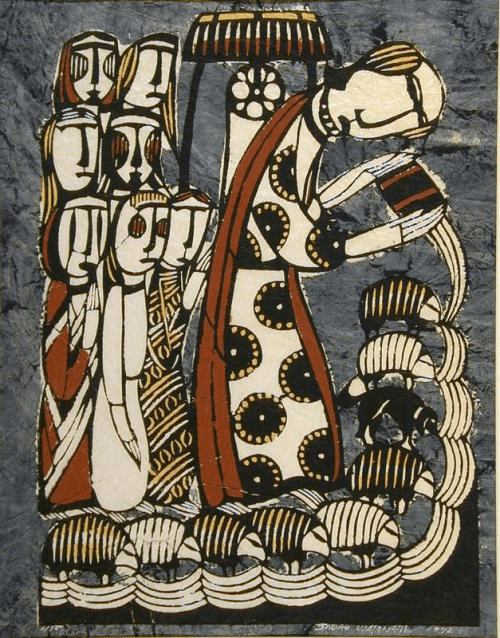
Moses in Midian, by Japanese artist Sadao Watanabe, 1972

One day, after Moses had grown up, he went out to where his own people were and watched them at their hard labor. He saw an Egyptian beating a Hebrew, one of his own people. Looking this way and that and seeing no one, he killed the Egyptian and hid him in the sand. The next day he went out and saw two Hebrews fighting. He asked the one in the wrong, “Why are you hitting your fellow Hebrew?”

The man said, “Who made you ruler and judge over us? Are you thinking of killing me as you killed the Egyptian?” Then Moses was afraid and thought, “What I did must have become known.”

When Pharaoh heard of this, he tried to kill Moses, but Moses fled from Pharaoh and went to live in Midian, where he sat down by a well. (New International Version)

Faith is dynamic, not static. It flows and moves, waxes and wanes, strengthens and weakens. Faith isn’t like a kitschy trinket you buy in a quaint downtown shop, and then place it as a nice object in a prominent place of your house or office. Rather, faith is much more subjective, like taking an adventure down some whitewater rapids, not quite knowing what’s going to happen.

Moses needed to learn how to make healthy decisions of faith, just like the rest of us. Just because we stand at this point in history and can look back at what a religious titan he was, doesn’t mean that Moses was always a paragon of faith and patience. In fact, quite the opposite.

An eighty year old Moses became the human agent of God’s deliverance of the Israelites from the Egyptians, after a forty year stint in the backside of the desert. This tells us that it took him awhile to mature into being the sort of leader God wanted to bring God’s people out of slavery. 

Even though the forty year old Moses may have had a sense that the Israelites needed freedom from slavery and acted on that sense by killing a ruthless Egyptian, his method, maturity, and misplaced timing were off.

There is a time for everything, said the Teacher of wisdom (Ecclesiastes 3:1). Wisdom – the ability to apply faith to concrete situations with appropriate forms – is often in the timing of things. To know when to speak and when to listen, when to act and when to wait, is an important facet of faith. 

The ancient Israelites were slaves in Egypt for a long time, 400 years. Moses knew they were suffering, and he acted in “good faith.” Yet, it was not yet time, and it was a rash action, in killing the Egyptian. Eventually, the Jewish cry of suffering arose to God, and God heard them, remembering the divine covenant. 

Questions of why God did not act sooner, or use Moses earlier, is information that is only privy within God, and likely will not be answered satisfactorily for us, this side of heaven.

In order to develop a strong and wise faith – with an opportune sense of timing – we need to rely on God. Trusting in ourselves, our own efforts, and our own gauge of how things ought to proceed, will usually not end well. We may, like Moses, find ourselves taking a “time out” from God in obscurity until we learn to wait on him.

Some might think of a “time out” as being negative, even punitive, such as giving a time out to a toddler because of naughtiness, or calling a time out in sports because the team is playing poorly. However, a time out can also be a positive experience. The following are some advantages of the “time out:”

Reflect

Little did Moses know at the time, but he would have the next 40 years to reflect on his life and actions in Egypt. Reflection is important. It gives us a chance to step back, learn from what happened, and adjust for the next time we experience a similar situation. Taking this time acts like a mirror, enabling us to gain some clarity on what we’ve said and done.

So I reflected on all this and concluded that the righteous and the wise and what they do are in God’s hands, but no one knows whether love or hate awaits them. All share a common destiny—the righteous and the wicked, the good and the bad, the clean and the unclean, those who offer sacrifices and those who do not. (Ecclesiastes 9:1-2, NIV)

Refocus

Upon taking the time to reflect, it then provides us with the opportunity to refocus our efforts with wisdom. To refocus means to come back around in giving close attention and concentration on what’s most important to us. The desire of Moses was admirable in being concerned about his fellow Israelites. He just went too far and needed to fix his eyes on the Lord and how to best go about freeing them.

We must focus on Jesus, the source and goal of our faith. He saw the joy ahead of him, so he endured death on the cross and ignored the disgrace it brought him. (Hebrews 12:2, GW)

Renew

Reflecting on the past and refocusing in the present are not quite enough to get us back in the game of life. We also need renewal. To be renewed involves fresh commitment to the things we have learned. I believe it’s best to renew our commitments with some sort of ritual, because rituals help us psychologically and spiritually to launch into the focused endeavors ahead of us. That’s why athletes always have a short ritual of breaking their huddle before returning to the contest.

Don’t be conformed to this world, but be transformed by the renewing of your mind, so that you may prove what is the good, well-pleasing, and perfect will of God. (Romans 12:2, WEB)

Return

A “time out” is designed to be temporary. Eventually, a “time in” happens. We get back in the game. We return to what we were doing, hopefully with a better understanding and grasp of what needs to happen and how to go about it.

In the fullness of time, the Apostle Paul said to the Galatians, Jesus came, born of a woman, born under law, to redeem those under the law (Galatians 4:4-5). God knows what he’s doing, even though it might seem like the Lord is sometimes slow to act. Yet, God sees, and God delivers – and does it according to divine timing.

If we live, we live for the Lord; and if we die, we die for the Lord. So, whether we live or die, we belong to the Lord. For this very reason, Christ died and returned to life so that he might be the Lord of both the dead and the living. (Romans 14:8-9, NIV)

Redeeming God, you control all things, including the clock. Give me wisdom so that my sense of timing might reflect your will and your way, through Jesus Christ, your Son, who with you and the Holy Spirit reign supremely as one God, now and forever. Amen.

Take the Long View (Genesis 49:1-33)

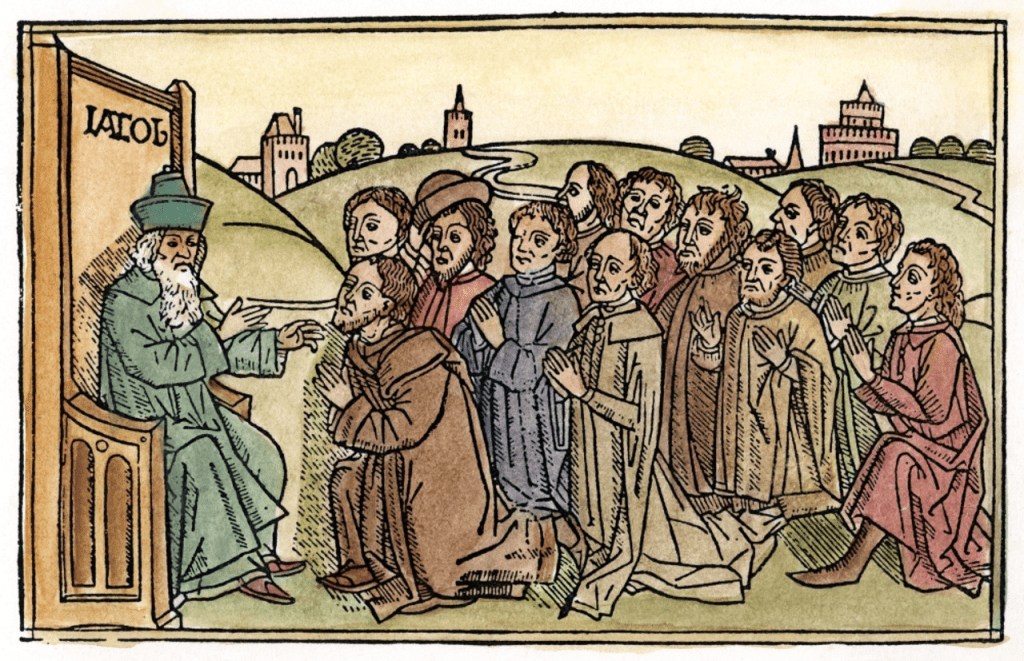
Jacob blesses his twelve sons, a woodcut from the Cologne Bible, c.1479

Then Jacob called together all his sons and said, “Gather around me, and I will tell you what will happen to each of you in the days to come.

“Come and listen, you sons of Jacob;
    listen to Israel, your father.

“Reuben, you are my firstborn, my strength,
    the child of my vigorous youth.
    You are first in rank and first in power.
But you are as unruly as a flood,
    and you will be first no longer.
For you went to bed with my wife;
    you defiled my marriage couch.

“Simeon and Levi are two of a kind;
    their weapons are instruments of violence.
May I never join in their meetings;
    may I never be a party to their plans.
For in their anger they murdered men,
    and they crippled oxen just for sport.
A curse on their anger, for it is fierce;
    a curse on their wrath, for it is cruel.
I will scatter them among the descendants of Jacob;
    I will disperse them throughout Israel.

“Judah, your brothers will praise you.
    You will grasp your enemies by the neck.
    All your relatives will bow before you.
Judah, my son, is a young lion
    that has finished eating its prey.
Like a lion he crouches and lies down;
    like a lioness—who dares to rouse him?
The scepter will not depart from Judah,
    nor the ruler’s staff from his descendants,
until the coming of the one to whom it belongs,
    the one whom all nations will honor.
He ties his foal to a grapevine,
    the colt of his donkey to a choice vine.
He washes his clothes in wine,
    his robes in the blood of grapes.
His eyes are darker than wine,
    and his teeth are whiter than milk.

“Zebulun will settle by the seashore
    and will be a harbor for ships;
    his borders will extend to Sidon.

“Issachar is a sturdy donkey,
    resting between two saddle packs.
When he sees how good the countryside is
    and how pleasant the land,
he will bend his shoulder to the load
    and submit himself to hard labor.

“Dan will govern his people,
    like any other tribe in Israel.
Dan will be a snake beside the road,
    a poisonous viper along the path
that bites the horse’s hooves
    so its rider is thrown off.
I trust in you for salvation, O Lord!

“Gad will be attacked by marauding bands,
    but he will attack them when they retreat.

“Asher will dine on rich foods
    and produce food fit for kings.

“Naphtali is a doe set free
    that bears beautiful fawns.

“Joseph is the foal of a wild donkey,
    the foal of a wild donkey at a spring—
    one of the wild donkeys on the ridge.
Archers attacked him savagely;
    they shot at him and harassed him.
But his bow remained taut,
    and his arms were strengthened
by the hands of the Mighty One of Jacob,
    by the Shepherd, the Rock of Israel.
May the God of your father help you;
    may the Almighty bless you
with the blessings of the heavens above,
    and blessings of the watery depths below,
    and blessings of the breasts and womb.
May my fatherly blessings on you
    surpass the blessings of my ancestors,
    reaching to the heights of the eternal hills.
May these blessings rest on the head of Joseph,
    who is a prince among his brothers.

“Benjamin is a ravenous wolf,
    devouring his enemies in the morning
    and dividing his plunder in the evening.”

These are the twelve tribes of Israel, and this is what their father said as he told his sons good-bye. He blessed each one with an appropriate message.

Then Jacob instructed them, “Soon I will die and join my ancestors. Bury me with my father and grandfather in the cave in the field of Ephron the Hittite. This is the cave in the field of Machpelah, near Mamre in Canaan, that Abraham bought from Ephron the Hittite as a permanent burial site. There Abraham and his wife Sarah are buried. There Isaac and his wife, Rebekah, are buried. And there I buried Leah. It is the plot of land and the cave that my grandfather Abraham bought from the Hittites.”

When Jacob had finished this charge to his sons, he drew his feet into the bed, breathed his last, and joined his ancestors in death. (New Living Translation)

The theme of confidence works its way through the patriarch Jacob’s deathbed prophecies and blessings – a resolute conviction in the promises of God, that he will accomplish what he said he would do.

Jacob expressed the hope and sure belief that God would bring the Israelites out of Egypt and into the land of Canaan as their inheritance – and, ultimately to the City of God, the eternal inheritance.

The Christian will find much in Judah’s blessing as the promise of the coming Christ, Jesus. Mentioning the implements of “staff” and “scepter” are symbols of authority. And, the reference to a donkey communicated a ruler was coming, as donkeys were the preferred mounts of royalty in ancient times.

What’s more, the washing of garments in wine, and eyes darker than wine, are allusions to the future blessing and abundance there will be through the tribe of Judah. In fact, the first miracle of Jesus was turning water into wine – a deliberate attempt by the Apostle John to connect Jesus with Old Testament messianic prophecies of abundance and blessing. (John 2:1-12)

It’s necessary to take a long view of life, keeping in mind that it took eighteen centuries for Jacob’s prophecy of Judah to occur. This long view is what gives us our confidence in life and provides the patience and perseverance we need right now. 

Keeping in mind the big picture of God’s work in this world is important, because if we do not, we will likely become discouraged with the circumstances we face right now.

The reason Jacob makes it into the great Hall of Faith in the New Testament book of Hebrews is not because he was squeaky clean and perfect in how he lived his life, but because he took the long view, the big picture, and saw that God was going to fulfill his promises to Israel:

By an act of faith, Jacob on his deathbed blessed each of Joseph’s sons in turn, blessing them with God’s blessing, not his own—as he bowed worshipfully upon his staff. (Hebrews 11:21, MSG)

Furthermore, when we string the following three verses together across both Testaments, we see the long view of God’s purposes:

It is true that you planned to do something bad to me. But really, God was planning good things. God’s plan was to use me to save the lives of many people. And that is what happened. (Genesis 50:20, ERV)

For I know the plans I have for you,” declares the Lord, “plans to prosper you and not to harm you, plans to give you hope and a future. (Jeremiah 29:11, NIV)       

And we know that all things work together for good to those who love God, to those who are the called according to his purpose. (Romans 8:28, NKJV)

In the Christian faith tradition, all God’s promises come together and are fulfilled in the person and work of Jesus. Christ is our salvation, our inheritance, and our hope. To give our lives to him in complete trust of faith is both our challenge and our privilege.

So, may you and I live by faith, and not by fear.

Be present, O merciful God, and protect us through these anxious times, so that we who are wearied by the changes of this life may rest in your eternal steadiness. Keep watch, dear God, with those who work, or watch, or weep this night, and give your angels charge over those who sleep. Tend the sick, Lord Christ; give rest to the weary, bless the dying, soothe the suffering, pity the afflicted, shield the joyous; and all for your love’s sake. Amen.