Listen to Lady Wisdom (Proverbs 9:1-12)

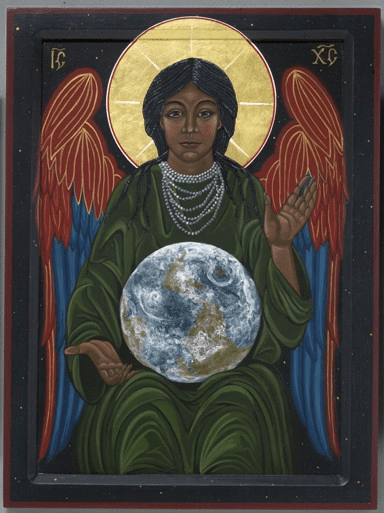
Sophia, Divine Wisdom, by Mary Plaster

Wisdom has built her house;
    she has set up its seven pillars.
She has prepared her meat and mixed her wine;
    she has also set her table.
She has sent out her servants, and she calls
    from the highest point of the city,
    “Let all who are simple come to my house!”
To those who have no sense she says,
    “Come, eat my food
    and drink the wine I have mixed.
Leave your simple ways and you will live;
    walk in the way of insight.”

Whoever corrects a mocker invites insults;
    whoever rebukes the wicked incurs abuse.
Do not rebuke mockers or they will hate you;
    rebuke the wise and they will love you.
Instruct the wise and they will be wiser still;
    teach the righteous and they will add to their learning.

The fear of the Lord is the beginning of wisdom,
    and knowledge of the Holy One is understanding.
For through wisdom your days will be many,
    and years will be added to your life.
If you are wise, your wisdom will reward you;
    if you are a mocker, you alone will suffer. (New International Version)

Life is full of choices. Whether we quibble about how much free will or deterministic fate a person actually has, or has not, we are still left with the ability to choose how we shall proceed and/or respond to basic life situations.

The two basic choices in life were often displayed in early film and television cartoons by having an angel on one shoulder and a devil on the other. The stereotypical portrayal helps us see that there is always a choice between good and evil.

Although our choices in life are quite personal and specific to a particular situation, the choice between good and evil is much bigger than this. It is choosing a certain way to look at the world, which then influences and informs the concrete decisions we make in life.

In our lesson for today, wisdom is personified as a lady calling out to us as people. In contrast, foolishness or folly is equally personified. The two ladies are continually speaking to us.

Lady Wisdom leads the community of sages who know how to live a right, just, and good life; she invites others to join her at the table and learn her ways. On the other hand, Lady Folly heads a group of simpletons who are driven by the passions of the moment; she easily attracts those who want cheap and easy solutions.

Wisdom’s message is a passionate appeal to take the path of insight through God’s revealed will. We are encouraged to leave empty-headed ways of thinking, and live with awareness, insight, and direction. The term “wisdom” in Scripture is the ability to apply sound biblical instruction and divine commands to concrete situations in our lives. 

For the spiritual person, especially, it is vital and imperative to daily listen to Lady Wisdom and follow her instructions.

The fact of the matter for too many people is that they are too impatient to let Lady Wisdom teach them her ways. It takes too much time, and is too hard for them. So, they turn to Lady Folly, who makes bogus promises of satisfaction without all the time and effort.

Idolatry (running toward other gods) immorality (running to victimize another) lying (running the mouth without any truth to it) and arrogance (running to get quick power and authority) often results from the inability to wait on the lessons that Lady Wisdom deeply desires to impart to us. 

Wisdom is not gained quickly; her teachings must be learned slowly with careful application over time. We are much too prone to wanting the simple solutions to complex problems that Lady Folly offers. But Lady Wisdom calls us to leave such simplistic thinking and take the high road of authenticity, self-awareness, and attention to the common good of all persons.

Therefore, rather than rushing to Google for answers to our questions; instead of allowing another person to make decisions for us; in place of implementing sheer pragmatic plans; allow Lady Wisdom to penetrate the mind and the heart so that what comes out is thoroughly good, benevolent, just, and helpful. 

And the best place to begin in starting down the road of wisdom is to give the Lord proper place in our lives. The skills for a good life gets its start through respect of God and obedience to the Lord. To truly have understanding and a wise life, one must get to know God. 

Nobody can talk themselves into wisdom, because it takes a reverent spirit, listening ears, and measured words to be able to put Lady Wisdom’s instruction into practice. There are no substitutes.

All-Wise God, the One who is never in a hurry and who is always holy, create in me a wise mind and a wise heart. Help me to sit still long enough for wisdom to bring spiritual growth and maturity to my life, through Jesus Christ my Lord, in the power of the Holy Spirit. Amen.

Wait for the Lord (Isaiah 64:1-9)

O that you would tear open the heavens and come down,
    so that the mountains would quake at your presence—

as when fire kindles brushwood
    and the fire causes water to boil—
to make your name known to your adversaries,
    so that the nations might tremble at your presence!
When you did awesome deeds that we did not expect,
    you came down; the mountains quaked at your presence.
From ages past no one has heard,
    no ear has perceived,
no eye has seen any God besides you,
    who works for those who wait for him.
You meet those who gladly do right,
    those who remember you in your ways.
But you were angry, and we sinned;
    because you hid yourself we transgressed.
We have all become like one who is unclean,
    and all our righteous deeds are like a filthy cloth.
We all fade like a leaf,
    and our iniquities, like the wind, take us away.
There is no one who calls on your name
    or attempts to take hold of you,
for you have hidden your face from us
    and have delivered us into the hand of our iniquity.
Yet, O Lord, you are our Father;
    we are the clay, and you are our potter;
    we are all the work of your hand.
Do not be exceedingly angry, O Lord,
    and do not remember iniquity forever.
    Now consider, we are all your people. (New Revised Standard Version)

Sometimes it feels like the whole world is messed up, with no resolution in sight. Everything is sideways.

In those moments, when I wonder if there will ever be glory after all the hardship and suffering, I come back to what I firmly believe and bank my life upon: God sees. God cares. God is still actively working behind the scenes in ways I don’t presently see. Truly, the invisible hand of God is looking after my life.

The ancient Israelites, in Isaiah 64, cried out for help because, although they could not see God, they trusted that somehow, someway, they were being seen. The prophet wanted God’s presence manifested in such a way that it would be recognized by both God’s people and God’s enemies.

The people cried out for mountains to quake, brushwood to burn, and water to boil. In other words, the people wanted the Lord to show up in a dramatic way. That’s neither a weird desire nor an offbeat prayer from God’s people. After all, the Lord has showed up and showed off with wondrous and awesome deeds for a long time in their history:

  • Divine plagues on Egypt forced Pharaoh to release Israel from bondage and go their own way
  • Divine deliverance brought them miraculously through the Red Sea
  • Divine judgment caused the waters to overwhelm the Egyptian army
  • Divine provision gave manna out in the desert
  • Divine presence was with the people as they entered the Promised Land
  • The Divine Warrior flattened the walls of Jericho and went before the people in fighting their battles

Indeed, God intervened with consistency. In today’s Old Testament lesson, there’s a qualification, a sort of prerequisite, which is given in order to realize God’s involvement: If the people want to see God move on their behalf, they will have to be patient and wait on the Lord.

Waiting. It seems to be the bane of many a person’s existence. Many people would rather do just about anything but wait. And yet, throughout the Bible’s Old Testament, people are exhorted to do just that: wait…

Wait for the Lord;
    be strong, and let your heart take courage;
    wait for the Lord!

Psalm 27:14, NRSV

Commit your way to the Lord;
    trust in him, and he will act.
He will make your vindication shine like the light
    and the justice of your cause like the noonday.

Be still before the Lord, and wait patiently for him;
    do not fret over those who prosper in their way,
    over those who carry out evil devices.

Refrain from anger and forsake wrath.
    Do not fret—it leads only to evil.
For the wicked shall be cut off,
    but those who wait for the Lord shall inherit the land. (Psalm 37:5-9, NRSV)

I waited patiently for the Lord to help me,
    and he turned to me and heard my cry.
He lifted me out of the pit of despair,
    out of the mud and the mire.
He set my feet on solid ground
    and steadied me as I walked along. (Psalm 40:1-2, NLT)

The psalmist, along with the faithful throughout the ages, can testify that patience with God is worth the wait. There is no answer to our dilemmas quite like that of God’s. And it’s really no use trying to cajole or manipulate God into acting sooner or quicker.

Although we are subject to time, God is above time, and is not subject to anyone’s clock. God will act when God will act, even if it seems painstakingly slow to us. Let’s not try to figure out God’s timetable. If Jesus wasn’t privy to the entire divine schedule, then what makes us think we’ll get a look at it?

“One of the greatest strains in life is the strain of waiting for God.” Oswald Chambers

Perhaps we ought to look more at ourselves and consider our own thoughts and actions. Are we really ready to receive what God wants to give us? Why do we want what we want? Is it for God’s glory, and the common good of all persons, or simply for our own narrow purposes?

It would be better if we consider that God’s word and promises are more powerful than any struggle we go through along the way. If we know the promise is truly coming, and it’s based in divine words, we can wait for it patiently.

For the ancient people, God promised to be the God of Israel; the people needed to be reminded that God’s apparent “slowness” doesn’t translate to a “no” in prayer. God created the elephant who never forgets, as well as the goldfish who never remembers. Take a guess which one is God and which one is us.

Even though God can be disappointed with our sinful behavior, and may allow us to die like a withered leaf in autumn, the Lord’s purpose isn’t for our destruction nor our destitution. God’s anger only lasts a moment, but the Lord’s favor endures for a lifetime.

Almighty and gracious God, help me to become patient, as Christ was patient. Through your guidance, may I become more accepting of my circumstances, and others around me. Assist me to welcome difficult times with a patient heart, through Jesus my Lord, in the strength of the Holy Spirit. Amen.

The End of the World (Matthew 24:1-14)

The Final Sign

Jesus left the temple and was walking away when his disciples came up to him to call his attention to its buildings. “Do you see all these things?” he asked. “Truly I tell you, not one stone here will be left on another; every one of them will be thrown down.”

As Jesus was sitting on the Mount of Olives, the disciples came to him privately. “Tell us,” they said, “when will this happen, and what will be the sign of your coming and of the end of the age?”

Jesus answered: “Watch out that no one deceives you. For many will come in my name, claiming, ‘I am the Messiah,’ and will deceive many. You will hear of wars and rumors of wars, but see to it that you are not alarmed. Such things must happen, but the end is still to come. Nation will rise against nation, and kingdom against kingdom. There will be famines and earthquakes in various places. All these are the beginning of birth pains.

“Then you will be handed over to be persecuted and put to death, and you will be hated by all nations because of me. At that time many will turn away from the faith and will betray and hate each other, and many false prophets will appear and deceive many people. Because of the increase of wickedness, the love of most will grow cold, but the one who stands firm to the end will be saved. And this gospel of the kingdom will be preached in the whole world as a testimony to all nations, and then the end will come. (New International Version)

I am a suspicious person when it comes to end-time gurus. I find most of them to be false teachers, trying to scare people into their own little group, like a bunch of nuts in a fruitcake.

Yet, Jesus is an end-time preacher, giving an answer to those who asked him about the future and how things will literally shake up and shake out at the end of the world. So, because I trust him when he lays out what will happen, I believe there is a time coming when there shall be a judgment of the living and the dead.

Christ’s disciples had heard Jesus pronounce doom on the Jerusalem temple, and wanted to know about when this was going to happen, along with the signs leading to it. Jesus then went on to tell them about a much bigger picture than what the disciples were asking for; Jesus described not only the end of the temple, but also the end of the world as we know it.

I often find myself warning people about buying into those who constantly and confidently talk of the end, as if they have the inside track on it. Jesus did the same; so I’ll take my cues from him. Notice the warnings he offered his disciples concerning signs of the end time:

Don’t let anybody fool you

Watch out for deceivers. False teachers are those who claim to be Christians and have insider information from all their great study. Stay clear of them. Their sense of superiority, because of their supposed knowledge, will trick many people. Don’t be fooled by them.

Don’t be afraid

Anyone who pays any sort of attention to the news – whether local, national, or international – is likely to be concerned about the state of our world. We may even become terrified. But Jesus wants us to avoid being fearful all the time. And that will only happen if we listen as much or more to him than we do people who whip up a frenzy and get us all upset – much like talk radio hosts do to their audiences; or hack preachers do to spiritually vulnerable Christians.

We can be wise and discerning without being fearmongers and constantly worried. In times of crisis and disaster, Christians really ought to be the calmest people on the planet.

Armies may surround me,
    but I won’t be afraid;
war may break out,
    but I will trust you. (Psalm 27:3, CEV)

Wars, rumors of wars, coups, famines, and earthquakes happen. All these, and more, are signs – just like a woman with labor pains, about to give birth. When we look ahead, we may feel apprehensive, upset, and afraid with pain. But our fear will eventually give way to joy. Before things get better, things will get a lot worse. Disaster and destruction will lead to the renewal of all things.

The world will hate you

Because there is fear and deception, the Church will become an oppressed victim. The world hates those who truly follow Christ. All that has been simmering underground will break out in persecution against believers.

So, it ought not surprise any Christian or any Church when there is intolerance and disdain against them. Anyone following Jesus should expect the same treatment he received in his last days on earth.

Many “Christians” will turn against each other and hate each other. They will drop out and refuse association with Christ or his Church. The outside pressure will become intense enough to force a crumbling of the Church on the inside. Parishioners will tear each other to pieces.

Unfortunately, the world’s hate leads to the church’s apostasy – a turning away from faith. And this situation is a ripe situation for false teachers to rise and have their way. People will glory in their shame.

The ones who stick it out will be saved

The true believer holds onto faith, despite the intense pressure of hatred. This isn’t salvation by works; it’s salvation by a faith that is authentic, genuine, and the real deal. This faith remains as a testimony to all that love still exists and will never be extinguished.

And then the end will come.

There shall always be the good news in the middle of all the terribly bad news. Divine sovereignty will always be above the world’s hate and disorder.

Therefore, let the believer be the herald of good news and give themselves to the mission of faith, grace, hope, and love in Christ. No matter where or when you locate the time of great tribulation, it is always open season on gospel proclamation.

God will make something out of nothing. Trouble, hardship, oppression, persecution, and death are the signs of the end. Now is the time for faith and patience. Now is the opportunity to love with the light that penetrates the darkness of hate.

Eternal God, you are the light of the minds that know you, the joy of the hearts that love you, and the strength of the wills that serve you. Grant us to know you that we may truly love you; to love you so that we may truly serve you, through Jesus Christ our Lord. Amen.

Thankful for Your Faith (1 Thessalonians 1:1-10)

Paul, Silas and Timothy,

To the church of the Thessalonians in God the Father and the Lord Jesus Christ:

Grace and peace to you.

We always thank God for all of you and continually mention you in our prayers. We remember before our God and Father your work produced by faith, your labor prompted by love, and your endurance inspired by hope in our Lord Jesus Christ.

For we know, brothers and sisters loved by God, that he has chosen you, because our gospel came to you not simply with words but also with power, with the Holy Spirit and deep conviction. You know how we lived among you for your sake. You became imitators of us and of the Lord, for you welcomed the message in the midst of severe suffering with the joy given by the Holy Spirit. And so you became a model to all the believers in Macedonia and Achaia. The Lord’s message rang out from you not only in Macedonia and Achaia—your faith in God has become known everywhere. 

Therefore we do not need to say anything about it, for they themselves report what kind of reception you gave us. They tell how you turned to God from idols to serve the living and true God, and to wait for his Son from heaven, whom he raised from the dead—Jesus, who rescues us from the coming wrath. (New International Version)

The Apostle Paul wrote to the Church in Thessalonica, essentially saying, “I really can’t say enough good about you!” I also echo the same about your faith. Paul had plenty of reasons to express thanks for them in his prayers. He was thoroughly convinced of God’s work in them, and acknowledged the good work of God in their spiritual transformation.

The background of Paul and the Thessalonians

Paul visited Thessalonica on his second missionary journey (Acts 17). Thessalonica was the capital of Macedonia, located on an inlet, and so, was a port city along an important trade route. Thessalonica was a very religious city, with a host of various deities that were worshiped. It was also a politically prominent city that prided themselves on embodying the ideals of the Roman Empire, including bravery, loyalty, piety, seriousness, respect and authority.

When the Thessalonians heard Paul’s message and accepted its call to worship the God of Israel exclusively, they faced rejection and possibly persecution from their polytheistic families and neighbors. To accept and worship Jesus took some solid faith, hope, and love, because to be a Christian was costly within the culture.

God loved and chose the Thessalonians

Paul could praise their faith because it lifted and upheld the gracious work of God on this earth. Before the Thessalonians chose God, God chose them. God didn’t have to do that. But the Lord was gracious, merciful, and kind, extending salvation and deliverance from an empty way of life to a group of people who didn’t deserve it. In fact, none of us do. God’s grace chooses to grant us faith and salvation. To be included amongst God’s people is an incredible privilege.

The good news of Jesus Christ came to the Thessalonians with power, assurance, and the Holy Spirit. They turned from their idols to God. Jesus redeemed and rescued them from darkness and judgment. The Thessalonian believers turned from their previous religious expressions in order to serve the living and true God. As a result, they began imitating Jesus and his apostles. And because of their Christian way of life, the Thessalonian Christians then became worthy of imitation themselves.

Because of God’s merciful intervention in their lives, Paul was grateful for the work of God for three specific elements and expressions about the Thessalonians’ Christian lives:

  1. Their work produced by faith
  2. Their labor prompted by love
  3. Their endurance inspired by hope

Indeed, for every Christian, the Christian life is lived with the essential tools of faith, hope, and love.

Endurance inspired by hope

It’s a standup quality to be characterized as people of hope. The Thessalonian believers were anticipating and waiting for the Lord’s return; they had no doubt Jesus will come again. The Christians just needed some reassurance about those who have already died without yet seeing Christ – which is why Paul wrote his letter to them. And the believers were good at encouraging each other with the hope of Christ’s return.

Labor prompted by love

Paul didn’t really even need to teach the Thessalonian Christians about loving each other because they were good students of God as their teacher. They had a reputation of hearing the Word of God, then doing it. Specifically, they learned to love, not only one another within their local church, but the whole of the family of God throughout Macedonia. So then, the Thessalonians excelled at expressing their faith through love. (Galatians 5:6)

Work produced by faith

The Thessalonian believers became well-versed and practiced in the Christian elements of hope and love. And their faith became known everywhere. Paul was thankful for their work produced by faith. Yet, as the rest of the letter bears out, along with the second letter to the Thessalonians, Paul will have much to say to them about the nature of faith.

Paul reminded the Christians of his example to them and the gospel which he proclaimed. Several times, Paul talked of the work he put into them on their behalf (1 Thessalonians 2:9; 3:5; 2 Thessalonians 3:8). On the topic of following godly examples, Paul also admonished them to respect those who have authority over them, who labor and work among them (1 Thessalonians 5:12-13).

The Apostle encouraged the Thessalonians to continue in their work, so that every need would be met within the church; and so that there would be a good witness to those outside the church (1 Thessalonians 4:11-12). Paul let them know that a very practical way they can express their love is by working with their hands so that none among them have any need.

Faith and work are not mutually exclusive. Even though the Thessalonian believers were transformed by their belief in Christ, they still needed to remember that they must carry on in their regular daily lives until Christ returns.

Imitating the faith and patience of solid believers

And we are all still responsible to be faithful, every day, no matter what the situation or circumstances are. We must carry on in our faith, hope, and love through obeying and living into the words and ways of Jesus. We do this through imitating the faith and patience of trusted Christians, like the Apostle Paul.

Remember your leaders, who spoke the word of God to you. Consider the outcome of their way of life and imitate their faith.

Hebrews 13:7, NIV

People can only experience the fullness of their humanity when they are in deep, trusting relationships with one another. Even more, relationships have more depth when experienced and centered in a relationship with Jesus Christ. Imitation then becomes an outgrowth of this strong relationship.

Far too often we seek excuses, or to find loopholes, in order to avoid the vulnerability that a close mentoring relationship demands. We may look for ways to justify not getting close, or simply distance ourselves from other believers.

Maybe we do not want to do the work — desiring to avoid being hurt. It could be that we are tired of doing the relational work necessary for closeness and walking with Christ and one another. Relationships get messy and they take lots of energy. But our spiritual growth is completely tied to relational growth. The Apostle Paul himself was vulnerable:  

Just as a nursing mother cares for her children, so we cared for you. Because we loved you so much, we were delighted to share with you not only the gospel of God but our lives as well. Surely you remember, brothers and sisters, our toil and hardship; we worked night and day in order not to be a burden to anyone while we preached the gospel of God to you. (1 Thessalonians 2:7-9, NIV)

This imitative relationship is important for the advancement of the gospel. The faith is passed on from generation to generation, from disciple to disciple, in one long progression stretching all the way back to Jesus and the original twelve disciples. For our own faith, hope, and love to be effective, it requires following the example of Paul, and of committed faithful believers in your own life, through close relationships with them.

God of all faith, hope, and love, we praise and give you thanks for the resurrection of your Son, Jesus Christ. We celebrate the joy of life in you, and are grateful for the privilege and opportunity to live into the reality and power of the resurrection.

Inspire us, by your grace, to live the life of intentionally following Jesus. We surrender ourselves to the life of Jesus, who called us to be faithful servants of God. We commit to living for Christ, our Savior and Lord, in whose name we are bold to pray. Amen.