Revelation 11:15 – He Will Reign Forever

The seventh angel sounded his trumpet, and there were loud voices in heaven, which said:

“The kingdom of the world has become
    the kingdom of our Lord and of his Messiah,
    and he will reign for ever and ever.” (New International Version)

I am so looking forward to that day!

As an ordained Minister, I have done my share of weddings over the years. Working with engaged couples anticipating marriage is both exciting and awkward. It is, in some ways, a difficult time for the betrothed because they are committed to one another in a manner different from just dating. But they are not yet in a marriage relationship. 

The same is true for the Church. She is betrothed to the Lord Jesus. They are both quite committed to each other. But the marriage hasn’t yet happened. There is still this engagement period. We’re ready for permanent unending marital bliss.

The kingdom of God has been inaugurated, but not yet consummated. That’s a fancy way of saying that God’s rule and reign has come to this earth, but its fulfillment has not yet occurred. 

This present time we are now experiencing between the two advents of Christ – his incarnation and his coming again – is a weird and awkward time of engagement. We’re trying to figure out how to live in the world but not of it. 

Yet, there is a time coming at the consummation of the ages, at the end of time, when Christ will return to take his bride. Then, the Church will celebrate in a great wedding feast, the marriage supper of the Lamb. From then on, the kingdom of the world becomes the kingdom of our Lord, and he will reign forever and ever.

Just as marriage is designed for permanence, so our union with Jesus will last forever. His gracious and benevolent reign shall never end. Christ’s rule will be complete and extend over all the earth. 

Until then, however, believers must patiently persevere with fidelity to our Lord Jesus, who loved us and gave himself up for us.

Slow and steady is better than nothing at all.

We keep going, despite all obstacles, adversity, difficulty, and discouragement – without comparing ourselves to others or making everything a competition.

Let us throw off everything that hinders and the sin that so easily entangles. And let us run with perseverance the race marked out for us, fixing our eyes on Jesus, the pioneer and perfecter of faith. For the joy set before him he endured the cross, scorning its shame, and sat down at the right hand of the throne of God. Consider him who endured such opposition from sinners, so that you will not grow weary and lose heart. (Hebrews 12:1-3, NIV)

Persevering to the end is the goal, not being perfect all the time. Perfection is the sure road to depression and feeling defeated. Endurance, however, is able to focus on the small efforts of each day to get where it wants to go.

Even though we anticipate our eternal life, that very life has already begun, right now. So, we can live with confidence, knowing the Lord is with us.

Be strong and courageous; do not be frightened or dismayed, for the Lord your God is with you wherever you go. (Joshua 1:9, NRSV)

Perseverance can only happen with physical, mental, emotional, as well as spiritual health. We compromise our ability to keep going and remain encouraged with a lack of self-care.

We need to pay attention to our bodies because they are the vehicles by which we do the will of God.

We must attend to our minds because that is where we do battle with the enemy.

We have got to become comfortable with talking about feelings because we are emotional creatures, created by a God with deep feeling and emotion.

And we are to be disciplined with spiritual practices, just as we are with anything which requires our attention.

Exercise daily in God—no spiritual flabbiness, please! Workouts in the gymnasium are useful, but a disciplined life in God is far more so, making you fit both today and forever. You can count on this. Take it to heart. This is why we’ve thrown ourselves into this venture so totally. We’re banking on the living God, Savior of all men and women, especially believers. (1 Timothy 4:8-10, MSG)

In those times we are confused or just don’t know what the heck to do, we turn to the Lord.

With all your heart
you must trust the Lord
    and not your own judgment.
Always let him lead you,
and he will clear the road
    for you to follow. (Proverbs 3:5-6, CEV)

Keep moving. The Lord will direct you. The kingdom is coming in all its fullness.

Gracious heavenly Father, may we never lose the way through our self-will, and so end up in the far countries of the soul. May we never abandon the struggle, but endure to the end, and so be saved. May we never drop out of the race, but continually press forward to the goal of our high calling.

May we never choose the cheap and temporary things and let go the precious things that last forever. May we never take the easy way, and so leave the right way. May we never forget that sweat is the price of all things, and that without the cross, there cannot be the crown.

So, almighty and everlasting God, keep us and strengthen us by your grace so that no disobedience and no weakness and no failure may stop us from entering into the blessedness which awaits those who are faithful in all the changes and chances of life, through Jesus Christ our Lord. Amen.


Acts 5:17-26 – How to Handle Jealousy

Then the high priest and all his associates, who were members of the party of the Sadducees, were filled with jealousy. They arrested the apostles and put them in the public jail. But during the night an angel of the Lord opened the doors of the jail and brought them out. “Go, stand in the temple courts,” he said, “and tell the people all about this new life.”

At daybreak they entered the temple courts, as they had been told, and began to teach the people.

When the high priest and his associates arrived, they called together the Sanhedrin—the full assembly of the elders of Israel—and sent to the jail for the apostles. But on arriving at the jail, the officers did not find them there. So, they went back and reported, “We found the jail securely locked, with the guards standing at the doors; but when we opened them, we found no one inside.” On hearing this report, the captain of the temple guard and the chief priests were at a loss, wondering what this might lead to.

Then someone came and said, “Look! The men you put in jail are standing in the temple courts teaching the people.” At that, the captain went with his officers and brought the apostles. They did not use force, because they feared that the people would stone them. (New International Version)

Celebration and success have their own challenges. Whenever things are going well, there are inevitably others who become jealous. And when jealousy takes root in a person or a group of people, it can result in harming and hurting others.

Indeed, persecution broke out against the apostles. Their ministry was flourishing. Thousands of people were being added to the Church. Miraculous healings abounded. And, standing in the shadows, were a group of jealous religious leaders. Since their power was diminishing, the ruling council had the apostles arrested – seeking to contain their influence and stop the spread of the Church.

Jealousy is one of the places we go whenever we play the comparison game with others. Whereas envy is wanting something that someone else has, jealousy is a deep-seated fear of losing someone or a group of people.

The reason jealousy can be so damaging and insidious is because of the anger and sadness behind it. In the case of the religious leaders, they saw the success of the apostles, the popularity of the burgeoning church, and the attention being diverted from themselves onto the apostles – and they were angry. The loss of religious power was just too much for them, so they became jealous.

Jealousy, much like anger, is neither good nor bad. It is an emotion. It’s what we do with the feeling that matters. In our anger we might turn it inward on ourselves, direct it onto another with verbal or even physical violence, or just get downright snarky and passive-aggressive. Also, with jealousy, it too often gets worked out on others by attacking them in some way.

God feels both anger and jealousy. Yet, those divine emotions are used to bring justice, establish what is right, and help the disadvantaged. God as a jealous God means that the Lord is saddened and hurt by people trying to find satisfaction in all the wrong places through idolatry.

Israel soon became fat and unruly;
    the people grew heavy, plump, and stuffed!
Then they abandoned the God who had made them;
    they made light of the Rock of their salvation.
They stirred up his jealousy by worshiping foreign gods;
    they provoked his fury with detestable deeds.
They offered sacrifices to demons, which are not God,
    to gods they had not known before,
to new gods only recently arrived,
    to gods their ancestors had never feared. (Deuteronomy 32:15-17, NLT)

God desires that people discover healthy ways of coping and acknowledge their jealous feelings. The Apostle Paul did just that:

I hope you will put up with me in a little foolishness. Yes, please put up with me! I am jealous for you with a godly jealousy. I promised you to one husband, to Christ, so that I might present you as a pure virgin to him. But I am afraid that just as Eve was deceived by the serpent’s cunning, your minds may somehow be led astray from your sincere and pure devotion to Christ. (2 Corinthians 11:1-3, NIV)

The feeling of jealousy is meant to tell us something. Instead of pushing it aside, listen to what it has to say. Perhaps it is leading us to acknowledge our grief and lament our loss. It could be alerting us to our great loneliness or deep sadness.

For whatever reason the jealousy arises, stuffing it or pushing it aside may cause harm to ourselves or others. A profound lack of self-awareness will always come back to bite us in the behind.

So, how do I handle those feelings of jealousy when they come?

  • Seek to understand. Trace the feeling back to its true source. Whether the jealousy stems from insecurity, fear, or past relationship patterns, knowing more about the causes can help us figure out how to confront it and deal with it.

An understanding heart seeks knowledge; but fools feed on folly. (Proverbs 15:14, CEB)

  • Talk to someone. Give voice to your concern. Discuss the feelings of jealousy with a trusted friend, family member, or faith leader.

Carry one another’s burdens, and in this way you will fulfill the law of Christ. (Galatians 6:2, NET)

  • Express your grief. With jealousy there is a loss or a worry of losing someone or something. Prayer is a good idea when we are losing someone.

God, listen! Listen to my prayer, listen to the pain in my cries. (Psalm 102:1, MSG)

  • View another perspective. Try and take a big picture approach and consider other angles to the situation which is producing the jealousy.

“My thoughts are nothing like your thoughts,” says the Lord. “And my ways are far beyond anything you could imagine. (Isaiah 55:8, NLT)

  • Practice gratitude. Be thankful for the people, circumstances, and things you have in your life right now. Thankfulness is often a powerful antidote to strong feelings of jealousy.

Tell the Lord how thankful you are, because he is kind and always merciful. (Psalm 118:29, CEV)

  • Explore underlying issues. Sometimes jealousy has to do with insecurity or low self-worth. Addressing your value as a person and the unique contribution to others you bring to the world has the effect of kicking jealousy to the curb.

God created humanity in God’s own image, in the divine image God created them, male and female God created them. (Genesis 1:27, CEB)

  • Be patient. Give it time. Most people don’t get over their jealous feelings overnight. It’s a process. So be kind to yourself and stick with acknowledging and discovering what jealousy has to teach you.

Be patient when you have troubles. (Romans 12:12, ERV)

May you find satisfaction, peace, and joy in the Holy Spirit. Amen.

Acts 5:12-16 – Healing For All

The apostles performed many signs and wonders among the people. And all the believers used to meet together in Solomon’s Colonnade. No one else dared join them, even though they were highly regarded by the people. Nevertheless, more and more men and women believed in the Lord and were added to their number. 

As a result, people brought the sick into the streets and laid them on beds and mats so that at least Peter’s shadow might fall on some of them as he passed by. Crowds gathered also from the towns around Jerusalem, bringing their sick and those tormented by impure spirits, and all of them were healed. (New International Version)

Healing is a universal longing.

To long for healing, of course, presupposes that something or someone is broken.

Those with bodily ills and infirmities; the ones carrying diseased and disordered minds; those with deep emotional wounds; and tortured souls with broken hearts and damaged spirits are all intimately familiar with pain – not to mention their friends and loved ones who observe their suffering day after day.

How will the healing ever come? When will it ever be realized? Dare I hope for a miracle?

There is a reason the ancient apostles were able to be agents of healing. There was something happening privately which worked itself out in miraculous public healing. Within the believing community, earnest prayers were being offered:

Stretch out your hand to heal and perform signs and wonders through the name of your holy servant Jesus. (Acts 4:30, NIV)

Just as all were healed when brought to Jesus, so the same happened with his followers.

The natural world, along with the most modern medical practices and interventions, has its limitations. Yet, the supernatural realm is unlimited in its power and scope to bring thorough and complete healing.

Prayer discerns and understands that humanity is limited in its abilities to transform and heal. There is no magical incantation to access such power. There isn’t any specific formula to achieve results. There is only the simple prayers and faithful ministry of believing persons who know that healing can come in many forms and in various ways.

In many cases, I have witnessed my hospital patients improve without any specific medical interventions – decades of intestinal issues gone; heart and brain function restored (which, biologically, doesn’t return when lost); and even the paralyzed walking again.

A miracle isn’t finding an open spot in a busy parking lot. Miracles don’t occur by sending in $19.95 to a “faith healer” who will pray and rid you of your gout.

Bona fide miracles have no natural, medical, or biological explanation. They aren’t tied to money. They only have divine explanations.

Prayers offered daily, and for years, are still effective prayers. That’s because the miraculous occurs irrespective of time.

There shall be healing. It just might not be today. We may have to wait.

Whenever God heals, there is complete healing. The physical trauma of an accident or disease isn’t confined to the body. It also traumatizes the person mentally, emotionally, and even spiritually. This is why faithful believers who come out of a major surgery may feel estranged from God. It’s not that God is absent, or that the individual did something wrong. The spirit just needs to heal along with the body.

The Lord wants to heal the whole person. Whenever a person has been emotionally abused, that abuse is experienced throughout the entirety of personhood. It is common for such persons to have a bevy of physical health issues in their lives. As the individual is healed from their damaged emotions, the body follows.

In this era of religious, church, and clergy abuse, the broken spirits left in its wake need healing. Victims may find themselves with chronic depression, anxiety, or other mental and emotional disorders. The spiritual healing which the Lord carefully provides will also effect the mind and the feelings.

The deepest need of healing is holistic – to impact the breadth and depth of a person’s life. The myriad diseases, disorders, and depressions of humanity are devastating enough, in and of themselves. Yet, they also create social separation, economic challenges, emotional distress, spiritual wondering, relational disconnection, terrible grief, and grinding loneliness.

God seeks to restore a life, and not just a malady.

Restoration to a family, a community, a workplace, a position of respect and responsibility, and to God is the Lord’s goal for all humanity.

The Lord your God will restore your fortunes and have compassion on you and gather you again from all the nations where he scattered you. Even if you have been banished to the most distant land under the heavens, from there the Lord your God will gather you and bring you back. (Deuteronomy 30:3-4, NIV)

Your righteousness, God, reaches to the heavens,
    you who have done great things.
    Who is like you, God?
Though you have made me see troubles,
    many and bitter,
    you will restore my life again;
from the depths of the earth
    you will again bring me up.
You will increase my honor
    and comfort me once more. (Psalm 71:19-21, NIV)

After you have suffered for a little while, the God of all grace, who has called you to his eternal glory in Christ, will himself restore, support, strengthen, and establish you. To him be the power forever and ever. Amen. (1 Peter 5:10-11, NRSV)

Our simple prayers focused on the restorative healing of a person, are what God has chosen to use to mend the broken. Prayer is not a last resort; it is always the believer’s first order of business.

O God, you made us in your own image and redeemed us through Jesus your Son: Look with compassion on the whole human family; take away the arrogance and hatred which infect our hearts; break down the walls that separate us; unite us in bonds of love; and work through our struggle and confusion to accomplish your purposes on earth; that, in your good time, all nations and races may serve you in harmony around your heavenly throne; through Jesus Christ our Lord. Amen.

Psalm 126 – Planting in Tears and Harvesting with Joy

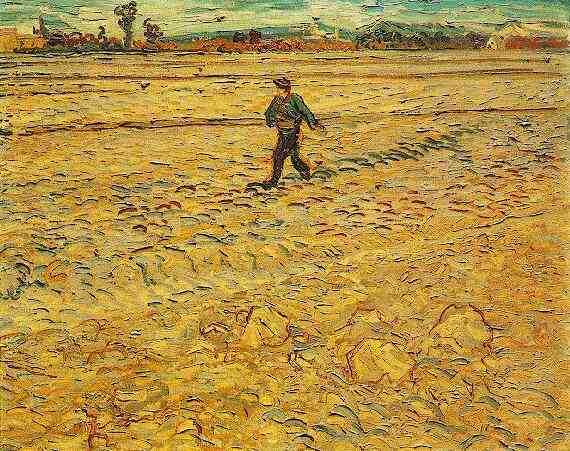
The Sower, by Vincent Van Gogh, 1881

When the Lord brought back his exiles to Jerusalem,
    it was like a dream!
We were filled with laughter,
    and we sang for joy.
And the other nations said,
    “What amazing things the Lord has done for them.”
Yes, the Lord has done amazing things for us!
    What joy!

Restore our fortunes, Lord,
    as streams renew the desert.
Those who plant in tears
    will harvest with shouts of joy.
They weep as they go to plant their seed,
    but they sing as they return with the harvest. (New Living Translation)

Many people are familiar with the phrase, “You reap what you sow.” Although the saying is typically referred to in the context of avoiding poor decisions (Galatians 6:7) the principle is woven throughout Holy Scripture in other scenarios, as well, as it is in today’s psalm.  

Sowing and reaping are, of course, agricultural terms. Farmers and gardeners tend to the soil through tilling, planting, cultivating, weeding, and eventually harvesting. The images of farming and the growth of plants serve as fitting metaphors for the spiritual life. Growth does not occur quickly. Instead, constant and vigilant attention to one’s spirit eventually brings a harvest of good works and godly attitudes. 

Jesus said, “My food is to do what the one who sent me wants me to do. My food is to finish the work that he gave me to do.” (John 4:34, ERV)

In a culture which values immediacy and having things now, the slow growth of the spiritual life can be a difficult principle to grasp. We may think that whenever we sin – with no immediate lightning to zap us – that therefore what we did must not have been so bad. 

Eventually, however, our implanted seeds will sprout and become visible to all. Conversely, we might believe whenever we dedicate ourselves to altruistic service, and then see no immediate results, that we must be doing something wrong. So, we may easily become discouraged and give up.

Sow for yourselves righteousness; reap steadfast love. Break up your fallow ground; for it is time to seek the Lord, that he may come and rain righteousness upon you. (Hosea 10:12, NRSV)

The psalmist reminds us of the need for patience. Just as it takes continual watering to reap a harvest in the field, so the Christian’s life of weeping and tears, of tilling deeply into the things of God, is the necessary work to eventually spot a sprout, see growth, and finally bear fruit. 

The tedious cultivating and weeding of our souls is the task before us. If we are patient and consistent, we will realize a harvest of righteousness. 

The Sower, by Vincent Van Gogh, 1888

Jesus taught his Beatitudes to help us understand that righteousness, peace, and joy come through connecting with our poverty of spirit; mourning over personal and corporate sin; embracing humility and meekness; hungering and thirsting after righteousness.

Only through the blood, sweat, and tears of spiritual agony will we come through to the deep happiness of seeing the Lord accomplish great things in our lives. In other words, joy is neither cheap nor easy. It is the fruit of many tears.

Spiritual farming involves sound practices of sowing and reaping. There is suffering before glory, tears before joy, lament before healing.

Just as a farmer cannot take short-cuts in the planting and cultivating process if he wants to have a bounteous and delicious harvest, so there is no getting around the painful work of grieving our changes and losses.

Avoiding the hard work of spiritual farming leads to a bogus harvest where we bite into a fresh ear of sweet corn only to discover a mouthful of worms.

Remember this: The person who plants a little will have a small harvest, but the person who plants a lot will have a big harvest.

2 Corinthians 9:6, NCV

The bulk of our lives are played out in the liminal space between sowing and reaping. The farmer plants and waits, attentive to the land and the weather until the time of harvest. We, too, exist in a time of patience. So, we pray, recalling past harvests and anticipate that with God’s good help, we will enjoy abundance.

This in-between time is often characterized by tears.

As she stood behind him at his feet weeping, she began to wet his feet with her tears. Then she wiped them with her hair, kissed them and poured perfume on them. (Luke 7:38, NIV)

I grew up on an Iowa farm. I only saw my father cry twice in my life. The first time, I was just a boy, two days after my eighth birthday – a devastating hailstorm destroyed the crops that had been planted just six weeks before. Despite farm equipment and technological savvy, the farmer is still at the mercy of the weather.

And we will always be at the mercy of God. Because God is good, just, and fair, the Lord does great and benevolent things. To be blessed, we need to embrace the dog days of summer in all its banality and its tears until we reach the time of reaping. There is joy, and it is coming, if we do the work of spiritual farming and wait patiently.

Likely, none of us awake in the morning, sit up on the edge of the bed, and say to ourselves, “Well, let’s see, I think I’ll cry and be sorrowful today.” We might do that with joy, but not with sadness. It can be easier to gravitate toward the fulfillment of dreams, laughter, and happiness than tears and weeping.

Yet, if we want to experience authentic joy, the path to it is through crying because it is our tears which find a better way.

“Normality is a paved road: It’s comfortable to walk, but no flowers grow on it.”

Vincent Van Gogh

Whether it comes from a certain denominational tradition, ethnic background, or family of origin dynamics, there are many Christians who love to emphasize Jesus as Victor and camp in resurrection power – while eschewing Christ as the man of sorrows, acquainted with grief and sadness.

By viewing only one dimension of Christ’s redemptive work, pastoral care often falls far short of true help. Trying to engineer cheerfulness and create solutions to a person’s genuine grief is, at best, not helpful, and at worst, damaging to their soul. It only leads to cheap inauthentic joy.

Sincerely singing spontaneous songs of joy, with a sense of abundant satisfaction, comes through suffering and sorrow. There must be a crucifixion before there is a resurrection. In the agrarian culture of ancient Israel, the metaphor of sowing a reaping connected well to the importance of planting tears and allowing them to flower later into an abundant harvest of joy.

Perhaps in contemporary American culture, a more apt metaphor would be financial investing and cashing out. The investment we put into attending to our grief with expressions of lament through tears, will eventually get a return, and we shall be able to cash out with a rich bounty of joy.

Easter is coming. Resurrection and new life will occur. The journey of Lent, with seeds repentance carefully planted, watered with tears, shall bring an abundant harvest of joy.

Gratias Deo. Thanks be to God.