Speak Up In Faith (Acts 7:1-16)

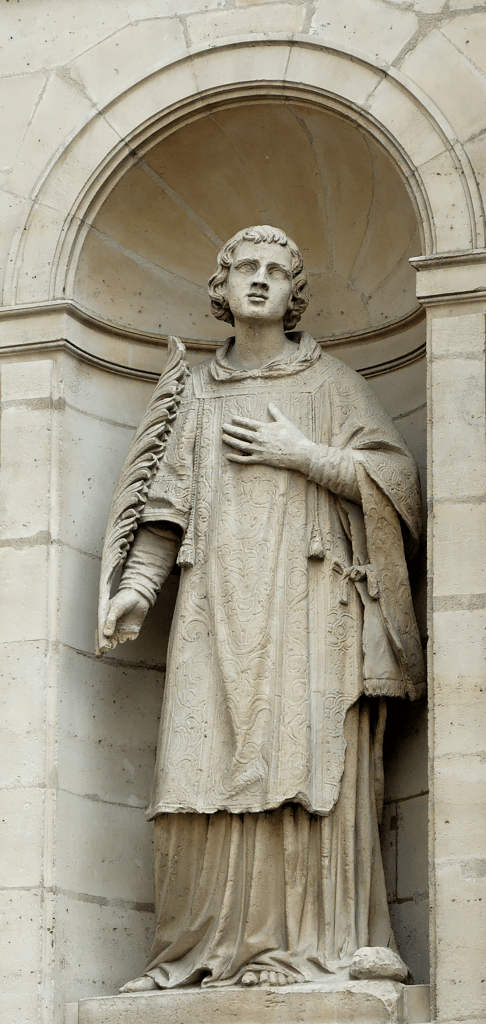
Statue of St. Stephen, by Joseph Marius Ramus (1805–1888) at the Saint-Étienne-du-Mont Church in Paris

Then the Chief Priest said, “What do you have to say for yourself?”

Stephen replied, “Friends, fathers, and brothers, the God of glory appeared to our father Abraham when he was still in Mesopotamia, before the move to Haran, and told him, ‘Leave your country and family and go to the land I’ll show you.’

“So he left the country of the Chaldees and moved to Haran. After the death of his father, he immigrated to this country where you now live, but God gave him nothing, not so much as a foothold. He did promise to give the country to him and his son later on, even though Abraham had no son at the time. God let him know that his offspring would move to an alien country where they would be enslaved and brutalized for four hundred years. ‘But,’ God said, ‘I will step in and take care of those slaveholders and bring my people out so they can worship me in this place.’

“Then he made a covenant with him and signed it in Abraham’s flesh by circumcision. When Abraham had his son Isaac, within eight days he reproduced the sign of circumcision in him. Isaac became father of Jacob, and Jacob father of twelve ‘fathers,’ each faithfully passing on the covenant sign.

“But then those ‘fathers,’ burning up with jealousy, sent Joseph off to Egypt as a slave. God was right there with him, though—he not only rescued him from all his troubles but brought him to the attention of Pharaoh, king of Egypt. He was so impressed with Joseph that he put him in charge of the whole country, including his own personal affairs.

“Later a famine descended on that entire region, stretching from Egypt to Canaan, bringing terrific hardship. Our hungry fathers looked high and low for food, but the cupboard was bare. Jacob heard there was food in Egypt and sent our fathers to scout it out. Having confirmed the report, they went back to Egypt a second time to get food. On that visit, Joseph revealed his true identity to his brothers and introduced the Jacob family to Pharaoh. Then Joseph sent for his father, Jacob, and everyone else in the family, seventy-five in all. That’s how the Jacob family got to Egypt.

“Jacob died, and our fathers after him. They were taken to Shechem and buried in the tomb for which Abraham paid a good price to the sons of Hamor. (The Message)

“What do you have to say for yourself?” conjures up for me women in a church basement with hands on hips, fingers pointing, staring at my 4-year-old self, after I ran through a bunch of old clothes at their annual rummage sale. And it wouldn’t be the last time I’d be asked that question throughout my life.

It’s a question that wants an accounting of something we’ve said or done. It’s not a polite question – more rhetorical than anything else.

Stephen was asked the question – and displayed a non-plussed presence that used the opportunity to turn it around back on his accusers and, indeed, of all humanity and human history.

Throughout Jewish history (and everyone else’s history, too!) there are human movements of good, inspired by divine initiatives; and alongside the good, there also are streams of resistant humanity who seek to thwart the good.

St. Stephen delivered a speech to the religious leaders, highlighting these two developments of human activity in the lives of two major figures in Jewish history.

Abraham

The patriarch of the Jewish people, Abraham, demonstrated faith by listening to the call of God to go to a country he knew nothing about. The Lord’s promises included both blessing and hardship. Although Abraham would be faithful to God’s covenant, his descendants would still find themselves as slaves in Egypt for four-hundred years.

Opposition to faith is always hanging in the shadows, ready to spring when there is an opportunity. Even though Abraham was a devoted follower of God, there were faithless people around him who had a different agenda than the Lord’s. His name continued into the New Testament with the faithless using it.

But invoking the ancient name of Abraham isn’t a protective amulet that makes everything okay. Doing the will of God is what really matters; and exhibiting faith like Abraham is the real issue.

“Produce fruit in keeping with repentance. And do not begin to say to yourselves, ‘We have Abraham as our father.’ For I tell you that out of these stones God can raise up children for Abraham. The ax is already at the root of the trees, and every tree that does not produce good fruit will be cut down and thrown into the fire.” (John the Baptist, Luke 3:8-9, NIV)

A good and right life comes through faith, and not by willpower nor in lifting up oneself by the bootstraps.

If, in fact, Abraham was justified by works, he had something to boast about—but not before God. What does Scripture say? “Abraham believed God, and it was credited to him as righteousness.” (Romans 4:2-3, NIV)

Joseph

Abraham, Isaac, and Jacob are the original pillars of Judaism. Jacob had twelve sons, known as the twelve patriarchs, from whom all Jews come from. The history of the brothers, like many families, is complicated. Joseph, next to the youngest of the brothers, was intensely disliked by several of the others.

Joseph found himself in Egypt because his brothers sold him into slavery. Like Abraham, Joseph had a robust faith, yet this did not inoculate him from trouble. Eventually, however, through a round-about turn of events, Joseph became in charge of the very empirical power that originally received him as a slave.

Through the eyes of faith, Joseph was not bitter, but understood why he needed to go through such terrible adversity. As administrator over all of Egypt, Joseph was able to handle severe years of drought with wisdom and confidence, thus saving many lives from hunger and starvation. And so, he was able to say to his brothers, many years later:

“You intended to harm me, but God intended it for good to accomplish what is now being done, the saving of many lives. “

(Genesis 50:20, NIV)

So, what do you have to say for yourself? Let you and I have the ability to say that we have been people of faith and patience. Let us be those who tenaciously hold to God, and steadfastly do good, speaking up in faith, no matter the situation, and regardless of faithless people who oppose us.

Because, in the end, the words of Jesus are true:

“So do not be afraid of them, for there is nothing concealed that will not be disclosed, or hidden that will not be made known. What I tell you in the dark, speak in the daylight; what is whispered in your ear, proclaim from the roofs. Do not be afraid of those who kill the body but cannot kill the soul. Rather, be afraid of the One who can destroy both soul and body in hell. Are not two sparrows sold for a penny? Yet not one of them will fall to the ground outside your Father’s care. And even the very hairs of your head are all numbered. So don’t be afraid; you are worth more than many sparrows.” (Matthew 10:26-31, NIV)

Just and right God, when we are faithless, you are faithful, because your very character is faithfulness. Help us to be faithful – not fearful – to the end, exhibiting the same commitment as your martyr Stephen, who fully entrusted himself to the Lord Jesus Christ, in whose name we are bold to pray. Amen.

Take the Scroll and Eat It (Revelation 10:1-11)

Then I saw another mighty angel coming down from heaven. He was robed in a cloud, with a rainbow above his head; his face was like the sun, and his legs were like fiery pillars. He was holding a little scroll, which lay open in his hand. He planted his right foot on the sea and his left foot on the land, and he gave a loud shout like the roar of a lion. When he shouted, the voices of the seven thunders spoke. And when the seven thunders spoke, I was about to write; but I heard a voice from heaven say, “Seal up what the seven thunders have said and do not write it down.”

Then the angel I had seen standing on the sea and on the land raised his right hand to heaven. And he swore by him who lives for ever and ever, who created the heavens and all that is in them, the earth and all that is in it, and the sea and all that is in it, and said, “There will be no more delay! But in the days when the seventh angel is about to sound his trumpet, the mystery of God will be accomplished, just as he announced to his servants the prophets.”

Then the voice that I had heard from heaven spoke to me once more: “Go, take the scroll that lies open in the hand of the angel who is standing on the sea and on the land.”

So I went to the angel and asked him to give me the little scroll. He said to me, “Take it and eat it. It will turn your stomach sour, but ‘in your mouth it will be as sweet as honey.’” I took the little scroll from the angel’s hand and ate it. It tasted as sweet as honey in my mouth, but when I had eaten it, my stomach turned sour. Then I was told, “You must prophesy again about many peoples, nations, languages and kings.” (New International Version)

Maybe this goes without saying, yet it probably needs to be said anyway: Our human participation is required to go along with God’s action.

We are fellow actors with God in the drama of what is happening in this world. This is both invigorating and scary, at the same time. Decrees were not simply shouted from above, and down to humanity. Instead, God’s words are sent by heavenly messenger to the earth, to be digested by people.

The world is not changed from its hateful ways and prejudiced stances simply by God decreeing love for us. Rather, the words are followed by the invitation to participate.

For the Christian, this participation begins with the Lord Jesus. He entered into our situation, lived among us, full of grace and truth. Christ took the words of God, ate them, digested them, and allowed them to thoroughly guide his earthly life and ministry.

Some believe that the mighty angel in today’s New Testament lesson is none other than Christ in the form of, or using, an angel to communicate. Whatever is happening in the text, it is clear that Jesus is certainly behind it all.

A scroll was given to the Apostle John. He was exhorted to move from observer to actor. The bad news of humanity’s sin and judgment must be transformed into good news of grace and forgiveness through human presence and cooperation.

Take the scroll and eat it. The prophet Ezekiel, in the Old Testament, was also told to eat a scroll and then go speak (Ezekiel 3:1). We aren’t told anything about what was written in the scroll which John took – and that’s because the words themselves aren’t really the point of what’s happening.

Whenever the people of God take and eat the words of God, they have the dual experience of delivering the good news of grace with great joy, as well as enduring suffering with patience because of the testimony they proclaim.

Revelation, or the Apocalypse of John, was written not to craft elaborate prophecy charts about the end times, but was meant to offer encouragement to a suffering church that their witness to the gospel was worth it.

The believers were experiencing persecution from the hands of unbelievers. The vision of John was designed to pull back the curtain a bit, revealing a peek that, in the end, God’s purposes will be accomplished, evil shall be vanquished, and the people of God will be vindicated.

Perseverance requires active participation, not passive acquiescence. We endure through hardship. It has always been this way for God’s people. Believers walk through the valley, and sit at the table with the presence of enemies, along with the presence of God.

Even though I walk through the darkest valley,
    I fear no evil,
for you are with me;
    your rod and your staff,
    they comfort me.

You prepare a table before me
    in the presence of my enemies;
you anoint my head with oil;
    my cup overflows. (Psalm 23:4-5, NRSV)

The ability to move through adversity requires collaborating with the Lord, knowing God’s words, and using that message for help and encouragement.

People do not live by bread alone, but by every word that comes from the mouth of God. (Matthew 4:4, NLT)

For the word of God is alive and powerful. It is sharper than the sharpest two-edged sword, cutting between soul and spirit, between joint and marrow. It exposes our innermost thoughts and desires. (Hebrews 4:12, NLT)

The angel of the Lord camps around
the Lord’s loyal followers and delivers them.
Taste and see that the Lord is good.
How blessed is the one who takes shelter in him.(Psalm 34:7-8, NET)

The word of God is active and powerful. Ingesting God’s words enables God’s message to move within us and shape us for active and effective participation in the world.

It is neither an easy path, nor a wide smooth highway to speed down. Yet, for those who will take the journey, it is a joyous road and a winding narrow trail full of God’s signs and wonders.

This is the way of perseverance, and God’s words are our guide.

Heavenly Father, give us faith to receive your word, understanding to know what it means, and the will to put it into practice; through Jesus Christ our Lord, in the power of the Holy Spirit. Amen.

Some Well-Ordered Wisdom (Psalm 37:1-17)

Don’t be worried on account of the wicked;
    don’t be jealous of those who do wrong.
They will soon disappear like grass that dries up;
    they will die like plants that wither.

Trust in the Lord and do good;
    live in the land and be safe.
Seek your happiness in the Lord,
    and he will give you your heart’s desire.

Give yourself to the Lord;
    trust in him, and he will help you;
he will make your righteousness shine like the noonday sun.

Be patient and wait for the Lord to act;
    don’t be worried about those who prosper
    or those who succeed in their evil plans.

Don’t give in to worry or anger;
    it only leads to trouble.
Those who trust in the Lord will possess the land,
    but the wicked will be driven out.

Soon the wicked will disappear;
    you may look for them, but you won’t find them;
but the humble will possess the land
    and enjoy prosperity and peace.

The wicked plot against good people
    and glare at them with hate.
But the Lord laughs at wicked people,
    because he knows they will soon be destroyed.

The wicked draw their swords and bend their bows
    to kill the poor and needy,
    to slaughter those who do what is right;
but they will be killed by their own swords,
    and their bows will be smashed.

The little that a good person owns
    is worth more than the wealth of all the wicked,
because the Lord will take away the strength of the wicked,
    but protect those who are good. (Good News Translation)

Today’s Psalm feels as if it could be in the book of Proverbs; it’s chocked full of wisdom sayings. And wisdom is most definitely something you, me, and the entire world needs. Indeed, we have enough fools around us running their mouths with a bunch of gobbledygook that’s nonsensical and meaningless.

We need helpful language and well-ordered words which reflect our ordered creation.

The underlying assumption of all biblical wisdom literature is that our world has been created by God with a material and moral order built into it.

That means that to buck this order is stupid and foolish. Somebody who walks off the roof of their house because they don’t believe in gravity will experience the harsh reality of that belief. Likewise, anyone who walks any old way they want in this world, without regard to the divine force operating within it, is going to experience a broken spirit.

Our human well-being depends on knowing the ordered creation we inhabit. There are social expectations which need to be realized in order to conform and be in sync with the natural (and supernatural!) universal rhythms all around us. Those expectations are framed for us as wisdom sayings.

Our actions and inactions have consequences. It’s our task to gain experiential knowledge as we move about this earth and interact with others. Notice I did not say we need to be perfect. No, instead, we are continually in a mode of improvement – seeking and learning to be better and do better.

And one of the things we all must discover is that our own personal actions and attitudes effects the entire surrounding community.

Biblical wisdom literature communicates how we receive blessing and how we hold onto it. True wisdom is to live in a responsible awareness of both Creator and creation – and then to make appropriate choices which will bless God and others.

So, in our Psalm for today, we have some wise choices to make that put us in the groove of how things are ordered and established:

  • Don’t worry about the evil simpletons around you. Why? Because in the Lord’s well-ordered world, the wicked cannot and will not survive; their end is certain, just as sure as death and taxes.

Those who are evil—
they are like straw
    blown by the wind.
Sinners won’t have an excuse
    on the day of judgment,
and they won’t have a place
    with the people of God.
The Lord protects everyone
    who follows him,
but the wicked follow a road
    that leads to ruin. (Psalm 1:4-6, CEV)

  • Trust the Lord. Everything changes. Everyone is fickle. Why trust? Because God, unlike everything and everyone else, is consistent, stable, and always true to character.

Trust God from the bottom of your heart;
    don’t try to figure out everything on your own.
Listen for God’s voice in everything you do, everywhere you go;
    he’s the one who will keep you on track. (Proverbs 3:5-6, MSG)

  • Be patient and wait on the Lord. Why? Because God is good, all the time, and has only good plans in mind for you and me. We short circuit what God is doing whenever we fail to have patience.

Be patient, then, brothers and sisters, until the Lord’s coming. See how the farmer waits for the land to yield its valuable crop, patiently waiting for the autumn and spring rains. You too, be patient and stand firm, because the Lord’s coming is near. (James 5:7-8, NIV)

The best things in life are internal, not external. One’s inner well-being, peace of mind, emotional awareness, and spiritual health are worth infinitely more than any title, position, wealth, or delusions of control.

A well-ordered life comes from tapping into the divine resources available to us.

Grant us patience, O Lord, to follow the road you have taken. Let our confidence not rest in our own understanding but in your guiding hand; let our desires not be for our own comfort, but for the joy of your kingdom; for your cross is our hope and our joy now and unto the day of eternity. Amen.

– A Prayer of St. Augustine

Take the Long View (Genesis 49:1-2, 8-13, 21-26)

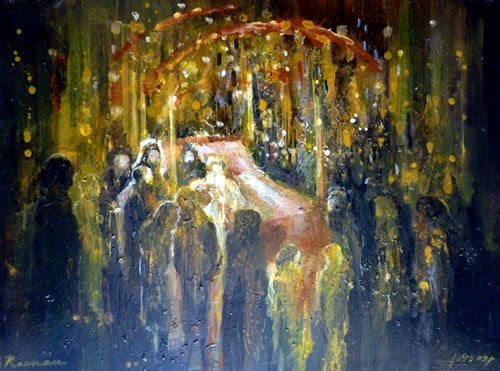
Jacob blesses his sons on his deathbed by Yoram Raanan

Jacob called his sons together and said:

My sons, I am Jacob,
    your father Israel.
Come, gather around,
    as I tell your future….

Judah, you will be praised
    by your brothers;
they will bow down to you,
    as you defeat your enemies.
My son, you are a lion
    ready to eat your victim!
You are terribly fierce;
    no one will bother you.
You will have power and rule
until nations obey you
    and come bringing gifts.
You will tie your donkey
    to a choice grapevine
and wash your clothes
    in wine from those grapes.
Your eyes are darker than wine,
    your teeth whiter than milk.

Zebulun, you will settle
    along the seashore
and provide safe harbors
    as far north as Sidon….

Naphtali, you are a wild deer
    with lovely fawns.

Joseph, you are a fruitful vine
growing near a stream
    and climbing a wall.
Enemies attacked with arrows,
    refusing to show mercy.
But you stood your ground,
    swiftly shooting back
with the help of Jacob’s God,
    the All-Powerful One—
his name is the Shepherd,
    Israel’s mighty rock.
25 Your help came from the God
your father worshiped,
    from God All-Powerful.
God will bless you with rain
    and streams from the earth;
he will bless you
    with many descendants.
My son, the blessings I give
are better than the promise
    of ancient mountains
    or eternal hills.
Joseph, I pray these blessings
    will come to you,
because you are the leader
    of your brothers. (Contemporary English Version)

Where does confidence come from?

The theme of confidence works its way through the patriarch Jacob’s deathbed prophecies and blessings – a resolute conviction in the promises of God – that the Lord will accomplish exactly what was promised.

Jacob expressed the hope and sure belief that God would bring the Israelites out of Egypt and into the land of Canaan as their inheritance – and, ultimately to the City of God, the eternal inheritance.

The Christian will find much in the blessing of Judah concerning the promises surrounding the coming of Christ. Mentioning the implements of “staff” and “scepter” are symbols of authority. And the reference to a donkey communicated a ruler was coming, as donkeys were the preferred mounts of royalty in ancient times.

What’s more, the washing of garments in wine, and eyes darker than wine, are allusions to the future blessing and abundance that will occur through the tribe of Judah. In fact, the first miracle of Jesus was turning water into wine – a deliberate attempt by the Apostle John to connect Jesus with Old Testament messianic prophecies of abundance and blessing. (John 2:1-12)

It’s important to adopt a long view of life. We must keep in mind that it took eighteen centuries for Jacob’s prophecy of Judah to occur. This long view is what gives us our confidence in life and provides the patience and perseverance we need for the here and now.

Seeing the big picture of God’s work in this world is necessary, because if we do not, we will likely become discouraged with the circumstances we face right now.

The reason Jacob makes it into the great Hall of Faith in the New Testament book of Hebrews is not because he was squeaky clean and perfect in how he lived his life; it was because he took the long view, the big picture, and saw that God was going to fulfill divine promises to Israel:

By an act of faith, Jacob on his deathbed blessed each of Joseph’s sons in turn, blessing them with God’s blessing, not his own—as he bowed worshipfully upon his staff. (Hebrews 11:21, MSG)

Furthermore, when we string the following three verses together across both Old and New Testaments of the Bible, we see the long view of God’s purposes:

It is true that you planned to do something bad to me. But really, God was planning good things. God’s plan was to use me to save the lives of many people. And that is what happened. (Genesis 50:20, ERV)

For I know the plans I have for you,” declares the Lord, “plans to prosper you and not to harm you, plans to give you hope and a future. (Jeremiah 29:11, NIV)       

And we know that all things work together for good to those who love God, to those who are the called according to his purpose. (Romans 8:28, NKJV)

In the Christian faith tradition, all of God’s promises come together and are fulfilled in the person and work of Jesus.

Christ is our salvation, our inheritance, and our hope. To give our lives to following Jesus in complete trust of faith is both our challenge and our privilege.

May we live by faith, and not by fear. And may we have patience and persevere through the most challenging of situations because we have adopted the long view of understanding the God is bringing all divine promises to fruition, all in good time.

Our confidence comes from the Lord.

Be present, O merciful God, and protect us through anxious times, so that we who are wearied by the changes of this life may rest in your eternal steadiness. Keep watch, dear God, with those who work, or watch, or weep this night, and give your angels charge over those who sleep. Tend the sick, Lord Christ; give rest to the weary, bless the dying, soothe the suffering, pity the afflicted, shield the joyous; and all for your love’s sake. Amen.