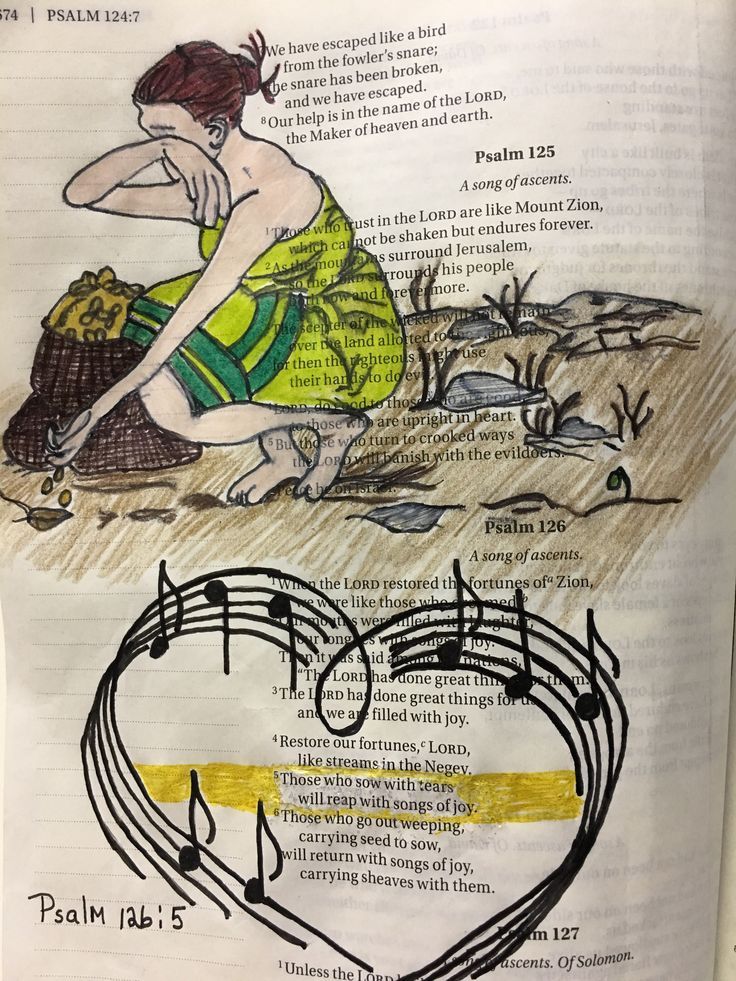
Psalm 126 – Sorrow and Joy

When the Lord restored the fortunes of Zion,
    we were like those who dreamed.
Our mouths were filled with laughter,
    our tongues with songs of joy.
Then it was said among the nations,
    “The Lord has done great things for them.”
The Lord has done great things for us,
    and we are filled with joy.

Restore our fortunes, Lord,
    like streams in the Negev.
Those who sow with tears
    will reap with songs of joy.
Those who go out weeping,
    carrying seed to sow,
will return with songs of joy,
    carrying sheaves with them. (NIV)

Likely none of us awake in the morning, sit up on the edge of the bed and say to ourselves, “Well, let’s see, I think I’ll cry and be sorrowful today.” We might do that with joy, not with sadness. It can be easier to gravitate toward the fulfillment of dreams, laughter, and happiness than tears and weeping.

If we want to experience authentic joy, the path is through crying because it is our tears which find a better way.

Whether it comes from a certain denominational tradition, ethnic background, or family of origin dynamics, there are many Christians who love to emphasize Jesus as Victor and camp in resurrection power – while eschewing Christ as the man of sorrows, acquainted with grief and sadness.

It is from this place of continually viewing only one dimension of Christ’s redemptive work that pastoral care often falls far short of true help. Trying to engineer cheerfulness and create solutions to a person’s genuine grief is, at best, not helpful, and at worst, damaging to their soul. Such attempts will only lead to cheap joy.

Coming to the place of sincerely singing spontaneous songs of joy with a sense of abundant satisfaction comes through suffering and sorrow.

There must be a crucifixion before there is a resurrection. In the agrarian culture of ancient Israel, the metaphor of sowing a reaping connected well to the importance of planting tears and allowing them to flower later into an abundant harvest of joy.

Perhaps in American culture, a more apt metaphor would be financial investing and cashing out. The investment we put into attending to our grief with expressions of lament through tears, will eventually get a return, and we shall be able to cash out with a rich bounty of joy.

All good things in life are realized through a lot of blood, sweat, and tears. “Blessed are those who mourn,” said Jesus, “for they shall be comforted” (Matthew 5:4, NIV). Just as it takes both field crops and economic investments time to grow and mature, so the believer’s life is a process of spiritual development which is watered through tears and experiences the up-and-down sorrows of a market economy.

There is coming a day when our joy will be realized in full measure. The season of Advent reminds us that we must wait, and that we must suffer many things before we enter the kingdom of God and enjoy unending fellowship with our beloved Savior and King.

Great God almighty, with expectant hearts we await the coming of Christ. As once he came in humility, so now may he come in glory so that he may make all things perfect in your everlasting kingdom. For Christ is Lord forever and ever. Amen.

What My Dementia Residents Teach Me

20180513_084304_resized

It can be uncommonly hard to live in this day and age.  Bills to pay and mouths to feed; kids to shuttle; work stuff that never seems to end; sickness and disease to navigate; retirement to plan for; family junk to deal with; hobbies you want to do; and, seemingly, a thousand other things vie for your time and attention to the point of having difficulty sleeping or even sitting still.  The problem is that you and I can become so busy and so concerned about tomorrow that worry, anxiety, and fear can attach themselves to us like ticks on a dog.

I minister to a group of people living in a memory unit of a care facility.  They’re there because of a diagnosis of dementia or Alzheimer’s.  You haven’t lived until you’ve had Bible study with 32 memory care residents in a healthcare facility.  It’s a trip, a hoot, and a challenge all at the same time.  Sometimes it’s difficult to know if what you’re doing or saying has any meaning or significance.  But let’s flip this around.  Maybe it isn’t all about the “normal” (and I use the term very loosely) guy like me coming in and doing his mentally attuned thing for some folks who have problems with disconnection.  Perhaps the dementia men and women have something to teach me and you.  Methinks they do.  I’ll let you in on a few of the things I’m learning from my dear brothers and sisters in the memory unit wing….

They live in the moment.

Whereas you might think it is sad that Aunt Bessie or Uncle Frank doesn’t remember what you just said to them two minutes ago, or where you were together a few hours ago, I think there is something amazing such folks have to teach me.  You see, when they eat a strawberry, or watch I Love Lucy, or have a conversation with you as if they have eaten, watched a comedy, and engaged a relationship for the very first time, it can be astounding.  Some of these folks just don’t remember that they have always loved strawberries, sit-coms, and their family.  And when they partake – as if they have never done it before – their joy, laughter, and endearing qualities come through like the beautiful wonderment of a child.

Oh, my goodness, if I could only learn to live in the moment taking the example of my blessed memory residents!  Their worries are limited.  Yes, they have them – and they can revisit decades-old worries like they were yesterday – but their own reassurances from the past are still at the tip of their tongues.  When we say The Lord’s Prayer together, I believe God takes a break from maintaining His creation to sit-in on the beautiful voices lifting an ancient prayer to Him.  The Prayer is so firmly inside them that they don’t realize that what they are uttering is routine.  It has new meaning for them.  They look at it differently.  They ask questions and make comments, as if this Prayer is the most wonderful thing they have ever heard.  I’ve beheld more than one person who does not talk at all, but when prompted with The Lord’s Prayer, bellows it out like a professional orator.

Perhaps no other group of people live into Christ’s teaching about avoiding worry more than the person who truly lives in the moment and doesn’t think about tomorrow.  Dementia and Alzheimer’s patients can teach us to live like the believers in Jesus we were meant to be:

“So don’t worry about these things, saying, ‘What will we eat? What will we drink? What will we wear?’ These things dominate the thoughts of unbelievers, but your heavenly Father already knows all your needs.  Seek the Kingdom of God above all else, and live righteously, and he will give you everything you need.  So don’t worry about tomorrow, for tomorrow will bring its own worries. Today’s trouble is enough for today.” (Matthew 6:31-34)

They keep short accounts with others.

Rivalries and animosities don’t really exist with my memory men and women.  If they had them at one time, they aren’t there anymore.  They are forgotten.  Yes, that can be a great consternation to the one who was at the other end of the old animosity.  But a new relationship can be forged.  One that is fresh and can start with a clean slate.

What’s more, my residents are quick to let me know what they think, where they are at the moment, and how they want something to go.  I, personally, find it refreshing to have someone say exactly what’s on their mind or heart.  The very first resident I met on the memory unit said her name to me, and then, with all seriousness, looked me in the eye and said, “If you mispronounce my name, I’ll punch you right in the face!”  I laughed out loud.  She laughed with me.  We laughed together.  She couldn’t even ball up her arthritic hand enough to punch, let alone raise her frail arm to do it.  So, there we sat laughing, with joy amidst the ravages of a disintegrating mind.

You know what?  In the days and weeks to come, I mispronounced her name.  She didn’t really care (at least, most of the time).  She forgot her own name sometimes.  And we would laugh about it.  At one point, I couldn’t help but note the juxtaposition between one woman in a former congregation who never forgot that I misspoke her daughter’s name and continually held it against me.  The woman never adopted the teaching of Jesus to “settle your differences quickly” (Matthew 6:25) and the instruction of Paul to “don’t let the sun go down while you are still angry” (Ephesians 5:26).  But here, in this time and at this moment, are two people in a non-descript nursing home experiencing a relationship free from the elephant-thinking that never forgets.

They have no inhibitions about expressing their emotions.

For a guy like me who tends to be emotionally constipated, it is good to be around a group of people that lets their feelings be known.  Just because a person’s mind begins to forget; and just because someone loses large swaths of memory (especially the short term stuff); doesn’t mean they have lost the ability to feel.  Sometimes all they have is their emotion.  Maybe some of them were stuffers of feelings back in the day, but now it comes out.  And you never know what it will be from hour to hour, sometimes even minute to minute.

I realize this is hard for family members or friends who have been close to the resident for years and years.  This isn’t the same person they knew in the past.  Yet, this is an opportunity to re-engage on a different level.  If expressing feelings and emotions were foreign to the relationship, now it can be engrafted into the friendship and become new and even healing.

Confessing your own emotions and feelings is on the table for you, as well.  After all, what are they really going to remember after you leave?  And even if they repeat it to someone, is that someone really going to believe what they’re saying?  Yes, I’m being a bit facetious, but you get what I’m saying.  You see, there is tremendous emotional freedom to be had, if you are willing to take it.  You might even realize that taking the risk to share your emotions and feelings with others is worth doing.  It would be a tragedy and a travesty if you moved through life always hiding how you really feel.  You have much to offer.

And that is the point I want to get across to you today, my friend.  Memory unit residents; dementia and Alzheimer’s patients; and, a host of other people we typically think always need us, it turns out that we really need them, too.  Every person, no matter who they are, is precious and carries within them the image of God.  To discover that God-likeness within is a journey worth taking.

A Safe Place


A most basic command of Holy Scripture is that we are called to love our neighbor.  The church is the people of God who exist, in part, to be a hospital for sinners.  There are certain subjects and issues that sometimes capture the church’s attention and may cause believers to lose sight of grace, love, and basic biblical commands.  There is a particular subject that continually gets identified (in my church circles) as an “issue.”  It is the “issue” of homosexuality.
 
            First of all, I have “issues” with this being labeled as an “issue.”  We are talking about people.  As long as we continue to frame our discussions in this realm of an issue, we are going to inevitably end up taking at least some of the human element out of the conversation.  It is much easier to lambast an issue than it is a person. It must be constantly and deliberately borne in mind that gay individuals are people who have been created in the image and likeness of God.  They are not bowling balls.  They aren’t Buicks.  They are people.  And based on that fact alone, they ought to be treated with all the respect due to any person.
 
            Second, using the term “homosexuality” betrays the reality that we have not done our due diligence in listening well to gay persons.  In my humble experience, homosexuality is a word that immediately puts up unnecessary roadblocks with LGBT folks.  Continually using the term homosexuality typically communicates that certain individuals are in the category of a mental disease that needs to be cured.  What is more, when certain church folks start tossing around the term, not far behind is the handful of biblical references that are supposed to make gay persons feel guilty enough to either:  become heterosexual on the spot; or, live an eternally celibate existence without ever talking about their dirty little secret again.  Even if all this is communicated with an altruistic sense of love by the church person (which seems pretty rare), it isn’t likely that anything good is going to come of the conversation.
 
            Here is my most basic concern:  the church ought to be a safe place.  Whatever your understanding is concerning gay persons, I would hope beyond hope that you can sign-off on the sheer necessity of the church being the one place on planet earth (or in God’s kingdom!) that people who are wrestling with Scripture when it comes to sexuality and gender can come with their questions and find help and resolution with what is going on deep in their souls.
 
            Whenever we church leaders make our pious pronouncements and babble on about how we are upholding the authority of Holy Scripture, it sounds to me like we are saying things that help make us feel better about ourselves instead of saying something that will help the otherthrough their time of need. 
 
            Here is a ridiculously simple observation:  gay people are not going to magically disappear.  Yet, it seems like there are some churches that want to blink and just expect that there will be no more gays around.  Here is another simple observation:  gay individuals have eternal souls just like anyone else, and they are looking for redemption and hope just like anyone else.  The question of the hour, then, is:  Will the church show pastoral care and sensitivity for all people, or will the church be a country club with a chaplain caring only for “acceptable” members?


            We are all sinners in need of God’s grace in Christ; we all belong to the same human family.  It is high time we begin focusing on our commonality so that we might shepherd one another toward Jesus, the Great Shepherd.  He is our Savior.  Let us come to him together.

"What Do I Say?"


            So far this year I have had an unusual amount of persons within my congregation who have and are experiencing significant health issues, especially cancer.  The church, of course, has a wonderful opportunity in such occasions to offer prayer, comfort, and encouragement.  However, oftentimes church members struggle with knowing what to say to persons going through such physical trials.  They may feel unable to truly say something helpful, so they do not say anything at all.  They might avoid going to visit someone in the hospital because they are too intimidated about the situation.  Even pastors and church leaders may feel so inadequate and small in dealing with some parishioners’ overwhelming pain and disease that they fail to say anything substantive.  This is a problem that does not really need to be a problem because we possess the words of God contained in Holy Scripture.
 
            Here’s the deal:  it is not really our words that bring health and healing to a person in need; it is God’s words.  Much more important than believing our speech is going to make or break a patient or victim’s health or happiness is our very presence.  Taking the time to be with someone in need and simply hold their hand and sit for a while can communicate more comfort and care than a bevy of forced words out of our mouths.  So, then, when we visit someone either at home or in the hospital our presence coupled with God’s Word are the vital tools of building encouragement into a patient’s heart. 
 
            Knowing the Bible is crucial to knowing what to say to a person in need.  Even the most shy among us does not need to put pressure on ourselves to come up with something to say when we are equipped with the Book of Psalms.  Whether it is reading Psalm 23 with its comforting promise of God’s provision, protection, and presence, or Psalm 91 with its grand vision of a God who shelters His people in a time of upheaval, the psalms offer us words to say that transcend anything we might come up with on our own.  More than once I have gone into a hospital room or a bedroom at home and simply spent my time reading Scripture after Scripture and allowing the Spirit of God to seep down into the fearful recesses of a person or a family’s innermost soul, bringing a sliver of light into the clouds of doubt and darkness that loom within.
 
            Another great fear of the one who would like to comfort another is whether they will be able to answer the difficult questions brought forth by the afflicted.  And, yes, they do often have questions of life and death on their lips, like an impetuous four year old peppering his mother with inquisitions for which she becomes exhausted over.  Yet, as human beings, we are not so grandiose as to have the answers to questions that only God glories to know.  “I don’t know” is a phrase that is not only perfectly acceptable to say, it may even be the best response to a large query.  Trying to drain all the mystery out of life by claiming to know the hidden places of the universe strikes me as, at best, hubris, and, at worst, leaves a person feeling more awful than they did before their inquiry.
 
            The only obstacles that stand in the way of our ministering care and compassion to a hurting person is our own self-made walls of excuses and fears.  If our presence and God’s Word are truly the best companions, then we can walk with confidence into the life of another and know that we are being conduits of grace to those who need it most. 


            If you are not sure about what kind of Scripture to use in a person’s life, every pastor on planet earth enjoys suggesting portions of God’s Word to use.  If you do not want to go alone to encourage another, there is likely a genuine follower of Jesus who would jump at the chance to be with you and assist in any way possible.  Too many hurting people’s pain is compounded by a well-intentioned person who simply says and does nothing out of a misguided belief that they have nothing to offer.  To feel ill or dying is to feel discomfort; to feel ignored is to suffer a terrible agony worse than death.  May God’s people use God’s Word to edify God’s people and transform God’s creation for God’s sake.