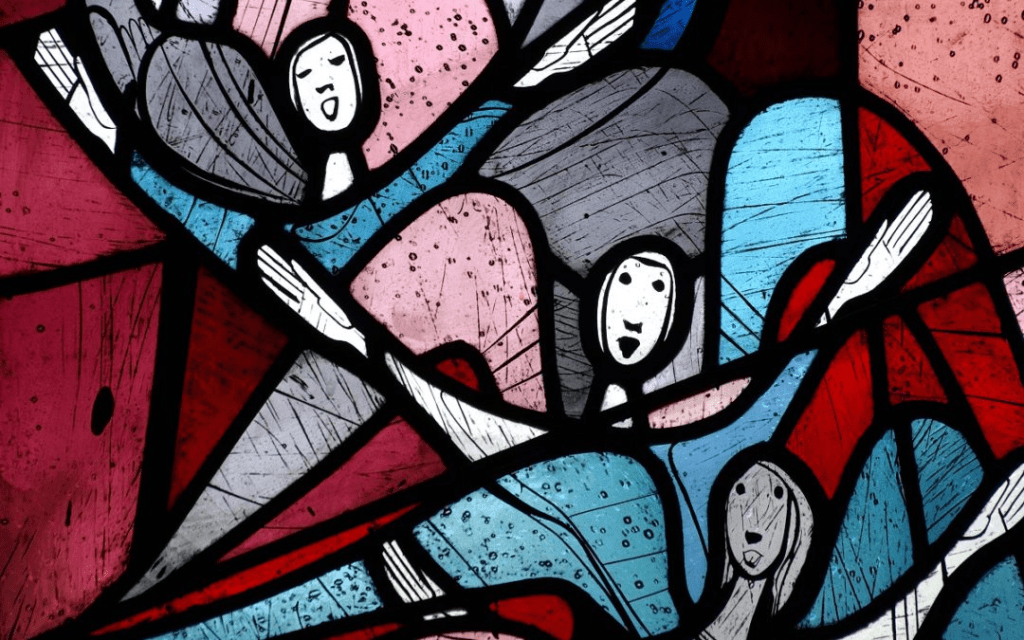
Facing Our Sadness (Psalm 42)

As a deer longs for a stream of cool water,
    so I long for you, O God.
I thirst for you, the living God.
    When can I go and worship in your presence?
Day and night I cry,
    and tears are my only food;
all the time my enemies ask me,
    “Where is your God?”

My heart breaks when I remember the past,
    when I went with the crowds to the house of God
    and led them as they walked along,
    a happy crowd, singing and shouting praise to God.
Why am I so sad?
    Why am I so troubled?
I will put my hope in God,
    and once again I will praise him,
    my savior and my God.

Here in exile my heart is breaking,
    and so I turn my thoughts to him.
He has sent waves of sorrow over my soul;
    chaos roars at me like a flood,
    like waterfalls thundering down to the Jordan
    from Mount Hermon and Mount Mizar.
May the Lord show his constant love during the day,
    so that I may have a song at night,
    a prayer to the God of my life.

To God, my defender, I say,
    “Why have you forgotten me?
Why must I go on suffering
    from the cruelty of my enemies?”
I am crushed by their insults,
    as they keep on asking me,
    “Where is your God?”

Why am I so sad?
    Why am I so troubled?
I will put my hope in God,
    and once again I will praise him,
    my savior and my God. (Good News Translation)

Sadness. Every human on planet earth knows the feeling. Since we are emotional creatures, profound sadness – even to the point of depression and/or despondency – will happen.

Despite the universal nature of discouragement and tears, many Christians buck the sadness. Far too many believers focus so exclusively on victory in Jesus through his resurrection, ascension, and glorification that they use religion as their denial when unwanted emotions like sadness come banging at the doorstep of their soul.

So, I most emphatically say: Depression is not sin. To be discouraged is not the Enemy. Experiencing sadness is neither wrong nor selfish. Quite the opposite, in fact.

It is necessary to sit with our emotions and feel the breadth and depth of them. Both our spiritual and emotional health come through an awareness and robust engagement with our feelings. To refuse to feel is to put the stiff arm to God.

The psalmist does anything but deny his feelings. He brings them before the Lord and spreads them out before the Divine. Why am I discouraged? Why am I restless? Why the sadness? Could it be that God has forgotten me? Where is the Lord? Is God angry with me? Are my troubles the result of divine wrath?

To blandly say we have never uttered or thought such questions is a telltale sign of denial. The bottom line for many folks is that they do not want to feel these emotions because it complicates their lives. Besides, discouragement and sadness hurt. “Why feel,” we reason, “when it only brings pain?”

Oh my, the avoidance of pain. And there is no pain quite like emotional and spiritual pain. Much like an open wound which needs a liberal application of painful peroxide, our spiritual wounds must sting with the salve of emotional feeling. Healing is neither cheap, easy, nor painless. It typically hurts like hell.

The psalmist’s own pain revolved around feelings of alienation from God, being cut off from fellow worshipers, and harassed by others around him. Understandably, he experienced despondency and loneliness. The psalmist wondered if anyone, including God, even cared what he was going through. In other words, he is desperate for God to show up.

Here’s a simple observation about this psalm: The psalmist did not get any answers to the several questions he posed. He even repeated them, to no avail. The only form of comfort the psalmist received was to remember what God had done in the past. Somehow, someway, this will help with the difficulties of the present.

There are times in life when we must recall what we know about God, ourselves, and others. If the Lord has delivered in the past, God can do it again. If others helped before, perhaps they will be present in the here and now. And just maybe, even likely, you and I will discover a resilient spirit within. We already possess everything we need to not only survive but to grow and thrive in life.

Hope arises from holding the big picture of the past, present, and future together at the same time. When present circumstances are difficult, and it appears we are about to be swallowed up into the now, we must hold the past and future along with it, in careful tension. Then, we shall find the enablement to keep going.

Trust in the future, and a confident expectation of hope is born from the trustworthiness of the past. A prayerful song in our heart will carry us through till our hope is realized.

Almighty and merciful God, you heal the broken-hearted, and turn the sadness of the sorrowful to joy. Let your fatherly goodness be upon all whom you have made. Remember in pity all those who are this day destitute, homeless, elderly, infirm, or forgotten. Bless the multitude of your poor. Lift up those who are cast down.

Mightily befriend innocent sufferers and sanctify to them the endurance of their wrongs. Cheer with hope all who are discouraged and downcast, and by your heavenly grace preserve from falling those whose poverty tempts them to sin. Though they are troubled on every side, suffer them not to be distressed; though they are perplexed, save them from despair. Grant this, O Lord, for the love of him who for our sakes became poor, your Son our Savior Jesus Christ.

Remember and Learn (Psalm 78:1-4, 12-16)

My people, hear my teaching;
    listen to the words of my mouth.
I will open my mouth with a parable;
    I will utter hidden things, things from of old—
things we have heard and known,
    things our ancestors have told us.
We will not hide them from their descendants;
    we will tell the next generation
the praiseworthy deeds of the Lord,
    his power, and the wonders he has done….

He did miracles in the sight of their ancestors
    in the land of Egypt, in the region of Zoan.
He divided the sea and led them through;
    he made the water stand up like a wall.
He guided them with the cloud by day
    and with light from the fire all night.
He split the rocks in the wilderness
    and gave them water as abundant as the seas;
he brought streams out of a rocky crag
    and made water flow down like rivers. (New International Version)

Every day I read in the biblical psalms. There are two reasons I do this. First, the psalms are the church’s prayer book. They are more than reading material; the psalms are designed to be owned by us as prayers. And second, I need their reminders – a lot!

Remembering is a major theme throughout the entirety of Holy Scripture. It’s just part of the human condition, fallen and forgetful as we are, to lose sight of what has taken place in the past. Today’s psalm invites us to seek the Lord through remembering all the good and wonderful works he has done.

For Israel, remembering meant continually having the events of Passover in front of them. God redeemed the ancient Israelites out of Egyptian slavery and into a good Promised Land. They were to never forget God’s miracle through the Red Sea, God’s protection over them from other nations, and God’s provision of food and necessities in the desert.

We are to remember because we are made in God’s image and likeness. God remembers. God has an ongoing reminder in a divine day timer – Fulfill the promises I made and keep the covenant I initiated with the people, even when they’re stinkers and forget who I am and what they are supposed to be about.

As old as God is, there is no danger of the Lord getting some sort of divine dementia. God doesn’t forget. The Lord always keeps promises made to people.

For the Christian, all God’s promises are remembered and fulfilled in the person and work of Jesus Christ. Deliverance from sin, death, and hell; the gift of the Holy Spirit; and ongoing presence and provision are given to us graciously and freely by the God who loves and cares for people.

For Christians, remembering means coming to the Lord’s Table, entering the once for all loving sacrifice of Christ on our behalf.

We remember the past action of the cross – the once for all sacrifice of Jesus for all the world.

We are mindful of Christ’s continuing presence now in the person of the Holy Spirit.

And remembering these things helps us to look forward with confidence when the Lord shall return and we will eat with him at a grand heavenly banquet table.

One of the reasons I write and journal about my life and Scripture is to remember. Sometimes I forget. There are times when I’m overwhelmed with life and it feels as if God has forgotten me. In such times, I look back into my journal and see what God has done.

And I peer into the psalms and see that the Creator God is active in the big, created world, always attentive to working what is just, right, and good – bending twisted circumstances and evil machinations back toward the great arc of love.

Psalm 78 is designed to recall historical events for the theological education of ourselves and the next generation. Through passing on eventful stories from the past to future generations, God’s people continue to remember and realize the incredible action of God in the world.

In recalling stories of care and deliverance, God’s commandments are kept. Putting trust in the powerful and benevolent God of all brings assurance and encouragement.

Using the psalms as a means of recollecting past events is a wise way of edifying God’s people and living into the command of the Law. As the Israelites were about to enter the Promised Land, Moses restated the Law for them, and then said:

These are the commands, decrees and laws the Lord your God directed me to teach you to observe in the land that you are crossing the Jordan to possess, so that you, your children and their children after them may fear the Lord your God as long as you live by keeping all his decrees and commands that I give you, and so that you may enjoy long life. Hear, Israel, and be careful to obey so that it may go well with you and that you may increase greatly in a land flowing with milk and honey, just as the Lord, the God of your ancestors, promised you.

Hear, O Israel: The Lord our God, the Lord is one. Love the Lord your God with all your heart and with all your soul and with all your strength. These commandments that I give you today are to be on your hearts. Impress them on your children. Talk about them when you sit at home and when you walk along the road, when you lie down and when you get up. Tie them as symbols on your hands and bind them on your foreheads. Write them on the doorframes of your houses and on your gates.

When the Lord your God brings you into the land he swore to your fathers, to Abraham, Isaac and Jacob, to give you—a land with large, flourishing cities you did not build, houses filled with all kinds of good things you did not provide, wells you did not dig, and vineyards and olive groves you did not plant—then when you eat and are satisfied, be careful that you do not forget the Lord, who brought you out of Egypt, out of the land of slavery. (Deuteronomy 6:1-12, NIV)

Since psalms are meant to be recited repeatedly throughout one’s spiritual life, doing so inoculates worshipers from faithless rebellion; and it counteracts the temptation toward trusting in idols. It’s a preservative which gives life, purpose, and wholeness.

Regular spiritual consumption of the psalms provides a pattern of instruction which molds and maintains the soul so that, when hard situations arise, the supports are there to hold us up under the adversity.

The life that is truly life – and the life of those who will come after us – happens through intentional remembrance and learning. Today’s psalm is a fitting invitation to set our hope in God, remember God’s wonderful works, and keep God’s commands.

O God and Father of our Lord Jesus Christ:
Give me strength to live another day;
Let me not turn coward before its difficulties or prove recreant to its duties;
Let me not lose faith in other people;
Keep me sweet and sound of heart, in spite of ingratitude, treachery, or meanness;
Preserve me from minding little stings or giving them;
Help me to keep my heart clean, and to live so honestly and fearlessly that no outward failure can dishearten me or take away the joy of conscious integrity;
Open wide the eyes of my soul that I may see good in all things;
Grant me this day some new vision of your truth;
Inspire me with the spirit of joy and gladness;
and make me the cup of strength to suffering souls;
in the name of our Deliverer, Jesus Christ, in the power of the Holy Spirit. Amen.

Remember and Listen to History (Deuteronomy 32:1-10)

Listen, heaven, and I will speak.

Earth, hear the words from my mouth.

Let my teachings come down like raindrops.
Let my words drip like dew,
like gentle rain on grass,
like showers on green plants.
I will proclaim the name of the Lord.
Give our God the greatness he deserves!
He is a rock.
What he does is perfect.
All his ways are fair.
He is a faithful God, who does no wrong.
He is honorable and reliable.

He recognizes that his people are corrupt.
To their shame they are no longer his children.
They are devious and scheming.
Is this how you repay the Lord,
you foolish and silly people?
Isn’t he your Father and Owner,
who made you and formed you?

Remember a time long ago.
Think about all the past generations.
Ask your fathers to remind you,
and your leaders to tell you.
When the Most High gave nations their land,
when he divided the descendants of Adam,
he set up borders for the tribes
corresponding to the number of the sons of Israel.

But the Lord’s people were his property.
Jacob was his own possession.
He found his people in a desert land,
in a barren place where animals howl.
He guarded them, took care of them,
and protected them because they were helpless. (God’s Word Translation)

In addition to being a church pastor and a hospital chaplain, I hold two academic history degrees. I firmly believe the past is important. Having an historical perspective on just about everything is helpful in order to negotiate present circumstances.

Another way of saying this is that it’s imperative that we remember times from long ago, and think about all the past generations – what they faced, why they faced it, and how they dealt with it – because it all influences us right now, whether we are aware of it, or not.

Listening to others is important. Hearing and responding to the voice of God is necessary. And listening to voices of the past is just as crucial. After all, Holy Scripture is ancient, containing the voices of hundreds of people, as well as the voice of the Lord. The faithful throughout the ages have encountered all sorts of situations related to their religious tradition; and they remain as a great cloud of witnesses testifying to us and encouraging us in the way we ought to go.

In today’s Old Testament lesson, the Lord exhorted the people to remember, simply because they had forgotten. And whenever a people forget where they have come from, they forget who they are; and if they forget who they are, their very identity is in jeopardy of being hijacked by corruption, guilt, and shame.

Israel needed to recall their own history, because they were in danger of failing to tell their stories to the next generation, who in turn, would not then have anything to remember.

The great redemptive events of God in calling their father, Abraham, out of Chaldea, promising divine presence and property to the descendants of Abraham, Isaac, and Jacob; the miraculous deliverance from Egyptian slavery; and the wandering in the wilderness had to be lifted up and recognized, not forgotten.

In fact, every generation of believers needs to not only affirm their faith, but also restate that faith for the next generation.

And that is precisely what Moses did for the people. He restated Israel’s history and the giving of God’s Law for a new generation about to enter the Promised Land. Only with this collective memory of divine help and revelation would the people be able to make it in in the place they were going.

There is, I believe, a great collective ignorance of history. Many Westerners know very little of their own genealogy beyond a generation or two. Folks have little to no recollection of seminal events which have shaped the places where they live and work. It’s as if there is no foundation under their feet from which to stand firm.

For example, this is one reason why so many people of color get treated as if they do not belong – because the white folk in the room don’t even know their own history, let alone the background and challenges of those who look different than them.

“Every true history must force us to remember that the past was once as real as the present and as uncertain as the future.”

George Macaulay Trevelyan, Professor of History, Cambridge University, 1898-1943

History is about people, and not so much about dates and facts. And so, to be indifferent about history is to be disinterested, even calloused, toward other people. Conversely, to engage history and learn from it is to be transformed by it.

Historians are people tasked with describing and interpreting the past. They take the many historical facts and responsibly interpret those facts and events in a coherent narrative for the benefit of those in the present. That’s exactly what Moses did. He told Israel’s story.

Moses recalled the past, then retold it and revised it for his contemporary generation. All history is revisionist – and that’s a good thing. It just means that we faithfully tell the story of our past by clearly understanding that history within the historical actors own time and terms, as well as possessing an equally discerning grasp of the people who hear it.

An attention to history can guide us, and help heal us of our narcissistic ways. It can help dethrone us from the misguided belief that we are the center of the universe. History provides us with the tools necessary to hear and understand the other, enabling us to reconcile with one another. 

As we learn from reading and listening to historical narratives, we find resources that can bring transformation of our own lives and the communities in which we live. So, what are you waiting for? Read the Bible. Read history. Read the contemporary culture. Perhaps you will have a compelling, challenging, and coherent voice that will rise above all the other competing contemporary voices of contempt and corruption.

Great God of all history, thank you for the many faithful people who, through the centuries, have made a positive impact in this world.

Thank you for the godly men and women who, by your grace, have rewritten history books by their actions; who have heard your call to go into the world. We praise you for the good example they have shown and the difference they have made.

May you enable each of us to leave an imprint and legacy of your love and mercy in our spheres of influence, so that those who come after us will look back one day and say, “They made a difference.” Amen.

A Living Hope (1 Peter 1:3-9)

Let us give thanks to the God and Father of our Lord Jesus Christ! Because of his great mercy he gave us new life by raising Jesus Christ from death. This fills us with a living hope, and so we look forward to possessing the rich blessings that God keeps for his people. He keeps them for you in heaven, where they cannot decay or spoil or fade away. They are for you, who through faith are kept safe by God’s power for the salvation which is ready to be revealed at the end of time.

Be glad about this, even though it may now be necessary for you to be sad for a while because of the many kinds of trials you suffer. Their purpose is to prove that your faith is genuine. Even gold, which can be destroyed, is tested by fire; and so your faith, which is much more precious than gold, must also be tested, so that it may endure. Then you will receive praise and glory and honor on the Day when Jesus Christ is revealed. 

You love him, although you have not seen him, and you believe in him, although you do not now see him. So you rejoice with a great and glorious joy which words cannot express, because you are receiving the salvation of your souls, which is the purpose of your faith in him. (Good News Translation)

There’s no need for hope if everything’s going just the way you like it. I remember when I was a college undergraduate, I hoped for Christ’s return toward the end of every semester. The prospect of all those final exams and the pressure of grades had me longing for heaven.

But that’s life. Maturity, resilience, perseverance, and just about every virtue you can think of comes as a result of life’s trials and sufferings. The Christian has hope, precisely because things aren’t the way they’re supposed to be.

Faith has to be tried and tested. And hard circumstances are the way of purifying it. Like gold being purged of any dross by being exposed to extreme heat, so our faith becomes strong, robust, and genuine by the purgative fires of life’s many large and small sufferings.

The whole point of it all is to make us people worthy of our spiritual calling. Resurrection only happens because there’s been a death. Glory is only realized through suffering.

New life, the Christian life, isn’t a matter of making a new set of resolutions, as if it were nothing more than aspirations at the beginning of a calendar year. Rather, Christian faith is a response to the mercy of God in Jesus Christ.

One of my all-time favorite stories is Victor Hugo’s Les Miserables. It’s a story of grace and new life, of a hopeless man given the chance at hope.

The main character is Jean Valjean, who spends nineteen years in jail for stealing a loaf of bread for his starving family. The experience in prison caused him to become a bitter and cynical man. After his release, Jean Valjean has nowhere to go. 

In desperation, he seeks lodging one night at the home of a Catholic bishop, who treats him with genuine kindness, which Valjean sees only as an opportunity to exploit. In the middle of the night, he steals the bishop’s silver and skedaddles. 

The next day, however, Valjean is caught by the police. When they bring him back to the bishop’s house for identification, the police are surprised when the bishop hands two silver candlesticks to Jean, implying that he had given the stolen silver to him, saying, “You forgot these.” 

After dismissing the police, the bishop turns to Jean Valjean and says, “I have bought your soul for God.” In that moment, by the bishop’s act of mercy, Valjean’s bitterness is broken. Hope springs to life.

Jean Valjean’s forgiveness is the beginning of a new life. The bulk of Victor Hugo’s novel demonstrates the utter power of a redeemed life. Jean chooses the way of mercy, as the bishop had done. Valjean raises an orphan, spares the life of a parole officer who spent fifteen years hunting him, and saves his future son-in-law from death, even though it nearly cost him his own life. 

“Jean Valjean, my brother, you no longer belong to what is evil but to what is good. I have bought your soul to save it from black thoughts and the spirit of perdition, and I give it to God.” ― Victor Hugo, Les Misérables

Throughout Jean Valjean’s new life, there are trials and temptations all along the way. Yet, mercy keeps his faith strong, and hope kindled. Whereas before, Valjean responded to mercy with a brooding melancholy and inner anger, now – after being shown grace – he responds to each case of unjust suffering with gratitude, deeply thankful for the chance to live a new life full of grace.

Hope is kept alive because of suffering. Faith is strengthened by means of adversity. And both originate because of mercy and grace.

Christianity is a worldview perspective that enables one to rejoice in difficulty. For the Christian, there is no empty meaningless grief; there is the hope that our suffering means something. Like the athlete who endures all the painful practice in order to realize a future hope, so the believer in Jesus goes into strict training for the development of faith – all in the confident expectation of a fulfilled salvation.

It’s a hard lesson to learn, this seemingly weird alchemy of faith, suffering, hope, joy, and new life. And every generation of Christians needs to experientially discover it. Each believer eventually learns, in the crucible of hard circumstances, that the promises of God are the ballast to persevere in faith and patience throughout life.

Christian hope is a confident expectation that the promises of God will be completely realized.

A Christian’s salvation encompasses past, present, and future.

We were saved back there in the past when Christ died on the cross for us. We were crucified with him.

We are presently being saved from the world, the sinful nature, and the devil, through the sanctifying work of the Spirit in making us holy.

And we will be saved in the future when Christ returns to judge the living and the dead. Then, our salvation will be fully realized. Since that hasn’t happened yet, we have hope to sustain us.

It was hope that sustained me in college. I endured all the hours of study, all the exams, all the various courses taken, with the confident expectation that I would someday walk across that stage, receive my diploma, and graduate with my intended degree.

We ourselves, who have the first fruits of the Spirit, groan inwardly as we wait eagerly for our adoption to sonship, the redemption of our bodies. For in this hope we were saved. But hope that is seen is no hope at all. Who hopes for what they already have? But if we hope for what we do not yet have, we wait for it patiently. (Romans 8:23-25, NIV)

The Christian’s hope for ultimate deliverance is imperishable, undefiled, and unfading. This means we can live through a difficult day or week or month or a year, or even decades, with spiritual endurance. Our goal shall come in all its fullness. 

Then I saw a new heaven and a new earth, for the first heaven and the first earth had passed away, and the sea was no more. And I saw the holy city, the new Jerusalem, coming down out of heaven from God, prepared as a bride adorned for her husband. And I heard a loud voice from the throne saying,

“See, the home of God is among mortals.
He will dwell with them;
they will be his peoples,
and God himself will be with them and be their God;
he will wipe every tear from their eyes.
Death will be no more;
mourning and crying and pain will be no more,
for the first things have passed away.” (Revelation 21:1-4, NRSV)

Eventually, suffering will have done its work and we will be with Christ forever. Until that day, let us explore all that God has for us, embracing both the meaning and the mystery of faith. 

Since our salvation is assured, let us live with confidence and run the race marked out for us.

Heavenly Father, you created us and lovingly care for us. We accept all our sufferings willingly, and as truly obedient children we submit ourselves to your holy will. Give us the strength to accept your loving visitation to us through adversity, and never let us grieve your heart by giving-in to impatience. We offer you our pains to be used for your honor and glory, through Jesus Christ our Lord, in the strength of the Holy Spirit. Amen.