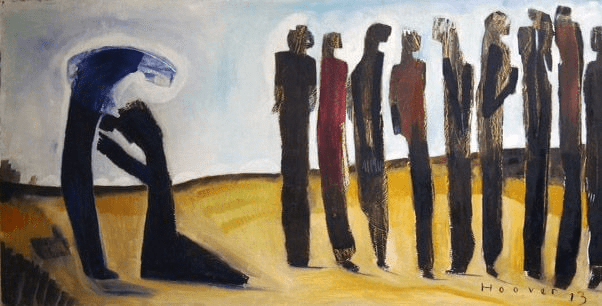
“Your Faith Has Made You Well” (Luke 17:11-19)

Jesus heals ten lepers, with one returning to give him thanks

On the way to Jerusalem Jesus was going through the region between Samaria and Galilee. As he entered a village, ten men with a skin disease approached him. Keeping their distance, they called out, saying, “Jesus, Master, have mercy on us!” When he saw them, he said to them, “Go and show yourselves to the priests.” And as they went, they were made clean. Then one of them, when he saw that he was healed, turned back, praising God with a loud voice. He prostrated himself at Jesus’s feet and thanked him. And he was a Samaritan. Then Jesus asked, “Were not ten made clean? So where are the other nine? Did none of them return to give glory to God except this foreigner?” Then he said to him, “Get up and go on your way; your faith has made you well.” (New Revised Standard Version)

Ten persons seeking healing called out to Jesus. And they got it. Yet, those persons were much more than passive receivers of healing. And Jesus was more than simply a giver.

Even though the lepers had heard about Jesus, they did not personally know him. It seems that – from their perspective – they had a chance encounter with Jesus. When they least expected a healing, a healing happened.

They called out to Christ, recognizing who it was that had entered their village. There was enough faith present for the diseased persons to make themselves known to Jesus – to expectantly put themselves out there and cry out for a healing to happen.

If you think about it, the power of any healing is really in the connection of being seen and heard in crying out to Jesus.

Although the healing of a person can come through a wondrous miracle, healing most often happens by the beautiful act of mutuality and participation. That is, the healer and the one in need of healing encounter each other with the willingness to both give and receive.

It’s in real human connection that healing happens. And it’s more than a physical cure; it’s also a healing reconnection of persons who were once isolated from the community. In other words, the healed person no longer needs to be on the outside of society, but can once again be a full participant in neighborhood and community.

Faith is central to what happens in the healing process. We all have some agency in realizing our own healing. We need not be passive spectators just wishing for things to be different.

Our anxiety and/or discouragement of present circumstances can move to a different place. We can discover relief through participating in social activities, taking walks in nature, and other modes requiring us to actively make a meaningful connection.

It requires faith.

Where faith is present, relational interaction and participation happens. In this context, a healing can occur. Rarely, if ever, does healing happen in complete isolation from others.

The fact that Jesus declared to the cleansed leper, “your faith has made you well,” indicates the mutuality of the healing encounter.

Let’s keep in mind that it takes at least two in order to have a healing: the healer and the healed one. Both participate together in the healing.

What’s more, when Christ heals, he heals without prejudice or favoritism.

In my front yard is a large ash tree with broad and expansive boughs. It is the ultimate shade tree. The tree’s name is Bob (I have a tendency to name trees, especially the ones I enjoy daily). Bob and I share the similarity of being created by the same Creator; and we both glorify God by simply being who we are created to be.

For Bob, he provides shade to people and animals without prejudice or favoritism. Anyone who comes under his great limbs can enjoy his shade. All that is needed for the protective and enjoyable experience of Bob’s boughs is a person under him.

Although it is appropriate to highlight the need for gratitude and praise in today’s story, the narrative itself builds to the climax of faith, of a participatory experience between Jesus and the leper(s).

And it did not matter if the persons healed were lepers, Samaritans, or even miscreants. What mattered was the faith-dialectic of the healer Jesus and the ones to be healed. All may enjoy the grace of divine shade if they move to becoming participants together with Christ by merely coming under his mercy.

I find that many people get hung-up about faith. We often make faith either too simple or too difficult. We create an overly simplistic faith when it becomes a completely passive affair of just waiting on God, or expecting someone else to heal me. We make faith a great difficulty whenever it becomes all about our level or amount of faith through the strenuous effort of intense prayer and contacting umpteen prayer chains.

But more or less prayer, more or less work, more or less of anything misses the point – because even a puny amount of faith will do, if it moves toward Jesus and seeks the participatory experience of a divine/human relation.

There is a cost to healing. It requires participation, relationship, and most of all, the humility to be seen and heard, instead of trying to control some sort of process to get the healing I want.

We call this genuine participation faith.

When the Son of Man comes, will he find faith on the earth? (Luke 18:8)

The only thing that counts is faith expressing itself through love. (Galatians 5:6)

Your faith has made you well. (Luke 17:19)

In your love, O God of all, your people find healing. Grant that the pains of our journey may not obscure the presence of Christ among us, but that we may always give thanks for your healing power as we travel on the way to your kingdom; through Jesus Christ, your Son, our Lord, who with you and the Holy Spirit are one God, now and forever. Amen.

I Want To Know Christ (Philippians 3:7-11)

Jesus Christ and the Apostles, by Nikolas Martínez Ortiz de Zarate (1907-1990)

But whatever were gains to me I now consider loss for the sake of Christ. What is more, I consider everything a loss because of the surpassing worth of knowing Christ Jesus my Lord, for whose sake I have lost all things. I consider them garbage, that I may gain Christ and be found in him, not having a righteousness of my own that comes from the law, but that which is through faith in Christ—the righteousness that comes from God on the basis of faith. 

I want to know Christ—yes, to know the power of his resurrection and participation in his sufferings, becoming like him in his death, and so, somehow, attaining to the resurrection from the dead. (New International Version)

Whenever someone asks me what my favorite portion of Holy Scripture is, I reflexively turn to these verses in our New Testament lesson for today.

I resonate with these words from the Apostle Paul to the Church at Philippi, because they match what I truly believe, and how I really feel about Jesus.

We go through a lot of loss in this earthly life. We experience hardship and adversity. We grieve and lament.

Some of the losses in this life, we are okay with, or at least, we come around to being okay with them after a bit of time. Yet, there are other losses that are heartrending.

On the flipside, there are many gains we experience in this life. Some of them we worked very hard for, and others came to us as gifts.

Oftentimes, our gains and our losses are inextricably bound with each other. Something we consider precious is lost. We may even choose to set aside or give up something we have – we allow it become lost – so that we can gain something even better.

At other times, the process of gaining, losing, then gaining something good was not purposed by us, but by God.

And, to me, that’s probably the best sort of good there is.

Another way of putting the matter is: We must let go and accept how something or someone is, before we can experience what a truly good life really is.

Jesus, by Ghanshyam Gupta

Allow me, or please indulge me, as I frame the Apostle’s words in my own sort of language:

Anything in this life that I have achieved; anything I have come to possess; any sort of position or title I hold or have held; any kind of identification I have, or prestige  I have gained, is of no value. In reality, it’s all rather worthless.

If you will let me take it even further, compared to having an authentic, real, and experiential relationship with Jesus as my Savior, my Lord, and my Friend, everything else is like a bunch of garbage. That’s how much I value Jesus. There’s no other thing, no other relationship, that comes remotely close to knowing Christ.

It isn’t so much that I found Jesus, but that he found me. So, I have a faith that’s got nothing to do with keeping up appearances or rule-keeping, or keeping ahold of anything. I have the life that is truly life.

But, oh my, there is so much more to experience and to know with Jesus! I want to experientially know the power of Christ’s mighty resurrection. I  want to be like him, and participate with him, as if Jesus were living his life through me.

And, I must tell you, I know that this sort of life means suffering. But I also know that this suffering puts me in solidarity with my Lord – which is exactly where I want to be.

I only want to live up to who I’m supposed to be in Christ, to be my true self, and not some faux Christian living according to mere rules and regulations. The only thing that counts to me is faith expressing itself through love.

I understand that I took a lot of liberties with the text, and elaborated on it in order to make it my own. But, truth be told, we all need to find ways to make scripture as our own.

We all must let go of some old ways and unlearn a lot of things, in order to discover new life and be united with Christ. Everyone needs to learn from the past, so that we can live a new life here in the present.

If you don’t like my words, that’s fine. You aren’t under any obligation to read them. Yet, I do believe we have an obligation to Holy Scripture, and specifically, to ingest it as if it were the best meal you’ve ever eaten.

Indeed, we end up experiencing a lot of losses in this life. Yet, with Jesus, we will never lose him, because he will never forsake us. Christ is our eternal gain. He’s alive, always living, so that we need never be concerned about him not existing anymore.

That’s my faith. That’s what I trust in, or rather whom I put my faith in, and my trust upon. It’s all about Jesus. Anything less will not stand the test of time, nor of satisfaction in life.

What will you do with Jesus?

Christ isn’t going to strongarm you into the kingdom of God. But he will doggedly go after you, and be a pester pup in your ears and an ever-present sense in your heart.

You might as well go ahead and consider him, or perhaps reconsider him, like you’ve never done before.

After all, you’ve really got nothing to lose.

We believe in one Lord, Jesus Christ,

the only Son of God,
eternally begotten of the Father,
God from God, Light from Light,
true God from true God,
begotten, not made,
of one being with the Father;
through him all things were made.
For us and for our salvation
he came down from heaven:
was incarnate of the Holy Spirit and the Virgin Mary,
and became truly human.
For our sake he was crucified under Pontius Pilate;
he suffered death and was buried.
On the third day he rose again
in accordance with the Scriptures;
he ascended into heaven
and is seated at the right hand of the Father.
He will come again in glory to judge the living and the dead,
and his kingdom will have no end. – The Nicene Creed, on Jesus Christ

The Need for Partnership and Participation (Malachi 3:5-12)

“So I will come to put you on trial. I will be quick to testify against sorcerers, adulterers and perjurers, against those who defraud laborers of their wages, who oppress the widows and the fatherless, and deprive the foreigners among you of justice, but do not fear me,” says the Lord Almighty.

“I the Lord do not change. So you, the descendants of Jacob, are not destroyed. Ever since the time of your ancestors you have turned away from my decrees and have not kept them. Return to me, and I will return to you,” says the Lord Almighty.

“But you ask, ‘How are we to return?’

“Will a mere mortal rob God? Yet you rob me.

“But you ask, ‘How are we robbing you?’

“In tithes and offerings. You are under a curse—your whole nation—because you are robbing me. Bring the whole tithe into the storehouse, that there may be food in my house. Test me in this,” says the Lord Almighty, “and see if I will not throw open the floodgates of heaven and pour out so much blessing that there will not be room enough to store it. I will prevent pests from devouring your crops, and the vines in your fields will not drop their fruit before it is ripe,” says the Lord Almighty. “Then all the nations will call you blessed, for yours will be a delightful land,” says the Lord Almighty. (New International Version)

Return To God

God and God’s people were at odds with each other. The Lord was weary of the people’s constant complaining. They had a wrongheaded notion that God was absent, just because circumstances were not going their way.

Yet it is important to keep in mind that belief in God’s presence and God’s inherent goodness is absolutely essential to a faithful and good life.

If you think God is absent, then the best place to find God is at the outskirts or margins of a society. The Lord is there to protect the weakest persons and those who have been neglected by others.

The needy in Israel were on the outside without any power or a voice, which is why the prophet Malachi called the people to repentance – to change and amend their ways. They should return to God.

But what does a return to God look like? Since the people generally did not think they were doing anything necessarily wrong, they didn’t have a clue how to do this returning to God. They didn’t have the sense to know they were on the outs with God – which is why the prophet Malachi was speaking to them.

To the people at that time, and practicing the injustice that they were practicing, God responded that they should return by stopping their robbery of God.

Tithes and Offerings

Specifically, the people should reinstate the full mandated practice in the law of tithes and offerings.

Please understand that these tithes and offerings have nothing to do with modern capital fund campaigns for building churches or establishing new ministries. Rather, these words have a specific context that we must pay attention to.

The “tithe” in Israel was the temple tax, paid to the Levites, because this was the tribe of Levi’s only source of income. (Numbers 18:20-30)

An “offering” is a general term, referring to all the sorts of sacrifices offered at the temple as a part of Israelite worship. And once again, the Levites depended upon these offerings in order to eat and live.

Thus, tithes and offerings in Israel had a synergistic purpose of providing the people an opportunity to worship God and center their communal life around the Lord; and also providing for the Levites, so that they could make their living.

And then, the priests who attended to all the temple functions would use funds from the tithes and offerings to help the poor and indigent in the community.

So, a failure to provide tithes and offerings was an injustice, because it was neglecting to care for fellow members of society who needed help.

People could starve and die without practicing God’s law concerning tithes and offerings. And that is why it angered God so much whenever people reneged on their duty toward the temple practices.

Cooperation, Not Competition

Therefore, repentance and returning to God would happen only when the priests and the people cooperated together. Then, God’s faithfulness could be made effective and manifest itself among the entire social structure of Israel.

The entire society was built upon a divine/human cooperative. It required both human action and divine blessing working together.

None of this was a contract or a deal in which people do the right thing, and then God automatically blesses, like some divine slot machine that persons put coins into.

Instead, it is a system in which the laity work together with the clergy; and then all the people work together with God. In other words, God’s ideal is partnership and participation.

God will bring a great produce. But the people would have to do the hard work of planting and harvesting the crops. This is very far from any sort of name-it-and-claim-it theology in which a person prays for whatever they want and God will give it to them. That is not how an abundant life is produced.

Abundance comes wherever there are partners who participate with each other. If that system breaks down, then people are in a world of trouble.

So, people must take the social justice of God quite seriously – with its specific requirements about caring for one another.

Although we may not have the same particular system of Levites and a Temple, God’s heart for justice, for people’s basic needs to be met and satisfied, has never changed. That value still stands the test of time throughout all of human history.

Almighty God, who created us in your own image: Grant us grace to fearlessly contend against evil, and to make no peace with oppression. Enable us to reverently use our freedom, in the establishment and maintenance of justice in our communities and among the nations, to the glory of your holy Name. Amen.

Living Bread from Heaven (John 6:51-58)

Art by Nigel Wynter (1957-2024)

I am the living bread that came down from heaven. Whoever eats of this bread will live forever, and the bread that I will give for the life of the world is my flesh.”

The Jews then disputed among themselves, saying, “How can this man give us his flesh to eat?” 

So Jesus said to them, “Very truly, I tell you, unless you eat the flesh of the Son of Man and drink his blood, you have no life in you. Those who eat my flesh and drink my blood have eternal life, and I will raise them up on the last day, for my flesh is true food, and my blood is true drink. Those who eat my flesh and drink my blood abide in me and I in them. Just as the living Father sent me and I live because of the Father, so whoever eats me will live because of me. This is the bread that came down from heaven, not like that which the ancestors ate, and they died. But the one who eats this bread will live forever.” (New Revised Standard Version)

To the religious leaders of Christ’s day, Jesus was making more noise than a couple of skeletons dancing on a tin roof. And they neither liked it, nor appreciated him drawing so much attention to himself.

Tensions had been escalating between Jesus and the religious establishment. The atmosphere was thick with grumbling leaders, as they tried to make some sense of Christ’s words to them.

Jesus offering his body for people to eat was causing far too much noise for the Jewish leaders. What in the world is this guy talking about?

Rather than making the meaning clear for them, Jesus added drinking his blood to the discussion. What’s more, Christ got up in their grill and confronted them with a choice, instead of a straightforward explanation.

Using some good old double negative language, Jesus flatly stated that there’s no life without any eating of his flesh and drinking of his blood. Then conversely, stated positively, Jesus affirmed that eternal life is found in those who eat his flesh and drink his blood.

This was next level communication of Jesus to the religious leaders. Earlier, Christ let them know that they needed to make the choice of coming to himself, of engaging in a life-giving relationship with him.

Yet now, it’s a matter of outright participation in Jesus, of eating and drinking the body and blood of Christ. Both the choice of relationship and of participation are radical decisions, which requires ditching some old traditions, and beginning some new ones.

Christ’s words are difficult, because they demand a change in thinking and behavior. Indeed, his words demand a change in our very way of being.

Christian discipleship requires that we stop the false ways of being in this world, and start a different way of being, according to the true self. In other words, Jesus was insisting on repentance and faith.

We are all on the hook to not just talk some theology and take some communion elements. It’s a lot more involved than that. Jesus demands our very lives, and not simply to sign off on some doctrinal statement about him. It’s about life itself, the power of life and death.

By eating and drinking Christ, there is meaningful relational connection, and ongoing participation in his life and ministry.

None of this is about literal cannibalism, and not even about actual bread and wine. This is deep metaphorical stuff which is meant to convey to us who Jesus is and how we can be related to him.

When we ingest food and drink, it goes into us and throughout our entire body. You cannot get much closer to something than by eating it and having it inside you. Just as eating bread goes to our very core and helps sustain life, so ingestingJesus is about allowing him to be as close to us as possible, into the very depths of our soul.

And by taking Christ into us, we will truly live and connect; and not be separated and die.

Art by Soiche Watanabe

We can no more spiritually live without taking Jesus into us, as we could live without eating on a regular basis. Christ is our breakfast, lunch, and dinner; our midnight snack and our birthday cake. Jesus is all that, and more.

Perhaps you are wondering why Jesus didn’t just state plainly who he is, why he came, and what will happen. Because it’s too much to handle.

We don’t simply accept Jesus into our heart, and then go on our merry way. Jesus Christ is someone to search for and discover, as if we were looking for fresh water or for the best baguette in the world.

Anyone can affirm a few belief statements, or do some good deeds. But it takes real courage to go hard after the spiritual life and find out what it’s all about:

It requires some solid bravery to explore the depths of your own true self and face the internal crud that’s been hiding in the shadows of your soul.

It demands identifying the bogus ways we prop up a false self for others to see – wanting to control how people view us and treat us.

It takes some real chutzpah to pursue the God life without worrying about where it will take you or who it will upset.

Jesus is a force to contend with. He is the Son of God, sent from above, to provide the world with real spiritual food and drink. Christ is the one who sustains life, and makes abundance possible. He is the Lord who speaks, calls out, and draws us to himself.

Jesus Christ helps us fit, even though we come from the island of misfit toys.

Even more pertinent than the question of “Who is Jesus?” is the probing question, “And what will you do with him?”

Christ cannot fit into your neat theological system, your tidy doctrinal statements, and on your nicely cleaned coffee table within the attractive Bible. Sooner or later, we all must contend with the divine force which gives life to everything. We cannot get away from him.

So, go after Jesus. Find out who he is. Determine how to deal with a mercy so powerful that it melts away guilt and shame as if it were in a 500 degree oven. After all, it’s better to have a tasty loaf of bread than to become a hard slice of burnt toast.

But let’s not worry about how hot it is in here, but how noisy it’s getting.

Gracious Lord, move us, your people, to experience your love more deeply. Fill us with the energy that comes from a desire for service. Connect us with creation to care for your world. Engage us in the scriptures and increase our knowledge of you. Raise up your power and come among us. May your bountiful grace and mercy equip us. Amen.