Romans 2:1-11 – Against Condemning Others

You, therefore, have no excuse, you who pass judgment on someone else, for at whatever point you judge another, you are condemning yourself, because you who pass judgment do the same things. Now we know that God’s judgment against those who do such things is based on truth. So, when you, a mere human being, pass judgment on them and yet do the same things, do you think you will escape God’s judgment? Or do you show contempt for the riches of his kindness, forbearance, and patience, not realizing that God’s kindness is intended to lead you to repentance?

But because of your stubbornness and your unrepentant heart, you are storing up wrath against yourself for the day of God’s wrath, when his righteous judgment will be revealed. God “will repay each person according to what they have done.” To those who by persistence in doing good seek glory, honor, and immortality, he will give eternal life. But for those who are self-seeking and who reject the truth and follow evil, there will be wrath and anger. There will be trouble and distress for every human being who does evil: first for the Jew, then for the Gentile; but glory, honor and peace for everyone who does good: first for the Jew, then for the Gentile. For God does not show favoritism. (NIV)

The Apostle Paul, writing to the Church at Rome, merely upheld the teaching of his Lord Jesus, who said:

“Do not judge, so that you may not be judged. For with the judgment you make you will be judged, and the measure you give will be the measure you get.” (Matthew 7:1-2, NRSV)

Although most people would affirm that showing favoritism is a bad thing, in practice we have a difficult time avoiding it – especially in an election season, like the one in the United States. Political mudslinging is (unfortunately) a time-honored American tradition. And so is religious judgmentalism.

Some of the most emotionally laden vitriol comes from folks who are so heavily entrenched in their religious convictions that they believe any deviation from their way of belief is worthy of scathing criticism.

People, however, do not change because someone criticizes or judges them. They experience transformation through basic divine and human kindness. As a hospital chaplain in a behavioral health unit, I affirm this to be true. Many patients have been told repeatedly by family or friends to stop doing something, get with it, move on, wake up, etc. – all with the condescending edge of judgment. Yet, when someone takes notice, is curious about them, offers helpful encouragement and a listening ear without trying to fix, souls become open to receiving the healing grace of love and truth.

God shows no partiality, and neither should we. God is right, just, and fair in all dealings with everyone. The Lord judges according to divine standards of righteousness and mercy, no matter one’s race, ethnicity, gender, economic status, or social standing. And it is all laced with the love and compassion of Christ.

Christians are not exempt or given a pass on being judgmental. Our own unhealthy practices, bad habits, and angry outbursts will be treated just like any non-Christian by God. In a time when decrying the moral condition of our world is nearly a spectator sport, the New Testament lesson for today reminds us that we must first be concerned for the condition of our own hearts before we can point the finger at another.

We all equally stand in need of God’s grace in Jesus.  There is a symbiotic relationship between our actions and the state of our hearts.  A soft and tender heart toward God leads to obedience; disobedience hardens the heart and leads to God’s wrath, no matter the individual.

So, it will help if we all faithfully engage in daily spiritual practices which keep our hearts attentive and alert to God’s will and way.  No matter how busy we are, or how we feel, to forego or ignore the Word of God and prayer on a regular basis will slowly calcify our hearts and render them unable to respond rightly to grace.  Instead, we can drink deeply of the gospel throughout every day so that we may experience peace.

Judgmentalism, favoritism, and cronyism all begin to melt away when we pick up the tools of empathy, compassion, understanding, and acceptance – using them to forge connections and supportive encouragement. It takes little to no practice to bludgeon someone with condemning criticism. However, it takes repeated practice to speak and act with grace, mercy, and peace, especially when we are stressed and/or anxious about our surrounding circumstances.

Instead of judgment, observe and be curious. Seek more information. Expand the gap between observation and conclusion. The ability to have an awareness of one’s own emotions, to be mindful of self and surroundings, and to do it all with neither criticism nor judgment is perhaps the highest form of intelligence and spirituality.

It is kindness which leads others to repentance, not condemnation. Grace has the final word, not judgment. So, let us be blessed through a gentle spirit which spreads the goodness of God throughout the world.

O God, thank you for the gift of prayer and the grace of your Word.  May it seep deep down into my heart so that I am compassionate and kind, just like Jesus.  Amen.

James 2:8-13 – On Mercy and Against Favoritism

“Benevolent Mercy” by Iowa artist William Butler

If you really keep the royal law found in Scripture, “Love your neighbor as yourself,” you are doing right. But if you show favoritism, you sin and are convicted by the law as lawbreakers. For whoever keeps the whole law and yet stumbles at just one point is guilty of breaking all of it. For he who said, “You shall not commit adultery,” also said, “You shall not murder.” If you do not commit adultery but do commit murder, you have become a lawbreaker.

Speak and act as those who are going to be judged by the law that gives freedom, because judgment without mercy will be shown to anyone who has not been merciful. Mercy triumphs over judgment. (NIV)

One of my bedrock foundational unshakable beliefs is that God’s big world spins on the axis of grace. Without grace we would all be living in some nightmarish dystopian novel just trying to survive. Grace is the force which overwhelms and overcomes everything. 

When I was growing up, we had a dog named Sam. Sam loved being on the farm. More than once he tussled with a skunk. In those times, I could barely get close enough to clean him up because he stunk so badly.  Favoritism stinks, and God has a hard time getting close to us when we show partiality to others. God is going to clean us up when smelling the stench of discrimination on us.

Showing favoritism to some over others is evidence the dog is running away from the bath of grace. To develop relationships and interact with people the way God wants us to, we must be free from prejudice. Favoring the rich over the poor stinks because God cares about those trapped in poverty. When Jesus began his ministry, he lifted-up the importance of poor folk by placing himself in the position of extending grace to them:

The Spirit of the Sovereign Lord is on me, because the Lord has anointed me to proclaim good news to the poor. (Isaiah 61:1; Luke 4:18, NIV)

In the Old Testament, there are seven different words for the “poor” because poverty was a pervasive reality (and still is!). The various reasons for poverty range from being born into poverty, being lazy, or being oppressed and/or in slavery. The types of poor persons run the gamut from simple beggars to the pious and humble poor.  These spiritual poor persons were called in biblical times the anawim” (Hebrew עֲנָוִ֣ים). The anawim are humble and gentle folk caught in grinding poverty with no other option but to put their trust in God.

The mistreatment, exploitation, and inattention to the needs of the poor are a chief reason why Holy Scripture is filled with references about how to treat them. The anawim are dear and near to the heart of God:

“Poor persons will never disappear from the earth. That’s why I’m giving you this command: you must open your hand generously to your fellow Israelites, to the needy among you, and to the poor who live with you in your land.” (Deuteronomy 15:11, CEB)

“If you hire poor people to work for you, don’t hold back their pay whether they are Israelites or foreigners who live in your town. Pay them their wages at the end of each day because they live in poverty and need the money to survive. If you do not pay them on time, they will complain about you to the Lord, and he will punish you.” (Deuteronomy 24:14-15, CEV)

Listen to this, you who rob the poor
    and trample down the needy!
You can’t wait for the Sabbath day to be over
    and the religious festivals to end
    so you can get back to cheating the helpless.
You measure out grain with dishonest measures
    and cheat the buyer with dishonest scales.
And you mix the grain you sell
    with chaff swept from the floor.
Then you enslave poor people
    for one piece of silver or a pair of sandals.

Now the Lord has sworn this oath
    by his own name, the Pride of Israel:
“I will never forget
    the wicked things you have done!” (Amos 8:4-7, NLT)

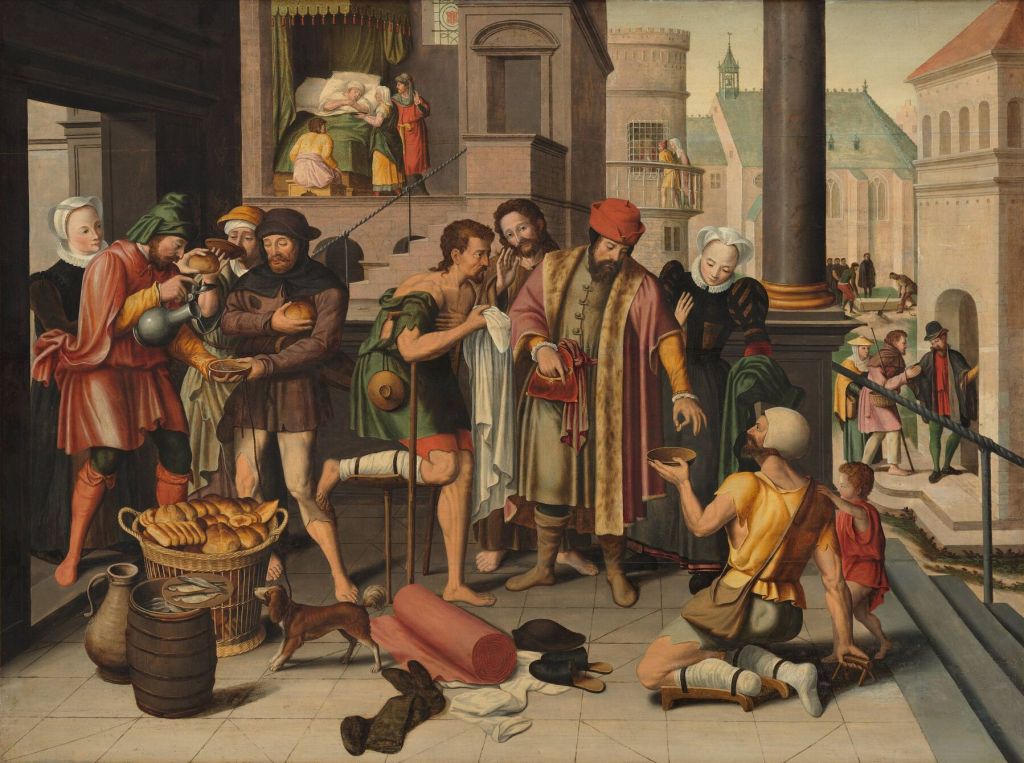
The Seven Corporal Works of Mercy by Unknown Dutch artist, 1580.

Nothing gets God’s hackles up more than unjust and unfair favoritism which is devoid of mercy and grace toward the poor. It all stinks to high heaven, and when God smells it, divine egalitarian power is not far behind.

It is the poor in spirit with no trust in stuff and ingenuity who will enter the kingdom of heaven. The humble person gives grace to another even though the person cannot offer something in return. It is easy to be merciful to people who have a deal with you about scratching each other’s backs. However, it is altogether a different thing to be gracious simply because it is the right thing to do and pleases the heart of God. 

God cares about the condition of our souls and not the balance of our bank accounts. Inattention to the poor and needy only betrays a heart of unjust favoritism – a materialistic heart full of greed. A 2012 Boston Globe article asked the following question: Does money change you?

The Globe article stated, “most people are convinced that gaining a lot of money … wouldn’t change who they are as people. Yet, a mounting body of research is showing, wealth can actually change how we think and behave—and not for the better. Rich people have a harder time connecting with others, showing less empathy to the extent of dehumanizing those who are different from them. They are less charitable and generous. They are less likely to help someone in trouble. And they are more likely to defend an unfair status quo. If you think you would behave differently in their place, meanwhile, you are probably wrong: These are not just inherited traits but developed ones. Money, in other words, changes who you are.”

The University of Minnesota’s Carlson School of Management found in their research that even the mere suggestion of getting more money makes people less friendly, less sensitive to others, and more likely to view some groups of people as inferior to others.  Another series of studies from the University of California at Berkley concluded that wealthier people tend to be less compassionate toward others in a bad situation than people from lower-class backgrounds. Their research concluded, “If you win the lottery and you want to avoid becoming an insensitive jerk, there is a simple solution: Give at least half the money away.” 

Some poor people, as in the days of the Apostle James, are willing to put up with being treated unfairly so they might get a piece of the rich person’s pie. Favoritism ignores the sin in others to gain something from them. God says that is stinking thinking.

Favoritism is flat out a violation of God’s law. The entire law is summed up in two commands: Love God and love neighbor. Favoritism violates our neighbor, and therefore, is sinful disobedience of God. Any needy human we encounter is our neighbor – no matter their social or economic status, their ethnicity, race, gender, or anything that identifies them as different. They are to be helped when we can do so.

We are to speak and act with mercy because we will eventually have to face the Judge. God is always watching us – every word and every action. Judge Jesus will respond to how we have treated each person we encountered and how we talked about other people when they were not around. We will all appear before Christ at the end of the age and must give an account of ourselves. (2 Corinthians 5:10)

Words are important, so they ought to be full of grace, seasoned with salt. Showing mercy instead of favoritism is the way love expresses itself.  Mercy is best given when we have first received it ourselves from God. A heart touched by the grace of the Lord Jesus is one which will stand in the judgment.

We rid ourselves of favoritism’s stench through the cleansing bath of God’s mercy in Jesus Christ.  There is grace available if we will receive it. God is the expert in transforming lives, renewing minds, and putting to death the pride of favoritism. The work is done with needed grace and compassionate mercy.

So, we are to make it our goal to be a grace-givers, to have willing hearts which seek to emulate the mercy of Christ. The bath of mercy and grace takes away the stank of prideful favoritism and leaves us with the sweet aroma of love, justice, peace, and joy in the Holy Spirit.

May it be so to the glory of God.