First Sunday of Advent – The Paradoxical Christ (Luke 21:25-36)

Christ Among the Doctors, by Paolo Veronese, c.1560

“There will be signs in the sun, the moon, and the stars and on the earth distress among nations confused by the roaring of the sea and the waves. People will faint from fear and foreboding of what is coming upon the world, for the powers of the heavens will be shaken. Then they will see ‘the Son of Man coming in a cloud’ with power and great glory. Now when these things begin to take place, stand up and raise your heads, because your redemption is drawing near.”

Then he told them a parable: “Look at the fig tree and all the trees; as soon as they sprout leaves you can see for yourselves and know that summer is already near. So also, when you see these things taking place, you know that the kingdom of God is near. Truly I tell you, this generation will not pass away until all things have taken place. Heaven and earth will pass away, but my words will not pass away.

“Be on guard so that your hearts are not weighed down with dissipation and drunkenness and the worries of this life and that day does not catch you unexpectedly, like a trap. For it will come upon all who live on the face of the whole earth. Be alert at all times, praying that you may have the strength to escape all these things that will take place and to stand before the Son of Man.” (New Revised Standard Version)

Do we understand the dire situation of humanity? Is there comprehension of the sinister road that many choose to walk? Or are we cut off from ourselves, fragmented and unable (or unwilling) to participate in becoming people who are wise and seek what is just?

Perhaps we are adrift, lost in our own hubris, believing that our beliefs and opinions are so right as to either force them on others; or either live and let live, as if nothing bad will ever happen.

But the Son of Man is coming. He has a lesson for us from a tree; and an exhortation to beware.

I just hope it’s not too late for many of us.

Today’s Gospel lesson is part of a longer discourse by Jesus, warning about coming persecution and impending destruction of the Temple. It’s apocalyptic stuff about famine, war, judgment, with exhortations in the midst of suffering.

This is how we are beginning the new Christian Year, and season of Advent. Dealing with judgment and cosmic cataclysm may seem out of sync with the month of December.

Advent helps us prepare our hearts in anticipation of Christ’s birth. It’s actually one of the best times to remember that just as Jesus came as a child in his first advent, a second advent is yet to come, in which Jesus returns as the judge.

The Coming of the Son of Man

The season of Advent, and Jesus himself, are paradoxical. In my estimation, all of Christianity is inherently paradoxical. A paradox brings two contrasting truths or images together. Jesus is God. Jesus is human. Both are true. Jesus is a paradox. Jesus came. Jesus is coming. His advent is a paradox.

Jesus and his teaching may seem self-contradictory. But it nonetheless shows us truth. That’s what a paradox does. It expresses things like Jesus being both a baby and a savior, an infant and a king, a servant and a sovereign.

Christ brings peace. And Christ brings division. To keep your life, you must lose it. In order to be first, you must be last.

The Lesson of the Tree

Trees are some of our greatest teachers, that is, if we will but listen to them and observe them. The tree teaches us the paradox that with the changing of the leaves, death can be beautiful. In using the tree’s wood, we learn there is new life through destruction.

The dormancy of the tree in winter appears as if it will last forever. Yet, when Spring arrives, we discover that the bare branches and lifelessness is temporary, not permanent. The tree blossoms, almost exploding with life and color.

Our earthly trials and tribulations will not last. God will vindicate the righteous. Redemption is near. There is the paradox of suffering that leads to glory, and tears which will give way to great comfort.

The Exhortation to Watch

But we must watch. Jesus tells us to beware. With paradox, and in the apocalyptic view of things, events that happen on this earth that we see are mere reflections of much greater workings on an unseen plane of existence.

Paradoxically, the struggle between good and evil is both earthly and celestial; it is playing out on multi-dimensional levels. There is always more going on than what meets the eye. Therefore, watch out, because you do not really know what’s happening unless you’re looking with both physical and spiritual eyes.

So, stay awake. Pay attention. Be prepared. Keep awareness of yourself and your situations.

As we move into the busyness and bustle of this month, let us not overprepare for something transitory and impermanent. Let’s remember to use our vision to see a large and expansive world in need of the paradoxical Christ.

If you are reading this, or listening to this, then there is hope. This present existence is not permanent; it won’t last forever.

For what is at stake is the coming of the kingdom of heaven, a realm of existence that is both already here, and not yet here. In allowing such a rule to come and take over our lives, we find freedom and peace and permanence.

Tying our hopes to earthly rulers and all of their construction of petty kingdoms and fiefdoms will only end in darkness and disappointment.

The Servant King, who rules through loving service, is coming. And the Universal Judge, who controls all things with a powerful gracious force, is also coming.

The paradoxical Jesus was here, is here, and is to come.

Almighty God, give us grace that we may cast away the works of darkness, and put on the armor of light, now in the time of this mortal life, in which your Son Jesus Christ came to visit us in great humility; that in the last day, when he shall come again in his glorious Majesty, to judge both the living and the dead, we may rise to life immortal; through him who lives and reigns with you and the Holy Spirit, now and forever. Amen.

Nothing Makes Sense (Ecclesiastes 1:1-18)

Statue of “The Thinker,” by Auguste Rodin, 1880. Photo by Robert Reynolds.

When the son of David was king in Jerusalem, he was known to be very wise, and he said:

Nothing makes sense!
Everything is nonsense.
    I have seen it all—
    nothing makes sense!
What is there to show
for all of our hard work
    here on this earth?
People come, and people go,
but still the world
    never changes.

The sun comes up,
    the sun goes down;
it hurries right back
    to where it started from.
The wind blows south,
    the wind blows north;
round and round it blows
    over and over again.
All rivers empty into the sea,
    but it never spills over;
one by one the rivers return
    to their source.

All of life is far more boring
    than words could ever say.
Our eyes and our ears
are never satisfied
    with what we see and hear.
Everything that happens
    has happened before;
nothing is new,
    nothing under the sun.
Someone might say,
    “Here is something new!”
But it happened before,
    long before we were born.
No one who lived in the past
    is remembered anymore,
and everyone yet to be born
    will be forgotten too.

I said these things when I lived in Jerusalem as king of Israel. With all my wisdom I tried to understand everything that happens here on earth. And God has made this so hard for us humans to do. I have seen it all, and everything is just as senseless as chasing the wind.

If something is crooked,
    it can’t be made straight;
if something isn’t there,
    it can’t be counted.

I said to myself, “You are by far the wisest person who has ever lived in Jerusalem. You are eager to learn, and you have learned a lot.” Then I decided to find out all I could about wisdom and foolishness. Soon I realized that this too was as senseless as chasing the wind.

The more you know,
    the more you hurt;
the more you understand,
    the more you suffer. (Contemporary English Version)

There’s an awful lot of nonsense in this old world. Arguably, the wisest person who ever lived, King Solomon, said that everything is nonsense, and all things are meaningless.

That’s probably why the Book of Ecclesiastes isn’t at the top of most people’s reading list. Admittedly, in many ways, it’s a depressing read.

Yet, maybe we are being led to consider that it really isn’t our task or purpose to understand everything in this world. After all, if a wise guy like Solomon didn’t make heads nor tails of it all, why in tarnation would you or I try to do so?

This doesn’t mean we don’t understand anything; it just means that we don’t have the ultimate answers on the universe’s workings. And if we try to have perfect knowledge of all things, it will be a fool’s errand. That’s because only God has ultimate understanding and perfect knowledge of everything and everyone.

So then, what do we do? Glad you asked. We accept our limitations, and thereby, it is likely we will gain more understanding than any other way we try.

Meister Eckhart, a medieval Catholic monk, had some sage observations in this short poem:

What is the prayer

of a heart loosed

from all the things

that crowd our lives

and worry our minds

from day to day?

it is coming to that

place within us where

not knowing is the

mark of faith,

not wanting

the work of hope,

and not demanding

the gift of love.

Meister Eckhart talked of acceptance, and letting go of expectations. Learning to allow things to go as they will go, to be okay with not always having to have answers for everything, and refusing to control people and outcomes, is not only the path to acceptance, but is also the way of peace and less anxiety.

Likely, the best that we can do every day is to show up, pay attention, speak the truth in love, and don’t be married to the consequences.

If we can accept our limitations and weaknesses, and embrace the mysteries of life, then a whole world of discernment and wisdom can open to us within the narrow scope of our very mortal lives.

Indeed, we can find a sense of satisfaction and happiness in who we are, and what our place is in this very big world. Yet, this only comes with some significant struggle. Taking the easy path only results in cheap counterfeit contentment.

We will need to become comfortable with mystery and paradox, the knowledge that comes with not knowing, and upside-down theology. These are our keys to the secrets of life.

We must rid ourselves of the idea that Scripture is merely a life map that shows how and where to live. Holy Scripture may be a map, yet, it will point us in directions we may not want to go; and may even tell us to be in two places at once.

To try and make the Bible neat and tidy, with clear answers to modern day questions, is probably why such persons avoid the Book of Ecclesiastes as if it were the plague.

In reality, Ecclesiastes is a book that stands the orderly nature of life on its end. It is the scriptural place where playing by the rules and believing the right things won’t give you the good life you’re searching for.

Eventually, everyone encounters a dark night of the soul in which the death of a loved one, a failed relationship, or the loss of health turns our neatly ordered world upside-down to the point where we don’t recognize who we are, or what the world really is anymore.

These are times when our platitudes of simple faith are impotent to help us. Trust and belief are still important and vital, but they are no longer as understandable and intelligible as they once were.

It is imperative in these times that we doubt and question things; and even question God. A genuine robust faith is one that has been gained by plodding through the muck of anger, and even depression.

Authentic belief is neither cheap nor easy. It engages more than a few mental thoughts; it also goes to the heart and the gut, often with heart-rending emotions and gut-wrenching insights.

The Book of Ecclesiastes is a book for all of us. But it must not be read lightly nor flippantly. It’s contents need to be grappled with. Simply reading the last page of the book and making a faith declaration from that place will not only get you nowhere, it is also potentially damaging.

Only engage this material if you are brave enough, have some chutzpah within you, and are willing to reconsider and perhaps let go of all previous settled ideas about how the world is, or at least, how it should work.

So, if you want some quick answers to life’s meaning and purpose, Ecclesiastes is not the place to look. There are plenty of charlatans out there who would be happy to give you such information.

But if you are searching for something real and authentic, genuine and lasting, then be prepared for a tough, yet fruitful, slog through the “meaningless” meanderings of Ecclesiastes.

Only the courageous and the vulnerable should enter.

O God, I am very sorry that I have sinned against you and for all the wrongs I have done and the good I have not done. Forgive me, and grant me strength and wisdom to amend my life.

I offer you praise and thanksgiving, for creation and all the blessings of this life, for redemption, faith, and love; and for the means of grace and the hope of glory. Amen.

Learn a Lesson from Conflict (2 Samuel 10:13-19)

David Attacks the Ammonites, by Gustave Doré, 1866

Then Joab and the troops with him advanced to fight the Arameans, and they fled before him. When the Ammonites realized that the Arameans were fleeing, they fled before Abishai and went inside the city. So Joab returned from fighting the Ammonites and came to Jerusalem.

After the Arameans saw that they had been routed by Israel, they regrouped. Hadadezer had Arameans brought from beyond the Euphrates River; they went to Helam, with Shobak the commander of Hadadezer’s army leading them.

When David was told of this, he gathered all Israel, crossed the Jordan and went to Helam. The Arameans formed their battle lines to meet David and fought against him. But they fled before Israel, and David killed seven hundred of their charioteers and forty thousand of their foot soldiers. He also struck down Shobak the commander of their army, and he died there. When all the kings who were vassals of Hadadezer saw that they had been routed by Israel, they made peace with the Israelites and became subject to them.

So the Arameans were afraid to help the Ammonites anymore. (New International Version)

Outward Conflict with Ammon

You would think that showing basic human kindness to another would always end well… Yet, not always. And King David found that out, the hard way.

David, having become king of Judah and Israel, demonstrated that his reign would be characterized by extending the sort of mercy and kindness that is characteristic of God.

Whereas David’s kindness was most often accepted, when it came to King Hanun and the Ammonites, it was misunderstood and rejected. The Ammonites humiliated King David’s sent ambassadors.

The delegation wanted to express David’s condolences to Hanun in the event of his father’s death. Then, after the Ammonites saw that King David was upset about how his ambassadors were treated, they mobilized a mercenary force of Arameans with Hadadezer leading the charge.

Both the Ammonites and the Arameans underestimated the experience and skill of the Israelite army under their commander Joab. Even though Joab was outnumbered, he conceived of a strategy that evened the odds.

All of this conflict, with preparations for battle and an escalating war, came about because a king wanted to show kindness to another. Indeed, this can be a very messed-up world that we inhabit!

The result of it all is that the Ammonites and the Arameans were soundly defeated by a smaller, yet much stronger, army with King David at the head. The Arameans became subject to Israel, and the Ammonites were left slack-jawed, not knowing what hit them.

Inner Conflict with Oneself

So, here we have David, who like all of us, is a bundle of contradictions. On the one hand, King David had his heart set on showing kindness and reflecting the heart of God in his rule and reign. And on the other hand, David is a soldier and a man of blood, who does an awful lot of killing people in his lifetime.

King David is both a paragon of moral behavior, and an example of immoral living.

He did not lift a finger against his former king who was trying to kill him; and evidenced a tender spirit through musical skill and an ability to write the psalms and songs of Israel.

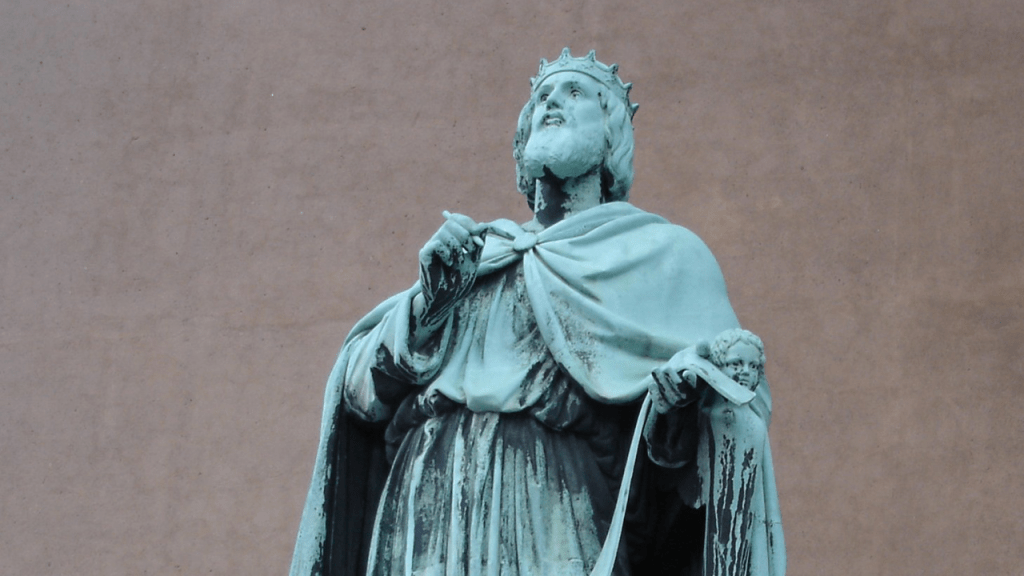
Statue of King David, Copenhagen, Denmark

Yet also, King David demonstrated for us some of the worst immorality, of which is clearly seen in the next few chapters of his story in the book of 2 Samuel. Throughout David’s adult life, he took thousands of human lives in battle.

He came to fame by beheading Goliath; made his mark in Israel by killing Philistines for King Saul; survived in the wilderness while Saul was trying to kill him by killing Amalekites; and secured Israel’s borders through an enormous amount of killing.

I won’t do to simply say that the people David killed had it coming to them, or that he did all the things he did for the sake of the nation. That sort of reductionism smacks of mental laziness and purposeful ignorance.

Coming to Grips with Conflict

At the least, it seems to me that we must accept the biblical narratives as they are, and not as we want them to be, whenever there is difficulty in understanding a story.

We have the human condition in front of us every time we read a scriptural story. Either making it all good, or all bad, just won’t do – because all of us, like David, are a bundle of contradictions and paradoxes that often don’t make sense.

It turns out that, throughout Holy Scripture, we find stories of people who are no better and no worse than we ourselves. The ancient persons, like David, are those for whom a gracious God chose to use and work through – despite either their sinning or their saintliness.

We get a glimpse of how things were and how the Lord operated through the people of the time in their own political, social, economic, and religious contexts.

God comes to us, not merely from the outside by simply mandating commands and imposing control, but enters our lives on the inside, taking us as we are and graciously working with and within us to accomplish good and just purposes on this earth.

And, as it turns out, God uses whomever God wants to use, without doing some sort of divine screening interviews to find out who the most moral candidate is available for the job.

If you are looking for a bottom line in all of this mayhem, then I believe it is this: God loves us. God is with us. And God holds us – all of us, with our maddening combinations of kindness and kookiness – to establish a truly right and benevolent world characterized by humility, gentleness, mercy, purity, and peace.

It’s a rather long and messy process of bringing in such a way of life, but God is patient and will take the centuries and even the millennia needed to accomplish it.

It’s Not All About Human Conflict

Although we are a flawed and fallible people, we are nevertheless God’s people. At the end of it all, we discover that none of this was really a story about Ammonites or Israelites or David or Joab or anyone else; it is actually a story about God – because God is both the object and subject of every biblical narrative.

And what we discover about God is that there are divine initiatives happening all the time which are meant to help us and save us from ourselves. The Lord is sovereign over all creation, and brings salvation despite what we do or don’t do.

God’s kindness – shown and expressed through our own human kindness – will eventually and always win the day.

Almighty and everlasting God, whose will it is to restore all things in your well beloved Son, the King of kings and Lord of lords: Mercifully grant that the peoples of the earth, divided and enslaved by sin, may be freed and brought together under his most gracious rule; who lives and reigns with you and the Holy Spirit, one God, now and forever. Amen.

Where Is God in My Suffering? (Psalm 22:23-31)

“Praise him, you servants of the Lord!
    Honor him, you descendants of Jacob!
    Worship him, you people of Israel!
He does not neglect the poor or ignore their suffering;
    he does not turn away from them,
    but answers when they call for help.”

In the full assembly I will praise you for what you have done;
    in the presence of those who worship you
    I will offer the sacrifices I promised.
The poor will eat as much as they want;
    those who come to the Lord will praise him.
May they prosper forever!

All nations will remember the Lord.
    From every part of the world they will turn to him;
    all races will worship him.
The Lord is king,
    and he rules the nations.

All proud people will bow down to him;
    all mortals will bow down before him.
Future generations will serve him;
    they will speak of the Lord to the coming generation.
People not yet born will be told:
    “The Lord saved his people.” (Good News Translation)

I find that a great deal of truth and reality in this world is something of a mystery and a paradox. Christianity, especially, is a religion of paradox, in my opinion. For example, God is Three – Father, Son, and Spirit – but God is One. Jesus Christ is fully human and fully divine, at the same time, all the time. And when it comes to the spiritual life, suffering exists, and God is sovereign and in control of all things.

This then, is what prompts many people to question if there is really a God – since so much suffering exists throughout the world. Yet, it’s necessary to maintain the tension that hard circumstances, adversity, and difficulty in the form of awful suffering, and the preeminence of the Lord God almighty, both exist without taking anything away from either of them.

The severity of suffering, nor the supreme majesty of God, need to be watered down in any way in order to try and make sense of our existential situations.

“Suffering” is a word we would like to avoid. Even saying or reading the word might make some folks cringe. Suffering? No thanks. I think I’ll pass on that. Yet, something inside of us instinctively knows we cannot get around it. Everyone suffers in some way. It is endemic to the human condition that at times we will suffer physically, financially, mentally, emotionally, and spiritually. 

That’s why I believe there is so much talk within some Christian circles about miracles. It’s more than understandable:

  • a chronic pain sufferer wants relief, so she prays for a miracle of health
  • a small business owner is bleeding financially, and looks to God for an immediate miracle of wealthy clients
  • a beloved senior saint knows she is afflicted with Alzheimer’s, so she prays for the miracle of deliverance, even to be taken home to be with the Lord
  • a young adult finds himself in the throes of depression and has tried everything to cope and get out of it, so he petitions God for a miracle out of the deep black hole
  • a believer in Jesus keeps experiencing a besetting sin and cannot get over it, so she looks to God for the miracle of not struggling any more with it

These scenarios and a thousand other maladies afflict people everywhere. There are a multitude of stories out there. Folks who have experienced a miracle tell of their wonderful deliverance. But what about the rest? Those without the miracle? Do they have a lack of faith? Has God forgotten them?

Oh, my, no! God sees, and God knows. God is acquainted with suffering. Jesus knows it first-hand. Remember that it was Jesus who said, “My God, my God, why have you forsaken me?” (Psalm 22:1; Mark 15:34; Matthew 27:46)

Even Jesus cried out in his suffering. But there was no deliverance coming for him.  There was, however, deliverance coming for us.

Sometimes the greatest miracle and deliverance of all is to be freed from the need for a miracle. The reason God doesn’t just offer immediate relief from everyone’s suffering and bring a divine miracle is that the Lord is doing something else: Walking with us through our suffering. God oftentimes has plans and purposes for us that are well beyond our understanding. 

We simply are not privy to everything in God’s mind.

We may not get the miracle we desire. Yet, what we will get without fail, is God’s provision and steadfast love all the way through the suffering.

Where is God in your suffering? Right beside you. Jesus is suffering with you. You are not crying alone; Christ weeps with you.

Let, then, those who suffer, eat and be full. Let them be satisfied with the portion God has given them. And, what’s more, let them offer praise to the God who is squarely beside them in every affliction and each trouble.

God Almighty, you are the One who knows suffering and affliction better than anyone. I admit I don’t often understand what in the world you are doing or not doing in my life and in the lives of those I love. Yet, I admit that I have found in you the comfort, encouragement, and strength to live another day in my trouble. For this, I praise you, in the Name of Jesus Christ, in the power of the Holy Spirit. Amen.