The Parable of the Weeds

Van Gogh Wheat Field
Wheat Field and Cypress by Vincent Van Gogh, 1890

Jesus told them another parable: “The kingdom of heaven is like a man who sowed good seed in his field. But while everyone was sleeping, his enemy came and sowed weeds among the wheat, and went away. When the wheat sprouted and formed heads, then the weeds also appeared.

“The owner’s servants came to him and said, ‘Sir, didn’t you sow good seed in your field? Where then did the weeds come from?’

“‘An enemy did this,’ he replied.

“The servants asked him, ‘Do you want us to go and pull them up?’

“‘No,’ he answered, ‘because while you are pulling the weeds, you may uproot the wheat with them. Let both grow together until the harvest. At that time, I will tell the harvesters: First collect the weeds and tie them in bundles to be burned; then gather the wheat and bring it into my barn.’”

Then he left the crowd and went into the house. His disciples came to him and said, “Explain to us the parable of the weeds in the field.”

He answered, “The one who sowed the good seed is the Son of Man. The field is the world, and the good seed stands for the people of the kingdom. The weeds are the people of the evil one, and the enemy who sows them is the devil. The harvest is the end of the age, and the harvesters are angels.

“As the weeds are pulled up and burned in the fire, so it will be at the end of the age. The Son of Man will send out his angels, and they will weed out of his kingdom everything that causes sin and all who do evil. They will throw them into the blazing furnace, where there will be weeping and gnashing of teeth. Then the righteous will shine like the sun in the kingdom of their Father. Whoever has ears, let them hear. (Matthew 13:24-30, 36-43, NIV)

We live in an increasingly polarized world. We see it, feel it, and experience it daily in our politics and economy, and even in our families, churches, and faith communities. How are we going to deal with our differences? What kind of path might we chart forward? Where might we turn for help?

Let us acknowledge from the outset that within our world there are vast differences in religion and belief structures, as well as deep differences on issues surrounding human sexuality, immigration, race, and COVID-19, just to name a few. And let us also acknowledge that when we read Christ’s parable of the weeds (or the parable of the wheat and the tares) there is strong tendency to view ourselves and our beliefs as the good seed, which leaves anyone who does not agree with us as the weeds.

It is fruitless for us to debate who is the genuine crop and who is the weeds. We will likely just go around and around with airing our own opinions as gospel truth and expecting others to simply accept our arguments. That approach is neither wise nor even possible. I highly suspect that Christ’s disciples had such a mindset. I see them as the servants who eagerly ask the owner, “Do you want us to pull up the weeds?” In other words, whenever we see weedy people, we want to yank them out and get them out of our lives.

Oh, wouldn’t it be nice if it were that easy? If we could only purge all those problem people with their goofy thinking and crazy politics from among us, then all would be okay. Right? Wrong. It would not be okay. For those who are followers of Jesus, we take our cues from him. So, what Jesus says takes precedence over our personal approaches of how to handle those who express evil.

And what Jesus gave was a clear and unequivocal answer to the issue of weeds: “No, do not pull them up!” I can imagine the disciples (and us for that matter) retorting with: “Well, for heaven’s sake, why not, Jesus? Don’t you see what is happening to our world? Are you going to let this evil keep happening? I thought you cared about us!”

“I’ll tell you, why not,” said our Lord, “Because doing violence to the weeds will end up doing violence to the crop as well.” Christ’s response to our questions about the problem of evil in the world is to let God take care of it. That means, in the meantime, we are supposed to co-exist with each other. Yes, you heard that right. No holy crusades to stamp out problem people. No inquisitions or purges or forced takeovers to uproot whom we consider to be wicked people.

There has always been a temptation for people throughout history to exterminate evil people and force others into right doctrine and theology. That, however, is not our mandate as Christians. God, the owner of the world’s field, will send his own harvesting angels to do the work. They will separate the crop from the weeds. That is not our job.

So, what are we supposed to do with evil – just let it go?  Am I to let that evil person just be evil?  Shouldn’t I give them what they deserve?  Shouldn’t I at least tell them that they are no good rotten sinners and that they are going to hell because they are wicked?

Earlier in the Gospel of Matthew, Jesus had already dealt with how to handle so-called problem people saying,

Love your enemies and pray for those who persecute you,” (Matthew 5:44). 

Jesus will decisively solve the problem of evil, and not us!  It is not our place, and if we make it our place, we will end up hurting and destroying our fellow brothers and sisters in the church and the world.  We are to love and pray people into God’s benevolent rule and reign of the earth, not give them the message that they must either turn or burn.

The sobering reality taught by Jesus in this parable is that it is not a simple matter that we, the crop, are here; and they, the weeds, are over there.  It is more sinister than that: The enemy is within, not out there.  We have no further to look than in our own hearts, which is why we desperately need the lordship of Christ to completely overtake us.

Evil is present alongside the good.  Evil exists in the here and now where there is a desire to trip others up, to discourage people in their respective faith commitments, to offend and hurt others who believe differently, to overlook the weak, and to speak ill of others.  Evil is in our backyards where there is an impatient eagerness to step on others to get our way.  Evil is at its height where there is ignorance of Christ’s teaching, for no one can truly follow Jesus if they do not know what that way is. “We have met the enemy, and he is us,” said Walt Kelly in his mid-twentieth century newspaper comic strip, Pogo.

Walt Kelly - Pogo 

The eventual end of evil, when Christ returns, is that wickedness will be handled once and for all. There will be no more tormenting of others; no more oppression; no more inattention to those who are in need; no more disparaging of the weak; no more misguided or petty wars waged on the innocent; no more injustice; no more pain; no more bondage to sin. The tormentors, apart from repentance, will become the tormented. As they have gone about their lives in anger fomenting division and destruction in this life, so the tables will turn in the next life. Therefore, the Holy Scripture is adamant that Today is the day of repentance and salvation because tomorrow is judgment day. As the writer of Hebrews said:

Today, if you hear his voice, do not harden your hearts… See to it, brothers, and sisters, that none of you has a sinful, unbelieving heart that turns away from the living God. But encourage one another daily, as long as it is called “Today,” so that none of you may be hardened by sin’s deceitfulness. We have come to share in Christ, if indeed we hold our original conviction firmly to the very end. As has just been said:

“Today, if you hear his voice,
    do not harden your hearts
    as you did in the rebellion.”

Who were they who heard and rebelled? Were they not all those Moses led out of Egypt? And with whom was he angry for forty years? Was it not with those who sinned, whose bodies perished in the wilderness? And to whom did God swear that they would never enter his rest if not to those who disobeyed? (Hebrews 3:7, 12-18, NIV)

Grace awaits us, my friends, ever-present and poised to wash over us with baptismal power and spiritual rest. We may expect God to do things in a hurry.  However, the kingdom of God does not work that way.  The kingdom of God comes gently, like a seed planted in the ground; and, it takes time for it to grow.  Meanwhile, evil exists, and we think it ought to be sucked-up in God’s divine vacuum cleaner like clods of dog and cat hair.  We expect not to be left waiting, and for God to act drastically when we are wronged or are uncomfortable in any way.  We might confuse God’s slowness as being uncaring, when it really means that God is patient, and desires people to come to repentance.  God awaits us, always ready to hear the prayer of the penitent person.

O Lord God Almighty, Creator of heaven and earth, we are complacent people.  While you desire us to be a beacon of light to a world in need, we have become preoccupied with all the weeds in the field.  We are sorry for the madness unleashed through our own sinful desires.  We invite you now to plant a seed of love in our hearts for all people, not just our friends.  We commit ourselves to watering that seed and nurturing it with your Word.  We choose to trust you and live by your words, Lord Jesus.  Amen.

Matthew 13:1-9, 18-23 – The Parable of the Sower

Welcome, friends! Simply click the video below to listen to a message from God’s Word and a virtual time of fellowship together:

You may also view this video at TimEhrhardtYouTube

For a lighthearted and kid-friendly version of the parable set to song, click The Ballad of Farmer Phil from Emu Music.

For adults, click The Sower’s Song by Andrew Peterson.

May you listen well to the words and ways of Jesus, and may they serve you well in your spiritual growth.

The Parable of the Sower

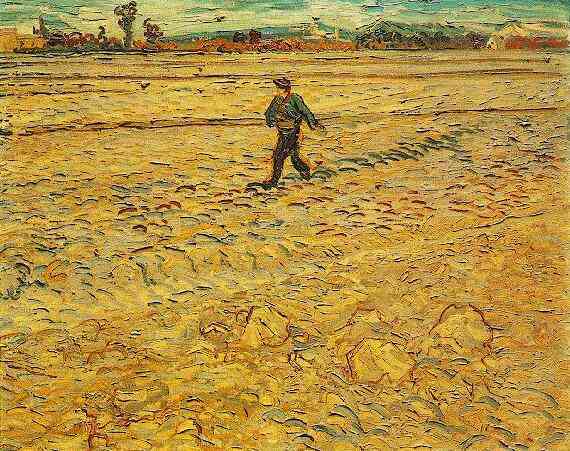
The Sower by Van Gogh 1881
“The Sower” by Vincent Van Gogh, 1881

“A farmer went out to sow his seed. As he was scattering the seed, some fell along the path, and the birds came and ate it up. Some fell on rocky places, where it did not have much soil. It sprang up quickly because the soil was shallow. But when the sun came up, the plants were scorched, and they withered because they had no root. Other seed fell among thorns, which grew up and choked the plants. Still other seed fell on good soil, where it produced a crop—a hundred, sixty or thirty times what was sown. Whoever has ears, let them hear.” (Matthew 13:3-9, NIV)

Introducing the Parable

I have been preaching sermons for over thirty-five years, so I have seen my share of people falling asleep in church.  The most common ways of drifting off during a sermon are, what I call, the “Snapback” in which the head dramatically snaps back from its gradual descent backward; the “Pious Nod” where it might appear the person is praying until the head either hits the pew in front of it or snaps up, as in the snapback; and, the “Cozy-Sweet” where the head goes to the side and eventually lands on its neighbor’s shoulder for a bit of a nap.

I tend to believe if you need to sleep, you need to sleep – and I find the nodding-off antics of parishioners as bringing some light-hearted levity to my life. That said, for the Christian, it is important to listen to the Word of God.  We need, first and foremost, to take a posture of listening, really hearing what Jesus has to say so that we can do the will of God.

The Parable

“Whoever has ears, let them hear,” said Jesus.  Truly hearing Jesus’ words and listening with focused attention is the key to life.  Our ears are the soil of our lives.  Ears that are attentive and devoted to listening to Jesus are good soil; ears that are distracted and inattentive and stopped up with ear wax are the bad soil.  Receptive listening to the Word of God brings a fruitful harvest of righteousness, peace, and joy in the Holy Spirit.  The Parable of the Sower (or Soils) lets us know that sowing (planting) the Word is important.   It is sown on four different soils….

  1. The seed on the path. A path is for walking, which is why the seed never takes root.  Here there is no listening. When we act without listening, our actions will be misguided.
  2. The seed on rocky soil. Here there is no deep listening.  A lack of attentive hearing results in a shallow person who perhaps relies more on Christian clichés or on his/her personality or abilities instead of the sown Word.
  3. The seed on the thorny soil. Here there is significant listening. However, there is too much listening to a cacophony of voices and not enough singular listening to the sown Word.  Listening to the wrong voices will cause an unfruitful life, so we must be careful to the kind of preaching and type of preachers we hear!
  4. The seed on good soil. A devoted listening to the Word without distraction leads to a productive, fruitful believer.

The Nature of Parables

A parable is a genre of biblical literature.  Parables are as much about concealing truth as they are conveying truth.  A person needs to give focused attention to the story to learn from it, much like a good novel conveys truth about the human condition without being preachy or outright saying the truth; or, much like a good movie that relies on character development and the power of story for its message instead of being a straightforward documentary.

Jesus neither strong-arms people into the kingdom nor puts a person in a full nelson to force them to do God’s will.  We will miss the kingdom if we are looking for a big dramatic hoo-ha of an event, because it comes as an awareness within people and works its way out. For the person who has no intention of changing, they will find Christ’s words confusing.  They might “hear” Jesus yet fail to really listen since they have their own ideas about how the kingdom ought to operate.

Yet, grace is present.  The very fact that Jesus addressed the crowd of people demonstrates he cared enough to communicate.  He could have said, “Hey, you guys, get lost, I’m just going to interact with people who really listen to me.”  Jesus, however, is full of mercy.  Instead of coming at the crowd and bursting through the front door, he came at them through the side door so that they would be able to receive the message well.

When I was a young Christian, I had a habit of puking the good news of Jesus all over people without really listening to them.  Being blunt without being attentive is not the best approach; neither is being worried about saying something offensive, so nothing is said at all.  Others cannot listen if we are either obnoxious or silent. A better approach is to ask permission to tell your story of what Jesus means to you, or what you have learned from God’s Word.

The Sower by Van Gogh 1888
“The Sower” by Vincent Van Gogh, 1888

The Parable Interpreted

“Listen then to what the parable of the sower means: When anyone hears the message about the kingdom and does not understand it, the evil one comes and snatches away what was sown in their heart. This is the seed sown along the path. The seed falling on rocky ground refers to someone who hears the word and at once receives it with joy. But since they have no root, they last only a short time. When trouble or persecution comes because of the word, they quickly fall away. The seed falling among the thorns refers to someone who hears the word, but the worries of this life and the deceitfulness of wealth choke the word, making it unfruitful. But the seed falling on good soil refers to someone who hears the word and understands it. This is the one who produces a crop, yielding a hundred, sixty or thirty times what was sown.” (Matthew 13:18-23, NIV)

The focus of the interpretation Jesus gave is the experience of the seed in a variety of soils.  The outside powers that act on the Word – devouring birds, rocks, the burning sun, choking thorn-bushes – demonstrate that the Word is central and needs to be received well:

  1. The soil on the path is the person who hears the message yet is unable to hear God’s Word because their heart is hard. The devil snatches it before any real understanding can take place.  We see that the devil is real and has ability to influence people who have listening issues.
  2. The rocky soil is the person who hears just enough to respond with joy but drops out when hard circumstances come around. “I didn’t sign up for this!” is their cry.  They needed to count the cost of discipleship before responding to the message.  This is merely a professing Christian, nothing more.  Rather than listening and internalizing the Word, there is only positive affirmation without any action or practice. So, tomorrow the message is gone and forgotten.  When difficulty comes, there are no supporting words to draw from, so the person fades away, unable to navigate life successfully.
  3. The thorny soil also hears and responds to the message. This person is also a professing Christian, nothing more.  The issue with such a person is that he/she also listens to the voices of worry and wealth.  Like some sort of spiritual attention-deficit-disorder, there is no ability to filter all the voices calling out, and so there is no growth.  The Word of God must reign supreme; there cannot be two thrones of Wealth and Word and two Masters of God and Money.
  4. The good soil is listening with the intention of understanding and putting into practice the message heard is what brings about fruit. Receiving the Word through careful listening brings about spiritual growth.  God brings the growth when we focus on the Word.  So, priority must be to listening well to the Word of God.  When a whole group does this, then it creates a greenhouse effect in which people cannot help but grow in the Lord!

Conclusion on the Parable

The simple reception of God’s Word makes a person fruitful.  The first soil did not receive the Word at all, though it listened to it; the second received it with joy but under pressure let it go; the third received it with only one hand because the other hand was busy; only the fourth soil received the seed of the Word with both hands.

Blessed is the one who does not walk in step with the wicked or stand in the way that sinners take or sit in the company of mockers, but whose delight is in the law of the Lord, and who meditates on his law day and night. That person is like a tree planted by streams of water, which yields its fruit in season and whose leaf does not wither—whatever they do prospers. (Psalm 1:1-3, NIV)

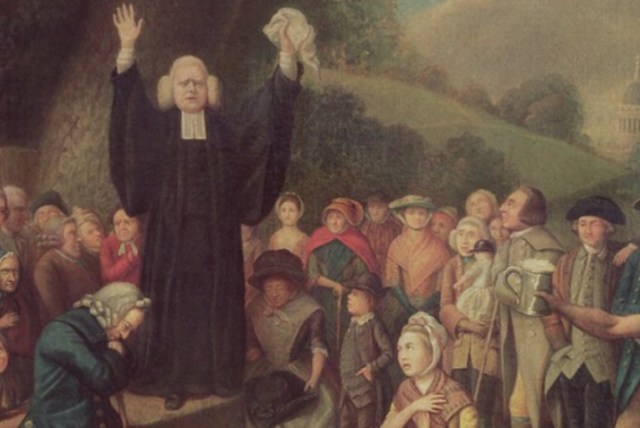
George-Whitefield
George Whitefield (1714-1770) preaching outdoors by English artist John Collet (c.1720-1780)

George Whitefield, arguably the greatest of all revivalists, addressed the topic of listening in a mid-eighteenth- century sermon based on the words of Jesus in Luke 8:18, “Take care how you hear:”

  1. Come to church out of a sincere desire to know what God has to say to you. Sermons are not for entertainment. They are to reform our hearts and teach us our duty towards God and men.
  2. Give focused attention to the things that are spoken. Listen as you would to the voice of someone you respect; the King of Kings demands even more respect! The stuff of sermons concerns eternal matters and not just the things of this world.
  3. Guard you heart against prejudice to the minister. Even when ministers urge us in the ways they themselves have trouble with, don’t refuse the urging on that account. If what they urge is biblical, receive as though Jesus were the one who spoke.
  4. Guard your heart at thinking more highly of a minister than you ought.It was the Corinthian evil that they began to prefer one preacher to another openly with terrible consequences for the body of Christ. Though one may minister to you more than another, respect both for what God does through them to the body of Christ and remember they are people just like you.
  5. Make application to your own heart of everything that is said.  Beware of that roving eye that says in a sermon, “That was meant for him” or “I sure hope she heard that!”
  6. Pray to the Lord, before, during, and after the sermon. Pray that the minister might be endued with power and boldness to declare the whole counsel of God and not be intimidated by anyone. Pray that God would apply the words to your own heart.

Whitefield concludes: “If only all who hear me this day would seriously apply their hearts to practice what has now been told them! How ministers would see Satan, like lightning, fall from heaven, and people find the Word preached sharper than a two-edged sword and mighty, through God, to the pulling down of the devil’s strongholds!”

May it be so, to the glory of God.

Luke 15:1-7 – One Lost Sheep

The Shepherd and the Lost Sheep
“The Shepherd and the Lost Sheep.” By Peter Clarke, 1969

A lot of men and women of doubtful reputation were hanging around Jesus, listening intently. The Pharisees and religion scholars were not pleased, not at all pleased. They grumbled, “He takes in sinners and eats meals with them, treating them like old friends.” Their complaining triggered this story:

“Suppose one of you had a hundred sheep and lost one. Wouldn’t you leave the ninety-nine in the wilderness and go after the lost one until you found it? When found, you can be sure you would put it across your shoulders, rejoicing, and when you got home call in your friends and neighbors, saying, ‘Celebrate with me! I’ve found my lost sheep!’ Count on it—there’s more joy in heaven over one sinner’s rescued life than over ninety-nine good people in no need of rescue. (MSG)

Lost people matter to God.  They matter so much to him that one lost soul found is the grounds for a big celestial party.  Please note this simple observation of today’s Gospel reading: If there is rejoicing in the presence of angels in heaven over one sinner who repents, then who is doing the rejoicing?  God!  God himself is crazy giddy with joy over one lost person being found.

Celebration is an important activity for the Christian. God throws the best parties, filled with plenty of joy and recognition of persons restored to fellowship. As people created in the image and likeness of God, we are hardwired for celebration. If God can go uncorked with joy and celebration, I’m going to say with confidence that open unabashed blowouts rejoicing over people’s transformation and new life is welcome and expected. Folks baptized in pickle juice can join the grumbling of all the high mucky-muck dudes who smugly look down on the marginal persons among us. Hopefully, the party-poopers won’t be heard because of all the noise at God’s party.

This parable of Jesus is meant to give us a glimpse of God’s own heart.  He would do anything to find a lost person, to restore and reconcile a person back to himself.  God would go dumpster diving and wade through the stinky nasty garbage to find that one lost valuable person.

Why should reaching out to marginal people with the grace and love of Jesus Christ be a high priority?  Because restoring lost people is a high priority for God.  God has placed the highest of priorities on recovering those who are spiritually lost and wandering around life without a purpose or a place to call home. Such people matter so much to him that God sent his Son, the Lord Jesus, to this earth.  Jesus went to the greatest lengths possible through enduring a cruel death on a cross in order to reconcile a broken lost relationship between people and God.

I can still remember what it felt like to be separated from God and estranged from the church – it was lonely and sad, like being in a deep black hole with no way of getting out and no one around to help.  But God, in his great mercy, sent spiritual commandos to extract me from my captivity of the soul. So, my greatest desire is to live my life basking in the grace shown to me, grateful for new mercies which come every day, and giving that same grace to others – especially those considered as the lost, the least, and the lonely in society.

In leaving the ninety-nine and going after the one sheep, God gave preferential attention to the lost. So, because of this, I ask a sincere and probing question which I believe needs to be asked:  Can you live with that?  My own answer is: “I sure can, because I was once that lone lost sheep!”

Jesus, you are the Good Shepherd.  Thank you for going after me when I was lost.  Help me to remember that you will often leave my pasture to go after others. I’ll be willing and happy to go with you when you do. Let’s also take the Spirit with us.  Amen.

Click Compassion Hymn by Keith and Kristyn Getty to remember the lengths of love God went to in restoring us.