Acts 2:22-36 – From Flake to Fearless

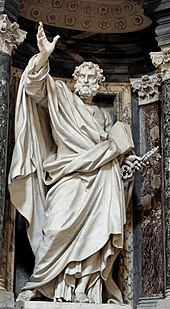
Statue of St. Peter in Rome

“Fellow Israelites, listen to this: Jesus of Nazareth was a man accredited by God to you by miracles, wonders and signs, which God did among you through him, as you yourselves know. This man was handed over to you by God’s deliberate plan and foreknowledge; and you, with the help of wicked men, put him to death by nailing him to the cross.But God raised him from the dead, freeing him from the agony of death, because it was impossible for death to keep its hold on him.David said about him:

“‘I saw the Lord always before me.
    Because he is at my right hand,
    I will not be shaken.
Therefore my heart is glad and my tongue rejoices;
    my body also will rest in hope,
because you will not abandon me to the realm of the dead,
    you will not let your holy one see decay.
You have made known to me the paths of life;
    you will fill me with joy in your presence.’

“Fellow Israelites, I can tell you confidently that the patriarch David died and was buried, and his tomb is here to this day. But he was a prophet and knew that God had promised him on oath that he would place one of his descendants on his throne. Seeing what was to come, he spoke of the resurrection of the Messiah, that he was not abandoned to the realm of the dead, nor did his body see decay. God has raised this Jesus to life, and we are all witnesses of it. Exalted to the right hand of God, he has received from the Father the promised Holy Spirit and has poured out what you now see and hear. For David did not ascend to heaven, and yet he said,

“‘The Lord said to my Lord:
    “Sit at my right hand
until I make your enemies
    a footstool for your feet.”’

“Therefore, let all Israel be assured of this: God has made this Jesus, whom you crucified, both Lord and Messiah.” (New International Version)

Throughout my ministerial life, there have been individuals who have come to me a bit discouraged because they have not experienced a changed life. After trying, time and again, to be different, they say to me, “Nobody ever really changes. We’re basically the same people throughout our whole lives.”

I couldn’t disagree more.

In the New Testament Gospels, the Apostle Peter was a flake. He sometimes was discerning and got it, and sometimes didn’t. 

Peter could understand Jesus was Messiah, but then turn around and refuse that Christ had to die on a cross. He would get bold and walk on water, but then also end up afraid, needing help from drowning. Peter stood tall for Jesus, ready to take on the world, and then turn around and deny the Lord three successive times.

However, when we come to biblical book of Acts, Peter is a completely changed man. Peter gets it. He is brave and fearless. He boldly confesses Christ. And all the while he does not falter, flinch, or back down. 

So, what in heaven’s name, happened and made the difference for Peter between the Gospels and Acts? 

The Holy Spirit, that’s what, or rather, who.

God’s Spirit comes upon Peter, and he is never the same again. He is a changed man. Peter goes from flake, to fearless.

Everything falls into place for Peter, who preaches with such boldness and effectiveness that thousands turn from their previous ways of thinking and living and turn to Jesus as the hope of the world. They changed, too.

Peter was all-in with a simple and straightforward message of good news, that God raised Jesus from death. He went on to insist, without wavering and with firm conviction, that this was so, because it was not possible for the Son of God to be held by anything, even death. The proof being the resurrection.

If it was impossible for death to keep a grip on Jesus, then there is absolutely nothing that can deter Jesus or hold him back from accomplishing what he wants to accomplish. 

Flaky believers are not going to frustrate Jesus or upset his plans; he’ll just send the Holy Spirit. 

We may too often imprison ourselves in self-made spiritual jail cells. Like the pre-Pentecostal Peter, we flake and flip-flop in the Christian life. Once-in-a-while we are spot-on, but cannot really explain why, like a golfer who hits an amazing shot but can’t reproduce it no matter how hard he tries. 

The truth is that Jesus has conquered sin, death, and hell. By faith, we have forgiveness of sins in him, and have the way opened to a new life in the Spirit. It isn’t a secret; it’s a new reality.

At the front end of the Christian season of Ordinary Time, we are reminded that God’s Holy Spirit is with us. We remember what good old Peter said so long ago, which is still relevant for us today:

We have everything we need to live a life that pleases God. It was all given to us by God’s own power, when we learned he had invited us to share in his wonderful goodness. God made great and marvelous promises, so his nature would become part of us. Then we could escape our evil desires and the corrupt influences of this world. (2 Peter 1:3-4, CEV)

The message Peter proclaimed was powerful, not only because it was inherently potent, but also that the gospel dwelled mightily in Peter and inhabited a central place within him.

We, too, have that same opportunity and privilege.

Loving Lord Jesus, I confess my faults, shortcomings, sins, and rebellious acts, and ask you to forgive me. I embrace you as my Savior and Lord. Thank you for your atoning death on the cross in obedience to your Father’s will to put away my sins. Be in charge of every part of my life. Indwell and empower me with your Holy Spirit, so that I may live as your faithful follower, now and forever. Amen.

Galatians 3:23-29 – A Ministry of Equals

Before the coming of this faith, we were held in custody under the law, locked up until the faith that was to come would be revealed. So, the law was our guardian until Christ came that we might be justified by faith. Now that this faith has come, we are no longer under a guardian.

So, in Christ Jesus you are all children of God through faith, for all of you who were baptized into Christ have clothed yourselves with Christ. There is neither Jew nor Gentile, neither slave nor free, nor is there male and female, for you are all one in Christ Jesus. If you belong to Christ, then you are Abraham’s seed, and heirs according to the promise. (New International Version)

So far, this year…

we have journeyed through Advent to see the Christ child…

followed the light of Epiphany with Jesus as the light of the world…

traveled in Lent to see ourselves in the light of Christ…

experienced Holy Week with the crucifixion, death, and resurrection of Jesus Christ…

exulted in the spiritual victory of Easter(tide)…

observed the Lord’s ascension to heaven…

and celebrated the incredible giving of the Holy Spirit to us as believers in and followers of Jesus.

Now…

we have entered the longest Christian season of the year: Ordinary Time or Proper Time.

Armed with the redemptive events of Jesus and with the Spirit as our Teacher, Guide, and Advocate, it is the ordinary ministry and proper life of every Christian to utilize our identity and belonging to spiritually grow and mature in Christ – and spread the seeds of the Gospel everywhere we go. This is simply the normative behavior of every Christian.

We are to bring…

faith, hope, and love to a world in need of God’s grace and peace – a world so often characterized by the chaos of hate, conflict, war, and unrest…

connection where there is disconnection, restoration where there is fragmentation, and inclusion wherever there is exclusion.

Ever since…

the fall of humanity, people have had the predilection to organize themselves in groups that keep them distinct from other groups. Whether it is high school peer groups or office politics; whether class warfare or church cliques; there has always existed a tendency to think better about the groups we identify with, and to look down and believe the worst about those we don’t understand or just don’t like.

But Jesus…

is the person who changes it all. Faith in Christ makes each of us equal with each other, whether Jew or a Greek, in bondage or in freedom, a man or a woman. The cross of Christ not only brought deliverance from sin, death, and hell; the work of Jesus Christ ushered-in a new egalitarian society.

I’m not sure the English translations of the Apostle Paul’s phrasing to the Galatian Church truly capture his passion about this issue. For Paul, Christ’s cross has done so much more than bring personal salvation; it has completely eradicated prejudice, discrimination, and division. 

Therefore…

the Church is to be the one place on earth where divisions no longer exist. It is to be a foretaste of heaven. The Church is to be a new society, a community of the redeemed, based in equity, diversity, and inclusion, from every people group, race, ethnicity, and gender.

Together as one, just as God is One, the Church lives the kingdom values of Christ’s words and ways in a fragmented and chaotic world.

Since then…

the ground is level at the cross, we are to live into our Christian unity with humble attitudes and loving actions. To do otherwise is to be immature. We (hopefully) expect kids to be kids and not be like adults. They need teaching, training, and tutoring to learn. When kids grow up and get into adulthood, we then expect them act like an adult. If they continue in childish behavior, they are immature.

Many adult Christians are still stuck in spiritual childhood. The evidence of this is seen in trying to stratify church society into insiders and outsiders, those who have always been in the church and newcomers who haven’t, or the committed servants and the lax pew sitters, or the givers and the takers, or the theological conservatives and theological liberals.

Rather than…

all of that dividing of people, our spiritual energy, powerfully given to us by the Spirit, is to be placed with living into the egalitarian society inaugurated by Jesus (and Paul). Not taking women’s leadership seriously, or avoiding relationships with the poor, or being xenophobic, or excluding gays, all come from a place of immaturity. It is childish behavior. And Jesus expects better.

Embracing an egalitarian society neither means we are all the same nor should act alike. The diverse backgrounds and experiences of people help make a rich mosaic of support for one another in the Body of Christ.

Being egalitarian means…

all people are created in the image and likeness of God – no exceptions. All persons, therefore, deserve morally equal treatment, respect, and justice. A just and good Christian ethic ensures all believers are handled with love, given sound instruction, and are free to explore their gifts and abilities within the church.

Pursuing equality means more than acknowledging our differences and saying we include others. We need the further step of becoming curious about other cultures, ethnicities, races, and peoples of all kinds.

We need curiosity…

about class differences, health disparities, and political views. It is good for us to actively seek to learn about things like gerrymandering and why its so important; or about what white privilege is and why that’s a big deal; or about mental illness or poverty or crime or any issue that impacts the human condition around us.

In other words, we become curious simply because, as Christians, we care about people.

The Church is…

at its heart, is a community of equals. Thus, the Church, as an egalitarian community, must actively reject racism, sexism, and all forms of discrimination while purposefully seeking ways to create and maintain a unified community without divisions.

Jesus reached out…

to the misfits and marginalized in society who were suffering from political, cultural, gender, and religious oppression and discrimination. The community of persons Christ formed included people of all ages and backgrounds. Children were welcome. Women sat down with men to learn and became active participants alongside one another.

Christ’s conversation with the Samaritan woman at the well, the parable of the good Samaritan, and the healing of the Canaanite woman’s daughter, all illustrate that ministry is to reach beyond our own familiar group. In short, Jesus practiced a radical hospitality. He loved and welcomed the stranger.

We Christians…

would do well to emulate our Lord, as well as take our cues on ministry from Paul, who grounded both his theory and practice of Christian mission and service in a Trinitarian theology of equals.

Gracious God, you have abolished barriers through the redemption of Christ. Prevent me from erecting walls that would divide and use me to be a bridge so that others may experience equality in Jesus. Amen.

2 Samuel 5:17-25 – Inquire of God

When the Philistines heard that David had been anointed king over Israel, they went up in full force to search for him, but David heard about it and went down to the stronghold. Now the Philistines had come and spread out in the Valley of Rephaim; so, David inquired of the Lord, “Shall I go and attack the Philistines? Will you deliver them into my hands?”

The Lord answered him, “Go, for I will surely deliver the Philistines into your hands.”

So, David went to Baal Perazim, and there he defeated them. He said, “As waters break out, the Lord has broken out against my enemies before me.” So that place was called Baal Perazim.The Philistines abandoned their idols there, and David and his men carried them off.

Once more the Philistines came up and spread out in the Valley of Rephaim; so, David inquired of the Lord, and he answered, “Do not go straight up, but circle around behind them and attack them in front of the poplar trees. As soon as you hear the sound of marching in the tops of the poplar trees, move quickly, because that will mean the Lord has gone out in front of you to strike the Philistine army.” So, David did as the Lord commanded him, and he struck down the Philistines all the way from Gibeon to Gezer. (New International Version)

Ordinary Time of Prayer

Let’s take a step back for a moment and see the big picture of the Christian Year. We have thus far experienced Advent and Christmas with the birth of Christ. We moved through Epiphany with its focus on the light of Christ for the world. We experienced Lent, celebrated Easter and spent weeks in Eastertide, basking in the glory of the resurrection. Christ’s ascension, then the Spirit’s coming at Pentecost have come.

Now we are in Ordinary Time – the longest season of the Christian Year. It isn’t sexy. It goes on and on until Advent finally arrives again, months later. We are in the doldrums of summer and the daily reality of living with the tedium of doing what we need to do, over and over again.

Prayer can sometimes feel that way. Although it is the normal ordinary vocation of every believer, prayer is not always easy nor is it done consistently.

David’s Time of Prayer

David continued a practice of prayer in his reign, just as he had done repeatedly in the years leading up to becoming the king. The compiler of stories about David wanted to ensure the connection between prayer, obedience, and success. King David inquired of God, did exactly what God told him to do, and then watched God act on behalf of the people.

It sounds simple when I put it that way, doesn’t it? Pray. Obey. Succeed. Yet we know it really isn’t so easy. The monotony and demands of our lives have a way of crowding out such a simple plan. Although it might only require a few minutes of our time to stop and inquire of God before acting, we still may not do it, believing our anxious action to be more necessary than a brief pause.

King David faced and defeated the opposition because he deliberately took the time and effort to ask God for direction in what to do. David neither trusted in his own past experience nor his accumulated expertise. Rather, he kept up his ongoing practice of living by faith and trusting the Lord to guide him.

Sometimes we ask for divine guidance and get what seems to be weird answers. David was given precise instructions in dealing with the Philistines. From the vantage of a human General, the orders didn’t make a lot of sense. However, David did not hesitate to do exactly what he was told – and there was a decisive victory.

Our Time of Prayer

When it comes to our prayers, we ought to expect the unexpected. God’s answers frequently look more like problems than answers. They are often not what we expect. We may fail to see how they correspond to our prayers.

If we inquire of God to love others, the Lord just might respond by having us pay attention to someone in our lives who is obnoxious to us, whom we rather would not be around, at all. (Mark 12:31; Luke 10:29)

If we inquire of God to be near us, the Lord may break our hearts to especially be close to us. (Psalm 73:28; Psalm 34:18)

If we inquire of God to receive grace and mercy, the Lord will likely dismantle our pride and humble our hearts. (James 4:6)

If we inquire of God for justice to be done on this earth, the Lord might put the spotlight on our own lives and expose our spiritual bankruptcy, cause us to mourn, and make us meek, as the Son is meek. (Matthew 5:3-5)

If we inquire of God for wisdom and discernment, the Lord could send a muddle of confusion for us to work through, teaching us to distinguish between good and evil. (Hebrews 5:14)

If we inquire of God to save us from our predicament and take away our fear and anxiety, we may get only silence for a long while – prompting us to persevere in prayer. (Luke 17:5; 2 Corinthians 5:7)

If we inquire of God for money, the Lord might give us opportunities to give money away and deplete our resources – helping to build treasure in heaven, not just on earth. (Matthew 6:19-21; Luke 16:13)

If we inquire of God for happiness, the Lord just may take away a bunch of our stuff so that we will know the surpassing joy of knowing Christ. (John 16:24; Philippians 3:8)

Many of God’s best and greatest gifts come in the form of befuddling answers. If we learn to go with it and obey, a new world of possibility is opened to us that we never would have anticipated.

Being in Ordinary Time doesn’t necessarily mean getting ordinary answers to our prayers.

 Now all glory to God, who is able, through his mighty power at work within us, to accomplish infinitely more than we might ask or think. Glory to him in the church and in Christ Jesus through all generations forever and ever! Amen.

*Above painting of King David by Dutch artist Gerard van Honthorst (1592-1656)