We’ve Had Our Fill of the Arrogant (Psalm 123)

I look up toward you,
the one enthroned in heaven.
Look, as the eyes of servants look to the hand of their master,
as the eyes of a female servant look to the hand of her mistress,
so our eyes will look to the Lord, our God, until he shows us favor.
Show us favor, O Lord, show us favor!
For we have had our fill of humiliation, and then some.
We have had our fill
of the taunts of the self-assured,
of the contempt of the proud. (New English Translation)

The patriarch of the Hebrews, Abraham, lived 4,000 years ago. Moses, the lawgiver and leader of the Israelites out of Egyptian slavery, lived 3,500 years ago. By the time the psalmist wrote today’s psalm, there had already been at least between 1,000 and 1,500 years of Jewish history. And, from the point the psalm was written until now, nearly 3,000 years of history have come to pass.

For all these millennia, the Jewish people have had to endure the contempt and hatred of all kinds of non-Jewish groups and nations. Their suffering has been continual and constant. They have endured multiple attempts of others trying to rid the earth of them. Jews have been mercilessly mocked, violently beaten, religiously persecuted, arrogantly humiliated, callously abused, and perennially shamed, just for being Jews.

The Jewish people know about generational trauma and suffering. They’ve experienced endless heartache and soul damage. And yet, the Jews are still here. They survive, despite so many intentions to wipe them off the map. There are few people groups that can say they still exist after 4,000 years of history.

I submit to you that one of the many reasons the Jewish people have survived, even thrived, for so long is that they have a rich heritage of Hebrew poetry and working out their emotions and their musings before God – and put it down on paper.

The Jewish people acknowledge their emotional and spiritual pain to God, lament it before God, and trust in God to handle their oppressors.

For the one who remains silent, and never sets pen to paper, will fade away and be forgotten. But the one who brings their shame to the light, and contends with the Lord about their suffering, shall see generation after generation continuing to struggle onward and upward.

Trusting God

The controlling image of today’s psalm has to do with the eyes looking. The psalmist looks up to heaven where God is enthroned as Creator and Sovereign over all the earth. Specifically, the eyes look toward the throne room of God.

Underlying the trust and faith of the people is the confession that God is the rightful and powerful Ruler of all. Just as servants look to their masters for provision, so the praying community of people looks to God for their every need – whether it be physical, mental, emotional, or spiritual.

Ultimately, this community looks for a sign of God’s inexhaustible and divine mercy. The worshiper prays, sings, and looks longingly with eyes wide open to the heavens. They look up in confident anticipation, searching for hope and a glimpse of divine mercy.

Here you will not find any sort of rugged individualism, prideful struggling alone, or refusals to ask for help. No! There is a refreshing realism and vulnerability of knowing who you are, where you are, and what you need – without any apology.

Complaining to God

The community of worshipers repeated their heartfelt and strong prayer for mercy from God. The people were facing a relentless stream of contempt from others, and they had more than enough of receiving this.

Those who mocked the Jews are identified as the proud and arrogant. In contrast to the worshipers, the mockers do not look up to the heavenly king, but instead look down on those different from themselves.

The arrogant look only to themselves, not to any master, and certainly not to the sovereign King of the universe. But the followers of the Lord look to their God for mercy because its absent from their experience of being and living on this earth.

Conclusion

The psalm begins with an affirmation of trust, and then, moves to the people’s plea for help from the God whom they place their trust and faith. This psalm was not only befitting of the ancient crisis of Israel’s exile to Babylon and all that happened afterwards in history; the psalm befits us today, as well.

Today, the Jewish people, along with many other religious communities around the world, are experiencing genocidal behavior from mockers who detest them and want to be rid of them altogether.

For all of us who seek the Lord and desire to truly live a pious and penitent life, our eyes look to the divine king for hope. In the midst of oppression by arrogant mockers who operate out of autonomy and independence from the God of mercy, we lift our eyes to the heavens and search God’s heavenly throne room for a glimpse of hope.

In every age – whether ancient, medieval, or modern – the faithful have always needed each other in the community. We have always had to embrace an interdependent dynamic of relating to one another, rather than operate as a mere collection of individuals who happen to be in the same place at the same time.

The faithful understand that life is not something they have earned or made, but is a gift from the Creator and Sovereign who is enthroned in the heavens. And without this perspective, we will continue to see hateful groups of people try to annihilate those different from themselves.

Merciful and loving God, when we are overwhelmed with fear and uncertainty, undermined by the distress of mockery, please love us and grant us patience under suffering.

Help us to love others as you love us; to accept others without judgment; to see difference as your gift of creation; and to remember that love is our greatest calling.

Generous God, you give freely of your love and mercy and grace. Prompt us to share our blessings and respond to the cries of the world.

Encourage us to help those facing the pain of discrimination and prejudice. May they experience healing of both body and soul.

Nurture us in faith, so that we will reach those in need, both near and far.

Inspire us to love all your children equally, without exception; and let us give and receive love, through the One whose name is Love, Jesus Christ, your Son, our Lord. Amen.

A Call to Truth and Justice (Exodus 23:1-9)

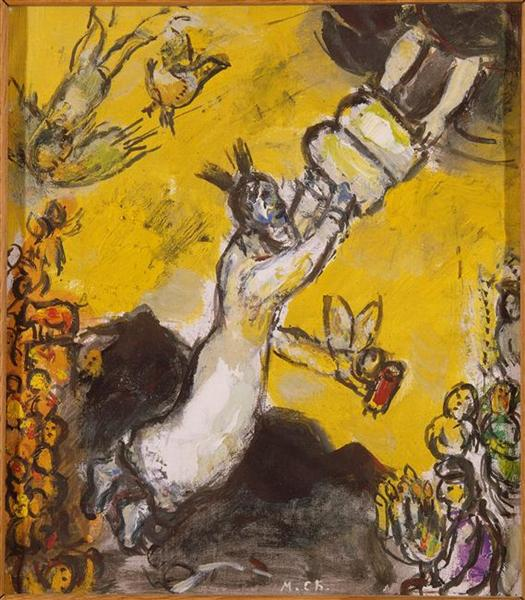
Moses Receives the Law, by Marc Chagall, 1963

“You must not pass along false rumors. You must not cooperate with evil people by lying on the witness stand.

“You must not follow the crowd in doing wrong. When you are called to testify in a dispute, do not be swayed by the crowd to twist justice. And do not slant your testimony in favor of a person just because that person is poor.

“If you come upon your enemy’s ox or donkey that has strayed away, take it back to its owner. If you see that the donkey of someone who hates you has collapsed under its load, do not walk by. Instead, stop and help.

“In a lawsuit, you must not deny justice to the poor.

“Be sure never to charge anyone falsely with evil. Never sentence an innocent or blameless person to death, for I never declare a guilty person to be innocent.

“Take no bribes, for a bribe makes you ignore something that you clearly see. A bribe makes even a righteous person twist the truth.

“You must not oppress foreigners. You know what it’s like to be a foreigner, for you yourselves were once foreigners in the land of Egypt. (New Living Translation)

On Mount Sinai, God gave Moses the Ten Commandments. These laws are basic ethical commands given to the people in their relationship to God and to one another. Following those Ten Words, the next several chapters of Exodus provide detailed instructions and commands for the Israelites in their own social, economic, and cultural context.

Today’s Old Testament lesson is part of this sequence of specific laws for the Israelites. These laws all have to do with being honest in legal matters. There is to be no perversion of justice through perjury, favoritism, bending to dishonest pressure, bribery, and false charges. What’s more, there must be no overlooking of the poor and powerless; and no disregard for the immigrant and foreigner.

All the sequences of commands – covering Exodus chapters 20-25 – are connected back to the basic Ten Commandments. The laws about justice and injustice are the fleshing-out of the ninth command to not testify falsely against your neighbor.

In other words, we are not to lie in public, especially when a person’s life or livelihood is at stake. We are to practice right relations with others; and do justice for all persons without prejudice or favoritism. We do this because God shows no favoritism and judges rightly with proper justice.

He will not judge by what he sees with his eyes,
    or decide by what he hears with his ears;
but with righteousness he will judge the needy,
    with justice he will give decisions for the poor of the earth. (Isaiah 11:3-4, NIV)

The Lord is a just God – it is inherent to the divine character. Therefore, our actions, as people created in the image of God, are to always be just, right, and truthful. There is a special place in God’s heart for the poor and powerless, and so, we ought also to consider their needs and treat them well and with respect – because true religion gives to those who we know cannot pay us back.

This, then, also is why immigrants and foreigners are mentioned. They need proper justice, and not negligence on our part to provide them with what they need. Throughout Holy Scripture we are admonished to not oppress the stranger from another place.

For through him [Christ] we both have access to the Father by one Spirit. Consequently, you are no longer foreigners and strangers, but fellow citizens with God’s people and also members of his household, built on the foundation of the apostles and prophets, with Christ Jesus himself as the chief cornerstone. (Ephesians 2:18-20, NIV)

The Lord watches over the foreigner
    and sustains the fatherless and the widow,
    but he frustrates the ways of the wicked. (Psalm 146:9, NIV)

Jesus picked up on the basic commands of God in his Sermon on the Mount – which, in many ways, is a restatement of the Ten Commandments by getting to the heart of them. Concerning the matter of giving false pledges, he said:

“Again you have heard that it was said to those who lived long ago: Don’t make a false solemn pledge, but you should follow through on what you have pledged to the Lord… Let your yes mean yes, and your no mean no. Anything more than this comes from the evil one. (Matthew 5:33, 37, CEB)

In court, we offer an oath, swearing that we will tell the truth and only the truth – and no lying. This is the only way that injustice can be avoided and justice can be established.

“I swear on a stack of Bibles I won’t…” “I will, if I get around to it….” These are a few of the caveats we give when making a promise or oath. Oaths communicate our truthful intentions of being above board with a high level of integrity.

It’s not okay when we bear false testimony concerning an event or incident that has taken place. There is no excuse for saying something is truthful when you know it isn’t quite true or all true. That makes us liars.

The Lord detests lying lips, but he delights in people who are trustworthy. (Proverbs 12:22, NIV)

Jesus wants us to clarify our values of right and wrong; make wise decisions; identify what we know is truth and error; and follow through on speaking the truth in love.

Any human society cannot stand unless it is committed to justice for all. People everywhere have a universal need for communities and nations which pursue truth, justice, benevolence, and integrity for everyone within their sphere of influence and responsibility.

Almighty God, who created us in your own image: Grant us grace to fearlessly contend against evil; and to make no peace with oppression, so that we may reverently use our freedom. Help us to employ that freedom in the maintenance of justice in our communities and among the nations, to the glory of your holy Name; through Jesus Christ our Lord, who lives and reigns with you and the Holy Spirit, one God, now and forever. Amen.

There Are Consequences to Injustice (Exodus 12:29-42)

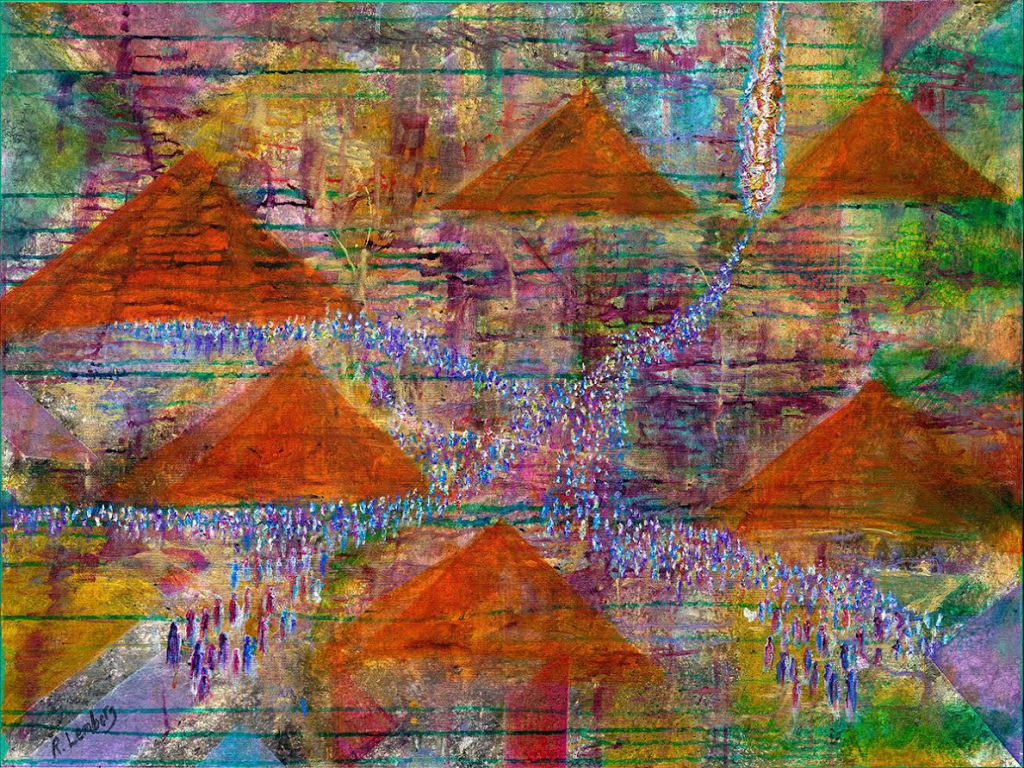
Exodus Out of Egypt, by Rivka Lemberg

At midnight the Lord struck down all the firstborn in Egypt, from the firstborn of Pharaoh, who sat on the throne, to the firstborn of the prisoner, who was in the dungeon, and the firstborn of all the livestock as well. Pharaoh and all his officials and all the Egyptians got up during the night, and there was loud wailing in Egypt, for there was not a house without someone dead.

During the night Pharaoh summoned Moses and Aaron and said, “Up! Leave my people, you and the Israelites! Go, worship the Lord as you have requested. Take your flocks and herds, as you have said, and go. And also bless me.”

The Egyptians urged the people to hurry and leave the country. “For otherwise,” they said, “we will all die!” So the people took their dough before the yeast was added, and carried it on their shoulders in kneading troughs wrapped in clothing. The Israelites did as Moses instructed and asked the Egyptians for articles of silver and gold and for clothing. The Lord had made the Egyptians favorably disposed toward the people, and they gave them what they asked for; so they plundered the Egyptians.

The Israelites journeyed from Rameses to Sukkoth. There were about six hundred thousand men on foot, besides women and children. Many other people went up with them, and also large droves of livestock, both flocks and herds. With the dough the Israelites had brought from Egypt, they baked loaves of unleavened bread. The dough was without yeast because they had been driven out of Egypt and did not have time to prepare food for themselves.

Now the length of time the Israelite people lived in Egypt was 430 years. At the end of the 430 years, to the very day, all the Lord’s divisions left Egypt. Because the Lord kept vigil that night to bring them out of Egypt, on this night all the Israelites are to keep vigil to honor the Lord for the generations to come. (New International Version)

“A horse may run quickly but it cannot escape its tail.”

Russian proverb

The ancient Israelites were in bondage to the Egyptians for hundreds of years. Their oppression finally came to and end with the Lord’s dramatic deliverance of them in the tenth and final plague directed against Egypt.

The actions of the Egyptians eventually and finally caught up with them. Their making slaves of the Israelites was not going to last forever. Even though it took a while, Egypt was held accountable and experienced divine judgment. The empire’s internal moral emptiness would not be able to hold up under the justice of God.

“Empty sacks will never stand upright.”

Italian proverb

Pharaoh was a hard man. The more Moses talked to him the more stubborn Pharaoh got. Eventually, Pharaoh’s heart became like stone; he and his empire fell because they were bent toward the way of injustice. Oppression had been Pharaoh’s proclivity by instructing the Jewish midwifes to kill firstborn sons of Israelite mothers. Now the Egyptians would fall into the very trouble they created for others.

The death of so many on one night, all at once, was too much for Pharaoh and the Egyptians. In such a grief, Pharaoh’s dogged resolve in holding onto Israelite slavery and ostracizing Moses was loosened. He summoned Moses in the middle of the night and commanded the Israelite slaves to be gone – without any conditions or strings attached to it.

The Egyptians wanted them gone, and so, urged them to leave in a hurry – just as God had predicted. All sorts of articles – including silver and gold – were willingly given to the fleeing Israelites by the lamenting Egyptians. No matter how hard and stubborn any earthly ruler is, the plans and purposes of a sovereign God cannot be thwarted.

Finally, the deliverance out of Egyptian bondage happened. The Israelites were free. It was a hasty departure. It was as if the Hebrew people had become so upsetting to the great Egyptian empire, that they vomited them out of their land, projecting the former slaves as far away as they could.

Sometimes people get the notion that if they do something bad, they will be struck by lightning or have some sort of tragedy occur. And when it doesn’t happen, they might reason further in their misguided notions by believing they can get away with bad behavior. So, they keep doing it. But, eventually, this all has a terrible effect.

“Those who lie down with the dogs, rise with the fleas.” English proverb

Actions and inactions have consequences. Those consequences may not happen immediately. However, all of us shall someday harvest the fruit of decisions that were made months, even years or decades, ago.

Make no mistake, God is not mocked. A person will harvest what they plant. Those who plant only for their own benefit will harvest devastation from their selfishness, but those who plant for the benefit of the Spirit will harvest eternal life from the Spirit. Let’s not get tired of doing good, because in time we’ll have a harvest if we don’t give up. (Galatians 6:7-9, CEB)

Almighty God, Creator and Preserver of all humanity, we humbly ask that you make your ways known to people everywhere, and bring saving help to all nations. We pray for Christ’s Church, and all faith communities across the earth, that they be guided and governed by your good, gracious, and benevolent Spirit; and that all who profess and call themselves Christians may be led into truth, and hold the faith in unity, peace, and righteousness.

Blessed Lord, we pray for all who are afflicted or distressed in mind, body, or spirit. May your divine mercy bring them comfort and relief, according to their need. Give them patience through their sufferings, and a joyful outcome from their distress. This we pray through Jesus Christ our Savior and Lord. Amen.

Let Go (Exodus 11:1-10)

Now the Lord had said to Moses, “I will bring one more plague on Pharaoh and on Egypt. After that, he will let you go from here, and when he does, he will drive you out completely. Tell the people that men and women alike are to ask their neighbors for articles of silver and gold.” (The Lord made the Egyptians favorably disposed toward the people, and Moses himself was highly regarded in Egypt by Pharaoh’s officials and by the people.)

So Moses said, “This is what the Lord says: ‘About midnight I will go throughout Egypt. Every firstborn son in Egypt will die, from the firstborn son of Pharaoh, who sits on the throne, to the firstborn son of the female slave, who is at her hand mill, and all the firstborn of the cattle as well. There will be loud wailing throughout Egypt—worse than there has ever been or ever will be again. But among the Israelites not a dog will bark at any person or animal.’ Then you will know that the Lord makes a distinction between Egypt and Israel. All these officials of yours will come to me, bowing down before me and saying, ‘Go, you and all the people who follow you!’ After that I will leave.” Then Moses, hot with anger, left Pharaoh.

The Lord had said to Moses, “Pharaoh will refuse to listen to you—so that my wonders may be multiplied in Egypt.” Moses and Aaron performed all these wonders before Pharaoh, but the Lord hardened Pharaoh’s heart, and he would not let the Israelites go out of his country. (New International Version)

It takes a lot for the status quo to die, to let go of something that has been relied on for centuries. In the case of ancient Egypt, it took the deaths of every Egyptian first born son.

The Israelites had been slaves in Egypt for 400 years. The vast Egyptian Empire was literally built on the backs of Jews. After so long, their cry about being in bondage was heard by God – who sent Moses to deliver them. But Pharaoh, the King of Egypt, was not about to let go of this large labor force.

So, a series of 10 plagues came upon the Egyptians from God. Today’s Old Testament lesson is the tenth and final plague – the one most devastating to Egypt. Although Pharaoh was determined to keep the Israelites in bondage, not even mighty Egypt could keep it’s grip on the people when God was determined to free them and bring them to the Promised Land.

God graciously informed Moses that this was the final plague. After nine others, and hearing Pharaoh say he would let the people go multiple times, it must have been a relief to hear that this would not keep going any longer.

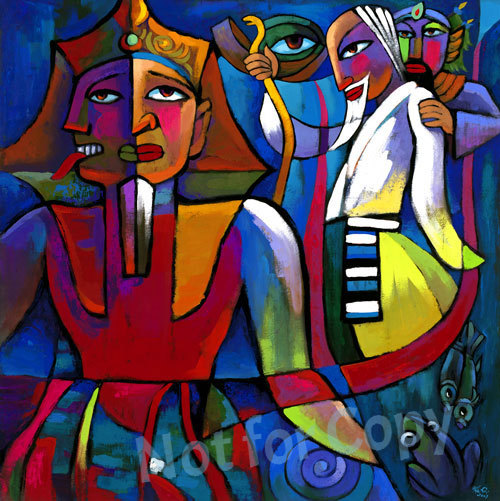
Moses and Aaron debating with Pharaoh, by He Qi

What’s more, the Lord added that not only would Pharaoh finally change and not hinder the people from leaving, but also that they should ask the Egyptians for what they needed when going. Indeed, the people of Egypt became so eager to have the Israelites away from them that they would give them anything to get them out.

The Israelites had worked hard and labored intensely for hundreds of years without any compensation. Now, they would leave the world of slavery and receive the riches of Egypt from which they were defrauded. Whereas Pharaoh’s heart became exceedingly hard, the Egyptians hearts became disposed to give – even though it was to be rid of the Israelites once and for all.

And so, God would deliver the Jews from their bondage and enrich them with many needed possessions, as if they were carrying away plunder from an enemy. The Lord both frees and empowers; God delivers from one situation and enables for another. When God closes a door, then another door is opened.

Indeed, the first will be last, and the last shall be first. In God’s upside-down kingdom, the oppressors eventually become the oppressed, and the poor become rich.

With this last and final plague, there would be no next generation to rise up and take back the Israelites into slavery again. A distinction was made between the first born of the Egyptians and the Israelites. Only the Egyptians experienced the awful deaths of so many.

After four centuries of keeping the Jews enslaved, maybe the Egyptians thought it would always be this way. Perhaps they even believed what they were doing was perfectly acceptable and right. So, when Moses comes along, speaking on behalf of God to Pharaoh, the great king of the empire thought things will not change; the Israelites ought to always be in subservience to Egyptians.

Why is it so hard to let go? Why do people keep holding on, even when it costs them nearly everything?

Whenever we cannot envision a different world or an alternative to what we are currently experiencing, then we hold on – even if it hurts to keep grasping it. Just because there was no divine judgment in hundreds of years, does not mean that God was okay with the situation in ancient Egypt. So, when the Egyptians experienced the judgment, it was absolutely devastating.

If ever we need to control other people in order to realize or maintain our own happiness or contentment, then we are in a very unhealthy place and need immediate help – before the providence of God steps in and pries that control from your clenched fists.

Conversely, if we have been in a place of oppression for a long time, it will not last forever. God sees the injustice. And God hears the cries which are uttered to heaven. A time is coming when all things will be made right.

Also, there are various sorts of traumas that people have endured. Sometimes, people don’t want to talk about any of it, and never do. But eventually, it overwhelms them. Without help, they will be in bondage. None of us can change on our own. We need others. Not everyone is going to harm us or shame us. There are people that God is ready to use in order to extend hope, healing, wholeness, and help. We should let them in, and keep the slave masters out.

Gracious and merciful God, help us to overcome the menace of evil in this world, and to be a part of freeing those weighed down with sinful oppression to realize a future of health and hope.

From famine and war, deliver us.

From hatred and from the demeaning of the dignity of others, deliver us.

From every kind of injustice in the life of society, both national and international, deliver us.

From the loss of awareness of good and evil, deliver us.

Accept our cry on behalf of the sufferings of all humanity, and of entire societies of people.

Empower us by your Spirit to resist evil in all its insidious manifestations.

May the saving grace and the redemption of Jesus put a stop to cruel bondage everywhere; and may hope be kindled in every heart. Amen.