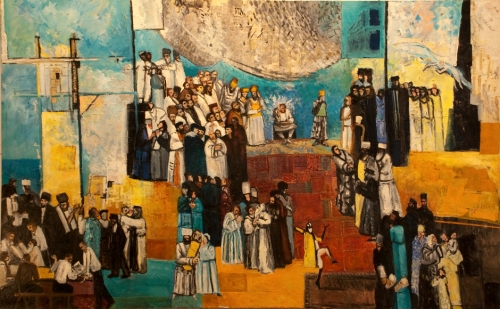
Exodus 3:16-25 – A Great Reversal

Moses and the Children of Israel by Richard McBee
“Moses and the Children of Israel” by Richard McBee

“Go, assemble the elders of Israel and say to them, ‘The Lord, the God of your fathers—the God of Abraham, Isaac and Jacob—appeared to me and said: I have watched over you and have seen what has been done to you in Egypt. And I have promised to bring you up out of your misery in Egypt into the land of the Canaanites, Hittites, Amorites, Perizzites, Hivites and Jebusites—a land flowing with milk and honey.’ 

“The elders of Israel will listen to you. Then you and the elders are to go to the king of Egypt and say to him, ‘The Lord, the God of the Hebrews, has met with us. Let us take a three-day journey into the wilderness to offer sacrifices to the Lord our God.’ But I know that the king of Egypt will not let you go unless a mighty hand compels him. So, I will stretch out my hand and strike the Egyptians with all the wonders that I will perform among them. After that, he will let you go. 

“And I will make the Egyptians favorably disposed toward this people, so that when you leave you will not go empty-handed. Every woman is to ask her neighbor and any woman living in her house for articles of silver and gold and for clothing, which you will put on your sons and daughters. And so, you will plunder the Egyptians.” (NIV) 

Moses spent forty years in the back side of the desert tending sheep. The first forty years were lived in the most powerful place on earth at the time, Egypt. Although Moses had a privileged position, he forsook his place to be in solidarity with the enslaved Israelites. With a skewed sense of timing and method, he slew a cruel Egyptian, and was forced to flee into the desert. 

The time eventually became ripe, and God was on the move. At eighty years old, God called Moses out of the desert and back to Egypt. The deliverance was going to be accomplished according to God’s designs and purposes, and not from the impetuous actions of a younger Moses. God knew exactly what he was doing and put Moses on a course which would strike at the heart of imperial Egypt and bring freedom to millions of slaves. 

Today’s story is laced thick with divine promises. After all, it is the promises of God which give people hope and a future. Referring to himself as the God of Abraham, Isaac, and Jacob, the Lord connects the generations-long covenant promise to the Israelites and reminded them they are not forgotten. God’s covenant has neither disappeared nor changed; it still exists. While the Jews were languishing in slavery, God was not aloof but watching – carefully inspecting, caring, and paying close attention. 

The inheritance of the Promised Land was coming, and it would be realized. God affirmed the covenant, knowing the plans he has for them – plans to give them abundance and joy. And God knew full well that dislodging the Israelites from Egypt would take some work, since Pharaoh relied so heavily on slave labor to support his massive imperial state. 

You, like me, have likely noticed that God tends to move rather slow by our standards. We might question and wonder about so much injustice going unabated for so long. Yet, that is our perspective of things, not God’s. Whereas we often have our own self-interest at mind, the Lord has the concern of an entire world. God is patient and long-suffering, providing full opportunity for both individual and national repentance. The Lord is on the lookout for people to amend their errant ways and return to their true purpose for living. He only judges at the proper time. 

And when that time comes, look out! Nothing can stand in the way of God’s good plans for the earth. The ancient Egyptians had built an empire on the backs of slavery, and everything went into supporting the power and wealth of the state. God was not okay with this situation. As he had done many times before, the Lord would thoroughly dismantle and destroy the powerful system of oppression. God is the expert at flip-flopping the status of people – the slaves become free, and the free are bound; the hated become favored, and those who enjoyed all the perks of power and privilege become the despised. 

Embracing God’s upside-down kingdom means advocating for justice, righteousness, and holiness for all people, not just a select few whom I like. Jesus, over 1,500 years after Moses and the exodus from Egypt, had this to say: 

“Those who are last now will someday be first, and those who are first now will someday be last.” (Matthew 20:16, NCV) 

“Blessed are you who are poor, 
    for yours is the kingdom of God. 
“Blessed are you who are hungry now, 
    for you will be filled. 
“Blessed are you who weep now, 
    for you will laugh. 

“Blessed are you when people hate you, and when they exclude you, revile you, and defame you on account of the Son of Man. Rejoice in that day and leap for joy, for surely your reward is great in heaven; for that is what their ancestors did to the prophets. 

“But woe to you who are rich, 
    for you have received your consolation. 
“Woe to you who are full now, 
    for you will be hungry. 
“Woe to you who are laughing now, 
    for you will mourn and weep. 

“Woe to you when all speak well of you, for that is what their ancestors did to the false prophets. (Luke 6:20-26, NRSV) 

And the Apostle Paul said to the Church: 

“For our present troubles are small and won’t last very long. Yet they produce for us a glory that vastly outweighs them and will last forever!” (2 Corinthians 4:17, NLT) 

The New Testament references are not meant to sanitize or put a positive spin on the very real suffering that so many people have endured both past and present. It is, however, meant to lift-up the reality that we have a sure and certain hope. Our trust in the promises and presence of God will eventually be realized and gives shape to how we live today in persistent prayers with patience and perseverance. 

So, may the Lord of all creation bless and protect you. May the Lord show you mercy and kindness in your affliction. And, may the Lord be good to you and give you peace. Amen. 

Psalm 142 – The Cry of Emotional Pain

crying face looking up

I cry out loud for help from the Lord.
I beg out loud for mercy from the Lord.
I pour out my concerns before God;
I announce my distress to him.
When my spirit is weak inside me, you still know my way.
But they’ve hidden a trap for me in the path I’m taking.
Look right beside me: See?
No one pays attention to me.
There’s no escape for me.
No one cares about my life.

I cry to you, Lord, for help.
“You are my refuge,” I say.
“You are all I have in the land of the living.”
Pay close attention to my shouting,
because I’ve been brought down so low!
Deliver me from my oppressors
because they’re stronger than me.
Get me out of this prison
so I can give thanks to your name.
Then the righteous will gather all around me
because of your good deeds to me. (CEB)

One of the reasons I love the psalms so dearly is that they are raw and real. There is no pretense with the psalmist. He opens his mind and heart and lets the genuine feelings of his life pour out in an offering to the God who bends his ear and pays attention to the humble and contrite. The proud and arrogant will forever be flummoxed by the psalms, not understanding why they are even in the canon of Scripture.

Yet, here they are, in Holy Scripture for all to experience. Whereas the piously insincere are continually putting up a false front of godliness and keeping up appearances of superior spirituality, here we have authentic religion right here in front of our faces. To me, the psalms liberate me from the shackles of trying to be someone I am not and enable me to connect with a God who encourages me in my wondering, my pain, my situations – and who is perfectly at home with crying aloud and shouting prayers to heaven.

Those who oppress others, I believe, are easy to spot: the only questions they ask are rhetorical to just make a point and are not really asking a question; they make faulty assumptions, and, so, think nothing of leveling false accusations; and, they have no curiosity to listen or learn – just a desire to make their own message known.

If such oppressors are the ones in power, then, it feels like being in prison with no ability to leverage a release. However, there is One who is always on the lookout for the oppressed and the needy who are raising their voices to heaven.

When no one else will listen because they are too smug in their delusions of rightness and strength, God hears and will advocate on behalf of those experiencing injustice and maltreatment.

Since God takes a posture of listening to those in need of mercy, this is precisely the disposition we are to adopt as people created in God’s image. The proud, convinced of their superiority, either cannot or will not see those languishing underneath power structures. For there is no space in the hearts of the proud to accommodate those who cry out on behalf of justice. The only recourse for the oppressed is God – and God will act with equity and with integrity.

It is not the oppressed who need our pity; it is the ungodly. The poor and the needy would like to show empathy – but that would take knowing another, which the oppressor has no stomach for. Systems of oppression keep people at a distance and turn a blind eye to the genuine screams of those under their boot.

The weak, the distressed, and the spiritually tired people on this fallen planet of ours very much have an appeal to the God who knows them and their situations. Although cries for deliverance may not happen immediately, we can be assured that divine help is forthcoming.

cave

This psalm was crafted by David in a cave before he was king. David was on the run from King Saul, who was trying to take his life. David was hiding and just trying to stay alive. There was nothing in David’s life in which he deserved such treatment. It was sheer jealousy on Saul’s end of things that caused him to give his soul over to oppressive pride. And David was the brunt of that oppression.

We know the end of the story. Saul is eventually killed in battle and David is exalted as the new king. Yet, here, in today’s psalm, we have the genuine cry of a desperate man who longed for the justice of God. One of the reasons David was a person after God’s own heart is that he exhibited humility and remained connected to God without succumbing to the bitterness of his situation. I would suggest strongly that David was able to keep his life free from pride because he regularly liberated his spirit through real and raw expressions of his emotions and experiences to God.

Spiritual confidence cannot be ginned-up through pretending that all is well, and everything is okay. Rather, spiritual courage is forged in the most awful of circumstances through real expressions of need and loud cries of emotional pain to the God who truly hears it all. Anyone who tells you different is flimsily trying to maintain their puny sense of delusional power. God sees you in the dark place and he hears your cry for mercy.

Lord Jesus Christ, by your patience in suffering you made my earthly pain sacred and gave me the example of humility. Be near to me in my time of weakness and pain; sustain me by your grace so that my strength and courage may not fail. Heal me according to your will. Loving Jesus, as you cried out on the cross, I cry out to you in my desperation. Do not forsake me. Grant me relief and preserve me in your perfect peace. Amen.

Exodus 3:1-12 – God of the Impossible

Burning Bush by Yoram Raanan
The Burning Bush by Yoram Raanan

Now Moses was tending the flock of Jethro his father-in-law, the priest of Midian, and he led the flock to the far side of the wilderness and came to Horeb, the mountain of God. There the angel of the Lord appeared to him in flames of fire from within a bush. Moses saw that though the bush was on fire it did not burn up. So, Moses thought, “I will go over and see this strange sight—why the bush does not burn up.”

When the Lord saw that he had gone over to look, God called to him from within the bush, “Moses! Moses!”

And Moses said, “Here I am.”

“Do not come any closer,” God said. “Take off your sandals, for the place where you are standing is holy ground.” Then he said, “I am the God of your father, the God of Abraham, the God of Isaac and the God of Jacob.” At this, Moses hid his face, because he was afraid to look at God.

The Lord said, “I have indeed seen the misery of my people in Egypt. I have heard them crying out because of their slave drivers, and I am concerned about their suffering. So I have come down to rescue them from the hand of the Egyptians and to bring them up out of that land into a good and spacious land, a land flowing with milk and honey—the home of the Canaanites, Hittites, Amorites, Perizzites, Hivites and Jebusites. And now the cry of the Israelites has reached me, and I have seen the way the Egyptians are oppressing them. So now, go. I am sending you to Pharaoh to bring my people the Israelites out of Egypt.”

But Moses said to God, “Who am I that I should go to Pharaoh and bring the Israelites out of Egypt?”

And God said, “I will be with you. And this will be the sign to you that it is I who have sent you: When you have brought the people out of Egypt, you will worship God on this mountain.” (NIV)

The burning bush is one of those iconic objects and stories in Holy Scripture. The experience of Moses changed both his life and the lives of all the Israelites then and now. Having spent the first forty years of his life as a darling in the Egyptian court, then the next forty years far from that life on the backside of the desert with a bunch of sheep, it is an understatement to say Moses did not expect or ever envision encountering God in a burning bush.

The impossible has no possibility. Or, does it?

That incredible encounter engaged the senses of Moses: the paradoxical sight of seeing fire in a bush that isn’t burning up; the smells of sheep, the outdoors, and perhaps, even of fire; hearing the call of God from within the bush; spiritually and emotionally tasting the attentive justice of God; and, removing the sandals to touch and feel the grounding of sacred space.

The story comments on the senses of God, as well. Even though God is Spirit and is worshiped as such, God is alive with his own sensations: seeing the approach of Moses, and the misery of the Israelites; the smell of injustice wafting into God’s nostrils with a stench that brought a strong divine reaction; hearing the cries of suffering; anticipating the savory taste of showing mercy and justice together; touching Moses in such a profound way that he and the Israelites would never be the same.

Through it all, the close identification between God and God’s people is expressed. The Lord feels the humiliation and pain of the Israelites and vows to uproot them from the Egyptian factory farm of slavery and plant them firmly into rich Promised Land soil.

And what God promises to do, God has the authority and power to make good on.

An impossible situation, Moses thinks. How can hundreds of years of backbreaking bondage to a national force so mighty that nothing can be done about it be broken? Who am I, Moses, to face such odds? Ah, but God specializes in systems of oppression and miserable people. It is the Lord’s abilities which conquer the mightiest of foes and can extend mercy to the lowest and the least powerful. The entire situation is ripe for divine intervention and supernatural wonders to occur.

God will make a way where there seems to be no way. God works in ways which transcend our senses. Where we are blind, God gives sight. Where we are deaf, God opens our ears with the sound of justice. When our taste buds are shot with the gruel of poverty, God causes our tongues to dance with the zest of mercy. When our nerve endings are raw from cruel bondage, God touches us with freedom. Where our nostrils have become accustomed to the smell of death, God’s aroma of life awakens us to new hope.

My friend, I believe with all my heart that:

You already intuitively know deep in your spirit that the impossible is possible with God.

It is never a question of God’s ability, but of God’s timing. God is able – and the Lord works the impossible in its proper time so that justice and mercy will have their full effect.

God of the impossible: I believe. Help me in my unbelief.

God of mercy: I receive. Help me in my denial.

God of justice: I accept. Help me in my rejection.

God of all time: I endure. Help me in my impatience.

God of All: I submit. Help me in my rebellion.

God of power and of might: I trust. Help me in my distrust.

God of our Lord Jesus Christ: I follow. Help me in my wandering.

God of the nations: Yes, you know that I love you. Yes, Lord, you know I love you. Lord, you know all things, and you know that I love you. So, yes, I will answer your call to go. Help me in my sending. Amen.

Click God Will Make a Way by Don Moen as we believe together.