An Open Letter of Encouragement To the Residents of Minneapolis (and Minnesota)

I am, like you, a resident of Minnesota, specifically of the greater Twin Cities area. I have children, grandchildren, and relatives in the city of Minneapolis. So, I am regularly and often in the city’s neighborhoods. I am existentially involved in what is presently happening to the city with the presence of thousands of Immigrant and Customs Enforcement (I.C.E.) agents.

I am not someone who is observing from afar. I see you, up close and personal. And I want you to know that I understand and feel your abject fear, but most of all, your incredibly deep sadness at what is happening to you and your neighbors.

Yesterday, when at a healthcare appointment, with tears in my eyes, I bemoaned that, because of my health, I am unable to be with the protesters, providing spiritual care and emotional encouragement as a retired hospital chaplain and church pastor.

Hence, the writing of this letter. It’s my way of doing something, anything, to help in a time of trouble, in which there seems to be no law but the law of forced power and the might of militarized against the un-militarized.

Yet, my most potent form of help, I believe, are my abiding prayers lifted to God on your behalf and for your wellbeing. I know you are suffering, and I suffer with you. Please think of me as someone who is helping to carry your ridiculously heavy load of grief, confusion, and wondering.

I am with you in feeling like your neighborhoods are back in some COVID-style isolation. Communities have become ghost towns with people afraid to go outside for fear of being treated like “garbage” from a “garbage country,” even though many of you are United States citizens born and raised in Minnesota.

I see what the rest of the country and the world may not see: In the face of real oppression and abuse – designed to break your spirits – so many of you have risen to love your neighbors as yourselves.

Churches, faith communities, non-profit organizations, and individuals are providing meals and running errands for those fearful of going outside to likely face people dressed more like terrorists than fellow citizens.

Even you who help are getting stopped by I.C.E. agents and, in many cases, are detained for hours at a time. But you keep going out, nonetheless, because you are determined to do what is needed to achieve justice and mercy.

I see and applaud your efforts at helping each other. I know that you, including me, are a traumatized people, and for good reason. Please keep up your resilience and maintain your perseverance. It shall be rewarded.

Moreover, I also applaud those concerned citizens from neighboring states who have come with their fresh anger, righteous zeal, and words of encouragement, in order to protest with peace and non-violence. My thanks and gratitude to them for interrupting their own lives to be with us.

My friends, don’t give in to the massive gaslighting project that is directed toward you by the current federal government administration. They, along with their militarized lackeys, are trying their best for you to adopt their twisted view of reality.

No matter which way the Director of Homeland Security wants to spin it, a water balloon and a sub sandwich are not threats to body armor and helmets. But the clubs, tear gas, lack of respect, and very real bullets of I.C.E. agents are vital threats against us.

They may be armed with things which can harm the body, but you have spiritual weapons that they neither understand nor can see because of their spiritual blindness.

They’re trying to make you think that there’s something wrong with you when there isn’t. They want to force the view that sheer power is what’s important. But all along you remember, know, and are practicing that the way of love and compassion has more power than any sort of hate and lack of mercy.

In the future, you will be remembered for your steadfastness in showing grace to the weak and powerless, the immigrant and the alien among  you.

No matter who you are – whether white, black, brown, citizen or immigrant, rich or poor – you are all, in my Christian belief, created in the image and likeness of God. Therefore each one of you has inherent worth, and ought to be treated with respect and dignity befitting your status as human beings.

Please also know that I am on my knees in prayer for you each day. I often intercede for you with many of the biblical psalms, because they are prayers meant for us to use as our own. Today I offer Psalm 140. As I pray, I use nouns and pronouns which refer to you and me, as I believe the original psalmist wanted us to do…

Psalm 140

For the director of music. A psalm of David.

Rescue Minneapolis, Lord, from evildoers;
    protect them from the violent,
who devise evil plans in their hearts
    and stir up war every day.
They make their tongues as sharp as a serpent’s;
    the poison of vipers is on their lips.

Keep the residents of Minneapolis, St. Paul, and all of Minnesota safe, Lord, from the hands of the wicked;
    protect us from the violent,
    who devise ways to trip our feet.
The arrogant have hidden a snare for us;
    they have spread out the cords of their net
    and have set traps for us along our path.

I say to the Lord, “You are my God.”
    Hear, Lord, my cry for mercy.
Sovereign Lord, my strong deliverer,
    you shield our heads in the day of battle.
Do not grant the wicked their desires, Lord;
    do not let their plans succeed.

Those who surround us proudly rear their heads;
    may the mischief of their lips engulf them.
May burning coals fall on them;
    may they be thrown into the fire,
    into miry pits, never to rise.
May slanderers not be established in the land;
    may disaster hunt down the violent.

I know that the Lord secures justice for the poor
    and upholds the cause of the needy.
Surely the righteous will praise your name,
    and the upright will live in your presence.

May the grace of God, the love of Jesus, and the encouragement of the Spirit be with you all, now and forever. Amen.

Rev. Tim Ehrhardt, MDiv, MA, BCC

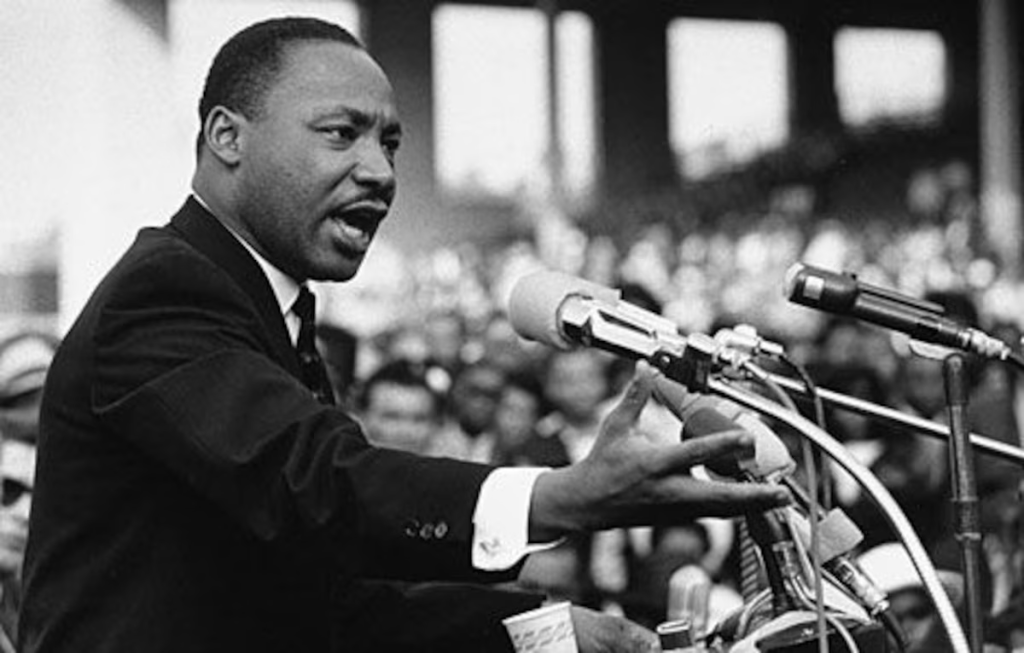
Remembering Dr. King

So the angel swung his sickle into the earth, and cut the vineyard of the earth, and he put what he reaped into the great winepress of God’s passionate anger. (Revelation 14:19, Common English Bible)

One of the things to keep in mind about Dr. Martin Luther, King Jr., especially on this day remembering his life and work, is that he was a committed Christian clergyman who had deep theological roots in everything he said and did.

King’s public speeches were filled with biblical allusions to the Old Testament prophets, and the New Testament writers. In his address to the Selma marchers, he said:

“How long will justice be crucified, and truth bear it?… It will not be long, because truth crushed to earth will rise again. How long? Not long, because you shall reap what you sow… How long? Not long, because the arc of the moral universe is long, but it bends toward justice.

How long? Not long, because: Mine eyes have seen the glory of the coming of the Lord; He is trampling out the vintage where the grapes of wrath are stored; He has loosed the fateful lightning of His terrible swift sword; His truth is marching on. He has sounded forth the trumpet that shall never call retreat; He is sifting out the hearts of men before His judgment seat. O, be swift, my soul, to answer Him! Be jubilant my feet! Our God is marching on.”

It seems to me that Dr. King would clearly understand our present moment in the United States of America. Two months before his assassination, King preached to his Atlanta congregation, stating:

“God didn’t call America to do what she’s doing in the world now.”

Dr. King could say that because he knew the keen distinction between patriotism and nationalism. Patriotism is a critical affirmation of one’s own country with the desire and attempt to help correct it, peacefully and non-violently, when she is in error. Nationalism, however, is an uncritical support of one’s own nation, regardless of any immoral speech or unethical actions in the world.

King was able to hold a fierce patriotic spirit, while at the same time understanding a nationalistic fervor which contradicted true and real patriotism. In his “I Have a Dream” speech of 1963, Dr. King reminded his listeners:

“My dream is deeply rooted in the American dream that one day this nation will rise up and live out the true mean of its creed: ‘We hold these truths to be self-evident, that all men are created equal.’”

Along with King’s hopeful patriotism, he expressed the sad reality of what he saw. Speaking a commencement address to Lincoln University students he said:

“Since the founding fathers of our nation dreamed this noble dream, America has been something of a schizophrenic personality, tragically divided against herself.”

Dr. King warned against a selfish and arrogant nationalism that champions one’s country at the expense of the world’s common welfare. He discerned that such narrow self-interest puts morality and ethical principles on the back burner of policy and practice. And once down that road, a nation will not stop “because of our pride and arrogance as a nation.”

A year before his death, King spoke at New York’s Riverside Church and called for “a worldwide fellowship that lifts neighborly concern beyond one’s tribe, race, class and nation,” insisting that this is “in reality a call for an all-embracing and unconditional love for all men.”

On this Martin Luther King, Jr. Day, I choose to remember that King’s words came from a place of scriptural wisdom which was hewn in the crucible of dedicated study, along with decided Christian conviction and practice that placed him in a long tradition of suffering saints who upheld what is most important in this life.

God’s justice for the weak and powerless, and God’s judgment against oppressive abuse, go hand-in-hand. It behooves us all to know which side of God we are really on.

Justice Remembered (Exodus 12:1-13, 21-28)

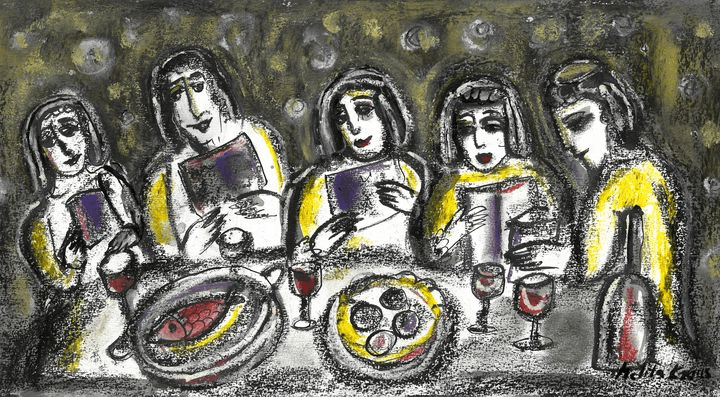
Passover Seder, by Melita Kraus

The Lord said to Moses and Aaron in the land of Egypt, “This month shall mark for you the beginning of months; it shall be the first month of the year for you. Tell the whole congregation of Israel that on the tenth of this month they are to take a lamb for each family, a lamb for each household. If a household is too small for a whole lamb, it shall join its closest neighbor in obtaining one; the lamb shall be divided in proportion to the number of people who eat of it. 

Your lamb shall be without blemish, a year-old male; you may take it from the sheep or from the goats. You shall keep it until the fourteenth day of this month; then the whole assembled congregation of Israel shall slaughter it at twilight. They shall take some of the blood and put it on the two doorposts and the lintel of the houses in which they eat it. 

They shall eat the lamb that same night; they shall eat it roasted over the fire with unleavened bread and bitter herbs. Do not eat any of it raw or boiled in water but roasted over the fire, with its head, legs, and inner organs. You shall let none of it remain until the morning; anything that remains until the morning you shall burn with fire. 

This is how you shall eat it: your loins girded, your sandals on your feet, and your staff in your hand, and you shall eat it hurriedly. It is the Passover of the Lord. I will pass through the land of Egypt that night, and I will strike down every firstborn in the land of Egypt, from human to animal, and on all the gods of Egypt I will execute judgments: I am the Lord. The blood shall be a sign for you on the houses where you live: when I see the blood, I will pass over you, and no plague shall destroy you when I strike the land of Egypt….

Then Moses called all the elders of Israel and said to them, “Go, select lambs for your families, and slaughter the Passover lamb. Take a bunch of hyssop, dip it in the blood that is in the basin, and touch the lintel and the two doorposts with the blood in the basin.

None of you shall go outside the door of your house until morning. For the Lord will pass through to strike down the Egyptians; when he sees the blood on the lintel and on the two doorposts, the Lord will pass over that door and will not allow the destroyer to enter your houses to strike you down. 

You shall observe this as a perpetual ordinance for you and your children. When you come to the land that the Lord will give you, as he has promised, you shall keep this observance. And when your children ask you, ‘What does this observance mean to you?’ you shall say, ‘It is the Passover sacrifice to the Lord, for he passed over the houses of the Israelites in Egypt when he struck down the Egyptians but spared our houses.’ ” And the people bowed down and worshiped.

The Israelites went and did just as the Lord had commanded Moses and Aaron; so they did. (New Revised Standard Version)

The Exodus, by Yoram Raanan

Today’s story of Passover is the highlight of Jewish history concerning both God’s judgment and God’s justice. It is a continual reminder that God is concerned with the divine Name; with his people; and with providing them what they need.

The Lord’s tenth and final plague against the Egyptians was the ultimate judgment of taking their firstborn children. At the same time, the Lord extended great justice to the Israelites by removing the oppressive obstacles which hindered them from having their basic human needs met.

Both God’s judgment and God’s justice were to be annually remembered through rituals established by God. These remembrance rituals of Passover are meant to be brought perpetually to Jewish minds, so that they will maintain a high view of Gods’ Name, and also never be a nation who acts like the Egyptians.

Passover and Exodus constituted a new beginning and new life for Israel. Slaughtering the Passover lamb was the start of liberation for the people; along with the eating of unleavened bread. Both the blood of the lamb, and the absence of leaven, together communicated freedom to the Israelites from God.

Even today, nearly four millennia later, Passover is still celebrated amongst the Jewish community as a great festival of freedom. The primary ritual in this celebration is the seder, an evening meal which involves eating several symbolic foods.

The purpose of coming together to eat special foods is to relive the experience of the Exodus from Egypt. It is a time of passing down the people’s communal memory, as well as reflecting upon God’s divine redemption for them.

The Passover rituals are the root of Christianity’s celebration of communion at the Table. For Christians, the final seder meal of Jesus and his disciples at the Last Supper in the Upper Room is remembered and relived, so that believers may contemplate the Cross of Christ as the ultimate divine redemption.

Table fellowship for both religions – Judaism and Christianity – has a central place in ritual remembrance. God is acknowledged and praised as the great Liberator from oppression. Justice is memorialized. Past events are remembered in order to live justly and rightly in the present.

Deliverance of people from both physical and spiritual slavery is a grand theme throughout all of Holy Scripture. People of freedom are never to let themselves again be placed in bondage. The New Testament puts the matter this way:

For freedom Christ has set us free. Stand firm, therefore, and do not submit again to a yoke of slavery. (Galatians 5:1, NRSV)

The yearning for freedom from oppression and injustice lies within the breast of every human on this earth. It’s why people will go out of their way to use whatever means they have of standing against abusive powers.

It is more than ironic that there are people today who espouse themselves as Christian, yet are hell-bent on using whatever means they have to oppress and abuse others into submission. Such persons are not demonstrating care for the Name of God, especially not the Name of Jesus Christ. Instead, they have another agenda – one that has nothing to do with liberation and freedom.

This is one big reason why we need rituals. Rituals keep us remembering the things we need to remember, and help us forget the things we need to forget.

Earthly power is not the summum bonum of life. Rather, real power is Love. Again, quoting the Apostle Paul from the Book of Galatians:

For you were called to freedom, brothers and sisters, only do not use your freedom as an opportunity for self-indulgence, but through love become enslaved to one another. For the whole law is summed up in a single commandment, “You shall love your neighbor as yourself.” If, however, you bite and devour one another, take care that you are not consumed by one another. (Galatians 5:13-15, NRSV)

Indeed, all that really counts for us in this life is “faith expressing itself through love.” (Galatians 5:6)

Remembering true freedom, and it’s real cost, through established rituals, is perhaps the best way of ensuring that the oppression and injustice of empires like Egypt and Rome do not happen in our present day.

Therefore, if we lose connection with important and seminal events of the past without ritual remembrance, we are setting ourselves up for terrible injustice to occur.

We are better than that. Redemption and remembrance can help show us the way.

Great God of all justice, righteousness, and redemption: Continue to break the yoke of Pharaoh in our time, and forever shatter the bonds of human oppression.. Hasten the Day when we shall all be free, at the coming of your Son, our Lord, Jesus Christ, who with you and the Holy Spirit are one God, now and forever. Amen.

A Calling Is a Sacred Responsibility (2 Kings 9:1-13)

King Jehu

The prophet Elisha called to a member of the group of prophets, “Get ready, take this jug of oil with you, and go to Ramoth-Gilead. When you arrive there, look for Jehu, Jehoshaphat’s son and Nimshi’s grandson. Go to him, then pull him away from his associates, taking him to a private room. Take the jug of oil and pour it on his head. Then say, ‘This is what the Lord has said: I anoint you king of Israel.’ Then open the door, and run out of there without stopping.”

So the young prophet went to Ramoth-Gilead. He came in, and the military commanders were sitting right there. He said, “Commander, I have a word for you.”

“For which one of us?” Jehu asked.

The young prophet said, “For you, Commander.”

So Jehu got up and went inside. The prophet then poured oil on his head and said to him, “This is what the Lord, Israel’s God, says: I anoint you king over the Lord’s people, over Israel. You will strike down your master Ahab’s family. In this way I will take revenge for the violence done by Jezebel to my servants the prophets and to all the Lord’s servants. Ahab’s whole family will die. I will eliminate from Ahab everyone who urinates on a wall, whether slave or free, in Israel. I will make Ahab’s dynasty like the dynasty of Jeroboam, Nebat’s son, and like the dynasty of Baasha, Ahijah’s son. And as for Jezebel: The dogs will devour her in the area of Jezreel. No one will bury her.” Then the young prophet opened the door and ran.

Jehu went out to his master’s officers. They said to him, “Is everything okay?

Why did this fanatic come to you?”

Jehu said to them, “You know the man and the nonsense he talks.”

“That’s a lie!” they said. “Come on, tell us!”

Jehu replied, “This is what he said to me: ‘This is what the Lord says: I anoint you king of Israel.’”

Then each man quickly took his cloak and put it beneath Jehu on the paved steps. They blew a trumpet and said, “Jehu has become king!” (Common English Bible)

The biblical books of 1 & 2 Kings (originally one book of Kings) tells of the kingdoms of Israel and Judah over a five-hundred year period from c.960-586 B.C.E. The dynasties of the house of Omri and the house of Jehu were the longest lasting in Israel.

The books of First and Second Kings are primarily concerned with an evaluation of the 20 kings of Judah and the 19 kings of Israel. Of greatest concern was whether the particular king was loyal to God, or not. If the king tolerated worship of other gods besides Yahweh, and established sacrifices outside of Jerusalem, then that king was evaluated as doing evil in the eyes of the Lord.

This judgment of the kings is consistent with Deuteronomic laws of sole loyalty to God, and the importance of a central location for all Jewish people to worship (in Jerusalem).

To understand why it was so important for Jehu to be anointed with a mission is to know something of the house of Omri, and in particular, the king Ahab and his queen Jezebel. They are both conveyed to us in the biblical text as a power couple who want what they want, without a lot of concern about the subjects of their kingdom.

Jezebel was a follower of Baal and Asherah, not Yahweh. She provided for hundreds of their prophets. Her husband the king was fine with this situation. Jezebel was a clear enemy of God’s prophets, and killed hundreds of them, so that there were only a few left, including Elijah and Elisha (1 Kings 18:13).

Ahab and Jezebel’s powerful misuse of authority is relayed in the story of Naboth (1 Kings 21). Ahab wanted to buy Naboth’s vineyard, which was adjacent to his own land. But Naboth refused to sell, mainly because the land was his family’s ancient generational inheritance.

Jezebel went to work and arranged false witnesses to claim that Naboth had cursed both God and King (which was the ultimate sign of treason in Israel). As a result, Naboth was wrongly stoned to death; and Ahab unjustly confiscated his property.

Elijah prophesied that Ahab’s descendants would die, his dynasty will perish, and that Jezebel would be eaten by dogs (1 Kings 21:17-24). In our story for today, this is alluded to in the reference of God eliminating all that belong to Ahab who “urinate on a wall,” that is, unjustly marking the territory of another as their own property.

Indeed, it all shook-out according to prophecy. Ahab died in battle. Then, Ahab and Jezebel’s son Ahaziah succeeded him as king. Young Ahaziah died two years into his reign, and his brother Jehoram became king. Jehoram was then killed by Jehu. After this, some of Jezebel’s own palace officials tossed her out a window to her death, and dogs descended on her carcass – all to Elijah’s earlier prophecy.

Injustice, unrighteousness, abuse of power, and selfish concerns are ugly nasty business. These sorts of attitudes and behaviors ruin people, and keep others locked into patterns of poverty and powerlessness. God is not okay with any of it.

Whenever we are in the middle of oppression and/or authoritative people abusing their power for their own benefit, its hard to maintain our sense of rightness and goodness. Yet, we must. In such times, patience and perseverance is needed without resorting to attempts of paying back evil with evil.

What’s more, we can find ways of tapping into the spiritual power of God within us, in order to resist and subvert unjust authority with righteousness. To some degree, everyone can do something by employing nonviolent resistance tactics like networking, protest, persuasion, non-cooperation, and speaking out through either speech or writing.

Only those who possess nothing can be entrusted with everything. Systemic evil isn’t changed from the top, because those at the top benefit from the system. Rather, structural evil is transformed through grass roots efforts from the bottom up. What’s more, individuals rarely change from the outside-in, but rather from the inside-out.

A ruling establishment is not always necessarily wrong. Yet, it takes a lot of willing accountability and plenty of intentional soul searching for administrations to remain on the straight and narrow.

Such realities characterized Jehu. He was a non-descript military man. There was nothing, in particular, which distinguished him as having a special calling from God.

Yet, although Jehu fulfilled his calling, he added to the call; the Lord was not pleased with Jehu’s form of violent bloodshed, and so, put an end to Jehu’s house, just as Omri’s house had been purged from Israel.

Power and authority will do that to a person – which is why leaders must be continuously vigilant to guard against developing a thick ego and following their pride.

And so do we. Anyone who receives a call from God has a sacred responsibility and trust to fulfill that calling with competence, care, and conscientiousness.

Almighty God, direct me in all my activity with Your grace, wisdom, and help, so that in all I do and say may glorify Your holy Name; through Jesus Christ our Lord, in the power of the Holy Spirit. Amen.