
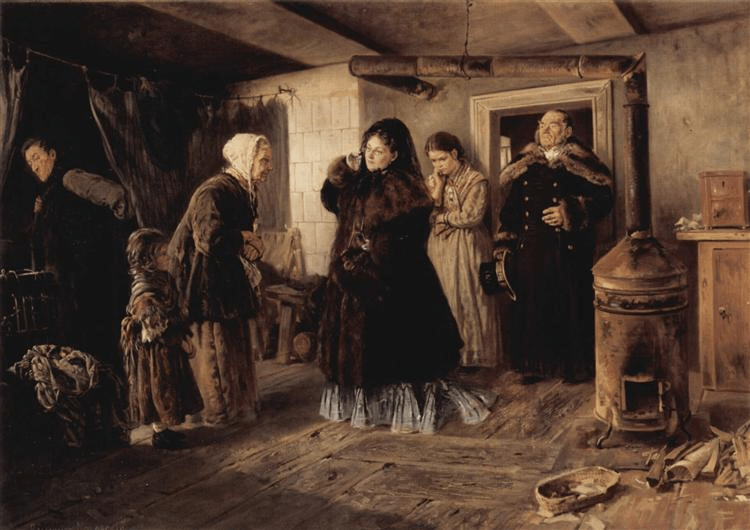
Learn To Do Good (Isaiah 1:1, 10-20)

Visiting a Poor People, by Vladimir Makovsky, 1874

The vision of Isaiah son of Amoz, which he saw concerning Judah and Jerusalem in the days of Uzziah, Jotham, Ahaz, and Hezekiah, kings of Judah…

Hear the word of the Lord,
    you rulers of Sodom!
Listen to the teaching of our God,
    you people of Gomorrah!
What to me is the multitude of your sacrifices?
    says the Lord;
I have had enough of burnt offerings of rams
    and the fat of fed beasts;
I do not delight in the blood of bulls
    or of lambs or of goats.

When you come to appear before me,
    who asked this from your hand?
    Trample my courts no more!
Bringing offerings is futile;
    incense is an abomination to me.
New moon and Sabbath and calling of convocation—
    I cannot endure solemn assemblies with iniquity.
Your new moons and your appointed festivals
    my soul hates;
they have become a burden to me;
    I am weary of bearing them.
When you stretch out your hands,
    I will hide my eyes from you;
even though you make many prayers,
    I will not listen;
    your hands are full of blood.
Wash yourselves; make yourselves clean;
    remove your evil deeds
    from before my eyes;
cease to do evil;
    learn to do good;
seek justice;
    rescue the oppressed;
defend the orphan;
    plead for the widow.

Come now, let us argue it out,
    says the Lord:
If your sins are like scarlet,
    will they become like snow?
If they are red like crimson,
    will they become like wool?
If you are willing and obedient,
    you shall eat the good of the land,
but if you refuse and rebel,
    you shall be devoured by the sword,
    for the mouth of the Lord has spoken. (New Revised Standard Version)

Today’s Old Testament lesson is a stout and ancient warning against an age-old problem: Worshiping properly on a high holy day, yet living an evil and unjust life the rest of the days. It’s the mentality of “I give to God what’s required on the Sabbaths and festivals, so I can therefore do what I want the rest of the time, because that’s my stuff and my time.”

Just to be clear: That sort of evil thinking and behavior will raise the ire of the Lord every time. It’s dichotomous messed-up thinking. It’s the wrongheaded notion of believing that my financial and professional success is obviously a validation of God’s blessing upon me.

However, motives of gaining more wealth, rather than being motivated by humility, meekness, righteousness, purity, mercy, and peacemaking, will end badly, no matter who we are.

One of the problems here is an arrogant assumption that we’re right in what we are doing. We feel justified in living a duplicitous life. I have power, authority, and wealth; you do not. Thus, I’m right; you’re wrong; and I can do whatever the heck I want because God is on my side, not yours.

In terms of contemporary Christianity, this is the megachurch mentality: Since there are so many church attenders and money being placed in the offering plates, this is an unquestioned sanction from God of our rightness.

Then, when Sunday passes and Monday comes, both parishioner and pastor feel justified in using their wealth in ways that are inconsistent with the ways and words of Jesus.

Indeed, many times the name of Jesus is rarely (if ever) used in justifications of living the rich life. A blind eye is turned away from the poor and needy. When pressed, far too many parishioners admit to the belief that the poor are underprivileged because of their own personal sin.

Such “Christians” get away with their injustice before God, largely because there is a mass of churchgoers who honor the wealthy and give them places of authority and power.

They think God has shown favor by “blessing” particular people and communities with wealth (because God would never bless someone with poverty!). This can even go so far as to elect a leader of a nation because he is exorbitantly rich. Never mind his daily immorality, meanness, and lying; God has blessed him, right?

Wrong! So says the prophet Isaiah. Judah and Jerusalem, in their hubris, claimed special status. They are God’s people; others are not. They believed they had divine immunity from judgment. After all, only the Judeans worshiped the Lord; all other nations were pagan worshipers.

But their worship and sacrifices, in Isaiah’s day, were offered with no concern for justice and righteousness. So, God called them to repent; and gave them a chance to learn how to please the Lord.

And what pleases God is removing evil and learning to do good.

“Good” is defined by God as seeking to meet the needs of the common people; rescuing those who are oppressed; defending the cause of the orphan, and pleading the case of the widow. There’s no mention of wealth as a sign of divine blessing.

In reality, Judah’s situation before God was pitiful. They failed, even refused, to do justice, love mercy, and walk humbly. Therefore, the Lord called them to repentance and reformation.

Just because Jerusalem had the temple, this sacred space didn’t inoculate the people from judgment. The bald fact of the matter is that the people were living with self-destructive habits of stupidity. And God had enough of it.

In essence, the Lord said to Judah, “Let’s get serious about this.” Despite all the disobedience, God was willing to entertain the people’s change of heart and life – that is, if they themselves were willing to do so.

It’s important for all of us to “have it out with God,” to engage the Lord forthrightly, passionately, intelligently, and realistically.

There are really only two choices: Choose life or choose death. Choose to connect in meaningful, right, good, and just ways with God and neighbor; or choose to disconnect from others and do whatever the heck you want.

Each of our choices impacts what will happen tomorrow and into the future.

Decisions consistent with justice, righteousness, and goodness will ultimately go well for us. Decision-making borne of selfishness, a lack of mercy, and callousness toward others will create all sorts of problems.

Judah’s practical and existential decision came down to whether they wanted a just and productive society, or an invading Assyrian army. Which would you rather have?

To have a public daily life of disrespect and disregard for the needs of others (and of God!) is to invite being up a stinking creek without a paddle, and no one around to hear the yells for help.

Nothing can ever replace good old-fashioned turning away from hate, unforgiveness, bitterness, and pride; and turning toward what is good, right, just, and godly – and then ordering our collective public life around caring for the least and the lost among us.

May it be so, to the glory of God.

God of judgment and grace, you ask not for sacrifices but lives of trusting faith that acknowledge Your power and mercy. Give us a deep belief in Your sovereign goodness, so that we may follow You all the days of our lives, as did Jesus Christ our Savior and Lord. Amen.

The Healing of the Demoniac (Luke 8:26-39)

Mosaic of the exorcism of the Gerasene demoniac from the Basilica of Sant’Apollinare Nuovo, 6th century C.E.

Then they arrived at the region of the Gerasenes, which is opposite Galilee. As he stepped out on shore, a man from the city who had demons met him. For a long time he had not worn any clothes, and he did not live in a house but in the tombs. 

When he saw Jesus, he cried out and fell down before him, shouting, “What have you to do with me, Jesus, Son of the Most High God? I beg you, do not torment me,” for Jesus had commanded the unclean spirit to come out of the man. (For many times it had seized him; he was kept under guard and bound with chains and shackles, but he would break the bonds and be driven by the demon into the wilds.) 

Jesus then asked him, “What is your name?” He said, “Legion,” for many demons had entered him. They begged him not to order them to go back into the abyss.

Now there on the hillside a large herd of swine was feeding, and the demons begged Jesus to let them enter these. So he gave them permission. Then the demons came out of the man and entered the swine, and the herd stampeded down the steep bank into the lake and was drowned.

When the swineherds saw what had happened, they ran off and told it in the city and in the country. Then people came out to see what had happened, and when they came to Jesus, they found the man from whom the demons had gone sitting at the feet of Jesus, clothed and in his right mind. And they became frightened. Those who had seen it told them how the one who had been possessed by demons had been healed. Then the whole throng of people of the surrounding region of the Gerasenes asked Jesus to leave them, for they were seized with great fear. So he got into the boat and returned. 

The man from whom the demons had gone out begged that he might be with him, but Jesus sent him away, saying, “Return to your home, and declare how much God has done for you.” So he went away, proclaiming throughout the city how much Jesus had done for him. (New Revised Standard Version)

Jesus exorcising the Gerasene demoniac, from the Hitda Codex

Jesus came to this earth to deliver people from all obstacles that gets in the way between us and God, so that humanity may freely connect with the divine, each other, and creation.

Whether it was in the synagogue, in public, in private, in a Jewish community, or in Gentile territory, Christ’s ministry was marked by healing people. He did this so that people could (re)attach themselves to the neighborhood, to God, and even to themselves.

Today’s Gospel story has Jesus take an unexpected trip across the Sea of Galilee to a foreign place full of non-Jewish persons. It was a place marked by all sorts of ritual impurity, and sorts of Gentile practices which a good Jew would have nothing to do with.

So, it’s no surprise, in a heathen setting, that Christ encountered the demonic in the form of a man riddled with demons to the point of being named “Legion.” This confrontation became a type of wild west shootout between the superhuman tortured man and the divinely filled Son of God.

The confrontation was intense. The atmosphere was charged with anticipation that someone wasn’t going to walk away from this shootout. But Jesus knew what he was doing: Christ was about to breakout a man from a demonic prison; and it would not go well for the demons.

In this remote western town, Jesus ended up performing a most extraordinary miracle. It would take a miracle to free this demonized person from his satanic jailcell. The legion of demons, however, were no match for the singular Son of God. Christ had no problem using his authority to exorcise the demons from the victimized man.

The demons exited the man and entered an entire herd of pigs. The herd then proceeded to destroy themselves in a powerful scene of what the demonic is all about. Yet, rather than acknowledging a divine miracle, those who were tending the pigs went and told the people in the area of how this interloper came along and upset the status quo. Instead of seeing a delivered man, the pig herders could only see dead swine.

As a result of the pig herders report, the folks in nearby towns wanted nothing to do with Jesus. The people begged him to get out of town. Christ purged the region of a significant presence of bad guys, and all the townspeople could do was fear for what might happen.

But despite the townspeople’s and pig herders’ disturbing lack of faith, there was one man who became a committed disciple of Jesus on the spot. The demoniac, now turned new citizen of God’s kingdom, saw Christ for who he was, and immediately discerned to whom he belonged – not the demonic world but the kingdom of heaven.

Although the newly delivered man begged to remain with Jesus, the Lord had another plan for the new disciple. Christ sent him back to his home to proclaim what God had done for him. In doing so, the man would become a powerful witness to God’s power. And, important for the man, old broken familial and community relations could be renewed and restored. The healing would come full circle.

If we bear witness to the works of God, where we are, it will bear fruit – even if it is among folks who may be in opposition to it.

Not even a legion of demons could keep Christ from restoring a tortured person to himself, his family, and his community. And it all happened on the demons’ turf. Nothing can stop the kingdom of God from expanding it’s good reach over all that is evil.

The good news of Christianity is that Jesus has the power to bring life from death. Christ has the ability to put us in a position where we can reconnect with both the human community and the divine realm.

The satanic in this world is not nearly as powerful as God; and the demons are under Christ’s authority. In fact, there is no power on earth (or under the earth) that can overcome the strength of the almighty God. This can be a comforting thought for every Christian.

Anyone afraid of Jesus has not yet discerned that he is inherently good. Ultimate power needs to be seen in the light of ultimate good. Otherwise, a person will walk around much like the demoniac, oppressed in their soul.

Instead, deliverance from the evil which vexes us is possible. For nothing is impossible with God. Whenever and wherever the healed person becomes a healer to others, then we know that the kingdom of heaven is among us.

Hear our prayers, God of power and might. Through the ministry of your Son, free us from the grip of the tomb, so that we may desire you as the fullness of life, and proclaim your saving deeds to all the world in the strength of the Holy Spirit. Amen.

Our Help Is In the Name of the Lord (Psalm 124)

If it had not been the Lord who was on our side
    —let Israel now say—
if it had not been the Lord who was on our side,
    when our enemies attacked us,
then they would have swallowed us up alive,
    when their anger was kindled against us;
then the flood would have swept us away;
    the torrent would have gone over us;
then over us would have gone
    the raging waters.

Blessed be the Lord,
    who has not given us
    as prey to their teeth.
We have escaped like a bird
    from the snare of the hunters;
the snare is broken,
    and we have escaped.

Our help is in the name of the Lord,
    who made heaven and earth. (New Revised Standard Version)

Today’s Psalm reminds believers of God’s deliverance in the past, so that we will not forget it in the present. If it were not for God, we would be toast. If not for God, none of us would be here; we’d be swallowed up by injustice and death.

Left on our own, and to our own devices, we don’t stand a chance against the oppressive flood of sinful sewage. But with God, there is hope; with God there is deliverance.

The ancient Israelites – and all the Jewish people throughout history – know a great deal of what it feels like to be overwhelmed by their enemies. Antisemitism is nothing new. Unfortunately, it has been around as long as Jews have existed. If some groups had their way, Israel would be wiped off the map.

The psalmist reminds Israel, as well as all of God’s people, of what the Lord has done in the past. Exhibit A of divine deliverance is the Exodus event and passing through the Red Sea to safety. The mighty Egyptians were no match for the God of Israel.

Each year, ever since that seminal deliverance from Israel’s enemies, Jews celebrate Passover, remembering and rehearsing this event of deliverance from the hand of Pharaoh. As pilgrims made their way to Jerusalem for the great Passover feast, they would sing Psalm 124, along with the other Songs of Ascent, giving praise to God for being attentive to their plight of slavery and oppression.

It is more than appropriate to give thanks and bless the Lord for the divine work of deliverance from enemies. God’s people are freed. For the Christian, God in Christ has delivered us from sin, death, and hell; and has made us joint heirs with Jesus.

When this perishable body puts on imperishability and this mortal body puts on immortality, then the saying that is written will be fulfilled:

“Death has been swallowed up in victory.”
“Where, O death, is your victory?
    Where, O death, is your sting?”

The sting of death is sin, and the power of sin is the law. But thanks be to God, who gives us the victory through our Lord Jesus Christ.

Therefore, my beloved brothers and sisters, be steadfast, immovable, always excelling in the work of the Lord because you know that in the Lord your labor is not in vain. (1 Corinthians 15:54-58, NRSV)

Recalling what God has done for us is a powerful part of the believer’s identity. The very Maker of heaven and earth, the Lord God almighty, is our help. It is God who prevails against those who seek to destroy and do harm. The Lord is the One who conquers enemies and makes things right.

The believer puts no trust in the power of weapons or in being the strongest. God is acknowledged as the true Deliverer from even the most formidable of foes, despite any power of the unjust.

In Christianity, Christ’s redemptive events of cross and resurrection has triumphed and won the victory over the powerful enemies of death, destruction, and the devil. Praising and singing to God is helpful and needed.

We all need help – not just sometimes but all the time. If we feel as if things are going pretty well for us, that only means we have just come out of a difficult time, or that we are about to undergo some enemy vitriol.

I wish we didn’t have to contend with selfish boneheads who only think of themselves all the time. But we do. And I wish we never needed to go through such hard times that grind us into the ground. Yet it happens.

However, we are not alone. We have a Champion, an Advocate, and One who has gone before us as the Pioneer of our salvation.

He has raised up a mighty savior for us
    in the house of his child David,
as he spoke through the mouth of his holy prophets from of old,
    that we would be saved from our enemies and from the hand of all who hate us. (Luke 1:69-71, NRSV)

Jesus did for us what we could do for ourselves. He willingly and deliberately let all evil exhaust itself on him, so that there is no enemy left to condemn us.

Enemies may still be around, but they are toothless. We may yet be like birds vulnerable to a trap, but the snare has been broken. All our enemies are powerless. We are free. Thanks be to God!

Our help is in the name of the Lord who made heaven and earth. Amen.

There Is No Other God (Daniel 3:1-30)

Shadrach, Meshach, and Abednego are thrown into a fiery furnace, by Chris Torre

King Nebuchadnezzar made a gold statue. It was ninety feet high and nine feet wide. He set it up in the Dura Valley in the province of Babylon. King Nebuchadnezzar then ordered the chief administrators, ministers, governors, counselors, treasurers, judges, magistrates, and all the provincial officials to assemble and come for the dedication of the statue that he had set up.

So the chief administrators, ministers, governors, counselors, treasurers, judges, magistrates, and all the provincial officials assembled for the dedication of the statue that King Nebuchadnezzar had set up. They stood in front of the statue the king had set up.

The herald proclaimed loudly: “Peoples, nations, and languages! This is what you must do: When you hear the sound of the horn, pipe, zither, lyre, harp, flute, and every kind of instrument, you must bow down and worship the gold statue that King Nebuchadnezzar has set up. Anyone who will not bow down and worship will be immediately thrown into a furnace of flaming fire.”

So because of this order as soon as they heard the sound of the horn, pipe, zither, lyre, harp, flute, and every kind of instrument, all the peoples, nations, and languages bowed down and worshipped the gold statue that King Nebuchadnezzar had set up.

At that moment some Chaldeans came forward, seizing a chance to attack the Jews. They said to King Nebuchadnezzar:

“Long live the king! Your Majesty, you gave a command that everyone who hears the sound of the horn, pipe, zither, lyre, harp, flute, and every kind of instrument should bow down and worship the gold statue. Anyone who wouldn’t bow and worship would be thrown into a furnace of flaming fire. Now there are some Jews, ones you appointed to administer the province of Babylon—specifically, Shadrach, Meshach, and Abednego—who have ignored your command. They don’t serve your gods, and they don’t worship the gold statue you’ve set up.”

In a violent rage Nebuchadnezzar ordered them to bring Shadrach, Meshach, and Abednego. They were brought before the king.

Nebuchadnezzar said to them: “Shadrach, Meshach, and Abednego: Is it true that you don’t serve my gods or worship the gold statue I’ve set up? If you are now ready to do so, bow down and worship the gold statue I’ve made when you hear the sound of horn, pipe, zither, lyre, harp, flute, and every kind of instrument. But if you won’t worship it, you will be thrown straight into the furnace of flaming fire. Then what god will rescue you from my power?”

Shadrach, Meshach, and Abednego answered King Nebuchadnezzar: “We don’t need to answer your question. If our God—the one we serve—is able to rescue us from the furnace of flaming fire and from your power, Your Majesty, then let him rescue us. But if he doesn’t, know this for certain, Your Majesty: we will never serve your gods or worship the gold statue you’ve set up.”

Nebuchadnezzar was filled with rage, and his face twisted beyond recognition because of Shadrach, Meshach, and Abednego. In response he commanded that the furnace be heated to seven times its normal heat. He told some of the strongest men in his army to bind Shadrach, Meshach, and Abednego and throw them into the furnace of flaming fire. 

So Shadrach, Meshach, and Abednego were bound, still dressed in all their clothes, and thrown into the furnace of flaming fire. (Now the king’s command had been rash, and the furnace was heated to such an extreme that the fire’s flame killed the very men who carried Shadrach, Meshach, and Abednego to it.) So these three men, Shadrach, Meshach, and Abednego, fell, bound, into the furnace of flaming fire.

Then King Nebuchadnezzar jumped up in shock and said to his associates, “Didn’t we throw three men, bound, into the fire?”

They answered the king, “Certainly, Your Majesty.”

He replied, “Look! I see four men, unbound, walking around inside the fire, and they aren’t hurt! And the fourth one looks like one of the gods.” Nebuchadnezzar went near the opening of the furnace of flaming fire and said, “Shadrach, Meshach, and Abednego, servants of the Most High God, come out! Come here!”

Then Shadrach, Meshach, and Abednego came out of the fire. The chief administrators, ministers, governors, and the king’s associates crowded around to look at them. The fire hadn’t done anything to them: their hair wasn’t singed; their garments looked the same as before; they didn’t even smell like fire!

Nebuchadnezzar declared: “May the God of Shadrach, Meshach, and Abednego be praised! He sent his messenger to rescue his servants who trusted him. They ignored the king’s order, sacrificing their bodies, because they wouldn’t serve or worship any god but their God. I now issue a decree to every people, nation, and language: whoever speaks disrespectfully about Shadrach, Meshach, and Abednego’s God will be torn limb from limb and their house made a trash heap, because there is no other god who can rescue like this.”

Then the king made Shadrach, Meshach, and Abednego prosperous in the province of Babylon. (Common English Bible)

Daniel’s three companions in the fiery furnace, by Adrianoupolitis Konstantinos, 1725

At the core of today’s story, and of the entire book of Daniel, is the assertion and demonstration that there is no other God but Yahweh.

King Nebuchadnezzar believed that he himself was big stuff. It turns out, not so much. Even the great king ended up confessing that there is no other god who is able to deliver like the God of Shadrach, Meshach, and Abednego. When the mighty king looked into the fire, all of his pomp and control and wrath and power proved to be nothing before the One God of all.

The earthly king threw all of his weight into showing how powerful and great he could be; and all of that unleashing of kingly destructive force did absolutely nothing to even singe the hair of the three worshipers of God.

Nebuchadnezzar did a lot of talking, a lot of posturing, and showed a lot of anger. Conversely, God said nothing, and was supremely successful over him. Turns out that Nebuchadnezzar was only a little yippee puppy barking in front of the large Mastiff dog who could squish him with but a movement of his paw if he wanted.

The experience of King Nebuchadnezzar is a telling lesson on all earthly rulers who presume to be supreme and all-powerful in their position.

And even in the great king’s confession of God’s true might and power, it’s almost tongue-in-cheek, as if Nebuchadnezzar himself is delusional enough to think that he’s the one who is setting up God as God. For those who are familiar with the prophecy of Daniel, they know what’s coming up in Nebuchadnezzar’s future that will purge him of that idea once and for all.

In truth, whatever strength Nebuchadnezzar had, it was God-given. In reality, you and I are recipients of God’s grace and strength; not a one of us conjured up our own success.

Things like a pompous attitude, a spirit of self-centeredness, and a position of hubris are totally out of sync with the values of God’s rule and reign on this earth. We fret and strut upon the stage of this planet in vain; the Lord is really the One who holds it all. Carrying the world on our shoulders is to be way out of touch with our job description as humans. Such a thing will only make us look as foolish as old King Nebuchadnezzar.

In between a rock and a hard place, within the throes of trouble, there is no step by step formula in dealing with it. Even in searching for clear instructions betrays that we desire to have situations within our own control. Shadrach, Meshach, and Abednego did not presume upon God, but fully trusted God and knew that they had no control over the circumstance other than choosing their own attitude in it.

All of the officials had gathered before Nebuchadnezzar’s statue; but by the end of the story they stood as witnesses to the work of the true God. Their worship of the statue had gained them nothing; they ended up under a new threat from Nebuchadnezzar. The king commended Shadrach, Meshach, and Abednego’s defiance of his decree, but followed it with a new decree commanding the worship of their God.

King Nebuchadnezzar commanded others, but he himself did not worship. His death-threat is hardly a fitting way to bring people to worship the true God. That sort of behavior ought to highly instruct us in this American  election year cycle.

The oppressor does not have the last word. God creates a future beyond oppressive human systems.

Sovereign Lord, I pray that You will right all wrongs taking place in our world; and vindicate those being treated unjustly. Keep us from taking matters into our own hands, for vengeance is Yours, not mine. In Your grace and mercy, give justice and peace to all who have been cruelly and unfairly treated by their fellow humanity. May injustice and carelessness end, and may all people be drawn into Your saving arms of grace. Amen.