Rebellion In the Community (Numbers 16:1-19)

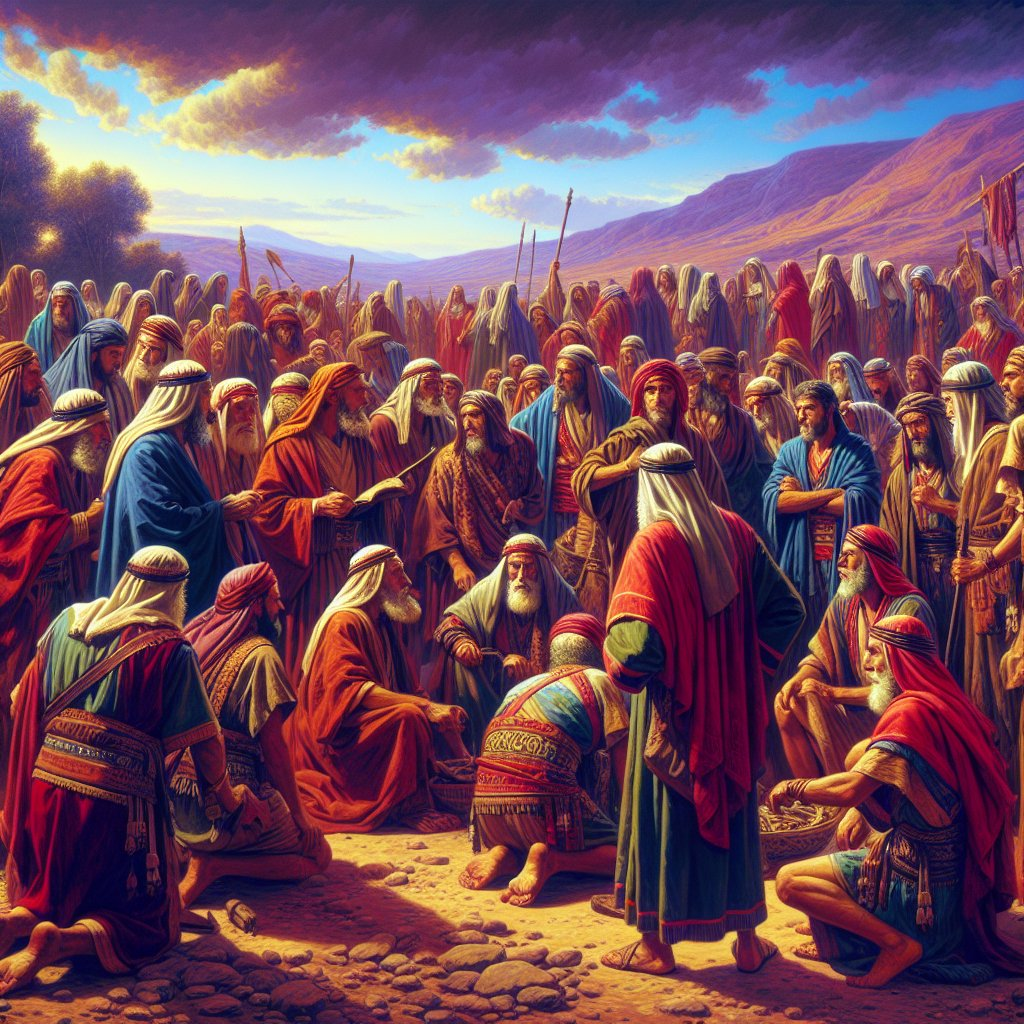
Korah and His Company Refuse to Obey Moses, by Wheatfield Media

Korah son of Izhar, the son of Kohath, the son of Levi, and certain Reubenites—Dathan and Abiram, sons of Eliab, and On son of Peleth—became insolent,and rose up against Moses. With them were 250 Israelite men, well-known community leaders who had been appointed members of the council. 

They came as a group to oppose Moses and Aaron and said to them, “You have gone too far! The whole community is holy, every one of them, and the Lord is with them. Why then do you set yourselves above the Lord’s assembly?”

When Moses heard this, he fell facedown. Then he said to Korah and all his followers: “In the morning the Lord will show who belongs to him and who is holy, and he will have that person come near him. The man he chooses he will cause to come near him. You, Korah, and all your followers are to do this: Take censers and tomorrow put burning coals and incense in them before the Lord. The man the Lord chooses will be the one who is holy. You Levites have gone too far!”

Moses also said to Korah, “Now listen, you Levites! Isn’t it enough for you that the God of Israel has separated you from the rest of the Israelite community and brought you near himself to do the work at the Lord’s tabernacle and to stand before the community and minister to them? He has brought you and all your fellow Levites near himself, but now you are trying to get the priesthood too. It is against the Lord that you and all your followers have banded together. Who is Aaron that you should grumble against him?”

Then Moses summoned Dathan and Abiram, the sons of Eliab. But they said, “We will not come! Isn’t it enough that you have brought us up out of a land flowing with milk and honey to kill us in the wilderness? And now you also want to lord it over us! Moreover, you haven’t brought us into a land flowing with milk and honey or given us an inheritance of fields and vineyards. Do you want to treat these men like slaves? No, we will not come!”

Then Moses became very angry and said to the Lord, “Do not accept their offering. I have not taken so much as a donkey from them, nor have I wronged any of them.”

Moses said to Korah, “You and all your followers are to appear before the Lord tomorrow—you and they and Aaron. Each man is to take his censer and put incense in it—250 censers in all—and present it before the Lord. You and Aaron are to present your censers also.” 

So each of them took his censer, put burning coals and incense in it, and stood with Moses and Aaron at the entrance to the tent of meeting. When Korah had gathered all his followers in opposition to them at the entrance to the tent of meeting, the glory of the Lord appeared to the entire assembly. (New International Version)
By Bible Art

I must admit that, having been a church pastor for decades, today’s story sounds eerily like several parishioners I’ve known over the years. They, along with the story’s antagonist Korah, strike me as ungrateful and continually concerned about angling for more power and authority within the community.

Rebellions are nothing new. They happen everywhere, from faith communities to neighborhood associations, from local politics to national governments.

The Book of Numbers is a rather depressing part of the Bible, largely because of the nature of the Israelite grumblings, without much gratitude happening.

The murmurings turned to complaints, and then to outright rebellion. It seems to have been a pattern with the Israelites in the desert. The animosities were directed against God or Moses, and sometimes both.

In each one of the various stories of rebellion in the desert, the rebellious people died in various ways by means of a plague, a fire, or in a battle. We get the sense with today’s story that a whopper of a divine judgment is going to happen.

The punishments mentioned in the Old Testament are meant to highlight, with rather strong illustrations, that the political and religious systems set up through the covenant code were divinely originated and sanctioned. In other words, don’t mess with God’s authority.

So then, a rebellion against Moses and Aaron was, in reality, a rebellion against God. And it would bring divine wrath on the rebels.

Having been in various leadership capacities in my life, to me the most insidious kind of rebellion is the subtle sort. Authority is challenged indirectly, in passive-aggressive forms through gossip, back-biting, and building a coalition from false information.

I also think that those subtle forms of rebellion really upset God. Which is why the Lord extended divine wrath on such rebels.

Korah was a Levite, like Moses. But that is about all he had in common with Israel’s leader. Korah’s rebellion was precisely directed against the leadership of Moses (and Aaron).

Similar to many arguments I’ve encountered throughout my ministerial life, Korah framed his argument with pious sounding language – as if Moses was the problem the one opposed to holiness.

Lord, have mercy. I really do despise religious gaslighting.

Korah implied that Moses was raising himself above the others, that the entire Israelite community was holy, therefore, there’s no need for a leader like Moses. The people’s holiness is enough. That’s all anybody needs, right?

Apparently, no.

Neither Moses nor Aaron dealt with the argument. Rather, Moses was satisfied to leave the matter with God as to what to do with the rebels.

It’s always good to let God reaffirm God’s own way of doing things. It was God who raised up Moses, and it would be God to whom Korah would have to answer.

The reason these sorts of situations keep popping up in every generation of history is that they deal with a problem which all humans encounter. Every person, group, faith community, and nation must contend with the tension between authority and freedom.

Like so many arrogant demagogues, Korah believed he was the guardian of freedom – and that the people ought to follow him. Yet, even though many did, the most important person in the room, God, did not.

Give peace in our time, O good and gracious God, a peace which the world cannot give. To those who have taken up arms in anger or revenge, or even in the cause of justice, grant the grace of conversion to the path of peaceful dialogue and constructive collaboration. And to those who are victims of human cruelty, open wide your arms and enfold them in the embrace of your compassion, healing, and life. Amen.

Be Ready (Mark 13:9-23)

Art by Mark Keathley

“As for yourselves, beware, for they will hand you over to councils, and you will be beaten in synagogues, and you will stand before governors and kings because of me, as a testimony to them. And the good news must first be proclaimed to all nations. 

“When they bring you to trial and hand you over, do not worry beforehand about what you are to say, but say whatever is given you at that time, for it is not you who speak but the Holy Spirit. 

“Sibling will betray sibling to death and a father his child, and children will rise against parents and have them put to death, and you will be hated by all because of my name. But the one who endures to the end will be saved.

“But when you see the desolating sacrilege set up where it ought not to be (let the reader understand), then those in Judea must flee to the mountains; the one on the housetop must not go down or enter to take anything from the house; the one in the field must not turn back to get a coat. Woe to those who are pregnant and to those who are nursing infants in those days! Pray that it may not be in winter. 

“For in those days there will be suffering, such as has not been from the beginning of the creation that God created until now and never will be. And if the Lord had not cut short those days, no one would be saved, but for the sake of the elect, whom he chose, he has cut short those days. 

“And if anyone says to you at that time, ‘Look! Here is the Messiah!’ or ‘Look! There he is!’—do not believe it. False messiahs and false prophets will appear and produce signs and wonders, to lead astray, if possible, the elect. But be alert; I have already told you everything. (New Revised Standard Version)

The genuineness and strength of one’s faith is demonstrated through the testing of it. A believer’s faith must and will be tried. How will that faith hold up when the world is angry and pours out its hate against them?

Jesus teaching in the Temple, by Willem van Herp (1614-1677)

The follower of Jesus will undergo afflictions and be oppressed by others. They will suffer.

Since that is true, the Christian must ensure that whatever suffering they endure is not because they have been obnoxious and unhelpful to people in this world; but that they are suffering because of their commitment to the words and ways of Jesus, because of their humility, gentleness, righteousness, purity, mercy, and peace.

Christians are meant to bear the cross, so that they may be conformed to the image of their Lord Jesus. There will be times when believers are the brunt of ungodly rage and fury, gossip and slander, opposition and injustice.

Jesus was warning his disciples that they needed to be prepared for endurance, to persevere over the long haul for their faith in him. Otherwise, they might be overwhelmed by temptation.

Christ followers are to remain steady in their purpose of living into the words of Jesus, and living out his ways in a world that prizes the opposite of Christian values.

The godly person values humility. The ungodly persons values pride.

The godly grieve and mourn over injustice in the world. The ungodly celebrate getting ahead by any means possible in this world.

The godly are meek. The ungodly are mean.

The godly seek right relationships with God and others. The ungodly leverage relationships to get what they want.

The godly prize mercy. The ungodly champion being merciless.

The godly are pure in heart. The ungodly have spiders in their heart, and garlic in their soul.

The godly engage in peacemaking. The ungodly engage in warmongering.

The godly end are persecuted for embracing the virtues of Jesus. The ungodly are the persecutors of good people.

The godly will be comforted, inherit the earth, receive mercy, see God, and belong to the kingdom of heaven. The ungodly will be judged, inherit the wind, receive condemnation, see nothing, and belong to the kingdom of darkness.

Sermon on the Mount, by Jorge Cocco Santángelo

The Lord wants us relieved of anxiety, and cheerfully living life with our burdens laid upon Jesus, for he gently and ably carries them. We can cast all our cares on him, because he cares for us. (Matthew 11:28-30; 1 Peter 5:7)

Whenever we are in the position of being afflicted by others, wisdom shall be granted to the godly who follow in the way of Christ.

The grace of God exists for those who seek to do justice, love mercy, and walk humbly. But there is nothing for the proud and arrogant, who believe they themselves are sufficient – because they refuse to receive any gift of God being offered to them.

All sorts of false prophets come along to try and deceive the godly into listening and following them. They make empty promises and blame others for unwanted situations. Know that whatever they say about others, is actually true of themselves.

So, when they accuse another of lying, cheating, stealing, murdering, etc. you can be sure that this is precisely what they themselves do to get ahead and get what they want in this life. Therefore, don’t be tempted by any rhetoric which demeans others.

Love of God and humanity is to be kindled hot, and not cooled through ingratitude and treachery. For whenever courage is weakened, a flood of violent speech and behavior follows.

We must strive against anything which harms the whole of humanity, and puts God at a distance. Instead, good news needs to be proclaimed.

The end will eventually come. Yet, we need not wander around in darkness, as if we don’t know what to do or where to go. We will indeed go through testing and many trials to our faith.

The desolating sacrilege, the abomination of desolation, will appear – which will be the sign that the time is short. An abomination, or desolation, means to profane something, to make it unclean or impure, to treat a holy thing as if it were simply not significant nor important.

In other words, whenever and wherever corruption is rife, and people (and God) are treated as disposable, then you know destruction is at hand. Thus, you must flee, because there is danger.

In such a situation, the rule of law will not help you. Services which were once helpful will be abolished and thrown away like garbage. And it could all happen rather quickly. So, don’t run back and try to save pieces of that previous life and existence; it isn’t worth it. You life is on the line.

Malicious motives and meanness of heart have no intention for the common good of all persons on this earth. A few people want what they want, and they don’t care who gets hurt in the process.

None of this awful behavior will go on forever. God’s judgment can and will deal with it. Yet, no one knows the time or date when that judgment will be rendered. For the sake of the godly, those days will be shortened.

Jesus was not attempting scare his disciples, but to exhort and arouse them to beware of the ungodly; and to keep watch, so that they would not fall into temptation and have their faith weakened.

As believers, we may experience troubles, but we need not be troubled.

The Good Shepherd of the sheep, Jesus Christ, is watching over us so that we don’t need to become distressed and discouraged.

My sheep hear my voice. I know them, and they follow me. I give them eternal life, and they will never perish. No one will snatch them out of my hand. My Father, in regard to what he has given me, is greater than all, and no one can snatch them out of the Father’s hand.  (John 10:27-29, NRSV)

The permanence of our deliverance from guilt, shame, sin, death, and hell does not depend on any of us. It is relies firmly upon the grace of God in Christ. And none who have been given to God shall perish. (John 17:12)

Be encouraged. But also be ready.

Keep watch, dear Lord, with those who work, or watch, or weep this night, and give your angels charge over those who sleep. Tend the sick, Lord Christ; give rest to the weary, bless the dying, soothe the suffering, pity the afflicted, shield the joyous; and all for your love’s sake. Amen.

The Parable of the Sower (Mark 4:1-20)

The Sower, by Mike Moyers

Again Jesus began to teach by the lake. The crowd that gathered around him was so large that he got into a boat and sat in it out on the lake, while all the people were along the shore at the water’s edge. He taught them many things by parables, and in his teaching said:

“Listen! A farmer went out to sow his seed. As he was scattering the seed, some fell along the path, and the birds came and ate it up. Some fell on rocky places, where it did not have much soil. It sprang up quickly because the soil was shallow. But when the sun came up, the plants were scorched, and they withered because they had no root. Other seed fell among thorns, which grew up and choked the plants, so that they did not bear grain. Still other seed fell on good soil. It came up, grew and produced a crop, some multiplying thirty, some sixty, some a hundred times.”

Then Jesus said, “Whoever has ears to hear, let them hear.”

When he was alone, the Twelve and the others around him asked him about the parables. He told them, “The secret of the kingdom of God has been given to you. But to those on the outside everything is said in parables so that,

“‘they may be ever seeing but never perceiving,
    and ever hearing but never understanding;
otherwise they might turn and be forgiven!’”

Then Jesus said to them, “Don’t you understand this parable? How then will you understand any parable? The farmer sows the word. Some people are like seeds along the path, where the word is sown. As soon as they hear it, Satan comes and takes away the word that was sown in them. Others, like seed sown on rocky places, hear the word and at once receive it with joy. But since they have no root, they last only a short time. When trouble or persecution comes because of the word, they quickly fall away. Still others, like seed sown among thorns, hear the word; but the worries of this life, the deceitfulness of wealth and the desires for other things come in and choke the word, making it unfruitful. Others, like seed sown on good soil, hear the word, accept it, and produce a crop—some thirty, some sixty, some a hundred times what was sown.” (New International Version)

The Sower, by Johne Richardson

All four of the New Testament Gospels have their own particular angle and focus upon the life of Jesus Christ. For Mark, he wrote to demonstrate and prove the established authority of Christ over everything.

God’s power is expressed in and through Christ. So, when Mark tells a story, he is concerned to communicate that God’s kingdom – God’s rule and reign on this earth – comes through Jesus as the Sovereign over this realm of the universe and our world.

By means of a parable – a farmer going out and scattering seeds – Jesus was making some points about the kingdom of God: it will be successful; it is thoroughly under divine control; and it’s inclusive.

God’s Reign Will Succeed

History is inexorably moving toward a climax. God’s sovereign rule has broken into human history. Christ’s authoritative rule is taking root, growing, and shall eventually envelope all the world.

It may not presently seem as if that’s going to happen. But appearances can be deceiving. Although much, if not most, of the good gospel seeds spread about this earth never produce a harvest of righteousness, there is enough good soil for those seeds to succeed.

Even though there is a lot of unproductive and ineffective soil in this world, good seeds in good soil will germinate and take root. They will grow, develop, mature, and ripen. An abundant yield of crops will more than satisfy the needs of the earth. And it will blow the imagination of even the wisest and best farmer.

One person, having realized the incredible fruit of the Spirit, makes a broad, deep, and expansive impact on dozens, hundreds, thousands, tens of thousands, and even millions of people. It certainly doesn’t happen overnight; but goodness, truth, beauty, and righteousness are making their way slowly – and will overtake and overwhelm all evil.

If you make disciples who make more disciples, that is multiplication. Jesus made disciples, and called his followers to do the same. He spent three years training twelve men; and then commissioned them to go out and reproduce the process with others. (Matthew 28:18-20)

Beginning in Jerusalem, the earliest disciples of Jesus began making more disciples, following Christ’s ascension, and that movement has never stopped. Jesus started a movement of a few seeds multiplying into many seeds, so that the Church would grow exponentially. Not even the gates of hell can stop the process from happening. (Acts 1:1-8; Matthew 16:17-19)

God’s Reign Is Ruled by God

That may seem like a ridiculously obvious statement, yet it still needs to be said. God is authoritatively in control, not only of God’s own kingdom, but of all things. This means that God’s rule and reign is the result of God’s action, not ours. The only thing we need to do is scatter the seed and be a simple farmer. Everything else is up to God.

Our ability to do anything is animated by God’s gracious work in our lives. The power to effect making disciples comes from the Lord. Since we are dependent upon God for our next breath, we are also completely under the authority and sustaining presence of God for everything in life.

Both the subject and object of every biblical story is God. In this unfolding drama of redemptive history that we are experiencing, God is the writer, producer, director, and lead actor; we only have some bit parts in the whole thing. It’s our job to respond – and not to try and take over the show.

God’s Reign Is Inclusive

When gospel seeds are established in good soil, eventually producing an abundant harvest, it will feed the entire world. It will include all kinds of people. The produce which is available is not limited to a particular group of people. God’s grace and goodness are shown to people without prejudice or favoritism.

The best things in life begin as small as a mustard seed. That’s because every good thing we have is a result of humility. And from that place – the hummus of the earth – God creates life, gives new life, and does the improbable and the impossible of transforming a tiny little seed into a tall expansive plant which blesses many.

Conclusion

As simple humble farmers of faith, we need to pay attention to what we have, so that we don’t become complacent. The forces of evil – the spiritual tornados and tsunamis – are still very much active on this earth. Those powers temporarily oppose the good power and authority of Christ.

The good word spread to us can be snatched and taken away by the ravens of Satan. Although other good words make some effective headway, all the weeds around them can choke the plants until they wither and die. All sorts of existential conditions surrounding the plants can cause a failure to thrive.

Whenever Christians face opposition – or when they observe young believers lost to those surrounding forces – they need not become discouraged. Why? Because this is all a part of the ministry to which every follower of Jesus is called. Our part is to keep sowing and planting. The rest is up to God.

Sovereign and almighty God:
Give me strength to live faithfully this day;
Let me not turn coward because of difficulties, or become irresponsible to my duties;
Let me not lose faith in other people;
Keep me sweet and sound of heart, in spite of ingratitude, treachery or meanness;
Preserve me from minding little stings or giving them;
Help me to keep my heart clean and to live so honestly and fearlessly that no outward failure can dishearten me or take away the joy of conscious integrity;
Open wide the eyes of my soul that I may see good in all things;
Grant me this day some new vision of your truth;
Inspire me with the spirit of joy and gladness, and make me the fertilizer to suffering souls; in the name of the strong Deliverer, our only Lord and Savior, Jesus Christ. Amen.

Dealing with a Clash of Belief (Acts 3:17-4:4)

“And now, friends, I know you had no idea what you were doing when you killed Jesus, and neither did your leaders. But God, who through the preaching of all the prophets had said all along that his Messiah would be killed, knew exactly what you were doing and used it to fulfill his plans.

“Now it’s time to change your ways! Turn to face God so he can wipe away your sins, pour out showers of blessing to refresh you, and send you the Messiah he prepared for you, namely, Jesus. For the time being he must remain out of sight in heaven until everything is restored to order again just the way God, through the preaching of his holy prophets of old, said it would be. Moses, for instance, said, ‘Your God will raise up for you a prophet just like me from your family. Listen to every word he speaks to you. Every last living soul who refuses to listen to that prophet will be wiped out from the people.’

“All the prophets from Samuel on down said the same thing, said most emphatically that these days would come. These prophets, along with the covenant God made with your ancestors, are your family tree. God’s covenant-word to Abraham provides the text: ‘By your offspring all the families of the earth will be blessed.’ But you are first in line: God, having raised up his Son, sent him to bless you as you turn, one by one, from your evil ways.”

While Peter and John were addressing the people, the priests, the chief of the Temple police, and some Sadducees came up, indignant that these upstart apostles were instructing the people and proclaiming that the resurrection from the dead had taken place in Jesus. They arrested them and threw them in jail until morning, for by now it was late in the evening. But many of those who listened had already believed the Message—in round numbers about five thousand! (The Message)

I believe a lack of self-awareness is at the middle of a great many sins in this world. A lot of folks just simply do not realize how they come across to others; what impact their words and actions have upon others; and their illogical and nonsensical forms of thinking.

It’s frustrating and maddening for those who can see the blind spots in another’s life. And, keep in mind, it’s the same for others concerning some area of thought or dogmatic belief we may hold to, as well.

Recently, I had one of those surreal conversations. I had made a statement, quoting a verse from one of the New Testament Gospels about what Jesus said. Later in the day, a person who heard me say it, approached me and emphatically stated, “Jesus never said that.”

Even though I went directly to the verse and read it, the person then stated, “But that’s not from the King James or New King James Version.” So, I went to the New King James and read it. “You have to go to the King James because that’s the most reliable.” And then, after reading it there, the person dogmatically stated, “Well, that was added by a scribe. Jesus didn’t really say that.”

Even after all this, and pointing the person toward the field of textual criticism and how languages get translated, they still refused to consider the evidence right in front of their face. Yes, indeed, it is maddening! (Note: The person went so far as to begin attacking my biblical hermeneutic and my faith, because well, if you cannot accept the evidence, then you must go the ad hominem route of discrediting the person. *Sigh*)

People generally do not like their beliefs challenged nor upended. And some persons will do just about anything to maintain those beliefs – including verbal attacks against someone’s very personhood.

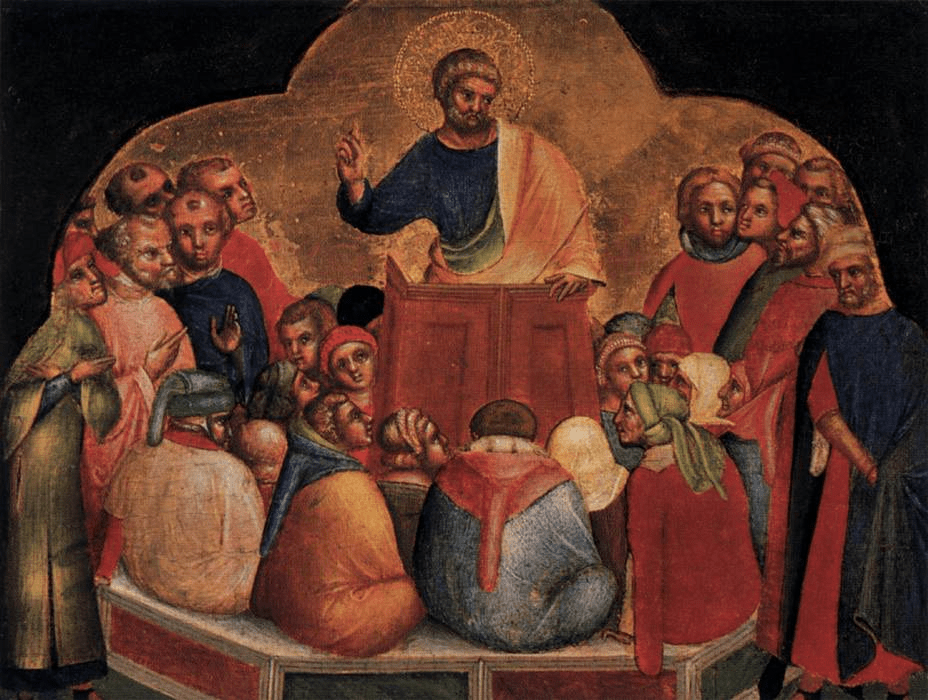
Apostle Peter preaching, by Lorenzo Veneziano, c.1370

And that is exactly what happened with the Apostles Peter and John. Their proclamation of Christ and his resurrection struck a nerve with the Jewish Sadducees who were the keepers of proper worship and liturgy amongst the temple. The Apostles’ teaching was so scandalous and threatening to their own beliefs, that they used their authority to throw Peter and John in jail – just for proclaiming a message the Sadducees didn’t like.

It never feels good getting toasted by those who claim insight and knowledge but are, in reality, a bunch of ignorant simpletons who don’t want to change and will hold onto their sense of power and superiority at all costs.

Yet, the consolation to all of this, is that there are others who are open-minded enough to listen well and adjust their belief systems to match the truthful evidence given to them. And so, despite the efforts of the Sadducees to suppress apostolic preaching, the fledgling group of Christ followers were being added by the thousands.

It turns out that nobody can resist the Holy Spirit of God, no matter how much earthly pull and power they possess.

Today’s New Testament lesson reminds us and teaches us that:

  • Self-awareness of why we hold to our particular beliefs, matters. We ought to hold our dogmatism very loosely.
  • Proclamation of the gospel, that is, the good news of Christ’s crucifixion and resurrection, makes a difference in lot of people’s lives.
  • Opposition is to be expected. There are some who view the good news of grace as the bad news of judgment against themselves; they will oppose it by any means possible.
  • Humility will always serve us well in the spiritual life, whereas condescending arrogance will never help anybody. For God’s sake, please have enough humility to listen and learn, even if (and especially) you don’t like what you’re hearing – no matter which end of the discussion you are on.

If we want the world to be different, then the change begins with you and me. Christians have the opportunity, if they will take up the mantle, of being the most calm, humble, and attentive people in the room. In this time of the year, no other stance and skill can be more important amongst family, friends, and others during the holidays.

O Lord, you have told us what is good, and what you require of us: To do what is right, to love mercy, and to walk humbly. Help us walk together in love and compassion towards the cross, humbly with you and one another. Let your Holy Spirit guide us on the right path to truth and reconciliation with humility; and enable us to hear each other, for we do not want to walk by pride or self-sufficiency, through Jesus Christ our Lord. Amen.