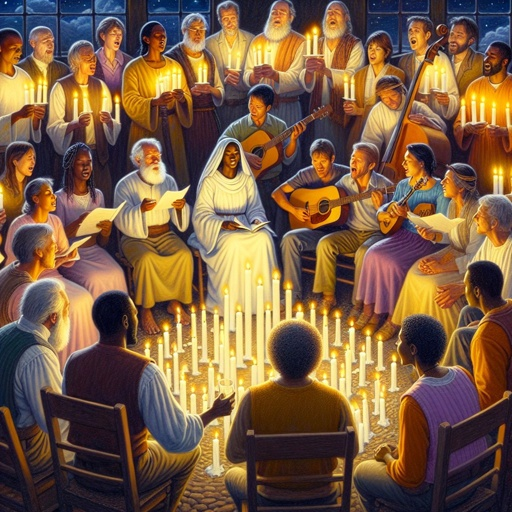
Sing Psalms and Hymns and Spiritual Songs to One Another (Ephesians 5:15-20)

By Bible Art

Be careful, then, how you live, not as unwise people but as wise, making the most of the time, because the days are evil. So do not be foolish, but understand what the will of the Lord is. Do not get drunk with wine, for that is debauchery, but be filled with the Spirit, as you sing psalms and hymns and spiritual songs to one another, singing and making melody to the Lord in your hearts, giving thanks to God the Father at all times and for everything in the name of our Lord Jesus Christ. (New Revised Standard Version)

It’s unlikely I need to tell anyone that the days are evil. The world is upside-down and topsy-turvy with injustice, waywardness, and narrow partisanship. In fact, there is a lot of similarity to the Apostle Paul’s time. Maybe that’s why Paul exhorted the church not to drown their sorrows in a bottle of spirits, but to be filled with the Spirit.

Perhaps, because of the times we live in, you don’t feel much like singing. You might not be finding much in your life right now to sing about. Yet, maybe singing is the very thing we need.

An inebriated person says and does things that they would not typically say or do when they’re sober. The Apostle’s point about being filled with the Spirit is that, instead of doing and saying foolishness, we are to be so filled with God that we do and say wisdom that we wouldn’t typically do and say, if not filled with God. 

Without the fullness of God’s Spirit, we end up mumbling, not singing; worrying, not making music in our hearts; complaining and arguing, not giving thanks. Half-filled Christians can only practice a half-hearted Christianity. And they’re only half-baked in their service and devotion to Christ.

Why sing? 

Because singing is part of being filled with the Spirit of God. Singing happens when we experience God’s overflowing grace in our lives through the blessings of being chosen, adopted, and redeemed into God’s new community. (Ephesians 1:3-11)

Music is powerful. It’s not only a means of expressing praise and commitment to Christ and each other, it is also a powerful means of remembering.

For example, when we first teach kids the alphabet, we teach it in a song. Trying to teach letters in a rote fashion doesn’t work well for pre-school kids. But words set to music is why we can still remember words from old TV shows, because those words were set to a catchy tune (alas, the lyrical theme from Gilligan’s Island will forever be in my head).  Music is why an Alzheimer’s patient doesn’t remember her daughter’s name, yet can flawlessly sing all four verses of Amazing Grace.

Singing is an offering and a sacrifice of praise to God (Hebrews 13:15). And singing is also a vehicle whereby we are taught, encouraged, and built up in the community of believers. We sing to God, one another, and even to ourselves.

Christian music, then, is to be both a means of praising God and a practice of encouraging each other. We accomplish this through singing psalms, hymns, and spiritual songs.

Sing Psalms

The word “psalm” helps us rightly think of the biblical book of Psalms. Singing the psalms is an ancient practice, going all the way back to the Israelites singing psalms in the temple and synagogue. The early church maintained this practice, especially as a means of being faithful to praying without ceasing. 

However, over time, medieval congregations began neglecting the practice. In fact, European congregations eventually gave up most singing altogether. Almost all the singing was done by church choirs and professional musicians employed by the king (there was no separation of church and state) to write, compose, and perform in worship services. 

Five-hundred years ago, during the Reformation, Martin Luther reinstituted congregational singing. He gave music back to the people. One of the results of this change was putting the book of psalms to song – the Psalter.  For many Protestant denominations, the Psalter became the primary means of singing. The Psalter chiefly set prayers to song. It was both a means of expressing prayer to God and learning Scripture.

Singing Hymns

There have always been hymns in the church. Yet, it was not until the Reformation that hymns began to be written and sung by congregations. For the Reformers, hymns were used to teach sound doctrine and theology, as well as a means of confessing the faith together

A mighty fortress is our God,
a bulwark never failing;
our helper he, amid the flood
of mortal ills prevailing.
For still our ancient foe
does seek to work us woe;
his craft and power are great,
and armed with cruel hate,
on earth is not his equal. (Martin Luther, 1529)

Singing Spiritual Songs

Spiritual songs are the present day equivalent of praise and worship choruses, or what some refer to as contemporary songs. These are songs purposefully designed to be emotional expressions of praise to God and to give powerful testimony for what God has done or is doing.

Remember When You Sing…

  • Psalms are used to pray and learn Scripture.
  • Hymns are used to teach us sound doctrine and confess the faith together.  
  • Spiritual songs are an important way of expressing praise to God and being encouraged in the faith. 

Therefore, church music is to serve as both a revelation from God, and as a response from God’s people.

There are two important deductions from the Apostle Paul’s exhortation:

  1. A variety of songs is inferred and expected
  2. Their use is commanded

The reason worship style seems always to be a controversial topic is because everyone has their personal preferences. And yet, if we are to be faithful to today’s New Testament lesson, we will do more than focus on what I want. 

Truth be told, we are selfish people when it comes to music. We want what we want, and we don’t care what somebody else wants. And we’ll persist in that self-absorbed spirit until somebody calls us on it… That somebody is the Apostle Paul. Scripture calls us to encompass psalms, hymns, and spiritual songs – all three of them – in our worship.

I have an old friend who is an accomplished church musician and worship pastor. I once asked him how I can lead a worship service among such a variety of preferences concerning music. He answered my question with a question:

“How highly do people, including and especially your musicians, value the unity of the church? Do they love each other so much that they can allow for a wider range of style, and do so without vocally complaining about it?”

My friend went on to say, “When I arrived at one church as their pastor, some people were in a rather bad habit of saying very openly, ‘Oh I hate that song,’ or, ‘If I hear this song one more time I’m walking out.’ What I tried to do was teach people that this is not the most loving or mature approach; and it does little to build up the rest of the Body of Christ.”

If a group of people are being faithful to Scripture, and doing their best musically, then – if the music seems lifeless, dull, or strange to us – the real issue isn’t style but our hearts.    

A heart filled with the Spirit of God will speak to others using the Psalter, time-honored hymns, and fresh new contemporary songs. The result is believers built up in the faith.

Gracious God, give us grace to take to heart the great dangers we are in by our unhappy divisions about all kinds of things, including music. Take away all hatred and prejudice, and whatever else may hinder us from godly union and harmony, so that as there is but one body and one Spirit, one hope of our calling, one Lord, one faith, one baptism, one God and Father of us all, we may from this time forward be all of one heart and of one soul, united in one holy bond of peace; and may with one mind and one mouth glorify you, through Jesus Christ our Lord. Amen.

Pillow Thoughts (Psalm 132:1-12)

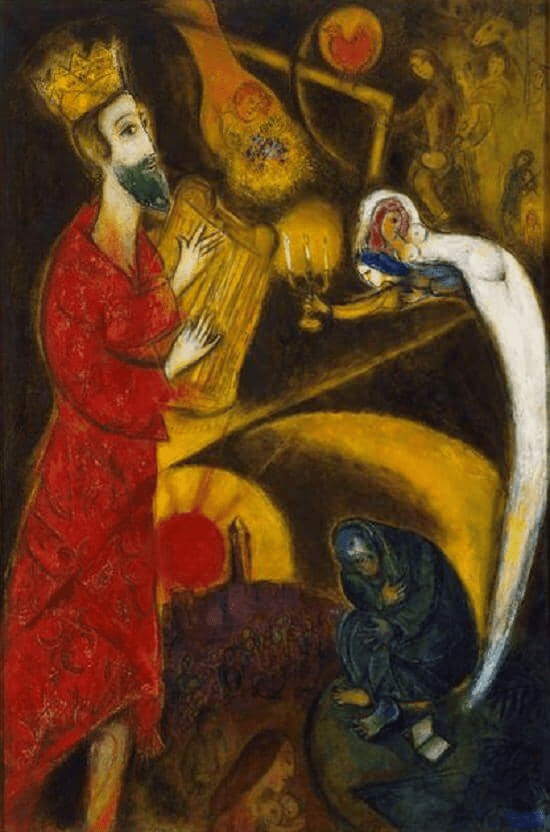
King David, by Marc Chagall, 1962

O Lord, remember in David’s favor
    all the hardships he endured;
how he swore to the Lord
    and vowed to the Mighty One of Jacob,
“I will not enter my house
    or get into my bed;
I will not give sleep to my eyes
    or slumber to my eyelids,
until I find a place for the Lord,
    a dwelling place for the Mighty One of Jacob.”

We heard of it in Ephrathah;
    we found it in the fields of Jaar.
“Let us go to his dwelling place;
    let us worship at his footstool.”

Rise up, O Lord, and go to your resting place,
    you and the ark of your might.
Let your priests be clothed with righteousness,
    and let your faithful shout for joy.
For your servant David’s sake
    do not turn away the face of your anointed one.

The Lord swore to David a sure oath
    from which he will not turn back:
“One of the sons of your body
    I will set on your throne.
If your sons keep my covenant
    and my decrees that I shall teach them,
their sons also, forevermore,
    shall sit on your throne.” (New Revised Standard Version)

King David took great pains in providing for the house of the Lord; and was very concerned about the worship of Yahweh. He went well out of his way to ensure that a temple would be built for his God.

David made as many preparations as he possibly could before his death, so that his son Solomon could follow through and build the temple. The editor of the Book of Chronicles commented on this:

David gave orders to gather together the aliens who were residing in the land of Israel, and he set stonecutters to prepare dressed stones for building the house of God. David also provided great stores of iron for nails for the doors of the gates and for clamps, as well as bronze in quantities beyond weighing, and cedar logs without number—for the Sidonians and Tyrians brought great quantities of cedar to David. 

For David said, “My son Solomon is young and inexperienced, and the house that is to be built for the Lord must be exceedingly magnificent, famous and glorified throughout all lands; I will therefore make preparation for it.” So David provided materials in great quantity before his death. (1 Chronicles 22:2-5, NRSV)

The king did all of this because God came to David and let him know that he would not be the one to build the temple; that job would fall to his son Solomon. (2 Samuel 7:4-13)

David’s final instruction to Solomon and the people had to do with the construction of a house for the Lord his God:

“Now set your mind and heart to seek the Lord your God. Go and build the sanctuary of the Lord God so that the ark of the covenant of the Lord and the holy vessels of God may be brought into the house built for the name of the Lord.” (1 Chronicles 22:19, NRSV)

The worship of God, for David, was to be the central feature of the Jewish people. All Israel and Judah were to encourage one another in worship at God’s house, the Lord’s Temple, in Jerusalem.

The priests of God wore special clothing, and handled the holy implements and the Ark of the Covenant of God. Yet, they were to be also clothed with righteousness, making sure that their outward ceremonial rituals reflected an inner moral purity and holiness before God.

David was bound and determined to not only worship the Lord himself, but to see that the entire nation of Israel had the opportunity to worship together in a central place.

Maybe a question arises for you about why David was so driven to construct a house for God. What is it that motivated King David to spend so much of his planning and energy on making sure that a temple would be constructed for the Lord?

Now when the king was settled in his house and the Lord had given him rest from all his enemies around him, the king said to the prophet Nathan, “See now, I am living in a house of cedar, but the ark of God stays in a tent.” Nathan said to the king, “Go, do all that you have in mind, for the Lord is with you.” (2 Samuel 7:1-3, NRSV)

A lot of events had transpired for David to be in the position of king, with peace all around him. The Lord had been with David, and brought him through the sort of adversities most of us will never know.

Once King David was at the pinnacle of peace and success, his thought were not about how to hold onto power, or to get more of it. He would lay his head on his pillow at night and wonder how he could give back to God for being so faithful.

And considering all that God had accomplished for him and for Israel, it seemed a travesty that he was luxuriating in a fine house, while the Ark of the Covenant – the objective presence of God among the people – was sitting in an old tent. So, David became determined to change that situation, because he could.

I wonder if when you and I are at a place in our lives where we feel safe and secure, prosperous and happy, our thoughts and dreams turn toward how we might give back to God in a worshipful way which will honor the Lord, as well as bless all the people of God.

I am curious what sort of things occupy your mind at night while your head is on your pillow, when you are feeling good about how your life is going.

Many, if not most, people will think about themselves, and what to do with what they have gained and/or accomplished. But what about you?

How will you respond to God’s grace, goodness, deliverance, and protection in your own life? What sort of ideas arise in your mind? What is in your heart to do for God and God’s people?

What are your pillow thoughts at night?

Presence itself is a great gift. The presence of God is incredibly gracious, good, and miraculous. And human presence, with each individual stamped with the image and likeness of God upon them, is also a wonderful gift from the Creator. And very much needed.

David enjoyed the presence of God, and longed for all the people to experience that divine presence. Although the Lord needed no temple to live in, David had in mind to provide one.

I imagine that King David understood that each person is a luminous icon of presence, reflecting God’s image, and needing the presence of God and others in order to have a nation who worships God as commanded in the Mosaic law.

Through communal worship at a designated site in Jerusalem, the Israelites could enjoy the beauty of God’s presence together, as well as the encouragement of one another.

Wherever there is presence and the acknowledgement of God and each other, there is freedom to offer affection, understanding, and respect.

It seems to me that these were the sort of thoughts that ran through King David’s mind, which made him determined to build a house for the Lord his God.

So, what will you do with your thoughts and your life?

Almighty God of all hope, of our thoughts and dreams: In humility, we give you thanks for all of creation; and for everything you give us. We praise you for forgiving us of our guilt and shame, even before we ask. You raise us from our broken state and make us whole. You give us the peace we yearn for.

Blessed God, fill us, your people, with your divine Spirit. Be our light in the darkness. Envelop us with your presence. Orient our hearts toward your justice; and help us always praise you. Let us ever be mindful of your power and grace in the world. Let us live as one with you in grace and in truth. Amen.

Keep On Praying For What’s Important (Romans 15:22-33)

Together We Pray, by Jerome White

This is why I have often been hindered from coming to you.

But now that there is no more place for me to work in these regions, and since I have been longing for many years to visit you, I plan to do so when I go to Spain. I hope to see you while passing through and to have you assist me on my journey there, after I have enjoyed your company for a while. 

Now, however, I am on my way to Jerusalem in the service of the Lord’s people there. For Macedonia and Achaia were pleased to make a contribution for the poor among the Lord’s people in Jerusalem. They were pleased to do it, and indeed they owe it to them. For if the Gentiles have shared in the Jews’ spiritual blessings, they owe it to the Jews to share with them their material blessings. 

So after I have completed this task and have made sure that they have received this contribution, I will go to Spain and visit you on the way. I know that when I come to you, I will come in the full measure of the blessing of Christ.

I urge you, brothers and sisters, by our Lord Jesus Christ and by the love of the Spirit, to join me in my struggle by praying to God for me. Pray that I may be kept safe from the unbelievers in Judea and that the contribution I take to Jerusalem may be favorably received by the Lord’s people there, so that I may come to you with joy, by God’s will, and in your company be refreshed. The God of peace be with you all. Amen. (New International Version)

Paul’s Intentions

It always had been the Apostle Paul’s intention to preach Christ in places where the name of Jesus was not known. He wanted all people everywhere to hear the good news of grace, forgiveness, and new life in Jesus Christ as the fulfillment of all God’s good promises.

Paul wrote a rather complicated historical and theological letter to the Roman Church. He specifically addressed their situation of both Jew and Gentile Christians worshiping together in one church. They were often divided and critical of one another.

Throughout his letter, the Apostle provided a solid apologetic for staying together on clear biblical and theological grounds. Paul also wanted them to work side-by-side in practical matters of ministry, which would help them learn to appreciate each other.

So, Paul intended on visiting them – hopefully sooner than later – to encourage them in the faith, and as a stop on the way to Spain. He longed to get to the farthest geographic point of the continent and make Christ known.

To that end, Paul made a concluding personal statement and emotional appeal to the entire Roman Church – Jew and Gentile alike – for their abiding prayerful support of his ministry and intentions.

Paul’s Prayer

For Paul, and from a New Testament perspective, prayer is the most necessary activity a believer can do. Prayer connects the divine and the human in meaningful dialogue, as well as connecting people to each other in a common purpose of seeking the Lord and knowing Christ.

The Apostle practiced what he preached. Paul continually prayed for the Roman Church and wrestled in prayer for all the believers. (Romans 1:9-12)

He specifically asked the believers to pray that he be rescued from unbelievers; and that his ministry in Jerusalem might be good and acceptable to the believers in that place. Paul took great pains to gather a collection throughout many of the churches he established, so that he could bless the needy persons in Judea.

Paul’s Longing

The Apostle Paul constantly sought and worked toward solidarity between the Christian Jews and converted Christian Gentiles. They were ancient enemies, and at the time of Paul’s writing the Roman Empire and their occupation created even more animosity between the two groups of people.

Paul longed for the world to see an alternative to such enmity. The Church is to be the one place on earth where there are no walls, no separations, no divisions. The Body of Christ is to be a place of unity, mutual encouragement, and sincere love for one another, without prejudice or favoritism.

Unity and the ability to work together in a shared purpose of gospel proclamation was a high value to the Apostle Paul. That’s because it was important to Jesus.

Christ’s Prayer of Unity

Stained glass of Jesus praying

My hope is that Christians will never lose sight of their Lord’s high priestly prayer, as recorded by the Apostle John:

“Holy Father, protect them by the power of your name, the name you gave me, so that they may be one as we are one…My prayer is not for them alone. I pray also for those who will believe in me through their message, that all of them may be one, Father, just as you are in me and I am in you. May they also be in us so that the world may believe that you have sent me. I have given them the glory that you gave me, that they may be one as we are one—I in them and you in me—so that they may be brought to complete unity. Then the world will know that you sent me and have loved them even as you have loved me.” (John 17:11, 20-23, NIV)

If this is the heartbeat of Jesus, then I submit that Christians everywhere ought to also pray this prayer, and work toward that which is important to Christ himself.

I am also keeping in mind that there is nothing automatic about prayer. Paul did not get all of his prayers answered the way he wanted. In fact, so far, neither has Jesus. Two-thousand years later, we are living in a fragmented and polarized world more than ever, even in Christianity between all sorts of different Christian traditions.

On the one hand, we can and ought to bemoan the situation of disunity and even outright animosity between people who confess the name of Christ. This needs to impel us forward by embracing the values of both Jesus and Paul.

On the other hand, there is reason to hope, knowing that the good news can and is making a difference throughout the world. We can be encouraged to keep on praying and to continue persevering in prayer.

The Apostle Paul envisioned a new society in which old enemies would become friends and co-workers around building a community of persons who are redeemed by Jesus and seek to live into his words and ways.

May it be so, to the glory of God. Amen.

Get Along with Each Other (Romans 3:1-8)

So, what difference does it make who’s a Jew and who isn’t, who has been trained in God’s ways and who hasn’t? As it turns out, it makes a lot of difference—but not the difference so many have assumed.

First, there’s the matter of being put in charge of writing down and caring for God’s revelation, these Holy Scriptures. So, what if, in the course of doing that, some of those Jews abandoned their post? God didn’t abandon them. Do you think their faithlessness cancels out his faithfulness? Not on your life! Depend on it: God keeps his word even when the whole world is lying through its teeth. Scripture says the same:

Your words stand fast and true;
Rejection doesn’t faze you.

But if our wrongdoing only underlines and confirms God’s right-doing, shouldn’t we be commended for helping out? Since our lies don’t even make a dent in his truth, isn’t it wrong of God to back us to the wall and hold us to our word? These questions come up. The answer to such questions is no, a most emphatic No! How else would things ever get straightened out if God didn’t do the straightening?

It’s simply perverse to say, “If my lies serve to show off God’s truth all the more gloriously, why blame me? I’m doing God a favor.” Some people are actually trying to put such words in our mouths, claiming that we go around saying, “The more evil we do, the more good God does, so let’s just do it!” That’s pure slander, as I’m sure you’ll agree. (The Message)

The Apostle Paul’s letter to the Roman Church is a hefty sixteen chapters of dense material and extended arguments of intense reasoning. Likely,

Likely, Paul felt compelled to be so verbose because of the church’s situation.

The Roman Church, at the time of Paul’s writing, was made up of both Jewish and Gentile believers in Jesus. Jews and Gentiles have a complicated history together, to say the least.

The Roman Empire was firmly in control of Palestine and did not always treat the Jewish people well. In addition, the religious backgrounds of Jew and Gentile were as different as you can get.

Whereas the Jewish Christians had a long and rich history with God and the Old Testament, the Gentile Christians were green believers, fresh from centuries of paganism and esoteric rituals. Now, the two of them were together in one place, worshiping Jesus together.

Jews and Gentiles together made for a potentially combustible situation.

Throughout the letter to the Romans, Paul goes back and forth addressing the two groups of Jews and Gentiles. The overarching problem was this:

  • The Jewish believers tended to look down on the Gentile Christians and thought they needed to become Jewish to really be the kind of Christians God was looking for.
  • The Gentile believers tended to dismiss their Jewish brothers and sisters as backward and stuck in tradition.

Each group thought the other must become like them. So, Paul, bless his apostolic heart, had a hot mess in the making with these believers.

In our New Testament lesson for today, Paul is directing his comments toward the Gentile Christians. He wanted them to gain some appreciation for the Jewish people. After all, they were chosen by God to become a nation of priests and prophets for the world. Discounting that history would be to neglect and even invalidate their shared salvation.

For Paul, to have two churches, one Jew and the other Gentile, would be a complete travesty of Christ’s redemption for humanity.

Jesus sought to bring disparate peoples together and not keep them divided. The cross freed us by eliminating the barriers which separate us. The Roman Church needed to work together at being one people under the lordship of Christ.

There was to be no ethnic, religious, or political one-upmanship on Paul’s watch.

Truth be told, both Jew and Gentile did not always do so well with their respective histories. So, there is no ground for boasting or trying to argue for their own way. In fact, the unfaithfulness of people simply shows the incredible faithfulness of God in greater relief. 

If there were no sin, grace would not be needed; no cross would have existed. Just because the foulness and degradation of sin brings out the gracious, faithful, and forgiving character of God in Christ, does not mean that sin is okay or that we can flippantly wave it off with uttering some mumbo-jumbo cheap grace which devalues the majesty of God.

For example, when antebellum southern slaveholders in nineteenth-century America argued for their peculiar institution by saying that snatching black Africans from their homes was a good thing so that they could get out of their religious animistic worldview and be exposed to Christianity, I am positively sure that the Apostle Paul rolled over in his grave and begged Jesus to resurrect him early and send him to tackle such an affront to the cross of Christ!

Sin is never to be excused through twisted human mental gymnastics.

Paul worked laboriously to unite the churches he established and bring differing people groups together under Christ.

  • This does not mean is that all cultural and personal distinctions are ignored or erased.
  • This does mean that we value one another’s differences and gather around the shared value of knowing Jesus Christ.

The Church was neither going to become Jewish nor Gentile but something altogether new – one new people out of the two. Paul framed the matter this way to the Ephesian Church:

Therefore, remember that formerly you who are Gentiles by birth and called “uncircumcised” by those who call themselves “the circumcision” (which is done in the body by human hands)— remember that at that time you were separate from Christ, excluded from citizenship in Israel and foreigners to the covenants of the promise, without hope and without God in the world. But now in Christ Jesus you who once were far away have been brought near by the blood of Christ.

For he himself is our peace, who has made the two groups one and has destroyed the barrier, the dividing wall of hostility, by setting aside in his flesh the law with its commands and regulations. His purpose was to create in himself one new humanity out of the two, thus making peace, 16 and in one body to reconcile both of them to God through the cross, by which he put to death their hostility. He came and preached peace to you who were far away and peace to those who were near. For through him we both have access to the Father by one Spirit. (Ephesians 2:11-18, NIV)

Solitary righteousness is an oxymoron. Righteousness can only be truly lived and expressed with other people.

Yes, there is freedom in Christ. Yet, that freedom must be continually applied through making every effort to keep the unity of the Spirit through the bond of peace.

So, get along with one another.

O God, the Father of our Lord Jesus Christ, our only Savior, the Prince of Peace: Give us grace to seriously lay aside all unhappy divisions. Take away all hatred and prejudice, and whatsoever else may hinder us from godly union and harmony: that, as there is but one Body, and one Spirit, and one hope of our calling, one Lord, one faith, one baptism, one God and Father of us all; so, may we be forever all of one heart, and of one soul, united in one holy bond of truth and peace, faith and love, with one mind and one mouth, glorify Jesus Christ our Lord. Amen.