The Ways of Wisdom (Proverbs 30:18-33)

There are four things that are too mysterious for me to understand:

an eagle flying in the sky,
a snake moving on a rock,
a ship finding its way over the sea,
and a man and a woman falling in love.

This is how an unfaithful wife acts: she commits adultery, takes a bath, and says, “But I haven’t done anything wrong!”

There are four things that the earth itself cannot tolerate:

a slave who becomes a king,
a fool who has all he wants to eat,
a hateful woman who gets married,
and a servant woman who takes the place of her mistress.

 There are four animals in the world that are small, but very, very clever:

Ants: they are weak, but they store up their food in the summer.
Rock badgers: they are not strong either, but they make their homes among the rocks.
Locusts: they have no king, but they move in formation.
Lizards: you can hold one in your hand, but you can find them in palaces.

There are four things that are impressive to watch as they walk:

lions, strongest of all animals and afraid of none;
goats, strutting roosters,
and kings in front of their people.

If you have been foolish enough to be arrogant and plan evil, stop and think! If you churn milk, you get butter. If you hit someone’s nose, it bleeds. If you stir up anger, you get into trouble. (Good News Translation)

If there is an overall theme in the wise sayings from this chapter in the Book of Proverbs, it is that we ought to renounce arrogant greed; while at the same time, we should uphold and embrace a humble life of contentment.

The four lists of wisdom address four observations of creaturely ways on this earth: mysterious ways, antisocial ways, instinctive ways, and impressive ways. We are meant to observe that each of these four numbered lists contain wisdom that is available to all of us, that is, if we will but apply the observational understanding to our own lived situations.

Mysterious Ways

The first list observes four invisible ways; the way of the eagle, snake, ship, and man, all leave no trace of where they have been and what they are up to. Thus, their ways are mysterious, causing us to wonder what is really going on with them.

Why is the eagle flying, the snake moving over the rock, the ship navigating the water, and the man interacting with the woman?

We are to apply wisdom to our circumstances, and discern that a single act of one being is, in reality, up for interpretation. We simply do not know why each is doing what they’re doing.

As wise persons, we understand that intentions and motivations vary from person to person, and from one observer to another.

The eagle may be enjoying the spread of his wings and the feel of the wind; or he might be the predator surveying the land to attack an unsuspecting fish or squirrel.

The snake may be seeking to warm himself in the sun, or he could be slithering with malevolent intent.

The ship may be hauling needed goods to bring into port; or it might be moving to pirate others and steal.

And the man may be intending to love a fair maiden; or he might be attempting to seduce her for his own advantage.

The point is that we must be wise and discerning, not always having a singular interpretation or belief about what we are seeing and observing. What at first glance may appear innocuous, may in fact come from a place in the heart of covetous greed, and vice versa.

Antisocial Ways

The second list, dealing with general societal roles, cites four instances of role reversal which turns the social order into antisocial ways that cause trouble in society.

A slave who becomes king may believe that he knows better than the ruler. He probably talked about how he could do a better job. Yet, when given such a responsible position, such a person is way out of their expertise and depth. Statecraft is a real thing; and if one hasn’t been duly trained in it, and had some experience in it, things will go south quickly.

A fool who has all he wants to eat is like the person without any self-control. He goes out to eat at an all-you-can-eat buffet; and it will not end well, especially if it’s done a regular basis.

A hateful woman who gets married is a train wreck waiting to happen. I’m not sure I need to comment on this, because likely you are already covering your eyes, imagining what will happen in such a relationship.

And a servant woman who takes the place of her mistress has perhaps had a fantasy about how easy it is to be in charge and simply tell others what to do. Little does she know how stressful it truly is to be in charge and be the administrator of an entire household. Like the slave becoming a king, she will soon learn that the role she coveted is not all it’s cracked up to be.

All four of these persons do not (yet) have the wisdom to fulfill a role; they need training, experience, and a proper character to do the job. Their limited perspectives, and their foolish character, will lead to disaster.

Instinctive Ways

The third list, dealing with natural instincts, cites four creatures who model survival because of their instincts and wisdom, not their strength.

An ant may be small, and not carry near as much as a bigger creature, yet they have sense enough to diligently work and have everything they need when it is needed.

Rock badgers compensate for any lack of strength by making their home a fortress where a much stronger creature cannot penetrate. They have sense enough to know how to live in safety.

Locusts are many. Even though they have no leader, and are small creatures, they know enough to move together and work together in order to accomplish thriving and flourishing on this earth.

And even though lizards are common, and not all that difficult to catch and possess, nevertheless they can be found in high places. They are taken care of by bigger and greater creatures than themselves.

When any creature lives into their true self, and doesn’t try to be something they are not, their needs are cared for. Humanity could take a big lesson from such small creatures about how to get along in life.

Impressive Ways

The fourth list, dealing with displays of majesty, cites four creatures who are stately in their appearance because of their position, design, and context.

Lions are majestic creatures. Their very appearance and the sound of the male’s roar elicits awe and fear in others. This is an important part of how the lion pride gets around in this world and is able to meet their own needs.

Goats and roosters strut around like the own the place. Their sense of presence and confidence is palpable. If you’re ever around them, you’ll need to match or exceed their level of acting in charge.

Which is precisely what a king does within his realm. Each of these four are an example of taking charge and acting the part that you ought to be playing.

Whereas the earlier list had examples of people who were trying to act a role they weren’t ready for, this list of examples are creatures who are living into the role they need to exhibit, no matter whether they feel brave or competent, or not.

Concluding Ways

The wise person takes the time to observe, listen, and learn from a variety of sources, including all of creation. Everything and everyone can teach us, that is, if we will but put ourselves in a position to learn from them.

The first two lists describe people who covet for more, and are discontent with their situation. The last two lists observe creatures who know their limits and weaknesses, yet nevertheless, have found resilient ways to meet their needs – ways that are consistent with who God created them to be.

So, which way will you go?

Almighty God, I humbly ask that You fill me with the Spirit of wisdom and revelation in the knowledge of You. Open the eyes of my heart to see Truth more clearly. Sharpen my spiritual discernment to distinguish good from evil, good from bad, better from best.

Help me not lean merely on my own finite understanding, but trust wholeheartedly in Your infinite wisdom given to me in creation. May divine wisdom from above flow through me each day in thought, word, and action. Amen.

Wisdom (1 Kings 4:29-34)

King Solomon, by Helen Zarin

God gave Solomon wisdom and very great insight, and a breadth of understanding as measureless as the sand on the seashore. Solomon’s wisdom was greater than the wisdom of all the people of the East, and greater than all the wisdom of Egypt. 

He was wiser than anyone else, including Ethan the Ezrahite—wiser than Heman, Kalkol and Darda, the sons of Mahol. And his fame spread to all the surrounding nations. 

He spoke three thousand proverbs and his songs numbered a thousand and five. He spoke about plant life, from the cedar of Lebanon to the hyssop that grows out of walls.

He also spoke about animals and birds, reptiles and fish. From all nations people came to listen to Solomon’s wisdom, sent by all the kings of the world, who had heard of his wisdom. (New International Version)

Talking about King Solomon of old is, in many ways, like talking about any human being. That’s because Solomon was an odd combination of extremely gifted, and yet, deeply flawed.

Solomon’s reign was the greatest that Israel and Judah ever had; and perhaps the wealthiest and most impressive reign that there ever was in the world. Here we are, talking about it nearly 3,000 years later.

Yet, for all the accomplishments of Solomon, he failed to maintain faithfulness to God throughout his lifetime. His wealth and power were so vast that it was his downfall.

Although he died a great king, at his death there were many who were not sorry to see him go. And Jerusalem, the capitol, was occupied with other gods, and not the exclusive worship of Yahweh, as God’s law was so careful to warn against.

However, in today’s Old Testament lesson, we remember the unparalleled wisdom of Solomon. In this regard, there is no one like him in history.

The text of Scripture makes it plain as to where Solomon got his supreme wisdom: God gave it to him (1 Kings 3:1-15). Indeed, God is the source of wisdom, and the fount of knowledge.

Solomon was the son of King David and Bathsheba. He became king of Judah and Israel in 967 BCE, at age twenty, and reigned until his death in 928 BCE. King Solomon’s wisdom was both broad and deep. He was given to wise parables and poetry; sage insights into human nature; and a keen sense to political, social, and economic administration.

The editor of the books of the Kings compares Solomon to the eastern Babylonian sages who were famous in the ancient world; and to the sages of Egypt. Specifically, he is compared to four men: Ethan, Heman, Kalkol, and Darda – the wisest in Israel before Solomon.

Israel had its sages, well before Solomon came along, and possessed a body of wisdom for the people to learn from. The editor tells us that King Solomon surpassed them all in his wisdom, knowledge, understanding, and insight.

Even though there are sages and wise persons, wisdom is for everyone, all humans, without exception. From wisdom we learn to pay attention and observe. This is why Solomon was so wise – his powers of observation were second to none.

He took the time to pay attention to plants, animals, and all creation. He dedicated himself to looking into all the differing affairs of what humanity does. As a result of his efforts at observing humanity, we have the biblical wisdom books of Proverbs (short pithy sayings of experiential truth), Ecclesiastes (issues of ultimate meaning), and Song of Songs (an ode to Love).

King Solomon, by William Pajaub (1925-2015)

In short, Solomon’s wisdom teaches us that those who take the time to learn, listen, and mature have a happy life; and those who don’t, injure themselves and have a sad life.

Through wisdom, we discover the importance of respecting the poor, the value of creative and fulfilling work, helpful speech, handling money well, and virtuous friends. Each person’s wise conduct benefits the wellbeing of the community, whereas foolish conduct destroys a people.

Wisdom is attuned to morality and consequences (and not to moralism and judgmentalism). Our words and actions bring either connection and encouragement, or separation and duress. Good choices bring life and peace; bad decisions lead to death and division.

One might assume that wisdom is a moral code – but it is not. Rather, wisdom is a dynamic force which brings satisfaction and fulfillment to the world. Being a wise person means that one’s conduct and way of life is in sync with unity, harmony, integrity, and peace.

Foolishness, on the other hand, goes against the grain of a moral life. A fool assumes they can do what they want, whenever they want, without restraint. They think they are an autonomous being who answers to no one. A fool lives as if God is non-existent, and other people are no more valuable than insects on a sidewalk.

Solomon became king in Israel and Judah without a vote, and ruled without democracy. Yet, he recognized that wisdom was needed in order to rule. In reality, wisdom is still needed for any and every sort of leadership.

Our present American political campaign has all the markings of a foolishness that mocks wisdom. That’s why we get so much careless, unhelpful, and downright harmful speech. There is indifference to people in debt, and an overlooking of the poor. We have words and actions without any thought to others, and policies based in greed. Most of all, there is no moral coherence at all, even with cheap religious talk.

It appears that a large chunk of Americans have never taken the time to observe, listen, and pay attention. Their faith – if there is any faith at all – is shallow and disconnected from their fellow citizens. They fail to discern that society cannot be divided into classes of rich and poor.

Wisdom is about being connected, not divided. It has an understanding of all creatures, and that we are ethically and morally bound to the rest of creation. The wise person thus builds bridges, not walls; and does everything possible to turn away from violence, both physical and verbal.

There is no political party, no neighborhood association, no corporate board, and no church council who is all wise and immune to being foolish. We must not throw our ultimate allegiance to anything or anyone other than our all-wise Creator God. And we also must keep in mind that human institutions really can be brought into line with wisdom.

Unfortunately, foolishness is alive and well – not only in the United States of America, but also around the world. Foolish political candidates and leaders of all kinds promise us short-term selfish solutions to large communal and national issues.

Yet, the fool will not prevail. Sadly, King Solomon gave into some foolishness toward the end of his life. Yet, even despite that, Solomon could tell you that wisdom has always existed, and pre-dates foolishness.

Lady Wisdom calls to us, and we have the ability and the faculties to respond and learn from her. Please do so, hopefully, before election day.

Teach me to listen, O God, to those nearest me, my family, my friends, my co-workers. Help me to be aware of the inherent dignity and worth of every person I encounter, and to listen to their voice.

Teach me to listen, O God, to the despair of the hopeless, the plea of the forgotten, and the cry of the anguished.

Teach me to listen, O God, to myself. Help me to be less afraid to trust the voice inside — in the deepest part of me.

Teach me to listen, Holy Spirit, for your voice — in busyness and in boredom, in certainty and doubt, in noise and in silence.

Teach me, Lord, to listen.  Amen.

Effective Communication (Acts 17:16-31)

St. Paul preaching at the Areopagus in Athens, by Kennedy A. Paizs

While Paul was waiting for them in Athens, he was deeply troubled by all the idols he saw everywhere in the city. He went to the synagogue to reason with the Jews and the God-fearing Gentiles, and he spoke daily in the public square to all who happened to be there.

He also had a debate with some of the Epicurean and Stoic philosophers. When he told them about Jesus and his resurrection, they said, “What’s this babbler trying to say with these strange ideas he’s picked up?” Others said, “He seems to be preaching about some foreign gods.”

Then they took him to the high council of the city. “Come and tell us about this new teaching,” they said. “You are saying some rather strange things, and we want to know what it’s all about.” (It should be explained that all the Athenians as well as the foreigners in Athens seemed to spend all their time discussing the latest ideas.)

So Paul, standing before the council, addressed them as follows: “Men of Athens, I notice that you are very religious in every way, for as I was walking along I saw your many shrines. And one of your altars had this inscription on it: ‘To an Unknown God.’ This God, whom you worship without knowing, is the one I’m telling you about.

“He is the God who made the world and everything in it. Since he is Lord of heaven and earth, he doesn’t live in man-made temples, and human hands can’t serve his needs—for he has no needs. He himself gives life and breath to everything, and he satisfies every need. From one man he created all the nations throughout the whole earth. He decided beforehand when they should rise and fall, and he determined their boundaries.

“His purpose was for the nations to seek after God and perhaps feel their way toward him and find him—though he is not far from any one of us. For in him we live and move and exist. As some of your own poets have said, ‘We are his offspring.’ And since this is true, we shouldn’t think of God as an idol designed by craftsmen from gold or silver or stone.

“God overlooked people’s ignorance about these things in earlier times, but now he commands everyone everywhere to repent of their sins and turn to him. For he has set a day for judging the world with justice by the man he has appointed, and he proved to everyone who this is by raising him from the dead.” (New Living Translation)

Ancient ruins of Athens, Greece

The city of Athens was a major intellectual center in the ancient world. Ideas, philosophy, reason, rhetoric, and debate were standard fare amongst the citizens. At the time of the Apostle Paul’s arrival in the city, Greece knew next to nothing about Christianity.

Paul’s response to what he saw and felt in the city dictated what he did and said. And those words were wise and impactful for the people of Athens. The Apostle’s interaction with the philosophers was like a seminar in how to communicate with folks who believe and live very differently than ourselves.

Observation

Paul entered the city and made a simple observation: Athens is full of idols. Out of all the observations Paul could have made, this one would not likely be made by most people visiting the city. Athens was a glorious place with its unparalleled architecture. The Acropolis and the Agora were resplendent with the arts and democracy.

For all its physical beauty and brilliance, the one thing Paul homed-in on was the idols. This would have struck many folks as odd – something like focusing on the dog collar instead of the dog. Yet, Paul was using more than his physical eyes – his spiritual sight was making a big observation – that Athens was very much a religious place.

Feeling

The Apostle felt troubled and distressed. Paul was disturbed down deep in his gut with the spiritual state of this renowned city-state. The sheer volume of idols and the practice of idolatry did not sit well with him. He experienced feelings of pity mixed with anger.

Paul handled his emotions well. By freely acknowledging them, he was then able to choose his response. Had he not done so, it’s likely Paul might have gone on some frustrating tirade, thereby never truly connecting relationally with the people. There’s nothing wrong with being irritated or exasperated; it’s what we do with those feelings that’s important.

Need

Emotions, not thoughts, move us to act. Paul knew why he was feeling disturbed, and decided not to stuff those feelings. Instead, he stepped out and addressed the great need he was observing.

Paul decided to meet the Athenians on their turf and on their level by reasoning with them every day in the great buildings and open spaces of the city.

While in Athens, it seems that Paul, understandably, utilized the Socratic method of dialogue – involving questions and answers. It’s impressive that throughout the Acts of the Apostles, Paul demonstrated a deft ability to communicate and connect with a broad range of people.

Appeal

Paul wasn’t interacting and dialoging just for the fun of it; he wanted to make an appeal, a request for people to seriously consider the Christian good news of Jesus Christ’s resurrection as a viable philosophy of life. He made a widespread appeal to Jews, Greeks, and passers-by, as well as philosophers.

Since the massive intellect of Paul could handle any reasoned debate, he was invited to the Areopagus, which was the place where the best-of-the-best carried-on their discussions.

Paul’s address to them was incredibly cogent and well-reasoned – finding common ground from which to debate. While doing so, he maintained outward grace amidst his inward disturbance.

Conclusion

The late British exegete, John R.W. Stott, reflected on today’s New Testament lesson and gave us words which are still relevant for us in these contemporary times:

“Why is it that, in spite of the great needs and opportunities of our day, the church slumbers peacefully on, and that so many Christians are deaf to Christ’s commission, and dumb with tongues-tied in testimony? The major reason is this: We do not speak as Paul spoke because we do not feel as Paul felt. We have never had his indignation. Divine jealousy has not stirred within us. We constantly pray, ‘Hallowed be Thy Name,’ yet we do not seem to mean it… Paul saw people created in the image and likeness of God giving to idols the homage which was due to God alone… and he was deeply pained by it.”

May the good news of Jesus Christ be so pressed into our minds, hearts, and guts that what comes out of us is deep compassion, wise dialogue, and an effective ministry of communication with others. Amen.

Communicate with Clarity and Care (Genesis 35:1-4)

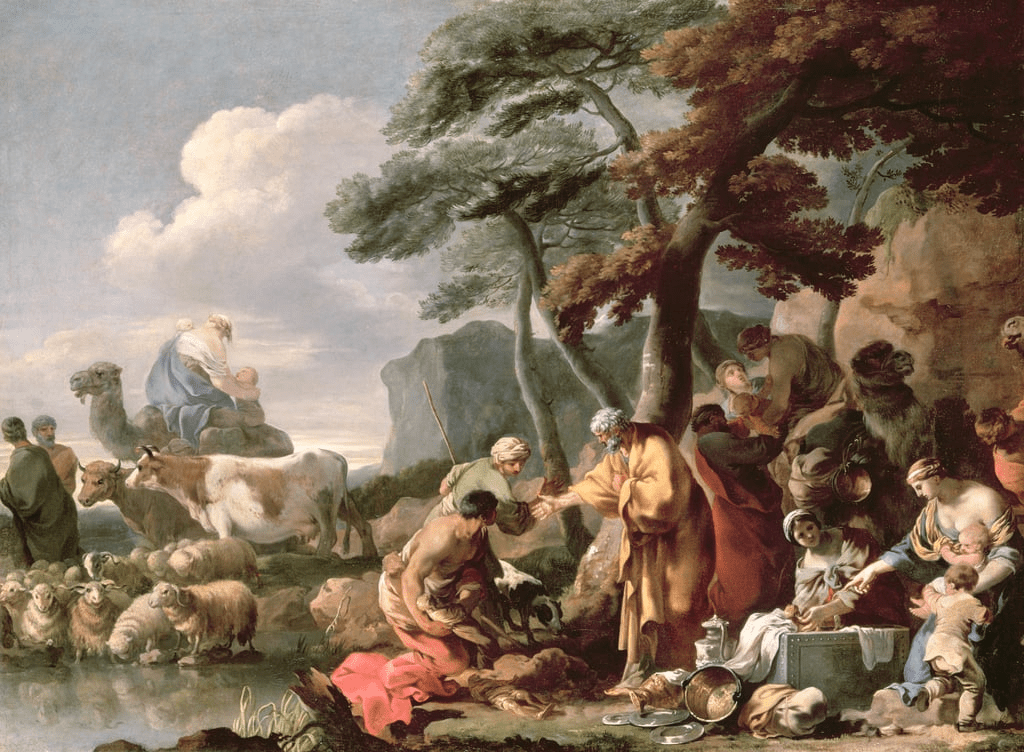
Jacob burying the false gods under the oak by Shechem, by Sébastien Bourdon (1616-1671)

Then God said to Jacob, “Go to Bethel and live there. Make an altar there. I am the God who appeared to you when you were fleeing from your brother Esau.”

So Jacob said to his family and those who were with him, “Get rid of the foreign gods which you have, wash yourselves until you are ritually clean, and change your clothes. Then let’s go to Bethel. I will make an altar there to God, who answered me when I was troubled and who has been with me wherever I’ve gone.” So they gave Jacob all the foreign gods that they had in their possession as well as the earrings that they had on. Jacob buried these things under the oak tree near Shechem. (God’s Word Translation)

Christianity has existed for 2,000 years; Judaism for 4,000 years or more. That’s a long time. On the one hand, this is a tremendous legacy of faith, grounded in several millennia of solid religious tradition. And on the other hand, something existing for so long is bound to accumulate some barnacles that get encrusted on the faith.

And if those barnacles are there for too long, it becomes assumed that they’re just part of the ship of faith. But they’re not; they need to be removed so we can see the real thing and move through life unencumbered and not dragged by extraneous stuff.

The familiar, over time, is taken for granted. And when that happens, we lose sight of what is most important, of what is most needed.

God helped Jacob – the son of Isaac, the son of Abraham – to reconnect with a seminal experience from earlier in his life. That experience was a vison of God, and an assurance that God was with Jacob. He was not alone.

But, years later, after accumulating two wives, twelve sons, and many flocks of sheep and other animals, it was time to move and make a home and an altar elsewhere. Instead of taking the Lord for granted, and forgetting the difficulties of the past, God intervened and called the whole crew to go and live in another place.

The communication from God brought Jacob to a spiritual place of realizing what had happened over the years; slowly and perhaps imperceptibly, the barnacles of idolatry had become encrusted amongst his family. And they were obstacles which needed to be jettisoned before they could move on.

Jacob needed to hear from God. Jacob’s family needed to hear from him. And that communication had to be a helpful way of scraping the barnacles off from decades of misplaced living.

Our world today is marked by unfeeling meanness to strangers, a profound lack of empathy, respect, and basic human kindness toward one another. Individuals, groups, communities, and entire nations don’t know how to talk to each other in a way that is helpful and life-giving.

We need a process which helps us have a way of being with others that is compassionate. It is imperative that we have communication that guides us in both expressing ourselves and listening to others. And that process must focus on what we are observing, feeling, and needing.

It is essential that humanity creates deeper personal relationships and maintains them. If not, we will be overcome by the barnacles of suspicion, hate, distrust of others, as well as distance from God.

Unless we are with each other in helpful ways, we will devolve into judgmental and critical speech directed toward others or even ourselves. Violent words are the main obstacle to having compassion on others.

Comparisons and classifications of people, denial of responsibility for words and behaviors, and making demands, leads to estranged relationships. Instead, we can do better. We can be with one another and talk to each other by communicating observations, feelings, needs, and requests.

Observation

  • Observe, rather than evaluate. Whenever we observe something, and then quickly evaluate it, the other person will tend to hear criticism and resist what we are saying.
  • Be specific, not general. It’s helpful to make a specific observation instead of a general one. For example, God was specific about what Jacob was to do. And Jacob was quite specific about the situation of idolatry and what to do about it before the family could move to Bethel.

Feeling

  • Acknowledge and express your emotion. Clearly and specifically identify and name your emotions because this is the way we connect more easily with others. Jacob told his family of feeling troubled in the past and that God helped him deal with it.
  • Be vulnerable. Expressing our feelings can help resolve conflicts. The old adage is true: People don’t care how much you know until they know how much you care.

Need

  • What do you need? Take responsibility for your feelings. Connect your feeling with your need. Jacob was devoted to God because his emotions were tethered with how God had met his needs throughout his life.
  • Others do not cause our feelings, and they are not responsible for our emotions. Jacob’s family did exactly what Jacob told them to do – and did not buck him or resist him – mainly because he let them know how he was feeling, and why he was telling them to rid themselves of idols and move on with him to Bethel.
  • Listen to yourself. Judgments of others are projections of our own unmet needs; and conversely, being kind to ourselves, listening to our thoughts, and paying attention to how we carry stress in our bodies, allows us to be helpful to others and present to them in whatever they are going through.
  • We are not responsible for other people’s feelings. We can never meet our own needs by trying to make others feel guilt or shame.

Request

  • Ask for what you need and want. We honor ourselves by making requests in clear, positive, and concrete language of what we really need. The clearer we are about what we want, the more likely it is that we’ll get it.
  • The message we send is not always the message which is received by another. Be clear about the response you want so that there is no confusion about what we truly need.

The objective of communication is not to change people and their behavior in order to get our way. Rather, it is to establish relationships based on honesty and empathy that will eventually fulfill everyone’s needs.

There is a need to express honestly and clearly our observations, feelings, needs, and requests, as well as receive another’s communication with focused attention and empathy.

So then, how we talk to and about God, and how we talk to ourselves, becomes a template for how we talk to others. A lack of clear communication is a surefire way of allowing the barnacles of displeasure and disappointment to attach to our souls.

However, clear communication is life-giving and even lifesaving. It’s worth putting significant effort into it.

Blessed Lord, in your infinite wisdom, you created us with the gift of communication. May we use this gift to foster love, understanding, and unity amongst ourselves and with you.

Guide our hearts to speak words of kindness and encouragement. May our tongues be instruments of love, grace and compassion to those around us.

Open our ears, so that we may truly listen and understand the needs and desires of our fellow humanity. Grant us the patience to hear their stories and the wisdom to respond with love and empathy.

Enlighten our minds to be clear and thoughtful in our affect and speech. As we share our thoughts and ideas, may we be ever mindful of your presence, seeking your holy and good will in all we say and do.

Fill our conversations with honesty and vulnerability. May we find the strength and courage to speak our truth while always remaining respectful and considerate of the feelings of others.

Bind us together in unity and love through our shared communication. May our words build bridges and forge bonds that reflect your divine love and mercy. Amen.