A Parable of Two Sons (Matthew 21:28-32)

The Lord of the Parables by Argentine artist Jorge Cocco Santángelo

“What do you think? A man had two sons. Now he came to the first and said, ‘Son, go and work in the vineyard today.’

“‘No, I don’t want to,’ he replied. But later he changed his mind and went.

“The father said the same thing to the other son, who replied, ‘Yes, sir.’ But he didn’t go.

“Which one of these two did his father’s will?”

They said, “The first one.”

Jesus said to them, “I assure you that tax collectors and prostitutes are entering God’s kingdom ahead of you. For John came to you on the righteous road, and you didn’t believe him. But tax collectors and prostitutes believed him. Yet even after you saw this, you didn’t change your hearts and lives and you didn’t believe him. (Common English Bible)

Contemporary persons aren’t the only ones who want to know whose in and whose out; it’s been around forever.

In the ancient world of Jesus, people were always concerned about conformity to the established system and society of the way things are. For religious folk, who gets in and who gets left out was an important issue .So, Jesus decided to tell a parable about entrance into the kingdom of God.

Turns out, there are spiritual insiders on the outside of the kingdom, and spiritual outsiders who are the true inheritors of the kingdom.

The parable, at its core, is a warning to all the spiritually serious insiders: Beware, lest your energies be spent in correctness of behavior, conformity of belonging, and cockiness of belief rather than following Jesus. And, at the same time, the parable encourages spiritually estranged outsiders with the wonderful possibilities of a changed life. 

Far too many people arrogantly assume they have the inside track by what they believe, and not by doing God’s will.

It may be challenging for us to imagine how truly offensive Christ’s story was to the original hearers of the parable, so I restate it in a more contemporary form:

There was a man who was well respected in the community and had two sons. One son grew up and became a respectable member of the community, too. He was a successful businessman and gave lots of money to causes in his community, including new lights for the school football field – which was no small cost. He only asked that appropriate and prominent recognition be given him with a plaque bearing his name on each of the light poles. 

The other son was not so successful. He was the one in school who the teachers said, “Why can’t you be more like your brother?” There was nothing spectacular about this son. In fact, he lived an “alternative lifestyle” and people murmured behind his back. 

The Parable of the Two Sons by Jorge Cocco Santángelo

One day the father said to this son: “Son, go and work at my place of business today; I am going away and need you to do some of the tedious paperwork I have gotten behind on.” “No way!” he answered, but later felt heartsick about the way he spoke to his father and decided to go and do all the grunt work his father needed done.

The father went to the well-respected son and said the same thing about needing him to do all the thankless paperwork that was piled up. That son answered, “Yes, sir, I will; anything you need I will do.” But that son did not go. Instead, he chose to go golfing with some people whom he was trying to coy favor with.

After telling the story, Jesus asked all the upstanding faith leaders and the people listening: “Which of the two did what his father wanted?” “The first,” they answered.

Jesus said, “I tell you the truth, folks with different sexual orientations, unemployed persons on the low rung of society, the religiously different with esoteric beliefs, immigrants from other countries, ex-convicts living in half-way houses, and persons with addictions are all entering the kingdom of God ahead of you.

For you have had heard thousands of sermons about grace and the way of righteousness, yet you did not believe by putting God’s Word into practice; but the others did. And even after you saw how God can change a person’s life from the inside-out, you yourselves did not repent and believe.

It was parables like this that created a religious scandal and eventually got Jesus killed.

The offense for many upstanding citizens is this: that their right doctrine and clean living is not the way of salvation.

Tax collectors and prostitutes were some of the most despised people in Christ’s time. It was simply assumed they were on the outside and would be judged by God.

However, the proof of genuine faith is not lip service but actively obeying God when no one is looking:

My friends, what good is it to say you have faith, when you don’t do anything to show that you really do have faith? Can that kind of faith save you? 

If you know someone who doesn’t have any clothes or food, you shouldn’t just say, “I hope all goes well for you. I hope you will be warm and have plenty to eat.” What good is it to say this, unless you do something to help? 

Faith that doesn’t lead us to do good deeds is all alone and dead!

Suppose someone disagrees and says, “It is possible to have faith without doing kind deeds.” I would answer, “Prove that you have faith without doing kind deeds, and I will prove that I have faith by doing them.” 

You surely believe there is only one God. That’s fine. Even demons believe this, and it makes them shake with fear. (James 2:14-19, CEV)

The Christian life comes down to obedience, not cheap talk. Jesus wants to bless a lost world in need of God’s love and grace.
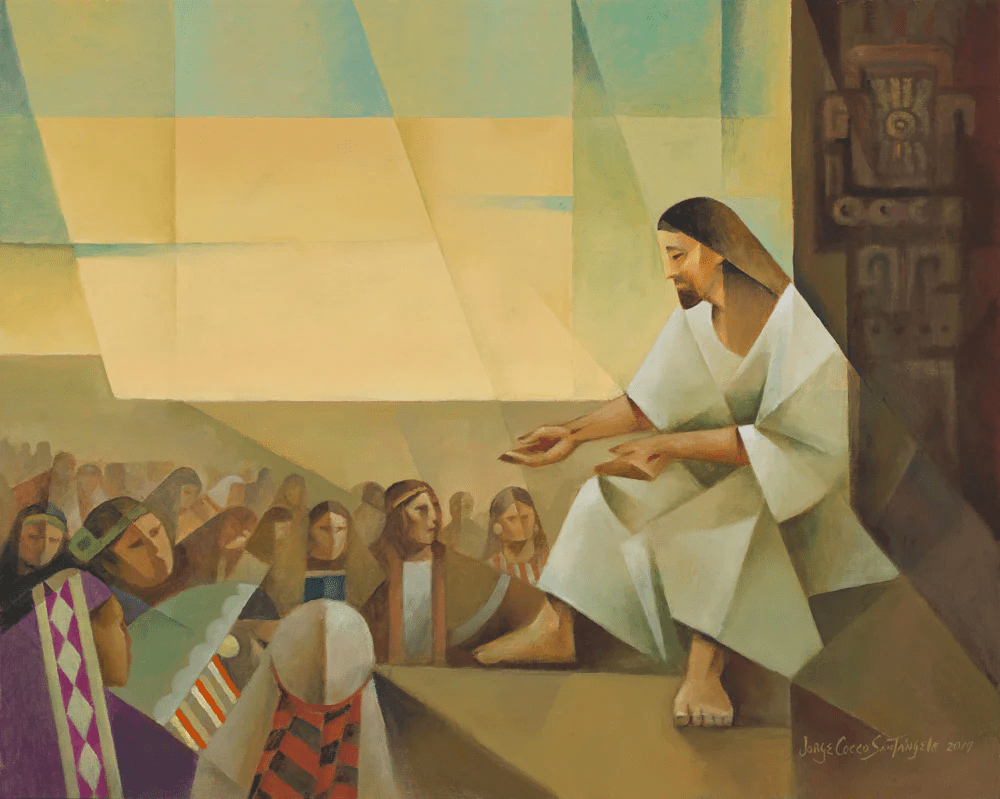
Jesus Preaching to the Multitude by Jorge Cocco Santángelo

If we have the spiritual ears to listen, we can hear numerous lost souls crying in the dark.

If we have the spiritual eyes to see, we can observe people overwhelmed with life circumstances standing in front of us.

If we have the spiritually strengthened hands willing to labor, we can support needy folks around us who can neither help themselves nor ask for it.

Whenever we take the focus off who is in and who is out, then without judgment and a heart full of compassion, we can address the:

  • Loneliness of so many people living alone and dying alone.
  • Shame which thousands secretly carry every day.
  • Pain of broken bodies, broken hearts, broken spirits, and broken minds experienced by individuals everywhere.

The Lord Jesus feels the loneliness, shame, and pain of people – which is why he told a parable like he did. Christ is looking to activate grace through his people, the church, to a world sinking in the depths of incredible human need.

Christ’s parable, however, is more than a warning; it is a story that flings open the door of mercy for unlikely people seemingly far from God – people who ruined their lives by saying “no” to God. The parable is an invitation for all the screw-ups and those with little faith to come to Jesus.

There is a rather obscure Scripture reference, tucked away in the Old Testament. David was on the outside looking in. King Saul was on the inside trying to capture and kill him, even though David had done nothing wrong. Here is what happened:

David got away and escaped to the Cave of Adullam. When his brothers and others associated with his family heard where he was, they came down and joined him. Not only that, but all who were down on their luck came around—losers and vagrants and misfits of all sorts. David became their leader. There were about four hundred in all. (1 Samuel 22:1-2, MSG)

This rag-tag group of outsiders in Israel became Israel’s insiders as David eventually became king and these were the “mighty men,” the ones who helped bring Israel into prominence. 

Jesus Christ came into this world and identified himself as the Savior to the outsider when he quoted the prophet Isaiah:

“The Spirit of the Lord is upon me,
    because he has anointed me
        to bring good news to the poor.
He has sent me to proclaim release to the captives
    and recovery of sight to the blind,
        to let the oppressed go free,
to proclaim the year of the Lord’s favor.”

And he rolled up the scroll, gave it back to the attendant, and sat down. The eyes of all in the synagogue were fixed on him. Then he began to say to them, “Today this scripture has been fulfilled in your hearing.” (Luke 4:18-21, NRSV)

In Christ, there are no lost causes and no persons too far on the outside to be redeemed.

Therefore, now is the time to act on what we believe – to not only affirm right doctrine, but to live out that doctrine in obedience to God’s call. Amen.

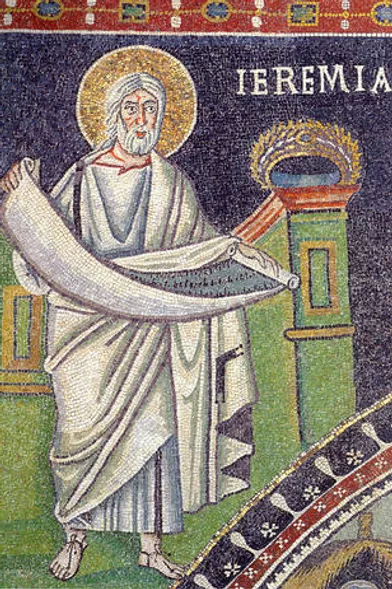
Speaking Truth to Power (Jeremiah 26:1-15)

The prophet Jeremiah, 6th century mosaic, Ravenna, Italy

Early in the rule of Judah’s King Jehoiakim, Josiah’s son, this word came from the Lord: The Lord proclaims: Stand in the temple courtyard and speak to all the people of the towns of Judah who have come to the temple to worship. Tell them everything I command you; leave nothing out. Perhaps they will listen, and each will turn from their evil ways. If they do, I will relent and not carry out the harm I have in mind for them because of the wrong they have done. 

So tell them, The Lord proclaims: If you don’t listen to me or follow the Instruction I have set before you—if you don’t listen to the words of the prophets that I have sent to you time and again, though you haven’t listened, then I will make this temple a ruin like Shiloh, and this city I will make a curse before all nations on earth.

The priests, the prophets, and all the people heard Jeremiah declare these words in the Lord’s temple. And when Jeremiah finished saying everything the Lord told him to say, the priests and the prophets and all the people seized him and said, “You must die! Why do you prophesy in the Lord’s name that ‘this temple will become a ruin like Shiloh, and this city will be destroyed and left without inhabitant’?” Then all the people joined ranks against Jeremiah in the Lord’s temple.

When the officials of Judah heard these things, they went up from the royal palace to the Lord’s temple and took their places at the entrance of the New Gate of the Lord’s temple. The priests and the prophets said to the officials and all the people: “This man deserves to die for prophesying against this city as you have all heard firsthand.”

Jeremiah said to all the officials and to all the people, “The Lord sent me to prophesy to this temple and this city everything you have heard. So now transform your ways and actions. Obey the Lord your God, and the Lord may relent and not carry out the harm that he’s pronounced against you. 

But me? I’m in your hands. Do whatever you would like to me. Only know for certain that if you sentence me to death, you and the people of this city will be guilty of killing an innocent man. The Lord has in fact sent me to speak everything I have said to you.” (Common English Bible)

When it comes to the spiritual and religious life, on the one hand, we hold the joy and contentment of divine connection and peace; and, on the other hand, we hold the sadness that many turn their backs on divine realities. In Christian terms, Jesus is both the cornerstone of faith and the stone which causes people to stumble and fall. (1 Peter 2:8)

Frankly, the Lord is not okay with cruel injustice, hollow worship, and inattention to both the divine and human. There is a way to make things right. But not everyone wants that. Systemic evil persists because there are always those who benefit from the current structures of power – and they care little about how it impacts those on the underbelly of their control.

Things may be going well for a large chunk of people. And, conversely, things may not be going well at all, for an even larger group of folks. Therefore, it is necessary to acknowledge that the world is not only good, but also quite broken. We must speak truth to power. I understand that this is no easy task, because rarely are things simply black and white, all good or all bad.

Jeremiah preaches in the temple gate, a woodcut by Unknown artist, 1886

In the prophet Jeremiah’s day, it was not that his opponents were pure evil with no acknowledgment of God. Rather, the problem was that the power brokers in Judah tried to keep a strict separation of religion from everything else; they were perfectly fine with God, that is, if the Lord would stay in the temple where he belonged.

But Jeremiah would have none of this sort of mentality and behavior. Keeping Yahweh out of matters of social justice, geopolitics, and institutional governance led to severe humanitarian problems. Jeremiah became God’s voice to a generation of people who ignored the divine in everything but religious ritual.

Bifurcating worship and work disconnects daily life from divine resources. Without God infused in all of life, a lack of grace fills the empty places. What’s more, the sovereign Lord can neither be silenced nor dismissed; God will find a way to accomplish peace and justice for the common good of everyone, and not just the few.

The heart of Jeremiah’s message was for king and people to be obedient in all of life, to recenter themselves around God’s law – not just the religious bits but the social ones, as well. Jeremiah did not proclaim something new. He was calling those in places of power and authority to a proper Torah observance.

The true needs and interests of our communities can never be addressed and lifted-up in the narrow self-serving interests of persons in power who turn a blind eye to anyone unlike them.

The needs and interests of our world lie in becoming who we were designed to be from the beginning: A people belonging to God, tapping into the deep reservoir of light and spirituality within us. It is to acknowledge the image of God inside us all.

We are to follow in the way of grace and truth. There is to be no division between the sacred and the secular because, for the Christian, Jesus is Lord of all.

We are to continually use our voice for both praise and prophecy, for shouting celebration to God and for speaking truth to power.

Holy God, the gracious Sovereign of all, we give you praise for your steadfast love toward us, your people. Keep us grounded in humility, sensitive to sin, attentive to that which is just and right, merciful in all things, pure in worship, and peace-loving through Christ our Lord in the strength of the Spirit. Amen.

Revelation 3:1-6 – Remember, Hold On, and Change

Ruins in the ancient city of Sardis (present day Sart, Turkey)

Write this to the angel of the church in Sardis:

These are the words of the one who holds God’s seven spirits and the seven stars: I know your works. You have the reputation of being alive, and you are in fact dead. Wake up and strengthen whatever you have left, teetering on the brink of death, for I’ve found that your works are far from complete in the eyes of my God. So, remember what you received and heard. Hold on to it and change your hearts and lives. If you don’t wake up, I will come like a thief, and you won’t know what time I will come upon you. But you do have a few people in Sardis who haven’t stained their clothing. They will walk with me clothed in white because they are worthy. Those who emerge victorious will wear white clothing like this. I won’t scratch out their names from the scroll of life but will declare their names in the presence of my Father and his angels. If you can hear, listen to what the Spirit is saying to the churches. (Common English Bible)

Many Christians reflexively think of good old Apostle Paul when it comes to biblical epistles (letters) to churches. Yet, contained within the first three chapters of Revelation are seven succinct letters to seven different churches. These letters are short and packed with a punch – and they don’t come from Paul.

What makes these short bursts of exhortation so powerful is that they come from Jesus himself. Yes, that Jesus – the Lord Jesus Christ, the head of the church. So, it seems to me that Christ’s observations about the church ought to carry more weight than anybody else’s thoughts.  

Christ was concerned about how far the church was from completing the work of God. So, he gave a pointed admonition, almost like a parent trying to awaken a teenager in the morning. “Wake up!” said Jesus because he found the church’s obedience incomplete and lacking strength. If this were the Apostle Paul talking, he would likely have framed it this way: “You have sinned and fallen short of the glory of God.” (Romans 3:23)

Our Lord went directly to the heart of the church’s life… and it’s death. The stark reality is that these statements from Jesus remain penetrating and relevant for today’s church.

So, what is to be done about the situation of spiritual deadness in the church? 

Jesus did not leave the church hanging but in a few compact words let them know exactly what they are to do to remedy their spiritual malady: Remember. Hold on. Change. Keep the memory of sound instruction alive, always adjusting the life of the church to it. The Christian term for this is “repentance.”

Sometimes, if not many times, we may tend to forget the things we need to remember and remember the things we must forget. We are to follow God in a pattern of remembering and forgetting. God has said:

I wipe away your sins because of who I am. And so, I will forget the wrongs you have done. (Isaiah 43:25, CEV)

I will forgive their wrongdoing and never again remember their sins. (Jeremiah 31:34, CEB)

I will forget their sins and never again remember the evil they have done. (Hebrews 10:17, ERV)

Concerning those who have wronged us, we are to emulate God’s grace, mercy, and kindness through forgiveness. To “forget” does not mean performing a personal lobotomy but simply not to hold an offense against another by continually bringing it to mind. On the other hand, God remembers divine promises made to people. Likewise, we are to constantly bear in mind what God has put before us to remember:

For I received from the Lord what I also handed on to you, that the Lord Jesus on the night when he was betrayed took a loaf of bread, and when he had given thanks, he broke it and said, “This is my body that is for you. Do this in remembrance of me.” In the same way he took the cup also, after supper, saying, “This cup is the new covenant in my blood. Do this, as often as you drink it, in remembrance of me.” For as often as you eat this bread and drink the cup, you proclaim the Lord’s death until he comes. (1 Corinthians 11:23-26, NRSV)

We need an abiding remembrance of the Lord Jesus, the very person who spoke to the church hundreds of years ago. It is in those times when we become distressed that we must center our memory on Christ:

We must focus on Jesus, the source and goal of our faith. He saw the joy ahead of him, so he endured death on the cross and ignored the disgrace it brought him. (Hebrews 12:2, GW)

Remembering Jesus Christ sets us on the path to fulfilling the work of God and completing that which has been given us to do. This is precisely why I choose to follow the Christian Year and remember time by having it centered around the life and ministry of Jesus.

Always think about Jesus Christ. He was brought back to life and is a descendant of David. This is the Good News that I tell others. (2 Timothy 2:8, GW)

I have been a constant example of how you can help those in need by working hard. You should remember the words of the Lord Jesus: “It is more blessed to give than to receive.” (Acts 20:35, NLT)

Let us remember together in prayer:

Awesome Lord Jesus, your words penetrate to the core my being. Strengthen me by the continuing presence of yourself through the Holy Spirit so that my every thought, word, and deed is done in your holy Name. Kindle in my heart a vision of your love and shine the light of your victory over sin, death, and hell over this dark world. Continually take me to yourself. Keep me in your wounds and mindful of your presence so that I shall fulfill all the will of God for my life through your divine enablement. Amen.

Luke 11:24-28 – Human Nature Abhors a Vacuum

Photo by Rene Asmussen on Pexels.com

“When an evil spirit leaves a person, it goes into the desert, searching for rest. But when it finds none, it says, ‘I will return to the person I came from.’ So, it returns and finds that its former home is all swept and in order. Then the spirit finds seven other spirits more evil than itself, and they all enter the person and live there. And so that person is worse off than before.”

As he was speaking, a woman in the crowd called out, “God bless your mother—the womb from which you came, and the breasts that nursed you!”

Jesus replied, “But even more blessed are all who hear the word of God and put it into practice.” (New Living Translation)

You have likely heard the old adage, “Nature abhors a vacuum.” This idiom is used to express the idea that empty or unfilled spaces are unnatural as they go against the laws of nature and physics. Jesus expressed a similar statement, not about physical nature but human nature.

People experience emptiness whenever something, or someone, has been expelled from our lives, creating a vacuum. In today’s Gospel lesson, the expulsion is that of an evil spirit. The bad spirit is kicked to the curb, so it goes looking somewhere else to settle, with no success. Then, the spirit decides to go back, check, and see if the person is occupied, or not.

Everything in nice, neat order. Cleaned up, looking good. But empty. For the spirit, this is ideal. So much space in such an organized environment that it becomes the ideal spot for a party of peers to turn the order back into chaos.

Yet, if there had been something to fill the void, the spirits could never have come and occupied the space.

It’s a pointed lesson about truly hearing. There’s the kind of hearing that goes in one ear and out the other. There’s also a type of hearing which listens yet does nothing to act on what is being heard. That seems to be the kind of hearing Jesus was talking about.

To hear God’s Word is one thing. To make it stick by putting into practice, is another thing altogether. It’s akin to the difference between having an attractive and expensive goatskin leather Bible adorning a coffee table in the center of the house. Looks great. Problem is, it never gets a genuine hearing because the cover rarely gets cracked open.

Once, in my first church as their Pastor, a man had a bevy of family issues which seemed endless. At first, I didn’t understand it. He seemed like a really nice guy. Every Sunday he was there, without fail, and always brought his Bible.

Then, one Sunday, after everyone had left, I found a Bible sitting in the pew where the man always sat. I opened it, and sure enough, it was his, his name written inside the cover. It appeared to be a brand spanking new one, until I looked at the publication date and inscription from when it was given to him: 1949.

In returning the Bible to the man the next day, I discovered that he indeed never read it. In fact, I quickly found out that in the thousands of sermons he had heard over the decades, none of them seemed to ever stick. He heard but didn’t really hear. Instead, he spent most of his life trying not to be involved in much of anything as a means of protecting himself from hurt.

Hearing God’s Word without putting any of into practice isn’t ever going to end well.

Obey God’s message! Don’t fool yourselves by just listening to it. If you hear the message and don’t obey it, you are like people who stare at themselves in a mirror and forget what they look like as soon as they leave. But you must never stop looking at the perfect law that sets you free. God will bless you in everything you do, if you listen and obey, and don’t just hear and forget. (James 1:22-25, CEV)

The Word of God has not been truly received until it is put into practice.

The person who only hears is like a Mr. Potato Head that is only ears. He can’t stand because he has no feet.  He cannot do anything because he has no hands. Mr. Potato Head needs some feet so that he can follow Jesus wherever he goes.  And he needs hands so he can do God’s will.

Listening to the Word without obedience is just that – it is mere hearing. 

Profession of faith in Jesus means nothing without a practice of that faith.

Learning the Bible is useless without living it.

Acceptance of the Word is nothing more than a mental exercise without action to back it up. 

Christianity is a vital love relationship with Jesus, and, so, is not merely a matter of hearing and affirming orthodoxy; it also involves orthopraxy, that is, having right practice, the doing of truth.

Good hearing leads to a good response.

When my firstborn daughter was still in her mother’s womb, I constantly talked to her. I was in seminary at the time, and I would come home and read her fairy tales in Hebrew. I spoke to her when I got up in the morning and when I went to bed. I told her all about how God was going to bless her and do great things through her. I told her of Jesus and his love for her. I practiced my sermons and Sunday School lessons on her – all before she was born.

When the day finally came of her birth, the nurses took her, and she cried and cried. She cried so much and so hard that I finally said to them, “Let me hold her.” The minute I held her, I began speaking to her, and what happened next got the attention of everyone in the room: my little baby daughter immediately got quiet. It was like that the entire time she was in the hospital. The only time she was happy was when I was speaking to her.

We respond to God’s voice when we recognize it. If we are not in the habit of responding to God’s Holy Word, it is likely that we do not know the Divine voice. My baby daughter didn’t need a lesson on how to respond to me. She knew exactly who I was: her father. 

Do we know our heavenly Father? Can we distinguish God’s voice?

We need to be servants who hear and respond to the voice of God, and not soakers who just sit and hear without any response at all.

Human nature abhors a vacuum. Our own inner emptiness needs to be filled with practicing the words of life we hear. This is the true path of blessing.

Gracious Lord, you have caused Holy Scripture to be written for our learning: help us so to hear, read, mark, learn, and inwardly digest the Word so that we may do what it says and embrace the joyful hope of everlasting life, which you have given us in our Savior Jesus Christ. Amen.