Obedience is Better than Sacrifice (1 Samuel 15:22-31)

“Tell me,” Samuel said. “Does the Lord really want sacrifices and offerings? No! He doesn’t want your sacrifices. He wants you to obey him. Rebelling against God or disobeying him because you are proud is just as bad as worshiping idols or asking them for advice. You refused to do what God told you, so God has decided that you can no longer be king.”

“I have sinned,” Saul admitted. “I disobeyed both you and the Lord. I was afraid of the army, and I listened to them instead. Please forgive me and come back with me so I can worship the Lord.”

“No!” Samuel replied, “You disobeyed the Lord, and I won’t go back with you. Now the Lord has said that you can’t be king of Israel any longer.”

As Samuel turned to go, Saul grabbed the edge of Samuel’s robe. It tore! Samuel said, “The Lord has torn the kingdom of Israel away from you today, and he will give it to someone who is better than you. Besides, the eternal God of Israel isn’t a human being. He doesn’t tell lies or change his mind.”

Saul said, “I did sin, but please honor me in front of the leaders of the army and the people of Israel. Come back with me, so I can worship the Lord your God.”

Samuel followed Saul back, and Saul worshiped the Lord. (Contemporary English Version)

God had given Saul explicit instructions on how to handle a group of people called the Amalekites (the first nation to attack the Jewish people after the Exodus from Egypt, and viewed as the archetypal enemy of the Jews). Saul obeyed only some of the instructions, but not all of them.

King Saul rationalized his behavior as worship. But God would have none of it. The Lord rejected Saul as king. God wants no monkey business when it comes to obedience. (1 Samuel 15:1-21)

Whenever I come across biblical characters like Saul, I find myself trying to distance from them. Yet, oftentimes, when I take the time to sit a bit with the Scriptures, I realize I can have some of the same propensities as their behavior. In today’s Old Testament lesson, I am like Saul whenever:

  • I say I will do something and then get busy and not do it. I sometimes rationalize my lack of follow through by explaining what good things I was doing with my time instead.
  • I justify a purchase of something I do not really need, but want, with the excuse that I am generous with my money.
  • I slander another person, even though its forbidden by God, with the knucklehead notion that I am protecting and helping others from that person’s evil ways.
  • I keep quiet in the face of a bad situation when I should be speaking up. I dismiss the lack of engagement and involvement with needing to save my energy for people who want it….

I could keep going with this little exercise, but I’m too convicted to keep thinking about it anymore. So, before we get too uppity about saying we are not like Saul and would never be like him, perhaps we ought to sit with the story for a while, being mindful and aware of any unacknowledged disobedience.

Rationalization is the way of sinners.  Repentance is the path of saints.  Which road will you choose today?

Unfortunately, as the story of Saul’s life unfolds, we discover that the encounter with Samuel becomes a typical pattern of behavior in which Saul:

  1. Disobeys or ignores God’s commands
  2. Rationalizes his bad behavior by putting a spiritual spin on it
  3. Is confronted with his sin
  4. “Repents” with crocodile tears
  5. Then goes back to his old ways of doing whatever the heck he wants

It seems that whenever Saul feels threatened, or anxious, or jealous, or stressed, he crumbles into a heap of fear and ends up making boneheaded decisions, hurting people, or becoming complicit in somebody else’s sin.

Don’t be like Saul.

Instead, get to the root of the trouble by addressing your own anxiety.

Focus on What Is Within Your Control

We cannot control other people. Many circumstances are also outside our control. However, we are always in control of ourselves. Learn good self-care, focus on helpful attitudes, and use the adversity before you to strengthen your faith.

The Serenity Prayer is a good reminder in those times when we feel out of control:

God, grant me the serenity to accept the things I cannot change,

The courage to change the things I can,

And the wisdom to know the difference.

Promote a Positive Mindset

Positive attitudes help us widen our perspective on things – and with a broader view of things comes more awareness of choices. Making spiritually and emotionally healthy choices for ourselves builds resilience and fortifies us for difficult situations down the road, without succumbing to old unhealthy coping mechanisms.

Be Humble

False humility looks a lot like what Saul did. But true humility isn’t about trying to save face or suck up to others. It’s about the willingness to ask for what you need and want without manipulation, to serve others without making sure everyone notices. Humility relates to, and empathizes with, others and doesn’t go out of the way to distance from folks on the lower end of society. And humility is always willing to accept the consequences of decisions and actions.

Rationalizing disobedience never ends well, especially with a God who holds everyone accountable for their words and behaviors. So, let’s all do ourselves a favor, and seek the good, the right, and the just with a spirit of meekness.

Holy God, you expect obedience to clear instructions. I am sorry for all those times I found creative ways to circumvent your teaching. Help me not to avoid your good commands, but to own them with vigor and vitality through Jesus Christ my Lord in the power of your Holy Spirit. Amen.

Listen! (Psalm 81)

Shout for joy to God our defender;
    sing praise to the God of Jacob!
Start the music and beat the tambourines;
    play pleasant music on the harps and the lyres.
Blow the trumpet for the festival,
    when the moon is new and when the moon is full.
This is the law in Israel,
    an order from the God of Jacob.
He gave it to the people of Israel
    when he attacked the land of Egypt.

I hear an unknown voice saying,
“I took the burdens off your backs;
    I let you put down your loads of bricks.
When you were in trouble, you called to me, and I saved you.
    From my hiding place in the storm, I answered you.
    I put you to the test at the springs of Meribah.
Listen, my people, to my warning;
    Israel, how I wish you would listen to me!
You must never worship another god.
I am the Lord your God,
    who brought you out of Egypt.
Open your mouth, and I will feed you.

“But my people would not listen to me;
    Israel would not obey me.
So I let them go their stubborn ways
    and do whatever they wanted.
How I wish my people would listen to me;
    how I wish they would obey me!
I would quickly defeat their enemies
    and conquer all their foes.
Those who hate me would bow in fear before me;
    their punishment would last forever.
But I would feed you with the finest wheat
    and satisfy you with wild honey.” (Good News Translation)

I have a wife and three daughters. They talk – a lot! When my girls were small, it was hard to get their attention long enough for them to hear anything I was saying. So I oftentimes cupped my hands to their little faces so they couldn’t look around and get distracted. Then, I would speak, with them looking me straight in the eye.

It’s hard to listen. And listening seems to be a lost art and a skill we no longer care to develop. Maybe that’s because we’re obsessed with hearing ourselves talk. There’s so much chatter about so many things that we rarely even remember much of what we said; and a lot of those words get uttered before we even think. 

What’s more, when other people talk, most of it seems like a bunch of gibberish, due to our lack of focused attention. Perhaps we need an adult version of the hand-cupping we do with kids.

We really need the wisdom to know when to speak and when to be quiet. Whenever being quiet is required, it’s for the purpose of listening. And whenever words and noise are needed, it’s to praise God with our mouths and our musical instruments.

In this day and age, folks get so worked up to express their opinions, and say what they want to say, that the virtue of listening is not at all valued. However, God puts a premium on taking the stance of listening. 

The more you talk, the more likely you are to sin. If you are wise, you will keep quiet. (Proverbs 10:19, GNT)

Another reason listening is not well-practiced is that we esteem being busy and constant activity, to such a degree, that taking the time for silence long enough to listen is not of value to us. But if God’s people are going to hear the voice of the Lord, we must be still and silent, long enough to listen to what’s being said to us.

And yet another reason we eschew listening is that we are uncomfortable with silence, and seek to fill any quiet space with noise so as to not have to deal with what is really going on inside of us. Since God often speaks within the stillness and quietness of things, we’ll never hear, because our inner dialogue is drowning the words we need to listen to. (1 Kings 19:11-12)

I have a friend (I’ll call him Elmer) who spent eighteen hours in complete silence, without any talking whatsoever, in order to listen to God. You might think that Elmer is a monkish sort of introvert who likes that sort of thing. However, he’s actually an extrovert who lives in the inner city and comes from a large family. 

Elmer simply came to the point of understanding that he was so busy moving from one thing to another, and constantly talking, to the point that he was drowning-out the voice of the Lord. Here’s what Elmer said about his time of silence: 

“Those eighteen hours of silence were the loudest hours I have ever experienced. My mind was so noisy and so filled with stuff that it nearly drove me nuts. But after many hours passed, as the noise started to fade away, I could begin to hear the still small voice of God.” 

Elmer discovered that he was a person who kept pushing and projecting his agenda onto God. His lack of listening led to an inability to obey. After Elmer’s experience, he determined to start including times of solitude and silence into his everyday life, even if for only ten minutes, so he could listen to what God wants rather than tell God what to do.

The Lord came and stood there, and called as he had before, “Samuel! Samuel!” Samuel answered, “Speak; your servant is listening.” (1 Samuel 3:10, GNT)

Any fool can babble on about their gripes and opinions. In Holy Scripture, however, human speech is generally viewed as being overrated. Instead, silence and solitude, listening and learning, are the virtues practiced by Jesus; the kingdom of God cannot operate without them.

Therefore, we must take up the shield of faith with which to extinguish all the flaming arrows of the evil one who wants to keep us trapped in either a cycle of constant chatter without listening, or continual silence without acting upon what we hear from God. 

We must be quiet for the purpose of listening to God. Then, when we hear the Lord speak, we must act in faith to say and do what we are called to.

God of silence and of all sound, help me to listen! Enable me to be patient and wait for your still small voice calling me. Give me attentive ears that can separate the noise from the sounds that are you. Today help me to hear you anew so that I may obey with wisdom and obedience. Amen.

How Can I Live a Pure Life? (Psalm 119:9-16)

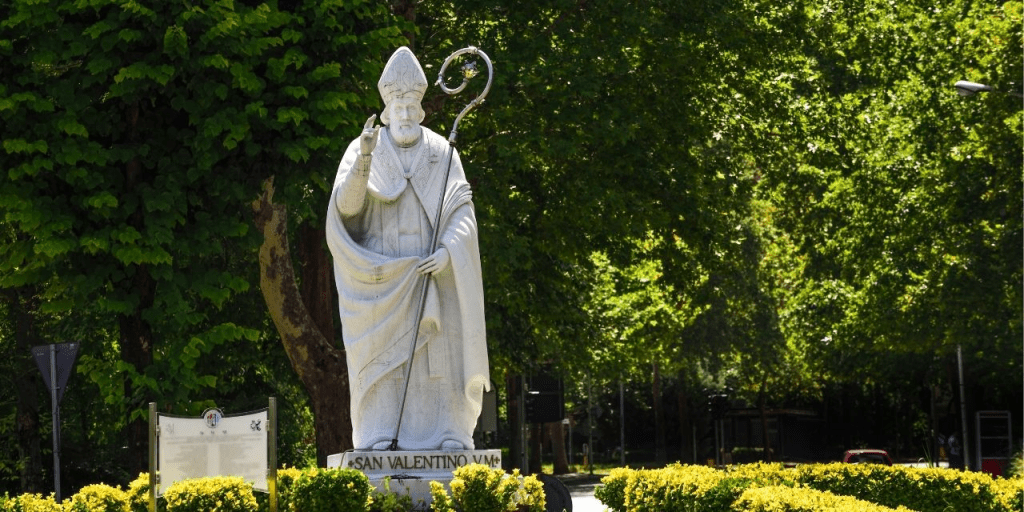
Statue of Saint Valentine in Terni, Umbria, Italy

How can a young person live a pure life?
    By obeying your word.
I try with all my heart to serve you.
    Help me obey your commands.
I study your teachings very carefully
    so that I will not sin against you.
Lord, you are worthy of praise!
    Teach me your laws.
I will repeat the laws we have heard from you.
I enjoy following your rules
    as much as others enjoy great riches.
I will study your instructions.
    I will give thought to your way of life.
I enjoy your laws.
    I will not forget your word. (Easy-To-Read Version)

There was an actual Saint Valentine (c.226-269 C.E.) who lived and served as a Bishop in Rome. The Roman Emperor of the time, Claudius II, was vehemently opposed to Christianity. Claudius forbad Christian marriages from taking place – which was something Bishop Valentine was unwilling to do, and was supposedly jailed for his refusal to stop performing Christian weddings. Hence, one of the reasons for Valentine being the patron saint of lovers.

That’s certainly one way of helping to keep young Christians pure. I, in fact, have more than once advocated on behalf of a young couple in love. Their parents, who wanted a large wedding and plenty of time to prepare for it, simply didn’t realize what they were asking of their kids and how much that put them in an awkward position.

To be pure means to be holy or set apart for a special or specific purpose. Christians are to be completely devoted to their Lord and Savior, Jesus Christ. In order to do that, they will need to pay particular attention to God’s commands and Christ’s teachings.

The Will

The whole person must be involved in obeying the teachings given to us. It begins with our will. Notice that the psalmist sets his resolve toward this great task by stating:

  • I will repeat (out loud) the divine laws I hear
  • I will study God’s instructions
  • I will give thought to my way of life with Yahweh
  • I will not forget the Lord’s words

I have considered my ways
    and have turned my steps to your statutes.
I will hasten and not delay
    to obey your commands. (Psalm 119:59-60, NIV)

We need strong affirmations toward engaging our will toward reading aloud, studying, and remembering biblical commands, so that we will succeed in our quest for purity and holiness.

The Emotions

Our affections also need to be involved. We are emotional creatures, having been formed by a Creator with deep feelings. Therefore, our own emotions are meant to be acknowledged and engaged. The psalmist enjoys God’s Law and is emotionally draw to it’s beauty and light.

Oh, how I love your law!
    I meditate on it all day long.
Your commands are always with me
    and make me wiser than my enemies. (Psalm 119:97-98, NIV)

We need strong feelings toward desiring God’s Word, so that there will be effective action toward a life of purity. Overall, we do what we want. Continually doing something we don’t really want to do ends up being either legalistic or loathsome.

The Body

Our bodies are the vehicles to doing and accomplishing God’s will on this earth. Thus, our physical selves must be animated toward the good, the right, and the just. The psalmist worshiped and praised God.

I, by your great love,
    can come into your house;
in reverence I bow down
    toward your holy temple. (Psalm 5:7, NIV)

Hear my cry for mercy
    as I call to you for help,
as I lift up my hands
    toward your Most Holy Place. (Psalm 28:2, NIV)

Our bodies need to move in physical rhythms of praise and worship to God, so that there will be purity of life. Holiness needs hands and feet to walk into the way of the Lord and obey God’s commands.

Philosophies of Purity

There are some unsound approaches to becoming pure and remaining holy:

  1. It’s up to me. God is too far away, maybe even absent altogether. This is a philosophy which ignores the gut. Yet, if we seek to connect with our innards, we’ll discover quickly that purity is not all on me. I am the vine; you are the branches. If you remain in me and I in you, then you will produce much fruit. Without me, you can’t do anything. (John 15:5, CEB)
  2. Follow your heart. Doing this has significance; however, if that’s the exclusive approach to purity, the mind gets left behind and the heart ends up vulnerable to deceit. The heart is deceitful above all things, and desperately sick; who can understand it? (Jeremiah 17:9, ESV)
  3. Knowledge is power. Yes, of course it is; but by itself, knowledge puffs up. We need the affections, particularly love, or else we become brains-on-a-stick, denigrating the body as superfluous to spirituality. Knowledge puffs up, but love builds up. (1 Corinthians 8:1b, NRSV)
  4. Control everything. There are certainly forces in operation in this world; yet we are never called to try and manipulate them. We may will ourselves to do many things, yet God has control of all things. Humanity is called to self-control, which takes up all our energy because it’s no easy feat. For the grace of God has appeared that offers salvation to all people. It teaches us to say “No” to ungodliness and worldly passions, and to live self-controlled, upright and godly lives in this present age. (Titus 2:11-12, NIV)

A sound philosophy of being holy and pure recognizes that we need divine help in strengthening our faith; the assistance of others who can walk alongside us and provide encouragement; and the engagement of our entire person, utilizing all our faculties in order to live a life of purity. Obedience to God’s Word is vital to a holy life; and to obey requires our entire selves.

There is to be a marriage between God’s commands and human obedience. The world may forbade this, but much like St. Valentine, we’ll let love have its way – and not the ruler of this present evil age.

There’s a Price to Pay (Leviticus 26:34-46)

At that time, while it is devastated and you are in enemy territory, the land will enjoy its sabbaths. At that time, the land will rest and enjoy its sabbaths. During the whole time it is devastated, it will have the rest it didn’t have during the sabbaths you lived in it.

I will bring despair into the hearts of those of you who survive in enemy territory. Just the sound of a windblown leaf will put them to running, and they will run scared as if running from a sword! They will fall even when no one is chasing them! They will stumble over each other as they would before a sword, even though no one is chasing them!

You will have no power to stand before your enemies. You will disappear among the nations—the land of your enemies will devour you. Any of you who do survive will rot in enemy territory on account of their guilty deeds. And they will rot too on account of their ancestors’ guilty deeds.

But if they confess their and their ancestors’ guilt for the wrongdoing they did to me, and for their continued opposition to me—which made me oppose them, so I took them into enemy territory—or if their uncircumcised hearts are humbled and they make up for their guilt, then I will remember my covenant with Jacob. I will also remember my covenant with Isaac. And my covenant with Abraham.

And I will remember the land. The land will be absent of them and will be enjoying its sabbaths while it lies devastated, free of them. They will be making up for their guilty deeds for no other reason than the fact that they rejected my regulations and despised my rules. 

But despite all that, when they are in enemy territory, I will not reject them or despise them to the point of totally destroying them, breaking my covenant with them by doing so, because I am the Lord their God. But for their sake I will remember the covenant with the first generation, the ones I brought out of Egypt’s land in the sight of all the nations, in order to be their God; I am the Lord.

These are the rules, regulations, and instructions between the Lord and the Israelites that he gave through Moses on Mount Sinai. (Common English Bible)

Disobedience has a price. Within God’s household, the Lord isn’t some geriatric or decrepit deity who let’s the kids run around and do whatever the heck they want. Instead, God has certain rules so that the children can grow and thrive within loving boundaries. The fences aren’t there in order to be a divine killjoy; rather, the rules and boundaries exist for the flourishing and enjoying of life.

The price of disobedience is brokenness and devastation. To continually buck our basic design as humans will eventually catch up to us. If we eat with impunity, spending copious amounts of time consuming food, we’ll one day collect a host of heart-related issues and diseases. If we drive the car and never maintain it through regular oil changes and inspections, someday it will break down, perhaps permanently.

And if we live our lives without punctuating our weeks with needed rest – and use the land as if it were an infinite resource – then everything will eventually go awry and not work or produce like it should. That’s not God being mean, as if the Lord is to blame; it’s us being stupid, not practicing our God-given wisdom.

“Because we do not rest, we lose our way.”

Wayne Muller

Everything and everyone needs rest. It’s vital to us, just as much as water to drink and air to breathe. So, if we ignore it, we’ll pay the price of our neglect.

Sabbath was built into the universal scheme of things because it’s necessary. Our bodies neither work right nor live right without regular sabbath rests. It’s not optional. Try telling your body that you’re too busy to go to the bathroom and see how that works out for you. Sooner than later, you’re going to have to submit, or there will be a hefty price to pay.

If we stray from wise ways of living, or even stubbornly refuse to obey, there’s hope; we won’t be left to wallow in our own foolishness. Grace is too big and strong for any of our puny human backsliding. The Lord is always ready and willing to receive the humble and penitent heart.

God’s expertise is in restoration; the Lord gives a new lease on life to people who could never do it themselves. In fact, from a New Testament perspective, God even goes so far as to pay the price of human waywardness with his own Son.

A loving God ensures that all of creation will have what it needs to survive and thrive. An unloving god turns a blind eye to it all. If we don’t learn to play well with the creation around us, we’ll be called into the house and not be allowed to be outside for quite some time.

We are meant to practice good self-care, be good caregivers for others, and concern ourselves with caring for all creation.

So, pay the price of caring for self, others, and the land. Accept and submit to the rhythms of life which are required to live well. You’ll be glad you did because the alternative may be something a whole lot harder.

Creator God, you made the goodness of the land, the riches of the sea and the rhythm of the seasons; as we thank you for your gracious providing may we cherish and respect this planet and its peoples, through Jesus Christ our Lord. Amen.