The Parable of the Two Sons (Matthew 21:28-32)

Wheatfield with Crows, by Vincent van Gogh, 1890

“What do you think about this? A man had two sons. He went to the first and said, ‘Son, go to work in the vineyard today.’

“His son replied, ‘I don’t want to!’ But later he changed his mind and went.

“The father went to the other son and told him the same thing. He replied, ‘I will, sir,’ but he didn’t go.

“Which of the two sons did what the father wanted?”

“The first,” they answered.

Jesus said to them, “I can guarantee this truth: Tax collectors and prostitutes are going into God’s kingdom ahead of you. John came to you and showed you the way that God wants you to live, but you didn’t believe him. The tax collectors and prostitutes believed him. But even after you had seen that, you didn’t change your minds and believe him. (God’s Word Translation)

I once cheated on a college exam. It was a required class for which I was not much interested, so my grade was rather tenuous going into the final exam of the semester. When the professor stepped out of the classroom for a few minutes during the final, my fellow students began sharing answers. I gave in and went with the others.

I got an “A” on the exam and passed the class easily. However, I royally flunked God’s test. After a few days of misery, I went to the professor’s office and confessed what I had done. I was prepared to take a failing grade for both the exam and the class, yet I think the professor was so shocked that I would come and admit such a thing that he worked up my grade right there in front of me… I passed, but just barely.

I originally said “no” to what was right, but then said “yes” and made it right.  For those who practice repentance, there is a God of grace waiting for them. God has no tolerance for those who profess truth with a big “yes” on the outside but are passive-aggressive on the inside and say “no,” undermining the truth by how they live. 

The Sower, by Vincent Van Gogh, 1888

Today’s Gospel lesson highlights entrance into the kingdom of God – and the people entering might surprise us. Turns out, there are spiritual insiders on the outside of the kingdom, and spiritual outsiders as the ones who really inherit the kingdom.

Christ’s parable is a warning to all the spiritually serious: Beware, lest our insider energies be spent in correctness, conformity of belief, and cockiness rather than following Jesus. At the same time, the parable encourages outsiders with the wonderful possibilities of a changed life. 

Jesus was warning those who arrogantly assume they have the inside track by what they believe, and not by doing God’s will. It may be challenging for us to imagine how truly offensive Christ’s story was to the original hearers of the parable, so I restate it in a more contemporary form:

There was a man who was well respected in the community and had two sons. One son grew up and became a respectable member of the community, too. He was a successful businessman and gave lots of money to causes in his community, including new lights for the school football field – which was no small cost.  He only asked that appropriate and prominent recognition be given him with a plaque bearing his name on each of the light poles. 

The other son was not so successful.  He was the one in school who the teachers said, “Why can’t you be more like your brother?”  There was nothing spectacular about this son.  In fact, he lived an ‘alternate lifestyle’ and people murmured behind his back. 

One day the father said to this son: “Son, go and work at my place of business today; I am going away and need you to do some of the tedious paperwork I have gotten behind on.” “No way!” he answered, but later felt heartsick about the way he spoke to his father and decided to go and do all the grunt work his father needed done.

The father went to the well-respected son and said the same thing about needing him to do all the thankless paperwork that was piled up. That son answered, “Yes, sir, I will; anything you need I will do.” But that son did not go. Instead, he chose to go golfing with some people whom he was trying to coy favor with.

After telling the story, Jesus asked all the upstanding faith leaders and the people listening: “Which of the two did what his father wanted?” “The first,” they answered.

Jesus said, “I tell you the truth, folks with different sexual orientations, unemployed persons on the low rung of society, and the religiously different with esoteric beliefs are entering the kingdom of God ahead of you. For you have had heard thousands of sermons about grace and the way of righteousness, yet you did not believe by putting God’s Word into practice; but the others did. And even after you saw how God can change a person’s life from the inside-out, you yourselves did not repent and believe.

For Jesus to tell such a story was so scandalous that, frankly, it got him killed. Specifically, the scandal is this: Merely believing rightly and living as an upstanding citizen is not the way of salvation. Tax collectors and prostitutes were some of the most despised people in Christ’s time. It was assumed they were outside of God.

However, the proof of genuine belief is not lip service but actively obeying God when no one is looking:

My friends, what good is it to say you have faith, when you don’t do anything to show that you really do have faith? Can that kind of faith save you? If you know someone who doesn’t have any clothes or food, you shouldn’t just say, “I hope all goes well for you. I hope you will be warm and have plenty to eat.” What good is it to say this, unless you do something to help? 

Faith that doesn’t lead us to do good deeds is all alone and dead! Suppose someone disagrees and says, “It is possible to have faith without doing kind deeds.” I would answer, “Prove that you have faith without doing kind deeds, and I will prove that I have faith by doing them.” You surely believe there is only one God. That’s fine. Even demons believe this, and it makes them shake with fear. (James 2:14-19, CEV)

The Christian life comes down to obedience, not cheap talk. Jesus wants to bless a lost world in need of God’s love and grace.

If we have ears to listen, we can hear numerous lost souls crying in the dark. If we have eyes to see, there are people caught in addictions standing in front of us. If we have hands willing to labor, needy folks surround us who can neither help themselves nor ask for it.
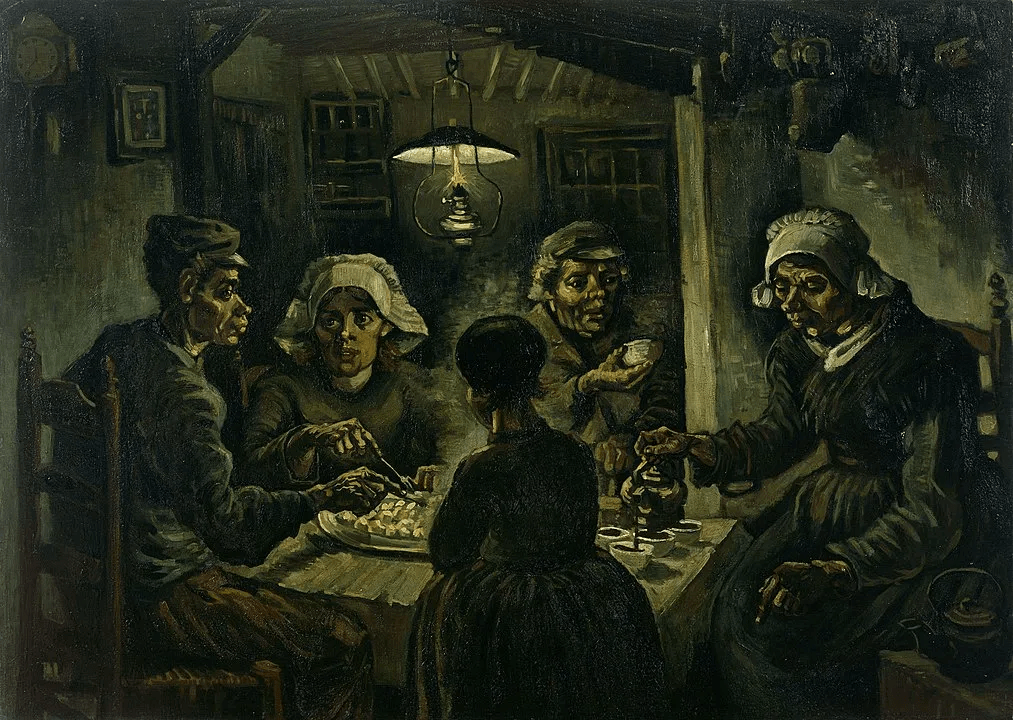
The Potato Eaters, by Vincent Van Gogh, 1885

Honestly, I am heartsick over the grinding loneliness of so many people; the boatloads of shame which thousands secretly carry; and the silent pain experienced by individuals everywhere. I feel this way because I genuinely believe my Lord feels the same. Jesus is looking to activate grace through his people to a world sinking in the depths of incredible human need.

Christ’s parable, however, is more than a warning; it is a story that opens the door of mercy for unlikely people seemingly far from God – people who ruined their lives by saying “no” to God. The parable is an invitation for all the screw-ups and those with little faith to come to Jesus.

There is a rather obscure Scripture reference, tucked away in the Old Testament. David was on the outside looking in. King Saul was on the inside trying to capture and kill him, even though David had done nothing wrong. Here is what happened:

David got away and escaped to the Cave of Adullam. When his brothers and others associated with his family heard where he was, they came down and joined him. Not only that, but all who were down on their luck came around—losers and vagrants and misfits of all sorts. David became their leader. There were about four hundred in all. (1 Samuel 22:1-2, MSG)

This rag-tag group of outsiders in Israel became Israel’s insiders as David eventually became king and these were the “mighty men,” the ones who helped bring Israel into prominence. 

Jesus Christ came into this world and identified himself as the Savior to the outsider when he quoted the prophet Isaiah:

Jesus went to the synagogue on the sabbath day, as was his custom. He stood up to read, and the scroll of the prophet Isaiah was given to him. He unrolled the scroll and found the place where it was written:

“The Spirit of the Lord is upon me,
    because he has anointed me
        to bring good news to the poor.
He has sent me to proclaim release to the captives
    and recovery of sight to the blind,
        to let the oppressed go free,
to proclaim the year of the Lord’s favor.”

And he rolled up the scroll, gave it back to the attendant, and sat down. The eyes of all in the synagogue were fixed on him. Then he began to say to them, “Today this scripture has been fulfilled in your hearing.” (Luke 4:16-21, NRSV)

In Christ, there are no lost causes and no persons too far on the outside to be redeemed. Therefore, now is the time to act on what we believe – to not only affirm right doctrine, but to live out that doctrine in obedience to God’s call.

May it be so, to the glory of God.

The Restorative Powers of Grace (Jeremiah 31:10-14)

Listen to the Lord’s word, you nations,
    and announce it to the distant islands:
The one who scattered Israel will gather them
    and keep them safe, as a shepherd his flock.
The Lord will rescue the people of Jacob
    and deliver them from the power of those stronger than they are.
They will come shouting for joy on the hills of Zion,
    jubilant over the Lord’s gifts:
        grain, wine, oil, flocks, and herds.
Their lives will be like a lush garden;
    they will grieve no more.
Then the young women will dance for joy;
    the young and old men will join in.
I will turn their mourning into laughter
    and their sadness into joy;
        I will comfort them.
I will lavish the priests with abundance
    and shower my people with my gifts,
        declares the Lord. (Common English Bible)

In the seasons of our lives, when we go through those times of difficulty, it feels like a hard slog uphill that never seems to end. But it will not always be this way. Suffering will eventually give way to rejoicing; sickness will turn to health; estranged relationships will reconcile; and broken spirits will be made whole again.

God is the expert in restoration. Dilapidated communities, broken individuals, and peoples in diaspora can find fresh hope amid challenging circumstances. The initiative, interventions, and actions of God are what make the difference in turning sorrow to joy.

The Lord gathers scattered people together, as well as making the disparate parts of people into a unified whole again. And in this gathering action of God, no one is left behind. Attention is given to the stragglers, to those unable on their own strength or ability to journey on the road back to the Lord.

With the Lord’s movements of mercy, those with unfortunate circumstances are turned into the fortunate ones. The underprivileged become privileged. Grief, lament, and mourning give way to joy and a new lease on life. A great reversal occurs with God’s intervention. Sorrow is transformed into praise. Goodness is found in abundance because the Lord is a good God.

God calls people to action, to a response of experiencing the restorative powers of grace. The Lord encourages such behavior because it helps us never forget that no one and no circumstance is ever beyond the renewing grace of God. The effect of God’s merciful activity in the lives of people is singing, shouting, listening, and proclaiming.

With spiritual renewal, there is no mumbling of words, no timidity about being off tune when lifting a song of praise and thanksgiving. The lonely person, fragmented group, depressed community, polarized neighborhood, or scattered nation who becomes restored by God’s merciful grace is a newly minted exuberant people. Singing organically arises from them.

God’s restorative work causes shouts of joy to emanate deep within the soul. In fact, the Lord’s activity is so wonderful that even the rocks will cry out if the people don’t. A last second win in the sports stadium amongst thousands of fans doesn’t even hold a candle to the celebrative shouts of believers gathered and restored.

Whenever a people hear God’s voice and respond, it results in restoration. The desire to listen is then heightened, and obedience to God’s will becomes the norm, instead of the exception. Increased proclamation of good news happens, as a joyous and privileged response to God’s amazing grace. More and more people are included within the community, and hope rises beyond what anyone thought was possible.

Rescue and redemption are at the heart of God toward lost and wayward humanity. Divine intervention leads to restoration of individuals, neighborhoods, faith communities, even nations. Like a faithful shepherd over a flock of sheep, the Lord actively seeks the lost, brings them home, and continues to stand watch over them as a compassionate guardian.

And just as God redeemed the people out of Egyptian slavery and took them to a good land of abundance, so the Lord shall return those persons exiled from that abundant place and restore them to the peace of settled rest. The restoring action of God gathers the scattered. The lost are found. That which is fragmented is made whole. Those previously disabled become able. The weak become strong, the sick healed, the hungry fed, and the prisoner freed.

In times of famine, disease, poverty, hardship, confusion, and scant resources, there is hope. The Lord knows how to restore fortunes and bring untold abundance amid the most difficult of situations.

True joy comes through hard suffering. The pains of childbirth give way to unspeakable joy.

Christians are about to enter the season of Advent, after the long months of ordinary time. God, in Jesus Christ, is about to enter the world through a woman, in the flesh. The gracious work is about to begin, of ransoming, redeeming, and restoring a sinful world that had exiled itself from peace and abundance. In Christ, our lives are about to become full of blessing.

Praise the God and Father of our Lord Jesus Christ for the spiritual blessings that Christ has brought us from heaven! (Ephesians 1:3, CEV)

“I am the gate. Those who come in by me will be saved; they will come in and go out and find pasture. The thief comes only in order to steal, kill, and destroy. I have come in order that you might have life—life in all its fullness. I am the good shepherd, who is willing to die for the sheep.” (John 10:9-11, GNT)

May you know and experience the restorative grace of God in Christ today and every day. And may this upcoming season bring you fresh hope and a renewed faith. Amen.

Family Dynamics (Matthew 12:46-50)

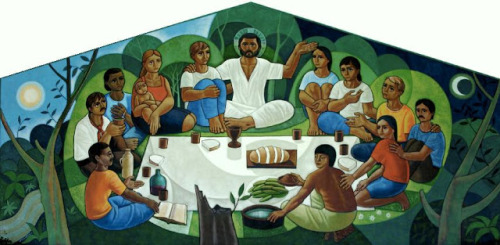
En la Cena ecológica del Reino (At the Ecological Kingdom Dinner) by Spanish artist Cerezo Barredo

While Jesus was speaking to the crowds, his mother and brothers stood outside trying to speak with him.Someone said to him, “Look, your mother and brothers are outside wanting to speak with you.”

Jesus replied, “Who is my mother? Who are my brothers?” He stretched out his hand toward his disciples and said, “Look, here are my mother and my brothers. Whoever does the will of my Father who is in heaven is my brother, sister, and mother.” (Common English Bible)

Jesus obviously did not get the cultural memo that blood is thicker than water.

When his own blood family were waiting outside for him, Jesus used the occasion to speak of what makes up a true follower of God. Christ boldly asserted that his true family is made up of people who do God’s will. By saying this, Jesus brought the point home that the kingdom of God turns on obedience.

Rather than merely confessing a belief, or appealing to a family heritage of faith, Jesus said that a genuine believer in God is one who listens to God’s words and then promptly obeys them. Therefore:

A Christian is defined by allegiance to Jesus, and not by having a certain bloodline. 

Identity determines activity. For example, if I identify myself primarily as…

  • a worker at my job, my activity will show it – I will spend long hours at my labor, and will do whatever it takes to please my boss and gain promotions.
  • an athlete, I will spend long hours honing my skills, and do whatever it takes to please the coach and to win.
  • a spouse and a parent, I will focus most of my attention on my family and seek to please them in all things. 

But if my identity is first and foremost as a Christian, I will seek to please Jesus. With my identity in Christ:

  • I will view my job as an opportunity to express the ethics of God’s kingdom, as a calling from God, and as a means for God to transform me for his glory.
  • I will view athletics as means to glorify God, and not as an end in and of itself but as a special gift for God to teach me about the importance of community and working together. 
  • I will view my kids as belonging to God and I will steward the trust of children given me by doing whatever it takes to teach and train them in the way of Jesus. I will thank God for my family and not confuse them with being God by idolizing them.

Jesus was inside a house, with his family on the outside. So, why were the family members of Jesus not inside the house sitting at his feet, taking the posture of a disciple?

The disciple Matthew wanted to communicate more than physical distance between Jesus and his physical family – being “outside” was meant to convey the posture of Christ’s family as spiritually distant, skeptical of him, and indecisive about who he was and what he was up to. The disciple Mark made this spiritual and emotional distance clear:

Jesus entered a house. A crowd gathered again so that it was impossible for him and his followers even to eat. When his family heard what was happening, they came to take control of him. They were saying, “He’s out of his mind!” (Mark 3:20-21, CEB)

Christ’s earthly family were not looking for Jesus to give them warm-fuzzies and have a big family hug. They were there to essentially say to him, “Cut it out, Jesus, because you’re acting like a nut-cake and embarrassing us all!”

Jesus was saying that identifying only with a biological family leads to only pleasing that family. However, identifying with Jesus leads to a radical form of following God that seeks to please him instead of submitting to family practices, mores, and beliefs which are inconsistent with the kingdom of God. 

Ethiopian Orthodox Church depiction of Christ and his disciples

For the Christian, the church is the family of God, and we are to act consistent with being in such a family.  We are to pursue God’s will, serve one another, and adopt outsiders into our family. The church is a family, not a restaurant. When we go to a restaurant, we either like the food and the service, or not. If the experience was unpleasant, we might complain to the waitress and may or may not come back. Try doing that with your mother and see where it gets you! 

As a biological family, we are committed to each other. There is no complaining about mom because of dad’s wrath. Instead, we are expected to clear our plates and put them in the dishwasher, to sweep the floor and clean the table, and to work together for the benefit of the entire family. In the same way, following Jesus means being committed to his family, the church.

Priority is to be given in doing God’s will, regardless of blood, because obedience to Christ identifies us as being in the family of God. Our actions and the way we live points to what we honestly believe and where our commitments truly lie. 

The first step of God’s desire for us is quality focused time in sitting at Christ’s feet and listening to him, because this is at the heart of all Christian discipleship. We can only do God’s will if we have clearly heard it; and we can only hear God’s will by taking the time to be at the feet of Jesus. 

Both listening and doing are necessary. Listening without engaging the world is a failure of mission; and doing without first listening leads to misguided acts and eventual burn-out. Allow Jesus to call the shots and let him instruct us so that we can live wisely and obediently. 

Jesus did not devalue blood relatives as irrelevant. Rather, the kingdom of God seeks to restore and redeem all things, including family. Both church and family are important. The relationships within each are to be nurtured.

The family of Jesus, the church, is important because Christ suffered and died for her. So, we are to be committed to the church, love the church, and serve the church because we are family. If we have a good grasp of this, we will make decisions based in what we believe God’s will is, instead of whether a relative will get upset, or not. 

We need to persistently pray for spiritually lost family members, and those whom we are estranged from. Most families have at least a few toxic persons in their orbit. Here is how we might pray for them:

  • That God will arrange divine appointments between them and others who love Jesus.
  • That God will draw them to the mercy of Christ.
  • That God will hinder the devil’s schemes against them.
  • That they will understand and respond to the good news of God’s grace.

O God, you made us in your own image and redeemed us through Jesus your Son: Look with compassion on the whole human family; take away the arrogance and hatred which infect our hearts; break down the walls that separate us; unite us in bonds of love; and work through our struggle and confusion to accomplish your purposes on earth; that, in your good time, all nations and races may serve you in harmony around your heavenly throne; through Jesus Christ our Lord. Amen.

God Is Good, Idols Are Bad (2 Kings 17:7-20)

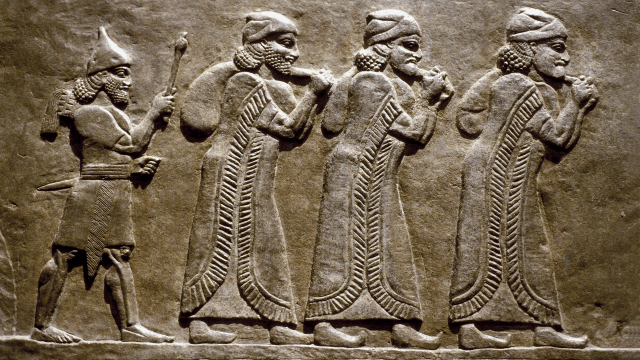
 An Assyrian solider deporting people from their land (From the Southwest Palace of Tiglath-Pileser III at Nimrud, ca. 730-727 B.C.E.; British Museum.)

The Israelites sinned against the Lord their God, who brought them out of Egypt and rescued them from the power of Pharaoh (the king of Egypt). They worshiped other gods and lived by the customs of the nations that the Lord had forced out of the Israelites’ way. They also did what their kings wanted them to do.The Israelites secretly did things against the Lord their God that weren’t right:

They built for themselves illegal places of worship in all of their cities, from the smallest watchtower to the largest fortified city.

They set up sacred stones and poles dedicated to the goddess Asherah on every high hill and under every large tree.

At all the illegal places of worship, they sacrificed in the same way as the nations that the Lord had removed from the land ahead of them.

They did evil things and made the Lord furious.

They served idols, although the Lord had said, “Never do this.”

The Lord had warned Israel and Judah through every kind of prophet and seer, “Turn from your evil ways, and obey my commands and decrees as I commanded your ancestors in all my teachings, the commands I sent to you through my servants the prophets.” But they refused to listen. They became as impossible to deal with as their ancestors who refused to trust the Lord their God. They rejected his decrees, the promise he made to their ancestors, and the warnings he had given them. They went after worthless idols and became as worthless as the idols. They behaved like the nations around them, although the Lord had commanded them not to do that. They abandoned all the commands of the Lord their God:

They made two calves out of cast metal.

They made a pole dedicated to the goddess Asherah.

They prayed to the entire army of heaven.

They worshiped Baal.

They sacrificed their sons and daughters by burning them alive.

They practiced black magic and cast evil spells.

They sold themselves by doing what the Lord considered evil, and they made him furious.

The Lord became so angry with Israel that he removed them from his sight. Only the tribe of Judah was left. Even Judah didn’t obey the commands of the Lord their God but lived according to Israel’s customs. So the Lord rejected all of Israel’s descendants, made them suffer, handed them over to those who looted their property, and finally turned away from Israel. (God’s Word Translation)

The Flight of the Prisoners, by James Tissot, 1898, depicting the Babylonian exile from Jerusalem

The prophets had warned the northern kingdom of Israel; but they did not listen, nor did they heed the prophetic utterance. Israel then stood as an example and a warning to the southern kingdom of Judah; yet they, too, refused to learn from their brother’s downfall.

And even before the kingdom was split between Israel in the north and Judah in the south, the ancient Israelites had a troubling tendency to buck the Lord’s instructions and find other more and creative ways of expressing themselves spiritually.

Every generation of people are responsible for their own spirituality and their own actions in life. We, in our contemporary time and place, need to learn the lessons of the past – for we also are not an exception in history, as if we can do whatever we want without attending to the common good of all persons and worshiping in any sort of way we want.

The trouble with the ancient worshipers of Yahweh is that they decided to pick and choose whatever commands they wanted to follow, or not. They went through continual times of idolatry and forgot about God and God’s Word to them.

To respect and revere the Lord is to obey God’s instructions. To worship Yahweh is to have an undivided allegiance to God and God’s commands. The failure to obey is really a failure of faith.

The prophets Amos, Hosea, Micah, and Isaiah specifically called out the sinful practices of the people and their negligence in upholding basic social and economic justice for everyone. They condemned violence and oppression of the poor; and expressed the divine displeasure with taking advantage of the disadvantaged.

How to treat people and live well were explicitly spelled out in the entirety of God’s Law. Yet, the leaders and the people, as a whole, decided to go another way. They kept introducing idolatrous and unhealthy forms of worship and living. And it led to their ruin.

The ancient people were continually offered grace if they would only accept it. They could return to the Lord and come back to the true worship and obedience of the God who had rescued them from trouble again and again. Turning from their unholy practices, and turning back to Yahweh, would reverse God’s impending judgment. Yet, tragically, the people did not listen.

Idolatry is a failure to trust God, and to rely instead on something else which is not able to sustain a life. Unfortunately, those who create a god according to their own liking end up becoming like the thing they worship, that is, worthless.

The tragedy of the Israelites is that they were to be God’s people, the Lord’s treasured possession, a kingdom of priests, and a holy nation which brings blessing to the earth. Instead, they traded their meaning and purpose in life to imitate everyone else around them.

Sadly, people have felt throughout history, and even we ourselves today, that there is something else, other than God, that we need in order to be happy – something more important to your heart than the Lord – whether it is human acceptance and approval, social reputation, political power and control, or financial advantage and privilege.

Idolatry creates an ignoring of the divine in our life. We might even have the chutzpah to think we can challenge God, like some small yippee pup who growls and takes on the big dog, who knows that with an effortless paw across the body, could toss the prideful pup away.

Like a mother bird who scours the land for food to sustain the babies, and brings it back to their gaping mouths, God longs to provide us with a good and beautiful life – if we will but only receive it.

Listen, my people, I’m warning you!
    If only you would listen to me, Israel.
There must be no foreign god among you.
    You must not bow down to any strange deity.
I am the Lord your God,
    who brought you up from Egypt’s land.
    Open your mouth wide—I will fill it up! (Psalm 81:8-10, CEB)

O Lord, as you gave us the greatest commandment, to love you with all our heart, soul, strength and mind, help us to love you above all else, putting you above the potential idols in our lives, including success, fame and wealth. May your benevolent kingdom come, and your moral and ethical will be done, here on this earth for this time, as it is always done in your heaven. Amen.