
Remember and Learn (Psalm 78:1-4, 12-16)

My people, hear my teaching;
    listen to the words of my mouth.
I will open my mouth with a parable;
    I will utter hidden things, things from of old—
things we have heard and known,
    things our ancestors have told us.
We will not hide them from their descendants;
    we will tell the next generation
the praiseworthy deeds of the Lord,
    his power, and the wonders he has done….

He did miracles in the sight of their ancestors
    in the land of Egypt, in the region of Zoan.
He divided the sea and led them through;
    he made the water stand up like a wall.
He guided them with the cloud by day
    and with light from the fire all night.
He split the rocks in the wilderness
    and gave them water as abundant as the seas;
he brought streams out of a rocky crag
    and made water flow down like rivers. (New International Version)

Every day I read in the biblical psalms. There are two reasons I do this. First, the psalms are the church’s prayer book. They are more than reading material; the psalms are designed to be owned by us as prayers. And second, I need their reminders – a lot!

Remembering is a major theme throughout the entirety of Holy Scripture. It’s just part of the human condition, fallen and forgetful as we are, to lose sight of what has taken place in the past. Today’s psalm invites us to seek the Lord through remembering all the good and wonderful works he has done.

For Israel, remembering meant continually having the events of Passover in front of them. God redeemed the ancient Israelites out of Egyptian slavery and into a good Promised Land. They were to never forget God’s miracle through the Red Sea, God’s protection over them from other nations, and God’s provision of food and necessities in the desert.

We are to remember because we are made in God’s image and likeness. God remembers. God has an ongoing reminder in a divine day timer – Fulfill the promises I made and keep the covenant I initiated with the people, even when they’re stinkers and forget who I am and what they are supposed to be about.

As old as God is, there is no danger of the Lord getting some sort of divine dementia. God doesn’t forget. The Lord always keeps promises made to people.

For the Christian, all God’s promises are remembered and fulfilled in the person and work of Jesus Christ. Deliverance from sin, death, and hell; the gift of the Holy Spirit; and ongoing presence and provision are given to us graciously and freely by the God who loves and cares for people.

For Christians, remembering means coming to the Lord’s Table, entering the once for all loving sacrifice of Christ on our behalf.

We remember the past action of the cross – the once for all sacrifice of Jesus for all the world.

We are mindful of Christ’s continuing presence now in the person of the Holy Spirit.

And remembering these things helps us to look forward with confidence when the Lord shall return and we will eat with him at a grand heavenly banquet table.

One of the reasons I write and journal about my life and Scripture is to remember. Sometimes I forget. There are times when I’m overwhelmed with life and it feels as if God has forgotten me. In such times, I look back into my journal and see what God has done.

And I peer into the psalms and see that the Creator God is active in the big, created world, always attentive to working what is just, right, and good – bending twisted circumstances and evil machinations back toward the great arc of love.

Psalm 78 is designed to recall historical events for the theological education of ourselves and the next generation. Through passing on eventful stories from the past to future generations, God’s people continue to remember and realize the incredible action of God in the world.

In recalling stories of care and deliverance, God’s commandments are kept. Putting trust in the powerful and benevolent God of all brings assurance and encouragement.

Using the psalms as a means of recollecting past events is a wise way of edifying God’s people and living into the command of the Law. As the Israelites were about to enter the Promised Land, Moses restated the Law for them, and then said:

These are the commands, decrees and laws the Lord your God directed me to teach you to observe in the land that you are crossing the Jordan to possess, so that you, your children and their children after them may fear the Lord your God as long as you live by keeping all his decrees and commands that I give you, and so that you may enjoy long life. Hear, Israel, and be careful to obey so that it may go well with you and that you may increase greatly in a land flowing with milk and honey, just as the Lord, the God of your ancestors, promised you.

Hear, O Israel: The Lord our God, the Lord is one. Love the Lord your God with all your heart and with all your soul and with all your strength. These commandments that I give you today are to be on your hearts. Impress them on your children. Talk about them when you sit at home and when you walk along the road, when you lie down and when you get up. Tie them as symbols on your hands and bind them on your foreheads. Write them on the doorframes of your houses and on your gates.

When the Lord your God brings you into the land he swore to your fathers, to Abraham, Isaac and Jacob, to give you—a land with large, flourishing cities you did not build, houses filled with all kinds of good things you did not provide, wells you did not dig, and vineyards and olive groves you did not plant—then when you eat and are satisfied, be careful that you do not forget the Lord, who brought you out of Egypt, out of the land of slavery. (Deuteronomy 6:1-12, NIV)

Since psalms are meant to be recited repeatedly throughout one’s spiritual life, doing so inoculates worshipers from faithless rebellion; and it counteracts the temptation toward trusting in idols. It’s a preservative which gives life, purpose, and wholeness.

Regular spiritual consumption of the psalms provides a pattern of instruction which molds and maintains the soul so that, when hard situations arise, the supports are there to hold us up under the adversity.

The life that is truly life – and the life of those who will come after us – happens through intentional remembrance and learning. Today’s psalm is a fitting invitation to set our hope in God, remember God’s wonderful works, and keep God’s commands.

O God and Father of our Lord Jesus Christ:
Give me strength to live another day;
Let me not turn coward before its difficulties or prove recreant to its duties;
Let me not lose faith in other people;
Keep me sweet and sound of heart, in spite of ingratitude, treachery, or meanness;
Preserve me from minding little stings or giving them;
Help me to keep my heart clean, and to live so honestly and fearlessly that no outward failure can dishearten me or take away the joy of conscious integrity;
Open wide the eyes of my soul that I may see good in all things;
Grant me this day some new vision of your truth;
Inspire me with the spirit of joy and gladness;
and make me the cup of strength to suffering souls;
in the name of our Deliverer, Jesus Christ, in the power of the Holy Spirit. Amen.

Love and Obedience (Revelation 3:7-13)

“Write this letter to the angel of the church in Philadelphia.

This is the message from the one who is holy and true,
    the one who has the key of David.
What he opens, no one can close;
    and what he closes, no one can open:

“I know all the things you do, and I have opened a door for you that no one can close. You have little strength, yet you obeyed my word and did not deny me. Look, I will force those who belong to Satan’s synagogue—those liars who say they are Jews but are not—to come and bow down at your feet. They will acknowledge that you are the ones I love.

“Because you have obeyed my command to persevere, I will protect you from the great time of testing that will come upon the whole world to test those who belong to this world. I am coming soon. Hold on to what you have, so that no one will take away your crown. All who are victorious will become pillars in the Temple of my God, and they will never have to leave it. And I will write on them the name of my God, and they will be citizens in the city of my God—the new Jerusalem that comes down from heaven from my God. And I will also write on them my new name.

“Anyone with ears to hear must listen to the Spirit and understand what he is saying to the churches. (New Living Translation)

In 1983, Chuck Colson, a former White House Counsel and founder of Prison Fellowship, wrote a timely and influential book entitled Loving God. In it, he presented a simple yet biblical premise concerning the life of every believer in Jesus: The way to love God is to obey God. 

Every door that opens, hinges on our listening to God, and then obeying what the Lord says to do. This is how we show our love for God.

Jesus himself communicated to the church at Philadelphia (not Pennsylvania, but ancient Asia Minor, now present-day Turkey) affirming their faithful obedience of the message. Because of their steadfast observance of the gospel, the Philadelphian believers would be protected and loved by Jesus. 

The church at Philadelphia did much more than offer a confession of loving God – they affirmed their confession through a steadfast loving obedience to Jesus. 

In some Christian traditions, this is described as “living into our baptism.”  It’s one thing to experience the waters of baptism through being set apart by the Holy Spirit for a relationship with God in the person and finished work of Jesus; and it’s quite another thing to “live into” this reality by learning and listening to God’s Word, and then dutifully obeying it.

Humans are complex creatures in their psychology, sociology, and history. However, there is at least one simple straightforward biblical truth we all can live into: To love God is to obey God. 

Therefore, it is quite necessary for us to spend extended times reading and knowing our Bibles, so that we can adhere and hold fast to what it says. 

“It is not what we do that matters, but what a sovereign God chooses to do through us. God doesn’t want our success; He wants us. He doesn’t demand our achievements; He demands our obedience. The Kingdom of God is a kingdom of paradox, where through the ugly defeat of a cross, a holy God is utterly glorified. Victory comes through defeat; healing through brokenness; finding self through losing self.”

Charles Colson, Loving God

When we truly love someone, we want to do what they say, to fulfill their wishes – whatever those desires are. And then, when we do it, there is joy in accomplishing it. We don’t think about how much it costs, or all the work that goes into it. Instead, we say to ourselves, “This person is worth it. I’m glad to do it.”

This is why love is at the center of all true obedience to God. Those without love eventually give up, fall away, and fail to persevere through the difficulties of doing the will of God. But those enamored with love for God consider it a privilege to endure suffering for the sake of Jesus Christ.

Just yesterday I met with a dear woman in the hospital who had endured many hard things in her life. She relayed all of this to me with a sincere smile – because she is so thankful for God’s grace in her life. The woman’s face was bright with the love of God in her life; and she was profoundly grateful that the Lord saw fit to send me to see her.

My friends, how our world would be so much different and better, if we Christians would but bask in the love of God through Jesus Christ our Savior and Lord! We have quite enough Christians in this world who appear as if they were baptized – not in the gracious water of life – but in the sour vinegar of pickle juice. They tend to only obey out of duty, and do so with the grumpy frown which no one wants to be around.

This old fallen world needs us – our love for God and our love for one another – a love which informs and guides our every word and action. Hard things become easy with the presence of love, which the patriarch Jacob knew so well:

Jacob worked seven years for Laban, but the time seemed like only a few days, because he loved Rachel so much. (Genesis 29:20, CEV)

People of God, we can do hard things. We can do them because of love.

What does the Lord your God ask of you? Only this: to revere the Lord your God by walking in all his ways, by loving him, by serving the Lord your God with all your heart and being, and by keeping the Lord’s commandments and his regulations that I’m commanding you right now. It’s for your own good! (Deuteronomy 10:12-13, CEB)

May it be so, to the glory of God, and for the blessing of the world, as well as our own lives.

Gracious God, thank you for the message of good news that in Jesus Christ I have forgiveness of sins. Help me to hold onto this gospel through all the vicissitudes of life so that obedience springs from my heart in all things by the power of the Holy Spirit. Amen.
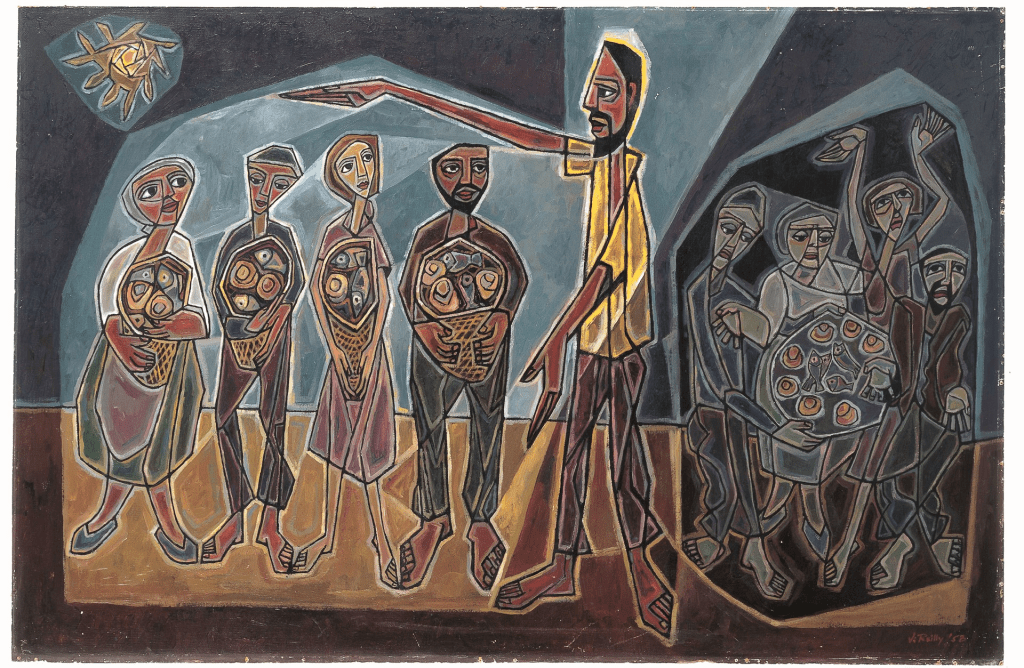
Jesus Feeds the Five Thousand (Matthew 14:13-21)

The Feeding of the Five Thousand, by John Reilly (1928-2010)

When Jesus heard what had happened, he withdrew by boat privately to a solitary place. Hearing of this, the crowds followed him on foot from the towns. When Jesus landed and saw a large crowd, he had compassion on them and healed their sick.

As evening approached, the disciples came to him and said, “This is a remote place, and it’s already getting late. Send the crowds away, so they can go to the villages and buy themselves some food.”

Jesus replied, “They do not need to go away. You give them something to eat.”

“We have here only five loaves of bread and two fish,” they answered.

“Bring them here to me,” he said. And he directed the people to sit down on the grass. Taking the five loaves and the two fish and looking up to heaven, he gave thanks and broke the loaves. Then he gave them to the disciples, and the disciples gave them to the people. They all ate and were satisfied, and the disciples picked up twelve basketfuls of broken pieces that were left over. The number of those who ate was about five thousand men, besides women and children. (New International Version)

Miracles still happen

I know of a woman who once brought a pan of lasagna to a community meal at her church, thinking that only 25-30 people would be fed. However, 70 people showed up. Her immediate thought was to go buy more, but she didn’t have the time.

So, here is what the dear woman did: She looked up to heaven, gave thanks, and started dishing out the lasagna – until every last person was fed. She confided in me that “every time I put my spatula down there was food to put on it!”

The story of Jesus feeding thousands of people is not just a nice account that happened a long time ago; Jesus is still in the miracle business. Christ can take our meager resources and turn them into something with a large impact on a lot of people. 

For this to happen, all we need to do is follow our Lord’s simple instructions: “You give them something to eat,” and, “Bring them here to me.” Jesus, using a simple act of obedience by the disciples, did one of the most famous miracles in history.

The message of the story is simple, but profound: Jesus can multiply whatever little we have, to accomplish his kingdom work, through us. Jesus could do miracles without us, but he wants us to participate in the work. We only need to bring our few loaves and fish to him.

The compassion of Jesus is the motivation for miracles

Jesus withdrew to a solitary place. But the crowd did not leave him alone. Rather than be annoyed by the situation, Jesus looked at the large group of people and his heart went out to them. So, he went about the work of healing the sick. Please know that God does not begrudgingly deal with you, as if you were an interruption to his day; he has compassion.

The desire of Jesus is for us to participate in the miracles

After a full day of healing, Christ’s disciples came to him as if he was unaware of the people’s need for food. They gave a very rational and realistic answer to the problem of hunger: Dismiss them so they can go out to eat. But Jesus said, “They don’t need to go away; you give them something to eat.” 

I detect maybe a hint of sarcasm in the tone of the disciples reply: “We have only five loaves of bread and two fish.” But their math was way off because they did not count Jesus.  “Bring them here to me,” Christ replied. If we have ears to hear, Jesus is still saying this today: bring them here to me. Through simple prayer and active obedience, we give Jesus what we have, no matter how little or insignificant it seems to us.

Much of what we do in the American church is a reasonable and rational ministry; it has little to do with the impossibility of faith and seeing God work in ways that are incomprehensible to our modern sensibilities.

A Chinese pastor once visited the United States. After seeing our vast resources of money, buildings, and ministries. He said, “This is amazing! It’s incredible what you American Christians can do without God!” 

In reality, we need God – who is in the business of taking our simple obedience and humble participation, and doing the miraculous. And it has always been this way. For example….

Elisha Multiplies the Widow’s Oil, from  L’histoire dv Vieux et dv Nouveau Testament, 1670

The wife of a man from the company of the prophets cried out to Elisha, “Your servant my husband is dead, and you know that he revered the Lord. But now his creditor is coming to take my two boys as his slaves.”

Elisha replied to her, “How can I help you? Tell me, what do you have in your house?”

“Your servant has nothing there at all,” she said, “except a small jar of olive oil.”

Elisha said, “Go around and ask all your neighbors for empty jars. Don’t ask for just a few. Then go inside and shut the door behind you and your sons. Pour oil into all the jars, and as each is filled, put it to one side.”

She left him and shut the door behind her and her sons. They brought the jars to her and she kept pouring. When all the jars were full, she said to her son, “Bring me another one.”

But he replied, “There is not a jar left.” Then the oil stopped flowing.

She went and told the man of God, and he said, “Go, sell the oil and pay your debts. You and your sons can live on what is left.” (2 Kings 4:1-7, NIV)

You want me to do what?

What if we were to operate as if God were truly in the business of doing miracles?  Would it impact the way we pray, and the way we act?  What if we understood just enough of Jesus and what he can and wants to do that we would be bold to say: “This might sound crazy, but what if we….”

  • found out everyone who needs food in this community, go love on them, and feed them…
  • used our property to create a community garden and seek to help people grow their own food…
  • came up with a God-sized plan to reach our community…
  • prayed to see a hundred people come to Christ through this church… 

Most of our plans don’t require us to do anything impossible, so we simply settle for the possible.

We too often do nothing out of a sense that God either cannot or does not want to use me or what I have. But it just won’t do to stand afar off and expect God to work without us giving what we have – whether that something is time, money, conversation, food, hospitality, or whatever. 

Our limitations mean nothing to Jesus, so he doesn’t hear us when we say:

  • my home is too small, and it’s not clean enough
  • I don’t have enough money,
  • I’m not smart enough
  • my schedule won’t allow it
  • I don’t have enough resources

You don’t need much – only the willingness to be part of the miracle Jesus is doing.

Conclusion

You want me to do what? Feed thousands? Lead someone to Jesus? Pray in front of others? Work for justice?

Sometimes, the greatest miracle is for people to be open, real, and transparent enough to believe that Christ can do a miracle through confessing my sin, participating in a ministry, or having a spiritual conversation with an unbeliever. 

The question is never, “Can God use me?” It is, “What miracle does God want to do through me and through this church?”

It is no accident that when Jesus distributed the bread that it sounds a lot like communion. The Lord’s Supper may seem irrelevant, as if it is merely remembering Jesus. However, God’s design is much bigger: The Lord wants to do a miracle. 

God wants the practice of our communion together to bring healing and wholeness that the world cannot give. It might be unrealistic to expect that Jesus can use a Table to feed and reach thousands, but we don’t serve a God who is limited to work through rational means.

Blessed are you, O Lord God, King of the Universe, for you give us food to sustain our lives and make our hearts glad. We thank you for your countless blessings, especially for the gift of your Son, for the Church, for our faith, and now for this meal we are about to participate in, through Christ our Lord. Amen.

Endure Patiently to the End (Revelation 14:12-20)

God’s holy people must endure persecution patiently, obeying his commands and maintaining their faith in Jesus.

And I heard a voice from heaven saying, “Write this down: Blessed are those who die in the Lord from now on. Yes, says the Spirit, they are blessed indeed, for they will rest from their hard work; for their good deeds follow them!”

Then I saw a white cloud, and seated on the cloud was someone like the Son of Man. He had a gold crown on his head and a sharp sickle in his hand.

Then another angel came from the Temple and shouted to the one sitting on the cloud, “Swing the sickle, for the time of harvest has come; the crop on earth is ripe.” So the one sitting on the cloud swung his sickle over the earth, and the whole earth was harvested.

After that, another angel came from the Temple in heaven, and he also had a sharp sickle. Then another angel, who had power to destroy with fire, came from the altar. He shouted to the angel with the sharp sickle, “Swing your sickle now to gather the clusters of grapes from the vines of the earth, for they are ripe for judgment.” So the angel swung his sickle over the earth and loaded the grapes into the great winepress of God’s wrath. The grapes were trampled in the winepress outside the city, and blood flowed from the winepress in a stream about 180 miles long and as high as a horse’s bridle. (New Living Translation)

The Scripture meditations I offer each day are based in the daily readings of the Revised Common Lectionary. The readings are designed to move us through the whole of the Bible in a three year cycle. And they are arranged so that Thursday, Friday, and Saturday readings anticipate the Sunday scriptures, and the Monday, Tuesday, and Wednesday readings reflect on Sunday’s texts. Today’s New Testament lesson is such a reflection on Sunday’s Gospel reading of Christ’s Parable of the Weeds (Parable of the Wheat and Tares).

Jesus made it clear in the parable that it is not our job to weed out evil. This will be done by the angels at the end of the age. In Revelation, we look forward into the future as to what happens with the plants and the weeds. As you can readily see, it is a grim picture. Those who are visual learners, and picture the words in their minds, their stomachs might be turning after the reading of today’s text.

The entire book of Revelation was originally meant to encourage believers in Jesus to persevere, endure, and keep going in their commitment to Christ. As they were undergoing difficulty and even persecution for their faith, this apocalyptic vision of the Apostle John was to instill hope: It will not always be this way.

There is a time coming soon in which the problem of evil is taken care of, once and for all. Until that final day of judgment comes, we are to hold fast to our faith, and continue to keep the commandments of Christ.

The wrath of God has always been an issue with various people throughout history. In contemporary theology, it is common to have groups of folks polarized between either making God out to be constantly angry and looking to zap people; or dismissing God’s wrath altogether as some outdated and antiquated idea. Neither of these approaches will do.

God’s anger and wrath exist, yet is never divorced from God’s love. Rather than viewing wrath and love as two sides of the same coin, I believe a healthier and more biblical understanding is to discern God’s wrath as an expression of God’s love. I will explain….

When God bends to observe us in the world and sees injustice, war, poverty, oppression, trauma, and abuse from narcissistic people who exalt themselves above others and use them for selfish purposes, God is not okay with this!

Whenever God looks at the world and sees governments, institutions, corporations, and even churches which maintain structures that keep others from becoming all that God intends for them to become, divine compassion is stirred up, along with a determination to bring about justice and righteousness.

Only God has the combination of willingness, power, and ability to handle the evil of this world, in a way which is both just and loving.

I realize there are many times when we wonder if God is really watching, or not, and are curious if the Lord is aloof and uncaring to our plight. There is a day when the dramatic will happen, but that day is not today. For now, God is patiently and carefully working divine love into the fabric of this world, in such a way that it will not destroy the innocent and compromise the integrity of the righteous.

Until the time is ripe for God to act in a more decisive manner by equipping angels with scythes and bringing in the final harvest, we experience pain and hurt.

We sometimes are misjudged and misunderstood by others. We often get shafted by systems which are supposed to be helping us. We can, however, be assured that God is working behind the scenes, planting seeds of love and grace. The Lord is pastorally tending to our growth, till the time is right to gather the abundant crop.

Acting too soon, and going off half-cocked without enough information, is what we humans tend to do. Not so with God.

The fact of the matter is: Justice and injustice will co-exist side-by-side for a while. Righteousness and evil will be found together everywhere we go, including our own hearts – holding both our altruistic motives and our evil inclinations.

Sisters and brothers, let us endure, persevere, and be patient. God is good, and will not forget your deeds done in faith; your actions inspired by hope; and your work animated by love.

Lord Christ, you came into the world as one of us, and suffered as we do. As I go through the trials of life, help me to realize that you are with me at all times and in all things; that I have no secrets from you; and that your loving grace enfolds me for eternity. In the security of your embrace I pray. Amen.