Be Careful What You Ask For (Numbers 11:18-23, 31-32)

Now tell the people, ‘Purify yourselves for tomorrow; you will have meat to eat. The Lord has heard you whining and saying that you wished you had some meat and that you were better off in Egypt. Now the Lord will give you meat, and you will have to eat it. You will have to eat it not just for one or two days, or five, or ten, or even twenty days, but for a whole month, until it comes out of your ears, until you are sick of it. This will happen because you have rejected the Lord who is here among you and have complained to him that you should never have left Egypt.’”

Moses said to the Lord, “Here I am leading 600,000 people, and you say that you will give them enough meat for a month? Could enough cattle and sheep be killed to satisfy them? Are all the fish in the sea enough for them?”

“Is there a limit to my power?” the Lord answered. “You will soon see whether what I have said will happen or not!”…

Suddenly the Lord sent a wind that brought quails from the sea, flying three feet above the ground. They settled on the camp and all around it for miles and miles in every direction. So all that day, all night, and all the next day, the people worked catching quails; no one gathered less than fifty bushels. They spread them out to dry all around the camp. (Good News Translation)

I can just imaging the dialogue around the campfire at night with some of the ancient Israelites. Out in the middle of nowhere, delivered from Egyptian slavery, but not yet to the Promised Land, they were feeling the awkward space of being in-between those two places:

“Manna, again!? Geez, are we ever going to get anything else to eat?”

“Doesn’t look like it, does it? Every single day we get up, go out on the desert, collect the manna, eat it all day, go to bed, then get up and do it all over again.”

Do you remember back in Egypt, we had garlic and leeks and stew and meat? Oh, glorious meat! Sometimes I think we were better of there. Dang it, I want meat! Don’t you want meat, too!?”

“Yeah, I’m sick of this manna. Hey, there’s Moses. Get us some meat, Moses! Did you bring us out here to bore us to death with manna!? What are you doing about it? Where are you leading us? Where’s the meat?”…

And on and on it goes, the murmuring about food and conditions in the desert.

When life is topsy-turvy and upside-down, it is so amazingly easy to grumble and complain. The ancient Israelites sometimes didn’t have water to drink. They had a limited diet of manna. They were anxious, nervous, and scared, wondering if things would get better, or not. The people were in a life-and-death sort of situation.

How would you respond?

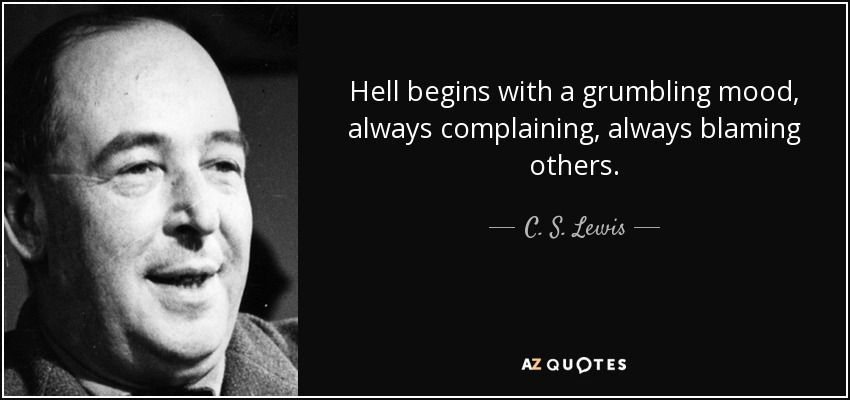
Complaining, unlike our emotions such as fear, is a volitional response. We choose to grumble. The problem with gripes and complaints is that it sets a person down a dark path. The criticisms and grievances begin easily and are seemingly harmless, that is, at first. They are, however, anything but innocuous or innocent.

The murmuring under the breath did not stop with getting meat to eat. If we look ahead in the story of God’s people in the exodus event, the moaning and complaining quickly returned. The people became so disillusioned with their circumstances that they began longing for the “good old days” back in Egypt when they had plenty to eat and drink, forgetting about their cruel bondage in slavery. (Exodus 16:1-3)

The psychological progression continued with beginning to blame their situation on God, as if the Lord were some mean malevolent deity. From that point, it was inevitable that the people would disobey God and eventually succumb to the idolatry of the golden calf. (Exodus 32:1-8)

Despite the grand celebration of leaving Egypt and experiencing a miraculous deliverance through the Red Sea, the people quickly forgot because of their present mundane circumstance of eating manna every day.

If they were spiritually healthy, they would realize that the mighty God who saved them with incredible acts of power would care for them in a desert. Yet, for many, there was no faith to be found in a new situation they had not faced before.

Failure of faith begins neither with ignorance nor an egregious sin. It begins with grumbling and complaining. And if allowed to run amok, complaints will bear the fruit of discouragement, disobedience, and finally, a disavowal of God.

Sometimes, if you want something bad enough, God will give it to you. And you won’t like it. That’s because the heart has already been attuned to grumbling and murmuring. The heart’s hunger will never be satiated; it’s sick. And it can become so sick that a heart transplant is needed – an altogether new heart. Yet God will even help with that:

And I will give you a new heart, and I will put a new spirit in you. I will take out your stony, stubborn heart and give you a tender, responsive heart. And I will put my Spirit in you so that you will follow my decrees and be careful to obey my regulations. (Ezekiel 36:26-27, NLT)

Acceptance means practicing a conscious effort to acknowledge and honor difficult situations and emotions. Fully accepting things as they are, instead of ignoring, avoiding, or wishing the situation were different, can be a critical step in moving through a difficult experience to experiencing more meaning.

Learning to be satisfied and content begins with accepting our current reality and present circumstances. The state of our minds and our hearts will determine whether we will ever be happy or not. When we discover how to synchronize ourselves with the groove of God’s Spirit, then we shall enjoy an abundant life of contentment – no matter the situation.

May we be able to say along with the psalmist:

I will bless the Lord who guides me;
    even at night my heart instructs me.
I know the Lord is always with me.
    I will not be shaken, for he is right beside me.

No wonder my heart is glad, and I rejoice.
    My body rests in safety.
For you will not leave my soul among the dead
    or allow your holy one to rot in the grave.
You will show me the way of life,
    granting me the joy of your presence
    and the pleasures of living with you forever. (Psalm 16:7-11, NLT)

Get Rid of Grumbling (Numbers 11:1-9)

Now the people complained about their hardships in the hearing of the Lord, and when he heard them his anger was aroused. Then fire from the Lord burned among them and consumed some of the outskirts of the camp. When the people cried out to Moses, he prayed to the Lord and the fire died down. So that place was called Taberah because fire from the Lord had burned among them.

The rabble with them began to crave other food, and again the Israelites started wailing and said, “If only we had meat to eat! We remember the fish we ate in Egypt at no cost—also the cucumbers, melons, leeks, onions and garlic. But now we have lost our appetite; we never see anything but this manna!”

The manna was like coriander seed and looked like resin. The people went around gathering it, and then ground it in a hand mill or crushed it in a mortar. They cooked it in a pot or made it into loaves. And it tasted like something made with olive oil. When the dew settled on the camp at night, the manna also came down. (New International Version)

Some complaints are a form of lamenting a significant loss and expressing grief. That’s normal, even healthy, and to be expected. Many other complaints come in the form of grumbling, murmuring, and just plain old selfish bellyaching.

The latter type of complaining is clearly what was happening with the ancient Israelites. They were delivered from Egyptian slavery and now free. The people ought to be celebrating. But instead, the minute things are hard, they grumble. When the God-given food became commonplace and too plain for their pallets, the people whined and complained.

And it was the rabble rousers among them who got the whole community up in arms and grumbling.

The Apostle Paul understood that negative people only create more negative people – which is why he offered the church leader Titus some counsel about how to handle such persons: 

After a first and second warning, have nothing more to do with a person who causes conflict, because you know that someone like this is twisted and sinful—so they condemn themselves. (Titus 3:10-11, CEB)

Whenever a passion for power and control prevails over a desire for the common good of all people, then we have an issue of character. Stirring up antagonism against biblically-oriented, Spirit-directed change is demonic – and the real test of it is a constant stream of negativism which is secretive, remains in the shadows, relies on gossip and slander for its fuel, and hates being in the light.

Jesus said to be as shrewd as snakes and as innocent as doves because there are wolves among the sheep (Matthew 10:16). You will know them by their fruit. We are called not to participate in negative influences!  Individuals must be called-out for their chronic negative spirits. So, how do we do it?  How do we shut-out the negative?

Refuse it

Name it. Call it what it is: fighting against the Holy Spirit and attributing evil to the work of God (Matthew 12:30-32). When someone comes to you and wants to dish up a little “sumthin’-sumthin’” on somebody or something, refuse to take the bait. Refuse it and reject it.

Keep a group of friends who are positive, encouraging, helpful, and steer clear of antagonistic attitudes. It is extremely beneficial to both physical and spiritual health. In a study at Stanford University, a pair of researchers reviewed over 200 studies on group therapy and concluded that group members “develop close bonds with the other members and are deeply influenced by their positive acceptance and feedback.” In other words, negative thinking keeps people in bondage, whereas positive encouragement of others brings freedom and life.

Rebuke it

Someone might be speaking to you, start talking around some issue slowly, but eventually comes around to carving up another person like a Thanksgiving turkey. What do you do? Rebuke it. We can say something like, “When you continue to speak with such negativity about ______ I feel upset because I need to be in a place which helps me to spiritually grow. Will you please stop being so negative?”

I once had a person come to me not knowing how to deal with a negative person. I walked him through some biblical ways about confronting the negativity when it comes. He simply hung his head and said he could not do that. But he was miserable, which is why he came and talked to me. And he walked away with that same misery because he was not willing to call out a person on their destructive negativity.

You and I are in control of our own happiness. If another person causes us anger; if some politician drives us nuts; if a television program or radio show is upsetting me; then, it is our responsibility to keep away.

If we have a chronic negative person in our life, and have tried to deal with that person, and they refuse to listen, we can say something like this when they start their rant: “I don’t want to hear it. And if you keep bringing it up and being negative, I will walk out of the room.” The principle here is that we control our own behavior, not somebody else’s.

Redirect it

Satan is the author of negative antagonism. He talked trash about God in the garden to Adam and Eve. So, avoid getting caught up in trying to dialogue with a negative person. Redirect the negativity by calling the person to change their ways, because truth be told, the negativity is really rebellion against God.

If you are wondering, “I could never do that” then you likely have been telling yourself a lot of negative thoughts. God calls us to stamp-out the negativity before it can get started, even within our own brains. In some cases, we need to re-train our minds to focus on the positive, and not the negative.

It takes two to tango. Negativity cannot survive if there is no one to listen to it. We must stop being negative and stop listening to negative people; constant complaining creates divisions and scandals.

If there are people who chronically have negative speech and can never seem to say anything good about someone or something, then stay away from them. Have nothing to do with them. Do not participate in the divisive speech. Refuse it. Rebuke it. Redirect it.

God wants us righteous and robust, holy, and happy – not walking around like a grump who was baptized in pickle juice.

We can choose to fill our minds with gracious good news; pray positively about everything; and find the positive in all things. We can continually choose to cultivate unity, purity, peace, and love. That’s how we enjoy life together.

May it be so, to the glory of God.

Humble Leadership (Numbers 11:24-30)

So Moses went out and told the people what the Lord had said. He brought together seventy of their elders and had them stand around the tent. Then the Lord came down in the cloud and spoke with him, and he took some of the power of the Spirit that was on him and put it on the seventy elders. When the Spirit rested on them, they prophesied—but did not do so again.

However, two men, whose names were Eldad and Medad, had remained in the camp. They were listed among the elders, but did not go out to the tent. Yet the Spirit also rested on them, and they prophesied in the camp. A young man ran and told Moses, “Eldad and Medad are prophesying in the camp.”

Joshua son of Nun, who had been Moses’ aide since youth, spoke up and said, “Moses, my lord, stop them!”

But Moses replied, “Are you jealous for my sake? I wish that all the Lord’s people were prophets and that the Lord would put his Spirit on them!” Then Moses and the elders of Israel returned to the camp. (New International Version)

“Blessed are the meek, for they will inherit the earth.”

Jesus (Matthew 5:5)

My dad was on the local schoolboard for many years when I was a kid. I remember him telling me that he could predict was the Superintendent of Schools was going to do. Dad would introduce a motion (an idea or action to take) knowing that it would be struck down by the Superintendent, who then would introduce the same motion months later as if it were his own idea.

We all have likely had the experience of other people taking credit for our work, or at least spinning a situation to make it appear like the person was more responsible or in charge of something good than they actually were. After all, most of us want to look good in the eyes of others. So, leaders sometimes (most of the time?) reinterpret and bend situations to make their leadership shine, especially when it isn’t shining at all.

But Moses was a different sort of leader. He is described in Holy Scripture as “a very humble man, more humble than anyone else on the face of the earth.” (Numbers 12:3, NIV)

Today’s Old Testament lesson illustrates for us what humility and meekness truly look like. And the leadership of Moses had an authentic shine to it which resulted from being close to God. (Exodus 34:29-34; 2 Corinthians 3:12-18)

What is a meek and humble leader?

In a world enamored with issues of power and authority, Moses was a counter-cultural leader who understood his position and embodied the true nature of service to both God and people.

Humility acknowledges that the leader is not the one who is truly in charge. Ultimately, God is, and not any of us. The Holy Spirit is totally sovereign and acts in whatever way the Lord wills. The Spirit will not be stereotyped, nor can anyone really discern or predict what the Spirit will do or not do.

For sure, a life of prayer, faith, and holiness are necessary for the Christian life. Yet, we must not therefore assume that our spiritual disciplines somehow guarantee particular outcomes. It’s plain arrogance to suppose that somehow we can maneuver or manipulate God for our own purposes – which is why we need to cultivate a life of humility and meekness.

The reply of Moses to Joshua’s concern about the Spirit being manifested in an unexpected way illustrates a gentle and generous spirit of heart. Far from silencing the two men prophesying apart from the others, Moses instead longed for such a blessing to be extended to all the people.

Good and godly leaders are such because their sole passion is to honor and glorify the Lord. For them, it doesn’t really matter whether they’re personally involved in the great and spiritual thing happening, or not. That’s humility, my friends.

If there’s a distinction between humility and meekness, it is this: The humble person is self-aware enough to know they can only do anything by the hand of God operating within them; and the meek person is socially aware enough to understand that, in their lowliness, they are unable to look down on anyone else. Therefore, pride, arrogance, and hubris are nowhere to be found.

To have divine validation is all that’s needed for the godly leader; and when one is content with what they need and want most, there’s no need for human accolades and constant attention.

Far too often, we equate meek with weak. If someone is meek, some folks wrongly reason they must be a washrag, or overly introverted, and maybe not taking proper initiative in life. Of all the leadership qualities we may aspire to, I doubt that meekness would make any leader’s top ten list of desired character traits.

Why would I want to be meek?

Jesus, an unquestioned leader, described himself as meek. Yet, many English translations steer clear of the word. For example, “Come to me,” the New International Version of the Bible says, “all you who are weary and burdened, and I will give you rest. Take my yoke upon you and learn from me, for I am gentle and humble in heart, and you will find rest for your souls. For my yoke is easy and my burden is light.” Only the King James Version translates the word as “meek,” instead of “gentle.”

What does it mean to be meek?

“Meek” is a word used in other ancient Greek literature for breaking a horse. It’s the change from being a wild stallion who wants to go his own way, to a broken horse who is able to be guided and used, allowing others on his back without bucking.

At the crucifixion, Jesus was naked, exposed, and vulnerable to the idle curiosity of the crowd and the vulgar frivolity of the soldiers who were having a party around his suffering. “If you are the king of the Jews,”they taunted,“save yourself.” (Luke 23:35-36)

The extraordinary thing is there was no spirit of revenge with Jesus. Christ did not curse his tormentors, but instead prayed, “Father forgive them, for they don’t know what they’re doing.” (Luke 23:34)

What characterizes a meek person?

  • The meek have a desire to put other’s interests ahead of their own, because they know it is not all about them. They practice healthy rhythms of giving and receiving with others, without prejudice or favoritism.
  • The meek are more concerned with edifying and building up their brothers and sisters than justifying themselves. They don’t care who gets the credit. And they receive criticism well.
  • The meek are truly egalitarian and do all things with equity and inclusion. They make no distinctions between rich and poor, beautiful and ugly, intelligent and cognitive deficits, black and white, gay and straight, Democrat and Republican, or insider and outsider. In the meek person’s mind, every person is created in the image of God and therefore deserves respect, attention, and justice.

How do I live as a meek person?

Perhaps repentance is in order. It could be that too many people have made much more of themselves than what they truly are. Maybe we have adopted a stance of shaming others, believing that some people need a bit of guilt from a leader in order to change their obnoxious ways.

Moses did not retaliate against the prophesying men or squelch what the Spirit was doing. Non-retaliation happens whenever we understand that we’re flat on our backs before God, and there is no place to look but up. And it also means there is no ability to look down on others. It is to be broken and moldable before God. 

Most importantly for the spiritual person, Moses had regular and extended times of meeting with God. It’s what kept him humble and maintaining a perspective on life that is healthy and helpful.

This day, almighty and holy God, be within and without me, lowly and meek, yet all-powerful. Christ as a light; Christ as a shield; Christ beside me, on my left and my right, I walk with you in humility of heart in the strength of the Holy Spirit. Amen.

Get Rid of Grumbling (Numbers 16:41-50)

Grumbling broke out the next day in the community of Israel, grumbling against Moses and Aaron: “You have killed God’s people!”

But it so happened that when the community got together against Moses and Aaron, they looked over at the Tent of Meeting and there was the Cloud—the Glory of God for all to see.

Moses and Aaron stood at the front of the Tent of Meeting. God spoke to Moses: “Back away from this congregation so that I can do away with them this very minute.”

They threw themselves face down on the ground.

Moses said to Aaron, “Take your censer and fill it with incense, along with fire from the Altar. Get to the congregation as fast as you can: make atonement for them. Anger is pouring out from God—the plague has started!”

Aaron grabbed the censer, as directed by Moses, and ran into the midst of the congregation. The plague had already begun. He put burning incense into the censer and atoned for the people. He stood there between the living and the dead and stopped the plague.

Fourteen thousand seven hundred people died from the plague, not counting those who died in the affair of Korah. Aaron then went back to join Moses at the entrance to the Tent of Meeting. The plague was stopped. (The Message)

grum-bled, grum-bling, grum-ble:

  • to murmur or mutter in discontent; complain sullenly
  • an expression of discontent; complaint; unhappy murmur; growl.

Out of all the bad things in this old world, grumbling and murmuring aren’t typically at the top of our list of heinous sins. Yet, they’re bad. The reason grumbling needs squelching is because complaining is like a gateway drug – start using it and it will surely lead to worse things, unless stopped.

A surefire way to divide a community of people is by grumbling and complaining. This was the deliberate tool of Korah – a Levite who was angling for more power and authority amongst the Israelites in their sojourn in the desert. His stirring up rebellion through constant complaints was a high-handed sin, meant to undercut Moses as the leader.

The revolt he incited resulted in a dramatic intervention of God in causing the earth to open up and swallow Korah and the rebels. The Lord has a zero tolerance policy toward satanic plans of upending godly leadership and replacing it with a lust for power.

The Punishment of Korah, Holman Illustrated Bible, 1890

Unfortunately, this was not the end of the story. Aftershocks of grumbling erupted around the community. And it was dealt with by God with the same sort of wrath that Korah experienced. A plague broke out and many more died.

So, why all the death? This was far more than a bunch of malcontents who were griping about how things were going. It was an assault against the Lord – in the same way Lucifer once brought rebellion to heaven. In both cases, swift action was taken.

Please keep in mind that we need a nuanced understanding of complaining, grumbling, and arguing. A great deal of complaining is an expression of grief, of pushing back against the hurt. There’s also the grumbling that comes because everybody else is doing it. But then there is the sort of grumbling that is intended to topple God as the authority and place oneself in that position. That’s the nasty sort which will get one in a heap of trouble.

I once had a parishioner, several years back, who continually complained about me. More than that, he seemed to be always trying to get others to join him in his constant grumbling. I certainly tried to be as meek as Moses. Whether that happened, or not, I’m not sure.

It got bad enough that one Sunday, the grumbler invited me to come outside after church and settle things “like men,” which meant with fisticuffs. Oy.

About a month later, the man was standing in his driveway, then fell straight over. He was dead before he even hit the pavement. I’ll leave it to you for an interpretation. I’ll also say that, obviously, the grumbling and rebellion stopped.

The people’s grumbling and revolt against Moses was tantamount to rebelling against God.

Grumbling is not okay. Whenever folks dig in and complain in order to overturn something or someone which the Lord has established, their plans for destruction get turned in on themselves. In other words, what happens to themselves is what they were planning all along for another.

The New Testament author of Hebrews picked up this tone of grumbling from the ancient Israelites, and offered a warning to his own contemporary audience:

“Today, if you hear his voice,
    do not harden your hearts
as you did in the rebellion,
    during the time of testing in the wilderness,
where your ancestors tested and tried me,
    though for forty years they saw what I did.
That is why I was angry with that generation;
    I said, ‘Their hearts are always going astray,
    and they have not known my ways.’
So I declared on oath in my anger,
    ‘They shall never enter my rest.’ ”

See to it, brothers and sisters, that none of you has a sinful, unbelieving heart that turns away from the living God. (Hebrews 3:8-12, NIV)

The author also provided some simple yet profound exhortation for keeping grumbling and murmuring at bay:

But encourage one another daily, as long as it is called “Today,” so that none of you may be hardened by sin’s deceitfulness. (Hebrews 3:13, NIV)

Encouragement is the daily practice which prevents a hard heart and soul rot – the very things which lead a person to begin complaining and rebelling.

If there is no encouragement, complaints will take root. And if complaints take root, bitterness begins to grow. And if bitterness begins to grow, it will feed itself on grudge-bearing. And if grudge-bearing persists, it will have very unpleasant results.

See to it that no one falls short of the grace of God and that no bitter root grows up to cause trouble and defile many. (Hebrews 12:15, NIV)

So, let us cultivate the fruit of the Spirit, and put aside the shameful deeds of darkness. Let us look for ways to encourage one another, rather than tearing down each other. Let us:

Fix our eyes on Jesus, the pioneer and perfecter of faith. For the joy set before him he endured the cross, scorning its shame, and sat down at the right hand of the throne of God. Consider him who endured such opposition from sinners, so that you will not grow weary and lose heart. (Hebrews 12:2-3, NIV)

Holy God, you work in us to will and to act in order to fulfill your good purpose. Help us to do everything without grumbling or arguing, so that we may become blameless and pure, without fault in a warped and crooked generation, through Jesus Christ our Lord, in the power of the Holy Spirit. Amen.