A New Year’s Blessing (Numbers 6:22-27)

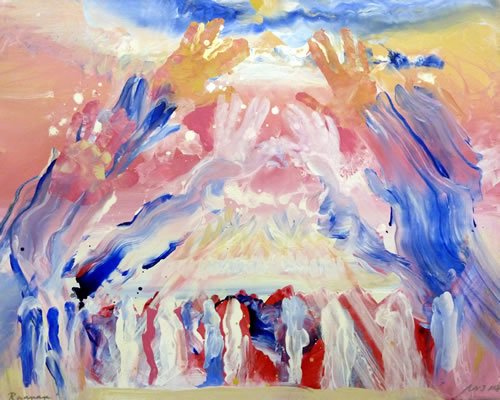
The Priestly Blessing, by Yoram Raanan

The Lord spoke to Moses, saying, “Speak to Aaron and his sons, saying: Thus you shall bless the Israelites: You shall say to them:

The Lord bless you and keep you;
the Lord make his face to shine upon you and be gracious to you;
the Lord lift up his countenance upon you and give you peace.

“So they shall put my name on the Israelites, and I will bless them.” (New Revised Standard Version)

Perhaps we are living in a famine of blessing. Maybe so many people are short-tempered, rude, drive their cars recklessly, ignore others’ needs, swear like sailors, and speak enough sarcasm to bury the earth six feet deep in cynicism, because they are not being blessed; and it could be they haven’t been blessed for a very long time, even never.

At the beginning of this New Year, we are reminded of deep longings and hopes for fresh starts. I invite you to consider the value and significance of giving and receiving a blessing.

Life operates by blessing, not cursing.

The world cannot stand up under the curse. The new earth will endure forever with a blessing.

People wither without a blessing. They die when cursed. Not necessarily in body. Most definitely in spirit.

Something must be said about the word “blessing.” It gets used (and misused) a lot, especially by Christians.

As with most words in the Old Testament, “blessing” is a relational word. It means to have God’s stamp of approval on your life. It’s meant to convey that the Lord’s presence is with us.

To be blessed by God is a multi-dimensional experience – receiving promises, enjoying peace, having right relationships with both God and other people, and knowing divine comfort and security.

A blessing isn’t simply having lots of money, plenty of family, or a good job. One could have none of those and still be blessed by God. And being blessed is not getting everything you want. Some people continually get what they want and are cursed, not blessed.

Blessing is tied not to human activity but to divine initiative.

We can’t finagle a blessing out of God. Plenty of folks try to do that, and, like Jacob, they might get away with it in their family – but it will not work with God. The grace of blessing is freely bestowed by a benevolent and merciful Lord.

Everything comes down to God. The Lord is not stingy but generous – not subject to the whimsy of human cajoling but deeply influenced by the unending unity, harmony, and love within the divine godhead.

In other words, divine blessing is a gift – not something earned or cleverly received through trickery or manipulation.

Blessing one another is also a gift. In fact, God clearly communicated to Moses and Aaron how they were to bless the people with powerful words.

I believe we all intuitively know that words and language have the power of life and of death, of blessing and cursing. And withholding words of blessing and keeping silent is to withhold goodness and love from another.

Speaking words of blessing and backing up those words with an active commitment, is vital to humanity’s spiritual and emotional health.

Fathers and mothers everywhere across the world stand in a unique and special position as those who have the power of bestowing a blessing on their children – a blessing of being with them, approving of them, affirming their gifts and abilities, envisioning for them a special future of how God can use them.

Those words of blessing have the power to help children navigate the world with assurance and confidence. Armed with blessing, they can filter-out the choices in front of them and walk in the way of God.

Notice in the New Testament Gospels how the God the Father blessed the Son:

And when Jesus had been baptized, just as he came up from the water, suddenly the heavens were opened to him and he saw the Spirit of God descending like a dove and alighting on him. And a voice from heaven said, “This is my Son, the Beloved, with whom I am well pleased.” (Matthew 3:16-17, NRSV)

God provided a constant presence and an active commitment through the Spirit; God spoke words of approval and affirmation; God the Father had a special future for Jesus the Son, which helped Jesus to repel the words of Satan. Since Jesus needed and received a blessing from his Father, how much more do we?

Jesus passed the blessing to his disciples with a promise of presence and commitment:

Jesus came near and spoke to them, “I’ve received all authority in heaven and on earth. Therefore, go and make disciples of all nations, baptizing them in the name of the Father and of the Son and of the Holy Spirit, teaching them to obey everything that I’ve commanded you. Look, I myself will be with you every day until the end of this present age.” (Matthew 28:18-20, CEB)

Jesus informed the disciples his presence would be with them; communicated an active commitment to give them authority to do the job of disciple-making; pictured for them a special future of reaching the nations; affirmed and approved them. “The Great Commission” is really a statement of God’s blessing.

One reality needs to be recognized and affirmed with all confidence: You and I already possess God’s blessing; there is no need to try and earn it. The words of blessing state what is, in fact, already true.

We have the privilege and the ability to reverse the world’s curse and turn it into blessing.

Those blessed with money can be a blessing by giving it away.

Those blessed by growing up in a loving family can provide love to others who are unloved and need a special blessing.

Those blessed with wisdom can mentor and instruct those who need wisdom.

Those blessed with the mercy of God can be merciful to others.

Those blessed with a wonderful relationship with God can pray people into the kingdom of God.

Parents, it is never too late to bless your children, even if they are adults. Children, it is never too late to bless your parents and your siblings, even if they are prickly and hard. To not bless is to curse.

Bless your family through words that build up, and do not tear down. Use those words to picture a special future of what God can do. Follow through with those words by demonstrating an active commitment to embodying blessing.

I leave you with this blessing for the New Year:

May God answer you when you are in distress; may the name of Jesus protect you. 

May the Lord send help when you need it and give you support when you cry out to him. 

May the God of heaven remember your good deeds done in faith and accept you just as you are. 

May the Lord give you the desire of your heart and make all your plans succeed.

When the Almighty goes out of the way to answer your prayers, then I will be the first to shout with joy!

I know the Lord is God. There is a special future for you beyond what you can even ask or think. And I will be there on the sidelines, encouraging you all the way.

Some people trust in the political process, others trust in the strength of the economy; but we trust in the name of the Lord our God. 

May God answer when you call.

May God bless you with an everlasting love. 

May you know Christ, and him crucified, risen, and coming again. 

May God’s presence and power be with you now and forever. Amen.

Fear vs. Faith (Numbers 13:1-2, 17-33; 14:1-9)

The Spies Return with Discordant Views, by Yoram Raanan

The Lord said to Moses, “Send some men to explore the land of Canaan, which I am giving to the Israelites. From each ancestral tribe send one of its leaders”…

When Moses sent them to explore Canaan, he said, “Go up through the Negev and on into the hill country. See what the land is like and whether the people who live there are strong or weak, few or many. What kind of land do they live in? Is it good or bad? What kind of towns do they live in? Are they unwalled or fortified? How is the soil? Is it fertile or poor? Are there trees in it or not? Do your best to bring back some of the fruit of the land.” (It was the season for the first ripe grapes.)

So they went up and explored the land from the Desert of Zin as far as Rehob, toward Lebo Hamath. They went up through the Negev and came to Hebron, where Ahiman, Sheshai and Talmai, the descendants of Anak, lived. (Hebron had been built seven years before Zoan in Egypt.) 

When they reached the Valley of Eshkol, they cut off a branch bearing a single cluster of grapes. Two of them carried it on a pole between them, along with some pomegranates and figs. That place was called the Valley of Eshkol because of the cluster of grapes the Israelites cut off there. At the end of forty days they returned from exploring the land.

They came back to Moses and Aaron and the whole Israelite community at Kadesh in the Desert of Paran. There they reported to them and to the whole assembly and showed them the fruit of the land. They gave Moses this account:

“We went into the land to which you sent us, and it does flow with milk and honey! Here is its fruit. But the people who live there are powerful, and the cities are fortified and very large. We even saw descendants of Anak there. The Amalekites live in the Negev; the Hittites, Jebusites and Amorites live in the hill country; and the Canaanites live near the sea and along the Jordan.”

Then Caleb silenced the people before Moses and said, “We should go up and take possession of the land, for we can certainly do it.”

But the men who had gone up with him said, “We can’t attack those people; they are stronger than we are.” And they spread among the Israelites a bad report about the land they had explored. They said, “The land we explored devours those living in it. All the people we saw there are of great size. We saw the Nephilim there (the descendants of Anak come from the Nephilim). We seemed like grasshoppers in our own eyes, and we looked the same to them.”

That night all the members of the community raised their voices and wept aloud. All the Israelites grumbled against Moses and Aaron, and the whole assembly said to them:

“If only we had died in Egypt! Or in this wilderness! Why is the Lord bringing us to this land only to let us fall by the sword? Our wives and children will be taken as plunder. Wouldn’t it be better for us to go back to Egypt?” And they said to each other, “We should choose a leader and go back to Egypt.”

Then Moses and Aaron fell face down in front of the whole Israelite assembly gathered there. Joshua son of Nun and Caleb son of Jephunneh, who were among those who had explored the land, tore their clothes and said to the entire Israelite assembly:

“The land we passed through and explored is exceedingly good. If the Lord is pleased with us, he will lead us into that land, a land flowing with milk and honey, and will give it to us. Only do not rebel against the Lord. And do not be afraid of the people of the land, because we will devour them. Their protection is gone, but the Lord is with us. Do not be afraid of them.” (New International Version)

“Pessimism has done infinitely more harm than atheism.”

Pierre Teilhard de Chardin

Fear can be debilitating. At its core, we fear either what we don’t know, or believe to be bad. For example, if I am convinced that my boss does not have my best interests at mind, then I will likely be afraid and hold back.

The majority of the ancient Israelites were paralyzed by fear because of the anxiety and fearfulness of those who came back from spying out the Promised Land. They had a low view of God. Yet Caleb, and only a few others, acknowledged that God is good for divine promises, and so, trusted the Lord completely in confidence, not fear.

If we view God as being angry all the time, then we will not use the incredible gifts given to us for fear of messing up and bringing divine wrath upon us. We will be plagued with uncertainty and only see giants in the land who we cannot begin to deal with.

Yet, if we commit ourselves to knowing God through seeking the divine will and trusting in divine promises, then we understand that God is gracious and generous, always having our backs. We live by faith, not by sight, and discern that giants in the land are really nothing more than gnats.

Fear is maybe the devil’s greatest tool to prevent God’s people from being productive and responsible in serving the church and the world. Beneath that fear are powerful feelings of inferiority, inadequacy, and a low view of self – which is really born of a low view of God. Being afraid wastes what impact a person could have for God, and waters-down life so that it’s ineffective.

Enjoy the Lord, and he will give what your heart asks.

Psalm 37:4, CEB

We are to enjoy the gracious and generous God; and in our enjoyment, the Lord places within us godly dreams that are a delight for God to fulfill. Our enjoyment of the Lord gives us the security and confidence to act upon those godly desires and wed them to divine promises from Holy Scripture.   

But put fear in the mix, and it dilutes and destroys everything. It makes you do nothing. And the fear is a result of not knowing the Lord, of not seeking God’s mind or will.

God had a grand vision and a big dream for the Israelites to enter the Promised Land. But ten of the twelve spies who came back after checking out the land were paralyzed by fear, feeling like grasshoppers next to the people in the land. 

Caleb and Joshua, however, had a different view of taking the land because they had a different view of God. They didn’t see giants – they saw a gracious and generous God who could easily take care of whoever might be in the land, and they wanted to act on the faith they had in a mighty and merciful God. 

The God of the other spies wasn’t big enough to handle the giants. Their low view of themselves as grasshoppers betrayed their low view of God.

“We wrap a lot of our fears in morbidly sanctified self-belittling.  We piously cover this self-despising and call it consecration and self-crucifixion.”

David Seamands

Too many people feel good about feeling bad – and then use those feelings to make spiritual excuses for not exploring what God promises, expects, commands, and dreams for them. 

It is high time for us to get into the world with our witness in a far greater way because we serve a God who sees giants as gnats; and we will, too, if we have a high view of God.

Yet, holding us back, is fear of criticism, of taking a risk, of going outside of the way we’ve always done it, and of what others may think or say. 

If you once dreamed something and you think your dream is dead because you destroyed it by your sins or bad habits, you are wrong. Dreams are destroyed by fear, by being tricked into thinking that we are nothing but grasshoppers and God doesn’t care, and so we do nothing.

Unfortunately, it appears the most common way of coping with feelings of fear, insecurity, and inferiority is by withdrawing from other people – because you cannot give yourself fully to your family, church, neighborhood, vocation, and the world without a healthy robust view of and relationship with God. 

Give God a chance to work in and through your life. May you step up and step out because you have a God behind you that is gracious and generous. Amen.

Facing Racism (Numbers 12:1-9)

Moses and his wife Zipporah, by Flemish painter Jacob Jordaens, c.1650

When they were in Hazeroth, Miriam and Aaron criticized Moses on account of the Cushite woman whom he had married—for he had married a Cushite woman. They said, “Has the Lord spoken only through Moses? Hasn’t he also spoken through us?” The Lord heard it. Now the man Moses was humble, more so than anyone on earth.

Immediately, the Lord said to Moses, Aaron, and Miriam, “You three go out to the meeting tent.” So the three of them went out. Then the Lord descended in a column of cloud, stood at the entrance of the tent, and called to Aaron and Miriam. The two of them came forward. He said, “Listen to my words: If there is a prophet of the Lord among you, I make myself known to him in visions. I speak to him in dreams. But not with my servant Moses. He has proved to be reliable with all my household. I speak with him face-to-face, visibly, not in riddles. He sees the Lord’s form. So why aren’t you afraid to criticize my servant Moses?” The Lord’s anger blazed against them, and they went back. (Common English Bible)

I have three observations about today’s Old Testament lesson I want us to notice and lift-up, because they are crucial considerations for us in our present world.

First, the older siblings of Moses – Miriam the eldest and Aaron the other brother – had a problem with their sister-in-law (whose name was Zipporah). She was a Cushite. Cush was an ancient country which encompassed present day northern Sudan and much of Ethiopia in Africa. In other words, Zipporah was black, and Miriam and Aaron were critical of their little brother for marrying her.

Second, although having a black sister-in-law was the real issue, Miriam and Aaron confronted Moses not about this, but went after him concerning his role as a prophet. In other words, the siblings engaged in the age-old practice of ostensibly presenting a concern which was not really the matter on their hearts.

Third, the omniscient God knew what was happening. God was fully cognizant of Miriam and Aaron’s cloak-and-dagger attack at Zipporah through her husband Moses. The Lord was incensed with this coup attempt because it was unjust, unfair, ungodly, and frankly, racist. And so, the text states that God, with divine anger aroused, “immediately” addressed the situation.

Racism is insidious. It tends to get expressed most often through the methods similar to those used by Miriam and Aaron by criticizing another somewhat related issue. So, I offer the following questions with as much humility from Moses I can muster:

  • Are we aware of our own inheritance of centuries, and even millennia, of dominance language which keeps other human beings docile and subservient to another’s authority?
  • Have we chosen to challenge points of order and procedure in the attempt to marginalize certain persons?
  • Are we detached from our own needs, and so, unable to listen well?
  • Is there secret fear in our hearts, believing that we must maintain our hegemony, or else there will be chaos?
  • Is the goal for others to become like us, as if we were the Borg who talk about how resisting us is futile?
  • Are we willing to do the hard work of pulling out our own roots of racial segregation and injustice?
  • Do we want cheap diversity or true solidarity?
  • Will we work toward creating a new liberated humanity, championing equity in all things for all people, instead of attempting to sanitize existing systems?

For far too long, too many individuals, institutions, and even faith communities, have relied upon individualism and anti-structuralism; and it has not served us well in addressing our contemporary problems. Individualism sees only individual racist words and actions and is blind to systemic issues. It views social problems as merely a reflection of broken relationships, and, so, again, makes it impossible to see the systemic nature of our racialized society.

Anti-structuralism (not addressing racism as an organizing structure) is the assumption that racism is only individual racial prejudice and hatred. Thus, the approach in dealing with racism is to always be on the lookout for “bad racists.” This avenue, however, diverts attention from upholding biblical justice, forming policies of liberation, and establishing equitable care and opportunity for the common good of all persons.

As a historian, I tend to view things through historical lenses. So, I resonate deeply with the late twentieth-century essayist James Baldwin when he said, “White people are still trapped in a history which they do not understand; and until they understand it, they cannot be released from it.”

I want my history to be with Moses and freedom. I want God to show up and put racism to an end. I want to be part of the solution, and not the problem. I want justice and fairness to flow like a river that never runs dry.

Lord, Jesus Christ, you reached across ethnic boundaries between Samaritans, Romans, and Jews. In your earthly ministry you offered fresh sight to the blind and freedom to captives. Gracious Savior, help us to break down walls and barriers in our community; enable us to see the reality of racism and bigotry; and free us to challenge and uproot it from ourselves, our faith communities, our society, and our world. Amen.

The Pathology of Complaining (Numbers 20:1-13)

In the first month the whole Israelite community arrived at the Desert of Zin, and they stayed at Kadesh. There Miriam died and was buried.

Now there was no water for the community, and the people gathered in opposition to Moses and Aaron. They quarreled with Moses and said, “If only we had died when our brothers fell dead before the Lord! Why did you bring the Lord’s community into this wilderness, that we and our livestock should die here? Why did you bring us up out of Egypt to this terrible place? It has no grain or figs, grapevines or pomegranates. And there is no water to drink!”

Moses and Aaron went from the assembly to the entrance to the tent of meeting and fell facedown, and the glory of the Lord appeared to them. The Lord said to Moses, “Take the staff, and you and your brother Aaron gather the assembly together. Speak to that rock before their eyes and it will pour out its water. You will bring water out of the rock for the community so they and their livestock can drink.”

So Moses took the staff from the Lord’s presence, just as he commanded him. He and Aaron gathered the assembly together in front of the rock and Moses said to them, “Listen, you rebels, must we bring you water out of this rock?” Then Moses raised his arm and struck the rock twice with his staff. Water gushed out, and the community and their livestock drank.

But the Lord said to Moses and Aaron, “Because you did not trust in me enough to honor me as holy in the sight of the Israelites, you will not bring this community into the land I give them.”

These were the waters of Meribah, where the Israelites quarreled with the Lord and where he was proved holy among them. (New International Version)

Moses Strikes the Rock, by Rivka Korf

Every heinous sin you can think of – the worst of the worst – initially began as complaining and quarreling. Wherever you find murmuring and disrespect, you are looking at a spiritual illness which, if untreated, will poison the soul and result in apostasy, that is, a complete failure and repudiation of faith.

Today’s Old Testament lesson is a reminder and a warning that people’s faith can weaken to the point of becoming almost non-existent. There is a pathological process which brings people to a point of turning away from their faith:

  1. Complaining. It all starts with muttering some discontentment under the breath; murmuring dissatisfaction; and grumbling some ingratitude for what one already has. The Israelites complained about the lack of water. They quarreled with Moses about it and directed their anger at him.
  2. Psychotic depression. Most depression is normal, understandable, and even needed. However, psychotic depression is expressing a wish to be dead because of spiritual instability and an inability to see God at work. In other words, it’s manipulative. It’s a passive-aggressive type of anger directed at those who represent God. This is not a depression you can diagnose or put on someone; it’s a grief reaction gone sideways in wishing harm at self or others.
  3. Daydreaming. This is a preoccupation with “the good old days.” Back there in Egypt, the Israelites had figs, and grapevines, and water. But out here, they’ve got nothing. The people were experiencing extreme tunnel vision, only remembering the food they used to eat, instead of the bland manna they had to gather every day. They had completely blocked out the reason they were in the desert – because God brought a miraculous deliverance from slavery. Egypt was, in fact, anything but the good old days.
  4. Blaming. The people blamed Moses for bringing them into the wilderness. They criticized him for their lack of food and water. In reality, Moses was just doing what God wanted – and actually what the people wanted. The Israelites wanted out of Egypt; and then, when they left and things got hard, the people shifted the blame of hard circumstances onto Moses (and God).
  5. Disobeying. Why obey Moses or even Yahweh if you believe they’re out to get you, or don’t care? Maybe we just look out for ourselves and do what we think is best. (Exodus 16:1-28)
  6. Idolatry. Eventually, the people formed a “Back to Egypt” campaign. They turned their backs on Moses and on God. They lost faith, made a golden calf, and called it their god. (Exodus 32:1-8)

Despite all the whining and twisted thinking, God was gracious. The Lord told Moses to take up his staff, gather the people, and speak to a rock. God would provide by causing water to gush out of it.

At this point, Moses was upset. It seems to me he had enough of the people’s insolence and complaining. So, he ends up speaking to the people instead of the rock; and striking the rock with his staff instead of letting God do the striking.

It looks like rebellion rubs off and infects everyone, because Moses is chided by God for his own rebelliousness. Specifically, he was rebuked for not trusting God. As a result, Moses would not join the rest of the community in entering the Promised Land.

This is really a sad ending to the story. Moses was just trying to obey the Lord and lead the people. I can totally understand how exasperated he must have been from the constant griping of the people. Yet, Moses was held to account for his own lack of faith. And the people would eventually experience a harsh judgment for their faithlessness.

Don’t be misled. Bad company corrupts good character. (1 Corinthians 15:33)

Being around a bunch of ingrates will cause the good person to quit giving thanks.

Surrounding oneself with faithless people will result in that person eventually losing faith.

And hearing other people continually complain about their circumstances will cause you to grumble, setting the whole group on the road to spiritual death.

I don’t want that. And I don’t want it for you, either. If you are in such a group, get out, go, and be around people with the sort of values you care about. Life is too short to mess around with a bunch of complainers.

Lord Jesus Christ, you prayed for your friends that they would be one as you and your Father are one. We confess our resistance to your prayer. We have failed to maintain the unity of the Spirit. We have broken the bond of peace.

For the times we have not listened to each other, when we have spoken in anger, haste or fear, we are sorry. For the times we have not loved each other, when we have competed, or insulted or judged each other, we are sorry. For the harm that our disunity has done to our witness to the Gospel, we are sorry.

Have mercy on us, we pray. Restore us to friendship with you and with one another, through the power of your Spirit. Amen.