Korah’s Rebellion (Numbers 16:20-35)

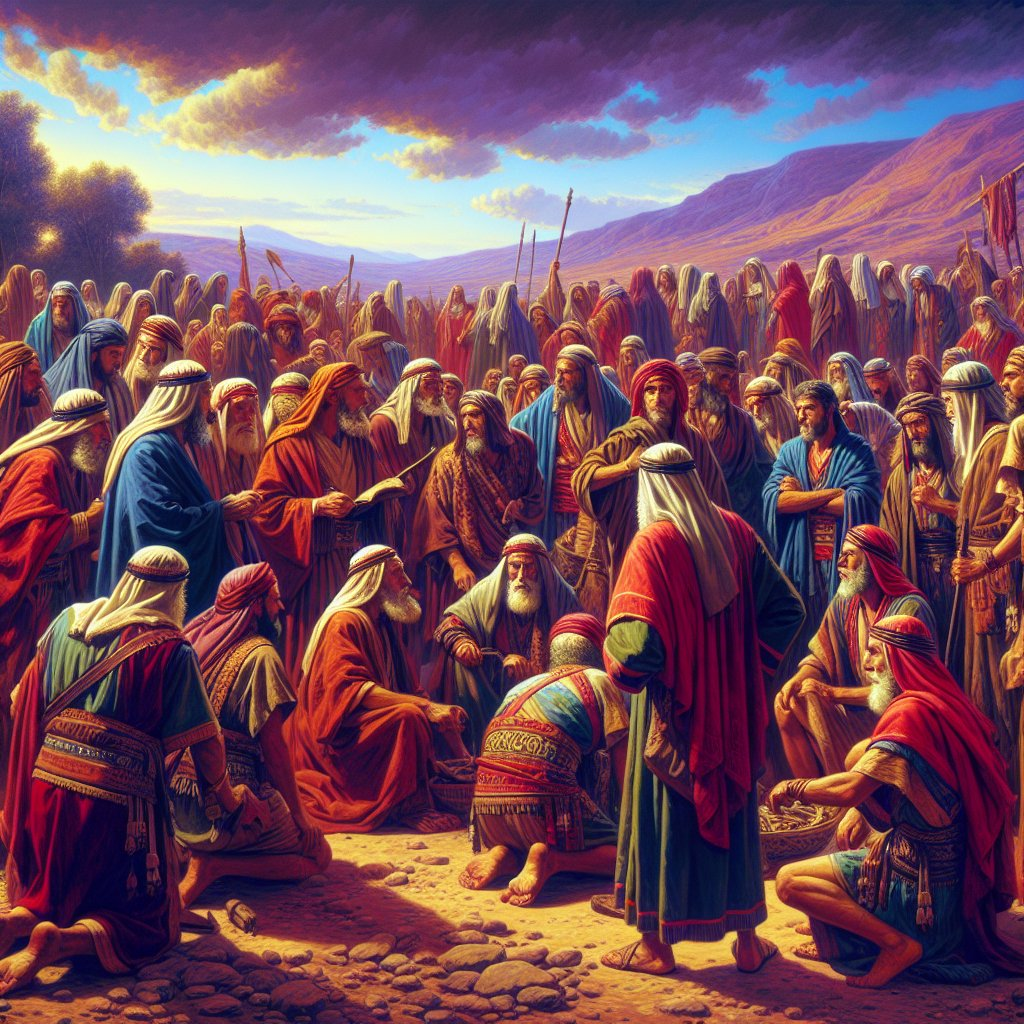
Korah’s Rebellion, by John Bradford

The Lord said to Moses and Aaron, “Separate yourselves from this assembly so I can put an end to them at once.”

But Moses and Aaron fell face down and cried out, “O God, the God who gives breath to all living things, will you be angry with the entire assembly when only one man sins?”

Then the Lord said to Moses, “Say to the assembly, ‘Move away from the tents of Korah, Dathan and Abiram.’”

Moses got up and went to Dathan and Abiram, and the elders of Israel followed him. He warned the assembly, “Move back from the tents of these wicked men! Do not touch anything belonging to them, or you will be swept away because of all their sins.” So they moved away from the tents of Korah, Dathan and Abiram. Dathan and Abiram had come out and were standing with their wives, children and little ones at the entrances to their tents.

Then Moses said, “This is how you will know that the Lord has sent me to do all these things and that it was not my idea: If these men die a natural death and suffer the fate of all mankind, then the Lord has not sent me. But if the Lord brings about something totally new, and the earth opens its mouth and swallows them, with everything that belongs to them, and they go down alive into the realm of the dead, then you will know that these men have treated the Lord with contempt.”

As soon as he finished saying all this, the ground under them split apart and the earth opened its mouth and swallowed them and their households, and all those associated with Korah, together with their possessions. They went down alive into the realm of the dead, with everything they owned; the earth closed over them, and they perished and were gone from the community. At their cries, all the Israelites around them fled, shouting, “The earth is going to swallow us too!”

And fire came out from the Lord and consumed the 250 men who were offering the incense. (New International Version)

Rebellion in the community was afoot. There were certain Levite leaders who rejected the leadership of Moses, and especially Aaron. They failed to discern that these men were God’s appointed leaders.

On the surface of things, Korah the ringleader, put the matter in a pious sounding way by presenting Moses and Aaron as against democracy. He insisted that all the community is holy, so therefore, Moses and Aaron were exalting themselves over everyone else.

It becomes apparent, however, that Korah and the other Levites were with him to gain the priesthood. It was the age-old play for power and authority. At the least, the rebels were ungrateful for their own place in the religious system that God, not Moses, had set up.

Moses responded by having Korah and his followers act like priests. He had them come to the tent of meeting with censers to burn incense before the Lord. Then, they could clearly find out whether God would accept their priestly service, or not.

The entire camp, of course, showed up, looking like the townspeople in an old Western movie. The Sheriff and the gunslinging bandit, in the street, about to duel each other.

Since the Lord is a big God, the Lord showed up big.

Yahweh’s glory appeared, threatening to exterminate everyone, townspeople included. Clearly, God had had enough of the people’s continual grumbling and their incessant rebellious spirit.

To demonstrate, once and for all, which side of things God is on, the Lord caused a singular disaster to occur – which had never happened before or since. The ground opened up and the earth literally swallowed up the rebels’ households and all who were with them in the rebellion.

As for the 250 men who were challenging Moses and Aaron with their censers in hand, were seen for who they were: Rebels against God. The little fires in each of their censers erupted into great flames of fire which completely consumed them. They were dead on the spot.

That experience clarified forever who was supposed to be doing the priestly service in Israel.

Although today’s Old Testament lesson is one of the more famous (or infamous) stories of divine judgment in the Bible, it seems to me that perhaps we might focus a bit more on the grace which existed with Moses and Aaron.

After all, if we want to see humanity’s better angels, then let’s talk about them.

I’m not really sure if I would have the humility and wisdom of Moses and Aaron to be concerned for the entire community in such a suspenseful and vitriolic situation. And yet, the two of them appealed to God for mercy on the nation. As a result, it was only the 250 men and their households who experienced condemnation.

There will always be persons like Korah and his followers on this earth. No matter where we go, and no matter how much we may try to avoid them, they’ll show up. And we will have to deal with them.

At such a point, we certainly have a biblical warrant for praying great imprecatory (judgmental) prayers upon them, just as the psalmist did many times.

And there is nothing wrong with our feelings of anger, that is, unless we allow that anger to come out sideways and add to the problem.

Yet, we really do have other options, which is what I think Jesus was getting at with his followers when he said:

“You’re familiar with the old written law, ‘Love your friend,’ and its unwritten companion, ‘Hate your enemy.’ I’m challenging that. I’m telling you to love your enemies. Let them bring out the best in you, not the worst. When someone gives you a hard time, respond with the supple moves of prayer, for then you are working out of your true selves, your God-created selves. This is what God does. He gives his best—the sun to warm and the rain to nourish—to everyone, regardless: the good and bad, the nice and nasty. If all you do is love the lovable, do you expect a bonus? Anybody can do that. If you simply say hello to those who greet you, do you expect a medal? Any run-of-the-mill sinner does that.

“In a word, what I’m saying is, Grow up. You’re kingdom subjects. Now live like it. Live out your God-created identity. Live generously and graciously toward others, the way God lives toward you.” (Matthew 5:43-48, MSG)

We, of course, see the real stinker that Korah was, along with those who followed him. Yet, we also see the real deal with Moses the leader and Aaron the priest.

In the crucible of a very difficult situation, their true muster came out. They did not try to become judges themselves, nor did they encourage God to raze the entire place and start all over again. Instead, they prayed with humility and wisdom, demonstrating why God had them as leaders over the nation of Israel.

And we are left with the realization that people like you and me will always need to be cognizant and aware to keep developing those virtues of wisdom and humility in our lives.

For there is always a new situation which arises, needing our better angels to show up and handle things well.

O God, you guide the humble in all things, and cause light to bear upon the darkness. Help us, in all of our doubts, uncertainties, and insecurities, to depend upon your grace and ask what you would have us to do. May the Spirit of wisdom save us from foolish choices, so that in your light we can see light, and walking your straight path we may not stumble. Amen.

Rebellion In the Community (Numbers 16:1-19)

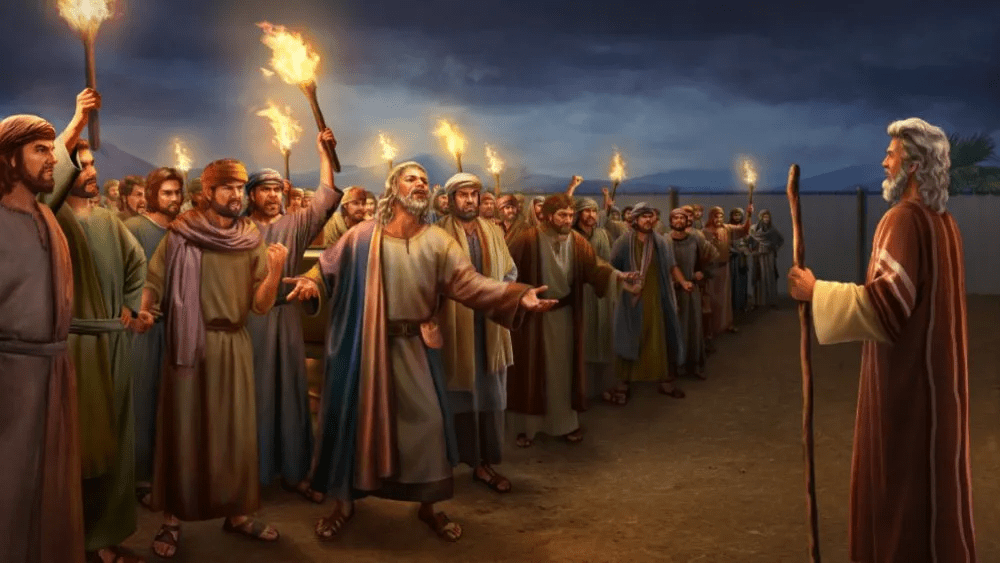
Korah and His Company Refuse to Obey Moses, by Wheatfield Media

Korah son of Izhar, the son of Kohath, the son of Levi, and certain Reubenites—Dathan and Abiram, sons of Eliab, and On son of Peleth—became insolent,and rose up against Moses. With them were 250 Israelite men, well-known community leaders who had been appointed members of the council. 

They came as a group to oppose Moses and Aaron and said to them, “You have gone too far! The whole community is holy, every one of them, and the Lord is with them. Why then do you set yourselves above the Lord’s assembly?”

When Moses heard this, he fell facedown. Then he said to Korah and all his followers: “In the morning the Lord will show who belongs to him and who is holy, and he will have that person come near him. The man he chooses he will cause to come near him. You, Korah, and all your followers are to do this: Take censers and tomorrow put burning coals and incense in them before the Lord. The man the Lord chooses will be the one who is holy. You Levites have gone too far!”

Moses also said to Korah, “Now listen, you Levites! Isn’t it enough for you that the God of Israel has separated you from the rest of the Israelite community and brought you near himself to do the work at the Lord’s tabernacle and to stand before the community and minister to them? He has brought you and all your fellow Levites near himself, but now you are trying to get the priesthood too. It is against the Lord that you and all your followers have banded together. Who is Aaron that you should grumble against him?”

Then Moses summoned Dathan and Abiram, the sons of Eliab. But they said, “We will not come! Isn’t it enough that you have brought us up out of a land flowing with milk and honey to kill us in the wilderness? And now you also want to lord it over us! Moreover, you haven’t brought us into a land flowing with milk and honey or given us an inheritance of fields and vineyards. Do you want to treat these men like slaves? No, we will not come!”

Then Moses became very angry and said to the Lord, “Do not accept their offering. I have not taken so much as a donkey from them, nor have I wronged any of them.”

Moses said to Korah, “You and all your followers are to appear before the Lord tomorrow—you and they and Aaron. Each man is to take his censer and put incense in it—250 censers in all—and present it before the Lord. You and Aaron are to present your censers also.” 

So each of them took his censer, put burning coals and incense in it, and stood with Moses and Aaron at the entrance to the tent of meeting. When Korah had gathered all his followers in opposition to them at the entrance to the tent of meeting, the glory of the Lord appeared to the entire assembly. (New International Version)

By Bible Art

I must admit that, having been a church pastor for decades, today’s story sounds eerily like several parishioners I’ve known over the years. They, along with the story’s antagonist Korah, strike me as ungrateful and continually concerned about angling for more power and authority within the community.

Rebellions are nothing new. They happen everywhere, from faith communities to neighborhood associations, from local politics to national governments.

The Book of Numbers is a rather depressing part of the Bible, largely because of the nature of the Israelite grumblings, without much gratitude happening.

The murmurings turned to complaints, and then to outright rebellion. It seems to have been a pattern with the Israelites in the desert. The animosities were directed against God or Moses, and sometimes both.

In each one of the various stories of rebellion in the desert, the rebellious people died in various ways by means of a plague, a fire, or in a battle. We get the sense with today’s story that a whopper of a divine judgment is going to happen.

The punishments mentioned in the Old Testament are meant to highlight, with rather strong illustrations, that the political and religious systems set up through the covenant code were divinely originated and sanctioned. In other words, don’t mess with God’s authority.

So then, a rebellion against Moses and Aaron was, in reality, a rebellion against God. And it would bring divine wrath on the rebels.

Having been in various leadership capacities in my life, to me the most insidious kind of rebellion is the subtle sort. Authority is challenged indirectly, in passive-aggressive forms through gossip, back-biting, and building a coalition from false information.

I also think that those subtle forms of rebellion really upset God. Which is why the Lord extended divine wrath on such rebels.

Korah was a Levite, like Moses. But that is about all he had in common with Israel’s leader. Korah’s rebellion was precisely directed against the leadership of Moses (and Aaron).

Similar to many arguments I’ve encountered throughout my ministerial life, Korah framed his argument with pious sounding language – as if Moses was the problem the one opposed to holiness.

Lord, have mercy. I really do despise religious gaslighting.

Korah implied that Moses was raising himself above the others, that the entire Israelite community was holy, therefore, there’s no need for a leader like Moses. The people’s holiness is enough. That’s all anybody needs, right?

Apparently, no.

Neither Moses nor Aaron dealt with the argument. Rather, Moses was satisfied to leave the matter with God as to what to do with the rebels.

It’s always good to let God reaffirm God’s own way of doing things. It was God who raised up Moses, and it would be God to whom Korah would have to answer.

The reason these sorts of situations keep popping up in every generation of history is that they deal with a problem which all humans encounter. Every person, group, faith community, and nation must contend with the tension between authority and freedom.

Like so many arrogant demagogues, Korah believed he was the guardian of freedom – and that the people ought to follow him. Yet, even though many did, the most important person in the room, God, did not.

Give peace in our time, O good and gracious God, a peace which the world cannot give. To those who have taken up arms in anger or revenge, or even in the cause of justice, grant the grace of conversion to the path of peaceful dialogue and constructive collaboration. And to those who are victims of human cruelty, open wide your arms and enfold them in the embrace of your compassion, healing, and life. Amen.

Keep the Rule of Law (Numbers 17:1-11)

The Lord said to Moses, “Speak to the Israelites and get twelve staffs from them, one from the leader of each of their ancestral tribes. Write the name of each man on his staff. On the staff of Levi write Aaron’s name, for there must be one staff for the head of each ancestral tribe. Place them in the tent of meeting in front of the ark of the covenant law, where I meet with you. The staff belonging to the man I choose will sprout, and I will rid myself of this constant grumbling against you by the Israelites.”

So Moses spoke to the Israelites, and their leaders gave him twelve staffs, one for the leader of each of their ancestral tribes, and Aaron’s staff was among them. Moses placed the staffs before the Lord in the tent of the covenant law.

The next day Moses entered the tent and saw that Aaron’s staff, which represented the tribe of Levi, had not only sprouted but had budded, blossomed and produced almonds. Then Moses brought out all the staffs from the Lord’s presence to all the Israelites. They looked at them, and each of the leaders took his own staff.

The Lord said to Moses, “Put back Aaron’s staff in front of the ark of the covenant law, to be kept as a sign to the rebellious. This will put an end to their grumbling against me, so that they will not die.” Moses did just as the Lord commanded him. (New International Version)

Issues of power – who has it, and who doesn’t, and how it is used – has been with us throughout all of human history.

And the issues of power are always tied to values, morals, and ethics. It ultimately comes down to who is truly in control, and whether that control is good or bad, moral or immoral, ethical or unethical.

One way of looking at the whole of the Bible is that it is a collection of books about power, control, and authority – mostly between God and humans, but also between one another as people.

If we fail to consider power issues, then a society will devolve into injustice, power inequities, and the few controlling the many.

In today’s Old Testament lesson, there were people questioning the authority system, and who had the power to act as a religious priest in the nation of Israel.

The covenant code, handed down from God to Moses on Mount Sinai, and then to the people, included only the tribe of Levi acting as priests. The other eleven tribes could not have a priestly class of people.

Specifically, only the Levite Aaron and his descendants could serve as a priest. And this structure did not sit well with some of the Levites from clans other than Aaron’s, as well as some of the other tribes.

Among all the tribes of Israel, the Lord chose the tribe of Levi. And among the Levites, Aaron is to alone be the priest, with his descendants serving after him in history.

A lot of grumbling in the tents of the Israelite tribes was happening. And God heard all the murmurings under their breath.

Therefore, God instructed each tribe to bring the symbol of their tribal authority – the staff – to Moses. They were all left overnight before the Lord, in front of the altar in the tent of meeting.

In the morning, the Levite’s staff with Aaron’s name alone engraved on it, was the only one that budded and sprouted almonds – all in a single night.

God was clarifying that Aaron was the divine choice as priest in Israel. The staff was then stored and kept as a continual reminder that when the Lord makes a choice, that is exactly what is going to happen.

The purpose of displaying the tribal staffs was to stop the incessant complaining of people about the Levites, and Aaron in particular, holding the power and authority of handling and officiating the sacrificial system in Israel.

Only Aaron could approach the tabernacle of God – and only then with detailed prescriptions of how to do it – and anyone else who would try to act as only a priest could, would die. The authority structure was that serious in Israel.

Nobody gets to do whatever the heck they want to do, when it comes to authority structures and systems of power. The rule of law is important; it’s serious business.

God bestowed an honorable privilege and responsibility on the family of Aaron. In doing so, their work, worship, and ministry was meant to contribute to the public welfare of all Israelite families.

And that is the case for all of us, when it comes to possessing any sort of authority. An authoritative position is never meant for personal use, but to be a public service for the good of everyone in the community, and in the leader’s constituency.

I suppose there will always be persons who arrogantly believe they ought to be in charge, or in some position of authority in order to wield power. They will, unfortunately, rarely examine their motives for wanting power; or consult wise persons who could help direct them.

If one has been elected – either by the people in a lawful election, or by God in a divine decree – then to murmur and grumble about that person who was chosen comes from a dark place in the complainer’s heart.

An unwillingness to submit to the rule of law only brings harm to others, and eventually to oneself. And it raises the ire of God.

Through the covenant law handed down to the Israelites, God intended to provide human justice, protect human rights, promote a good and just society, establish a fair economy, curb human sin and corruption, and bring peace and security to all the tribes of Israel.

If the power structure is unjust through an abusive individual, that’s another thing altogether. But if a good rule of law is in place, and appropriate people are serving the community, then it is our place and our duty to be properly submissive, obedient, and supportive.

It’s a question of being helpful or harmful to what is going on. And we always have a choice about how we are going to respond.

So, how will you use your own personal agency?

Almighty God, save us from violence, discord, and confusion; from pride and arrogance, and from every evil way. Defend our liberties, and make us one united people who are mindful of the rule of law.

Give the spirit of wisdom to those in the authority of government, so that there may be justice and peace at home, and that, through obedience to your law, we may show forth your praise among the nations of the earth.

In the time of prosperity, fill our hearts with thankfulness, and in the day of trouble, suffer not our trust in you to fail. Amen. 

When to Stay, When to Move (Numbers 9:15-23)

Pillar of Fire, Pillar of Cloud in the Desert, stained glass at the Congregation Beth Emeth, Herndon, Virginia

On the day the Tent of the Lord’s presence was set up, a cloud came and covered it. At night the cloud looked like fire. Whenever the cloud lifted, the people of Israel broke camp, and they set up camp again in the place where the cloud came down. The people broke camp at the command of the Lord, and at his command they set up camp.

As long as the cloud stayed over the Tent, they stayed in the same camp. When the cloud stayed over the Tent for a long time, they obeyed the Lord and did not move on. Sometimes the cloud remained over the Tent for only a few days; in any case, they remained in camp or moved, according to the command of the Lord. Sometimes the cloud remained only from evening until morning, and they moved on as soon as the cloud lifted.

Whenever the cloud lifted, they moved on. Whether it was two days, a month, a year, or longer, as long as the cloud remained over the Tent, they did not move on; but when it lifted, they moved. They set up camp and broke camp in obedience to the commands which the Lord gave through Moses. (Good News Translation)

I know a few believers who would really like to have their spiritual lives governed by a cloud lifting and moving and settling. Then, there wouldn’t be any doubt about what to do and when to do it.

But keep in mind that this arrangement of a cloud was temporary; it was only meant to get the Israelites from one place to another until they entered the Promised Land. Anytime we try and make something permanent which is designed to be temporary, we become stuck, not to mention missing out on the good things intended for us.

Clouds of Glory, by Yoram Raanan, 2014

In a time of transition for the nation of Israel, the gracious presence of God provided both guidance and assurance. The Lord was with them; and the divine presence reminded the people that God’s promise would be fulfilled.

The book of Numbers begins at the point where the book of Exodus leaves off. Leviticus is in between, interrupting the narrative flow with detailed legislation, especially of the sacrificial worship system. Exodus ends with the construction of the tabernacle (the sacred tent with the ark of the covenant and worship utensils).

Numbers then begins a year after Israel came out of Egypt. It covers the years of wandering in the desert wilderness in which an entire generation dies off and their children are poised to enter the Promised Land. The bulk of the book is given to the beginning and ending of the 40 years of wandering.

The Sinai Peninsula, where the Israelites walked, is a rather harsh environment. This is on purpose; it’s part of the nation’s spiritual development. The desert is the place where failures are acknowledged and purged. It’s a unique place and time which required a special system to safeguard the people. They needed to be guided toward holiness so that they could be a holy nation, set apart for God.

In many ways, Numbers is a depressing book. It tells us the painful shortcomings of Israel to their divinely appointed calling. There are plenty of murmurings, rebellions, and outright transgressions of all kinds. I can just imagine God shaking his head in disappointment.

Yet, even though many individuals were punished and an entire generation died, God’s covenant with the people held firm – namely because the Lord tenaciously held to it and did not abandon Israel altogether. The tabernacle remained, despite the fickle people.

The point is strongly made that God was with the people and governed their comings and goings. And this teaches us something about our own spiritual pilgrimage on this earth; and the decisions and discernments which must be made in that sojourn.

There are times we need to pack up and get moving; and there are other times when we need to stay put, pause, and wait on the Lord’s timing. Our entire earthly life is one big sojourn from birth to death. How we go about this pilgrimage is of upmost importance.

We are meant to connect with transcendent things, to discover the Divine. The Lord wants us to discern what to do, when to do it, and where. So we keep moving, learning both the value of putting down roots and blessing a particular place, as well as the importance of walking, traveling, and spreading out across the earth. In engaging these dynamics of movement and stillness, we learn about realities greater than ourselves.

There is a lot of work to do with discernment and decision-making. We may long for a pillar of cloud, but the Lord seems to want us leaping into the unknown with faith when it’s time; or to stop talking, sit down, and listen for the still small voice of God. And we’ll need to work together for this discernment to happen.

A change in direction requires right motives and proper attitudes. It’s got to have some solid knowledge, understanding, and wisdom behind it. And our movements must be purposeful in a way which blesses the world and doesn’t curse it.

In short, faith and trust are to be developed. Faith is not a static word, but dynamic. Believing is always moving, either in redemptive and helpful ways, or in the unbelieving ways of self-centeredness and ignorance. And since the believer serves a good God who has our best interests at mind, we can trust that we’re headed toward the place of promise and abundance.

Course corrections will always be needed, and that’s okay. But what’s not okay is the refusal to change, move, and discern next steps. One of the wonderful gifts of taking time for silence, solitude, and prayer is that we learn the subtle movements of God’s spiritual rhythms. We discern who we are, how we are, where we are, and where we need to be.

May it please the supreme and divine Goodness to give us all abundant grace ever to know his most holy will and perfectly to fulfill it. Amen.  —St. Ignatius of Loyola